Adverb Clause Example: A Practical Guide for Writers
Let’s start with a practical example: "Unless you finish the draft, you can't attend the team meeting." That first part—unless you finish the draft—is a perfect adverb clause example. It sets a condition for the main action. It has its own subject ("you") and verb ("finish"), but it can't stand on its own as a complete thought.
This simple structure is a workhorse in effective writing. It adds detail, context, and a natural rhythm that makes your content more engaging for readers.
What Is an Adverb Clause?
Don't let the grammar term intimidate you. An adverb clause is simply a group of words that provides more detail about the main part of your sentence. It does the exact same job as a single adverb: it modifies a verb, adjective, or another adverb.
Essentially, an adverb clause answers the key questions your reader has: When did it happen? Where? Why? How? Under what condition? It’s the context that turns a basic statement into a rich, informative sentence.
The Role of Connector Words
So, how do you attach this group of words to a sentence? You use a special kind of connector called a subordinating conjunction. Think of words like because, although, if, when, and while. These words act like glue, linking the main idea to the descriptive details in the adverb clause.
Without these connectors, you’d just have two separate, clunky thoughts. Subordinating conjunctions are the signals that tell your reader exactly what kind of relationship exists between the two ideas. To get a better handle on the basics, you can explore the foundational concepts in our guide on different clauses in grammar.
An adverb clause is a storyteller's tool. It doesn't just tell you what happened; it explains the circumstances surrounding the action, adding depth and color to your writing.
Placement and Its Impact
Where you place an adverb clause can change the rhythm and focus of your sentence. You have some flexibility here, which is great for content creators looking to add variety to their writing.
Putting the clause at the beginning is a great way to set the scene. In fact, one analysis of academic articles found that 53% of adverbial clauses appeared at the start of sentences. This front-loading technique helps build suspense or provide context before revealing the main point.
Placing it at the beginning adds emphasis, while tucking it at the end creates a smoother flow. Understanding how to move these clauses around is a key step toward making your sentences more dynamic.
Adverb Clauses at a Glance
This table breaks down the core function of adverb clauses by showing the questions they answer about the main clause, along with a simple adverb clause example for each.
| Question Answered | What It Tells You | Simple Example |
|---|---|---|
| When? | Time | After the rain stopped, we went for a walk. |
| Where? | Place | He hid the treasure where no one would find it. |
| Why? | Reason/Cause | I stayed inside because it was too cold. |
| How? | Manner | She spoke as if she knew the secret. |
| To what extent? | Degree | He is taller than his brother is. |
| Under what condition? | Condition | If you study hard, you will pass the test. |
| Why not? | Concession | Although he was tired, he kept working. |
As you can see, each clause adds a specific layer of meaning that a single-word adverb might not fully capture, making your writing more precise and engaging.
Mastering Subordinating Conjunctions
Think of the subordinating conjunction as the engine of your adverb clause. It's the essential word that kicks off the clause and signals its relationship to the main idea. Get this word right, and your meaning is crystal clear.
These conjunctions aren't just a random list of grammar words; they have specific jobs. They fall into neat categories based on the kind of information they introduce, whether it's about time, a reason, a condition, or a contrast.
The Power of Choosing the Right Conjunction
Picking the perfect conjunction is a small change with a huge impact on your writing. It instantly sharpens your message and tells the reader exactly how two ideas connect.
Just look at the difference here:
- The team celebrated after they won the championship. (This tells us when.)
- The team celebrated because they won the championship. (This tells us why.)
- The team celebrated although they lost the championship. (This signals an unexpected contrast.)
See how that one tiny word completely steers the meaning? If you're curious about how these fit into bigger sentence patterns, our guide on compound and complex sentences is a great next step.
This is especially critical if you are a content creator using AI writing tools. AI assistants often default to bland conjunctions, making your content feel robotic. A quick manual check to ensure the conjunction truly reflects your intended logic is a simple but powerful way to humanize your work.
This infographic breaks down the basic structure, showing how the adverb clause hooks onto the main clause to create a complete thought.
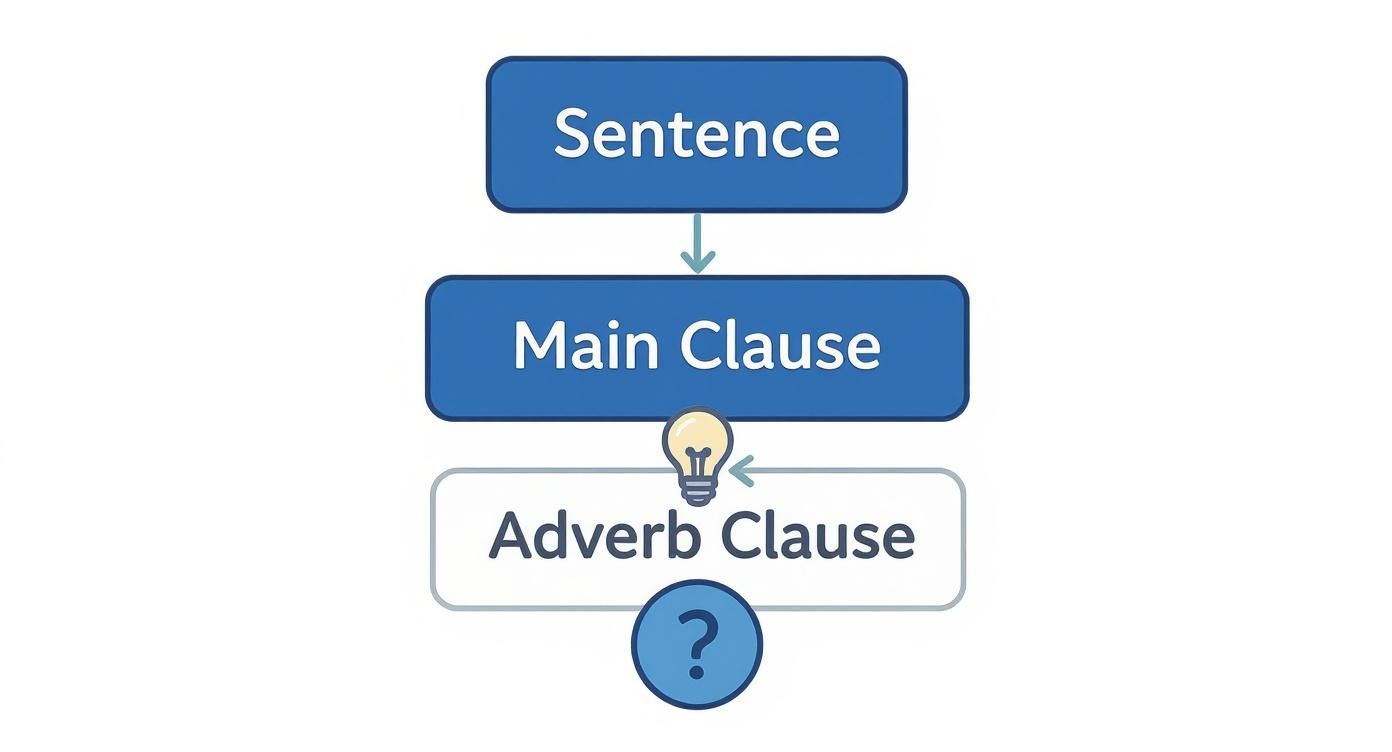
The diagram shows that the adverb clause isn't the star of the show; it's a crucial supporting actor that gives context (how, when, where, why) to the main event.
Common Subordinating Conjunctions by Function
To help you find the right word for the job, we've organized some of the most common subordinating conjunctions by the type of relationship they signal.
| Category | Common Conjunctions | Example Sentence |
|---|---|---|
| Time | after, as, before, since, until, when, whenever, while | When the bell rings, the students pack their bags. |
| Cause | because, since, as | I stayed inside because it was raining. |
| Contrast | although, even though, though, whereas, while | Although he was tired, he finished the race. |
| Condition | if, unless, provided that, in case | You can go to the party if you finish your homework. |
| Place | where, wherever | We'll have the picnic wherever we can find a sunny spot. |
This table isn't exhaustive, but it's a fantastic starting point for any writer or content creator. Having a mental toolbox of these words will make your writing more precise and varied.
A Simple Mnemonic to Remember Key Conjunctions
Need a quick way to remember some of the most common conjunctions? Just think of AAAWWUBBIS. It’s a handy little acronym that students and writers have used for years to keep the basics top of mind.
AAAWWUBBIS stands for: After, Although, As, When, While, Until, Because, Before, If, Since.
While AAAWWUBBIS won't cover every subordinating conjunction, it gives you a solid foundation. Getting comfortable with these workhorse words is the first step toward crafting sentences that are not just grammatically sound, but also nuanced and engaging.
Getting to Know the Different Types of Adverb Clauses
Okay, you've got the hang of subordinating conjunctions. Now for the fun part: seeing how they build different kinds of adverb clauses. Think of these clauses as specialized tools in your writing kit.
Each type adds a unique layer of meaning, answering the crucial questions your reader has: When? Where? Why? How? Let’s break down the most common types you’ll use in your content every day.

Adverb Clauses of Time
These are probably the ones you use most often without even thinking about it. They pin down when something is happening, using words like when, while, before, after, since, and until.
- Real-world use: When the new software update went live, our team immediately started testing it.
- Another example: He decided to pursue a new career path after he had worked at the same company for over a decade.
See how the clause locks the main action into a specific timeframe? It's a simple but powerful way to guide your reader through a sequence of events.
Adverb Clauses of Place
If time clauses answer "when," place clauses naturally answer "where." They establish the setting or location of an action and are almost always introduced by where or wherever.
- Real-world use: We recommend storing your files wherever your team can access them easily.
- Another example: They set up their campsite where the river bends and the trees provide ample shade.
These are fantastic for grounding your reader in a physical or digital space, making your descriptions much clearer.
The Big Idea: Your subordinating conjunction is the signpost. It tells the reader exactly what kind of information is coming next—whether it’s about timing, location, a reason for something, or a condition to be met.
Adverb Clauses of Reason (or Cause)
This is where your writing builds logic and depth. A clause of reason answers the all-important question: why? These are your go-to for explaining motivations, using conjunctions like because, since, and as.
- Real-world use: We canceled the marketing campaign because the initial data showed a low ROI.
- Another example: Since the new marketing strategy was so effective, the company saw a 25% increase in quarterly sales.
These clauses are workhorses in persuasive writing. Their importance isn't new; a linguistic analysis found that causal clauses were incredibly common in foundational texts, showing how fundamental they are to explaining context. You can dig into the data over at biblicalelearning.org.
Adverb Clauses of Condition and Concession
These two types are like two sides of the same coin, exploring possibilities and surprising contrasts. They add a sophisticated, critical layer to your writing.
Condition Clauses set a specific requirement, using words like if, unless, or provided that.
- Example: If you submit your application on time, you will be considered for the position.
Concession Clauses acknowledge a conflicting idea, using conjunctions like although, even though, or while.
- Example: Although he studied diligently, he did not pass the final exam.
Mastering these helps you move beyond simple statements. If you're looking for more ways to create dynamic sentences, our guide with examples of compound sentences is a great next step.
When you're working with AI-generated drafts, you can easily end up with repetitive sentences. We’ve found that a quick manual edit to vary your clause types can make a huge difference. Swapping a simple "because" clause for a more nuanced "although" clause can instantly elevate the writing and make it feel more authentic. Try PureWrite to see how our tool can help you spot these opportunities and truly humanize your text.
Mastering Placement and Punctuation
Knowing how to build an adverb clause is one thing, but knowing where to put it—and how to punctuate it—is what separates clunky sentences from polished, professional writing. The placement isn't just a rule; it's a stylistic choice that controls the rhythm and emphasis of your sentences.
You really only have two choices: put the adverb clause at the beginning of the sentence or at the end. This decision is surprisingly powerful. It lets you control the reader's journey through your content.
The Golden Rule: Commas for Introductory Clauses
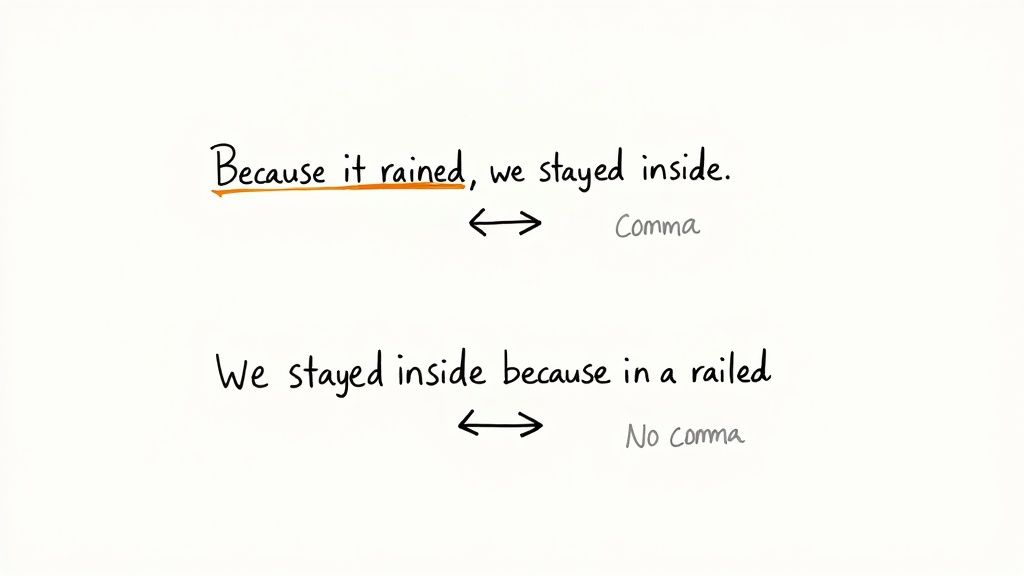
If there’s one rule you remember, make it this one: When an adverb clause starts a sentence, you must follow it with a comma. That comma is a crucial signpost for your reader, marking where the introductory information stops and the main part of the sentence starts.
Let’s see it in action:
- Correct: Because the traffic was heavy, we arrived late.
- Incorrect: Because the traffic was heavy we arrived late.
See the difference? That tiny comma does a lot of heavy lifting for readability. It’s a simple fix that adds immediate clarity to your writing.
Think of that comma as a courtesy pause. It separates the "why" or "when" from the "what happened," giving your reader a clear, logical path to follow.
When the Clause Comes Last
What happens if you flip the sentence around? When you place the adverb clause at the end, you usually get to drop the comma. The main idea flows straight into the supporting details without needing a break.
This structure often feels more direct and conversational. In fact, one study found that a staggering 96.1% of adverbial clauses used by young children were placed at the end of sentences. This suggests it's a more intuitive way for us to organize our thoughts.
Here’s how the punctuation changes with the new order:
- No comma needed: We arrived late because the traffic was heavy.
While this "no comma" rule holds up most of the time, there are a few exceptions. If you want to dive deep into the specific nuance of "because," check out our guide on using a comma before because.
If you're using AI writing tools, you might notice they default to the same sentence structures. A quick edit is to manually flip an adverb clause from the end to the beginning (and add that comma!). It's a simple trick to instantly add variety and make your content feel more human.
Sidestepping Common Adverb Clause Traps
Even experienced writers can get tripped up by grammar. While adverb clauses are fantastic tools, they come with a couple of common pitfalls that are easy to fall into. Let's walk through these mistakes so you can spot and fix them in your own work.
The two main issues are sentence fragments and comma splices. A fragment happens when you leave an adverb clause by itself, while a comma splice incorrectly smashes two complete thoughts together. Both can confuse your reader and dilute your message.
The Dreaded Sentence Fragment
Here’s the golden rule: an adverb clause is a dependent clause. That means it can't stand on its own as a complete sentence. Treating an adverb clause like a full sentence is one of the most frequent errors we see.
Think of it like a supporting character in a story. The character adds context, but they aren't the main hero.
Here’s what this mistake looks like:
- Incorrect: Because the internet was down.
- What's missing? We're left wondering what happened as a result.
- Correct: Because the internet was down, the team couldn't finish the project.
The fix is usually straightforward. Just connect the adverb clause to a main clause, and you've created a complete, coherent thought.
A dependent clause standing alone is a cliffhanger without a resolution. Always connect your adverb clause to a main idea to give your reader the full story.
Fixing Comma Splices and Run-On Sentences
A comma splice happens when you try to glue two complete sentences (independent clauses) together with just a comma. It's a classic grammatical foul. An adverb clause can easily get caught in the crossfire.
Let's break it down with an example:
- Incorrect (Comma Splice): The presentation was a success, since everyone understood the data.
- The Problem: "The presentation was a success" is a complete sentence. You can't just stick the next part on with a comma when it's meant to explain why.
- Correct: The presentation was a success since everyone understood the data.
In the corrected version, the clause "since everyone understood the data" properly acts as a dependent adverb clause that tells us why the presentation was successful.
Learning to catch these errors is a game-changer, especially if you're polishing AI-generated text. We built PureWrite to find and fix these exact problems, helping you make sure your final draft sounds polished and professional. Try PureWrite today to humanize your writing and get rid of those pesky grammar mistakes.
Using Adverb Clauses to Elevate Your Writing
https://www.youtube.com/embed/smgyeUomfyA
Knowing the rules is one thing, but using them to your creative advantage is where the magic happens. When you get the hang of adverb clauses, your writing goes from being just "correct" to being genuinely compelling.
This is a crucial skill for content creators and professionals today. AI writing tools can generate grammatically perfect sentences, but they often lack stylistic flair. One of the biggest tells of AI-generated content is its repetitive sentence structure—a dead giveaway to both human readers and detection software. By deliberately mixing in adverb clauses, you bring back that essential human touch.
Combining Ideas for Better Flow
Let’s see how adverb clauses can build sophisticated connections between your ideas. They are the perfect tool for weaving simple thoughts into a more fluid and logical narrative.
Take these simple sentences:
- The company launched a new app.
- It wanted to improve customer engagement.
- The app had some initial bugs.
They get the job done, but they feel disconnected. Now, let's use adverb clauses to stitch them together into something more professional.
Combined: Although the app had some initial bugs, the company launched it because it wanted to improve customer engagement.
This single sentence is much more powerful. It uses two different adverb clauses to show contrast ("although") and reason ("because"), guiding the reader through a more complex thought effortlessly.
Great writing isn't just about listing facts; it's about connecting them in a way that feels natural. Adverb clauses are the bridges that link your ideas together.
The Art of Moderation
Adverb clauses are a potent tool, but you should use them with purpose. Cramming too many into one sentence creates a tangled mess that is difficult to read. The key is finding the right balance.
Aim for variety in your writing. Not every sentence needs a complex clause; sometimes, a short, punchy sentence delivers the most impact. As you work on polishing your skills, you might also want to explore various writer tools that can help.
For writers ready to take the next step, our guide on how to improve English writing skills is packed with more practical advice.
Whether you're editing an AI draft or your own work, pay close attention to sentence structures. Try PureWrite today and see how our tool can help you spot repetitive patterns and add the natural variation that defines authentic, human writing.
Common Questions About Adverb Clauses
Let's be honest, grammar can throw some curveballs. Here are a few quick answers to the questions that pop up most often when writers start working with adverb clauses.
Can a Sentence Have More Than One Adverb Clause?
You bet. Stacking multiple adverb clauses can add rich layers of detail, but you have to be careful not to overdo it.
Take this adverb clause example: "When the sun sets, we’ll light the bonfire unless it starts to rain." This sentence flows nicely because each clause provides a different piece of information—one about time and the other about a condition. The goal is to make your sentence more informative, not just more complicated.
What’s the Difference Between an Adverb Clause and an Adjective Clause?
This is a classic point of confusion, but the answer is straightforward: it all depends on what the clause is describing.
An adverb clause modifies a verb, an adjective, or another adverb (answering when, where, why, how). An adjective clause, on the other hand, only modifies a noun or a pronoun (telling you which one or what kind).
- Adverb Clause: I read the book because it was recommended. (Why did I read it? This clause modifies the verb "read.")
- Adjective Clause: I read the book that was recommended. (Which book did I read? This clause modifies the noun "book.")
How Do I Pick the Right Conjunction?
Choosing the right subordinating conjunction is all about nailing down the relationship between your ideas. The conjunction is like a signpost for your reader, so you want it to be accurate.
Think about what you're trying to say. Are you explaining a cause (because, since)? Highlighting a contrast (although, while)? Or setting up a condition (if, unless)? The word you pick is crucial for getting your exact meaning across.
Learning to weave adverb clauses into your writing is one of the best ways to make your sentences sound less robotic and more natural. This is especially true if you're trying to humanize AI-generated text. A tool like PureWrite can spot repetitive sentence patterns and suggest more human-sounding alternatives.
Give PureWrite a try and see how it helps you polish your sentences and make your writing shine.