Mastering Figurative Language Types: Elevate Your Writing in 2025
Welcome to the world beyond plain text. Whether you’re a content creator battling AI-sameness, a student aiming for a higher grade, or a marketer trying to connect, your words need to do more than just inform. They need to resonate.
A key challenge today is that AI writing tools, while efficient, often produce flat, predictable prose. In fact, studies suggest that content lacking emotional depth can see engagement rates drop by over 40%. This is where mastering figurative language types becomes your secret weapon for creating authentic writing.
These creative tools don’t just decorate your writing; they build bridges of understanding and infuse your text with a human voice. For instance, crafting compelling thought leadership content requires a distinctive voice that stands out, a feat difficult to achieve with purely literal language generated by AI.
In this guide, we'll explore 10 essential types of figurative language, moving far beyond simple definitions. We'll give you practical, actionable advice with real-world use cases to help you elevate your content.
- Concise definitions to get you started quickly.
- Multiple real-world examples from literature and modern marketing.
- Actionable tips for content creators and professionals.
- Guidance on ethical AI usage and how PureWrite can help humanize your AI-assisted drafts.
Let's transform your writing from robotic to remarkable.
1. Metaphor - Direct comparison between two unlike things without using 'like' or 'as'
A metaphor is a powerful tool in your writer's toolkit. It creates a direct comparison between two unrelated things by stating one thing is the other, completely bypassing words like 'like' or 'as'. This technique allows you to layer meaning and evoke strong emotions by transferring the qualities of one concept onto another.
For instance, "Hope is the thing with feathers," a line from Emily Dickinson, doesn't literally mean hope is a bird. Instead, it imbues the abstract concept of hope with the tangible, resilient qualities of a bird that sings through a storm. This creates a far more memorable image than simply saying "hope is persistent."
Practical Use Cases & Examples
Metaphors make abstract ideas concrete and relatable, helping your audience grasp complex topics quickly. They are invaluable for content creators and marketers using AI writing tools who need to add depth to their work.
Thought Leadership: "All the world's a stage, and all the men and women merely players."
- Analysis: This classic line frames life as a performance. It suggests our actions are scripted and we all play roles, making a large concept understandable.
- Actionable Advice: Use a "container" metaphor like this to frame a complex business concept (e.g., "Our sales funnel is a journey") to make it more accessible for your audience.
Marketing Copy: "Our new marketing strategy is a rocket ship."
- Analysis: This immediately conveys speed, power, and an upward trajectory. It’s far more impactful than "our strategy is designed for rapid growth."
- Actionable Advice: In presentations, use metaphors to energize your points. A well-chosen metaphor can make data-driven claims more persuasive and memorable.
Refining with Ethical AI Usage
When editing, ensure your metaphor is consistent and enhances clarity. A mixed metaphor (e.g., "we need to iron out the bottlenecks") can distract your reader. For more tips on crafting clear and powerful prose, explore these strategies to improve your English writing skills.
If you're using an AI writing tool to generate ideas, your initial metaphors might feel generic. At PureWrite, we believe in ethical AI usage where you guide the tool. Use a tool like ours to refine AI-generated metaphors, ensuring they align with your unique voice and resonate with your audience, preserving your authentic writing style.
Ready to make your AI-assisted content more human? Try PureWrite to refine your metaphors and add a genuine, creative touch.
2. Simile - Comparison between two unlike things using 'like' or 'as'
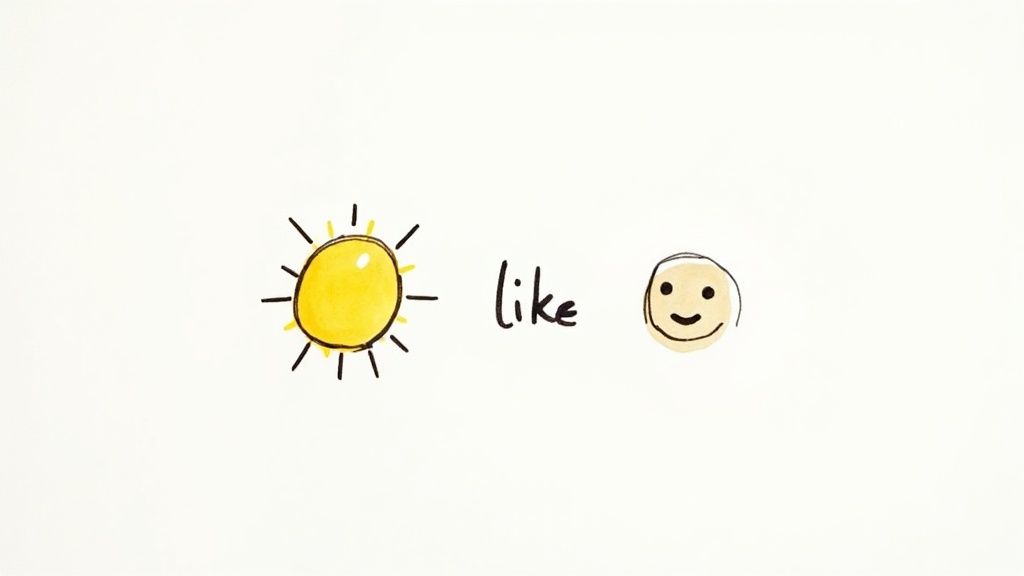
A simile is a foundational element among figurative language types, creating a comparison using 'like' or 'as'. Unlike a metaphor's bold statement, a simile offers a gentler, more explicit connection. This makes the comparison accessible and helps you create vivid imagery by relating an unfamiliar concept to something your reader already understands.
For example, "Her smile was as bright as the sun," immediately helps the reader grasp the smile's warmth and brilliance. This explicit comparison uses a familiar object (the sun) to illuminate a feeling, making it a versatile tool for content creators, students, and marketers alike.
Practical Use Cases & Examples
Similes excel at clarifying ideas and adding descriptive flair. They soften comparisons, guiding your audience toward the intended connection without causing confusion.
Creative Writing: Robert Burns' "O my Luve is like a red, red rose."
- Analysis: This links love to the beauty and vibrancy of a rose. The use of "like" makes the sentiment clear and universally understood.
- Actionable Advice: Use a simile when you want to make a poetic comparison that is instantly clear. It's perfect for conveying emotion in a way that feels both elegant and grounded in your content.
Business Communication: "He was like a fish out of water."
- Analysis: This common simile instantly communicates awkwardness. The imagery is so effective it has become a popular idiom.
- Actionable Advice: Incorporate simple, relatable similes into your writing to make complex emotional states or professional situations immediately understandable to your audience.
Refining with Ethical AI Usage
The biggest challenge with similes is avoiding clichés ("busy as a bee"). When editing your draft, especially one generated by an AI writing tool, push for originality. Ground your comparisons in concrete, sensory details to make them more impactful.
If your AI-generated text produces tired similes, use PureWrite to brainstorm more inventive comparisons. We help you polish the language to ensure your similes are original and align with your unique voice, making your authentic writing more engaging.
3. Personification - Giving human qualities or characteristics to non-human things
Personification is a creative form of figurative language that breathes life into the inanimate. It assigns human traits, emotions, and actions to non-human entities, like objects or abstract concepts. This technique forges a deeper connection between you, the reader, and the subject, making complex ideas feel more familiar and engaging.
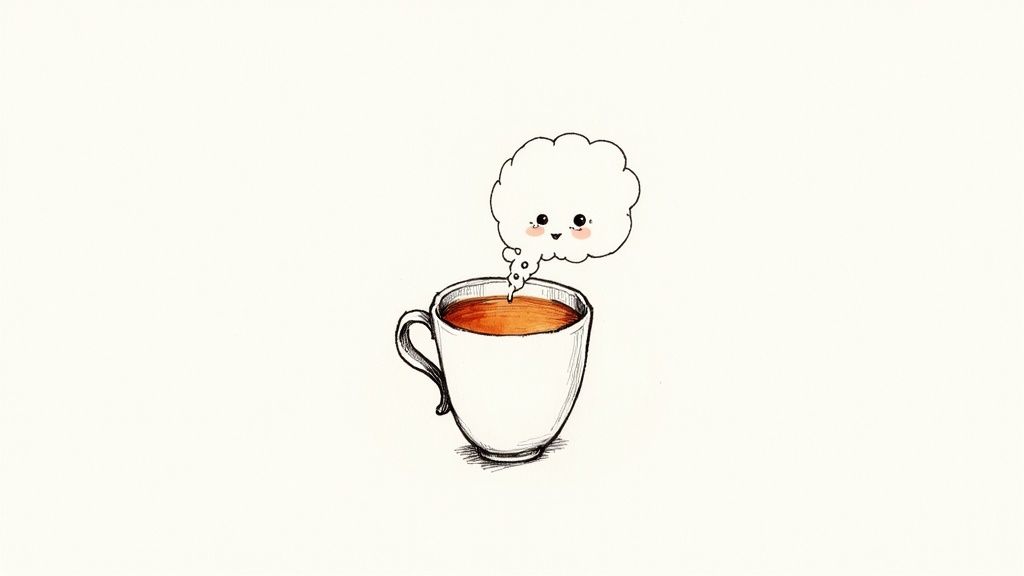
When Carl Sandburg writes, "The fog comes on little cat feet," he personifies the fog, giving it the silent, stealthy movements of a cat. This transforms a simple description into a vivid, memorable image, making the writing more dynamic and emotionally resonant.
Practical Use Cases & Examples
Personification excels at creating atmosphere and building empathy. By giving an object a human quality, you invite your audience to see it from a new, more personal perspective.
Storytelling: "The little house was sad and lonely."
- Analysis: This line gives the house human emotions. This makes the reader care about the house's fate, turning a simple structure into a character the audience can connect with.
- Actionable Advice: Use personification to create an emotional anchor in your narrative. Ascribing feelings to a key object or setting can shape the mood and guide your audience's emotional response.
Marketing Copy: "Your thirst-quenching adventure awaits. This bottle is calling your name."
- Analysis: This copy sells an experience. The bottle is personified as an active agent that "calls" to the consumer, creating a sense of personal invitation.
- Actionable Advice: In marketing, use personification to make your product feel like a companion or a solution that actively wants to help the customer, making your call to action more compelling.
Refining with Ethical AI Usage
The key to effective personification is subtlety. Ensure the human traits you assign are fitting and enhance your message. For a deeper dive into how this device works, explore this detailed example of personification.
If your AI-generated content includes personification that sounds unnatural, use PureWrite to refine it. We help smooth out the language, ensuring the personification adds depth that aligns with your unique voice, making your authentic writing more human and relatable.
4. Hyperbole - Extreme exaggeration used for emphasis or dramatic effect
Hyperbole is one of the most expressive figurative language types, employing extreme exaggeration for emphasis. This figure of speech is not meant to be taken literally; instead, it magnifies a statement to highlight its importance, evoke a strong feeling, or make a point more memorable. It’s a staple of everyday conversation and persuasive writing.
When you say, "This bag weighs a ton," you are using hyperbole to dramatically convey that the bag is very heavy. This overstatement creates a vivid mental image and communicates the feeling of strain more effectively than a simple description.
Practical Use Cases & Examples
Hyperbole grabs attention and injects personality into your writing. It's particularly useful for creating humor or making a feature seem exceptionally powerful, a great technique for content creators.
Informal Content: "I've told you a million times not to leave your shoes there."
- Analysis: The exaggeration "a million times" emphasizes the speaker's frustration. It conveys an emotional state, not a literal count.
- Actionable Advice: Use hyperbole in dialogue or social media content to capture a natural, human voice. It adds relatability and emotional depth, making your brand persona feel more authentic.
Humorous Writing (Mark Twain): "I was quaking from head to foot, and could have hung my hat on my eyes, they stuck out so far."
- Analysis: Twain doesn't just say his character was scared; he paints an impossible, cartoonish image of fear. This extreme exaggeration makes the character's terror both palpable and humorous.
- Actionable Advice: When describing emotions, push beyond simple adjectives. A well-placed hyperbole can illustrate a feeling with far more impact, leaving a lasting impression on your reader.
Refining with Ethical AI Usage
The key to effective hyperbole is ensuring the exaggeration is clearly understood as such. Overusing it can make your writing seem insincere, especially in professional content.
If your AI-generated content includes stale hyperboles, use PureWrite to brainstorm more creative alternatives. We help you refine these common exaggerations, ensuring they sound fresh and align with your unique voice, transforming bland statements into memorable claims. This is a core part of ethical AI usage—using the tool to enhance, not replace, your creativity.
5. Oxymoron - Combining contradictory or opposite words for effect
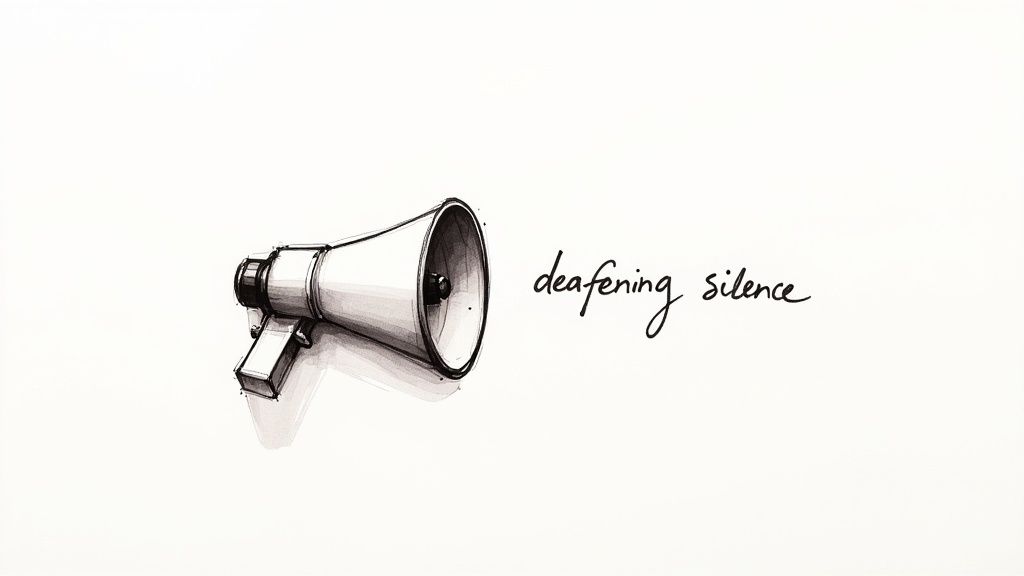
An oxymoron is a clever figure of speech that intentionally pairs two contradictory words to create a surprising and thought-provoking effect. This compact paradox grabs your reader's attention by forcing them to reconcile two opposing ideas, revealing a deeper truth. It’s a powerful technique for adding nuance and wit.
From Shakespeare's "loving hate" to the everyday "living dead," oxymora challenge our expectations. They distill a complex situation into a memorable two-word phrase, making them incredibly effective for highlighting irony or internal conflict.
Practical Use Cases & Examples
Oxymora make language dynamic by injecting tension and complexity. They can create humor, express confusion, or highlight a poignant contradiction in your content.
Critical Analysis: "The bookful blockhead, ignorantly read..." - Alexander Pope
- Analysis: "Bookful blockhead" and "ignorantly read" are brilliant oxymora. They expose the paradox of someone who has consumed information without gaining real wisdom.
- Actionable Advice: Use an oxymoron to critique a concept or reveal a hidden flaw in a product review or opinion piece. It’s a sharp, incisive way to make a point without a lengthy explanation.
Business Reporting: "Our last product launch was a beautiful disaster."
- Analysis: This phrase concisely captures a mixed outcome. It acknowledges both the failures ("disaster") and the valuable lessons learned ("beautiful").
- Actionable Advice: In reports or post-mortems, an oxymoron like "controlled chaos" or "successful failure" can communicate complex results efficiently and memorably.
Refining with Ethical AI Usage
An effective oxymoron should feel intentional, not accidental. Ensure the contradiction serves a clear purpose and illuminates an idea. A phrase like "open secret" works because it highlights a specific, well-understood paradox.
When using AI writing tools, you might get suggestions that are technically oxymoronic but lack impact. Use PureWrite to refine these ideas, ensuring they sound natural and strategically enhance your message. We help you polish the language while maintaining an authentic and human voice.
Want to add a layer of wit to your content? Try PureWrite to craft oxymora that make your writing smarter and more engaging.
6. Alliteration - Repetition of initial consonant sounds in nearby words
Alliteration is a sonic device that adds a musical quality to language by repeating initial consonant sounds. This popular member of the figurative language types family isn't about comparison; it focuses on rhythm and sound to make phrases more memorable and engaging. Its catchy nature is why it's a staple in everything from poetry to major brand advertising.
The classic tongue-twister, "Peter Piper picked a peck of pickled peppers," uses the repetition of the 'p' sound to create a playful rhythm. This sonic repetition embeds the phrase in our memory far more effectively than a simple sentence would.
Practical Use Cases & Examples
Alliteration creates cohesion and emphasis, drawing your reader's attention to a specific line or idea. It works by making language feel intentionally crafted and artful.
Content Marketing:
- Analysis: Blog post titles like "Five Fabulous Finds for Friday" use alliteration to be more catchy and shareable. The sound pattern creates an earworm that readers are more likely to remember.
- Actionable Advice: Use alliteration in your headings, subheadings, and key phrases to make them stickier. This is a simple but effective trick for content creators looking to improve readability.
Branding: "Coca-Cola"
- Analysis: The hard 'c' sound is repeated, creating a simple, punchy, and globally recognizable brand name. The alliteration gives the name a balanced rhythm, making it easy to say and recall.
- Actionable Advice: When brainstorming names for products, features, or campaigns, experiment with alliteration. A catchy, alliterative name can significantly boost memorability and brand recall.
Refining with Ethical AI Usage
The key to effective alliteration is subtlety. Overuse can make your writing sound childish. Aim for natural-sounding phrases where the repetition enhances the meaning. This is a core principle you can explore further as you learn how to write engaging content.
If your AI-generated text includes clunky alliteration, use a tool like PureWrite to smooth it out. We can help you refine the sentence structure to ensure the alliteration sounds intentional and sophisticated, preserving your creative intent while improving the overall flow.
7. Irony - Expression that conveys meaning by using contradiction or opposite of literal meaning
Irony is one of the most intellectually engaging figurative language types, creating a gap between what is said, what is expected, and what actually happens. This clever contradiction adds layers of depth and humor. It operates on three main levels: verbal, situational, and dramatic.
This technique forces your audience to look beneath the surface. For example, when a character says, "What a beautiful day!" during a torrential downpour, they are using verbal irony. The contradiction between the words and the reality highlights their frustration in a witty way.
Practical Use Cases & Examples
Irony grabs attention by subverting expectations. It can make a pointed critique without being overtly aggressive or create suspense that keeps your audience hooked.
Storytelling (Situational Irony): In O. Henry's "The Gift of the Magi," a wife sells her hair to buy her husband a watch chain, while he sells his watch to buy her hair combs.
- Analysis: The outcome is the opposite of what both characters intended, making their loving sacrifices tragically useless but profoundly meaningful.
- Actionable Advice: Use situational irony in storytelling to create poignant, memorable endings. Engineer plot points where the outcome of a character's actions is the inverse of their goal.
Social Media (Verbal Irony): After spilling coffee on a new shirt, someone tweets, "Well, this day is off to a fantastic start."
- Analysis: The speaker clearly means the opposite. This use of irony communicates displeasure through humor and wit, making the sentiment more relatable.
- Actionable Advice: In informal content, use verbal irony to build a brand's voice or add a light, witty touch. It can make a persona seem more intelligent and self-aware.
Refining with Ethical AI Usage
Effective irony depends on your audience's ability to spot the contradiction. Achieving this balance is crucial. Understanding what tone is in writing is essential to deploying irony without causing misinterpretation.
When you're generating content with an AI writing tool, the irony might come across as flat. Use a tool like PureWrite to refine the nuance and ensure the ironic tone feels authentic and lands with your intended impact. We can help you polish the language so your wit shines through as genuinely human.
8. Metonymy - Substituting the name of something with something associated with it
Metonymy is a subtle figure of speech where a concept is referred to by the name of something closely associated with it. Unlike a metaphor, which creates a comparison, metonymy works by substitution. This technique makes language more concise and evocative by leveraging existing associations in your reader's mind.
For example, when a news report states, "The Crown has issued a statement," "The Crown" is used as a stand-in for the monarchy. This substitution is efficient and carries a weight of authority that simply saying "the king" might not.
Practical Use Cases & Examples
Metonymy is a powerful shortcut that taps into shared cultural knowledge. It makes writing sound more sophisticated and can convey complex ideas with a single well-chosen word.
Professional Communication: "The White House is considering new legislation."
- Analysis: This uses a place (The White House) to represent the people and power within it. It’s more formal and less personal than naming an individual.
- Actionable Advice: Use place-based metonymy in professional or formal content to refer to institutions. This adds an air of authority and is a common convention in business and journalism.
Industry Content: "Hollywood is all about sequels this year."
- Analysis: "Hollywood" stands in for the entire U.S. film industry. The name evokes images of glamour and cinematic trends.
- Actionable Advice: Employ industry-specific metonymy (e.g., "Silicon Valley" for tech) to connect with a niche audience. It instantly signals a shared understanding and builds credibility.
Refining with Ethical AI Usage
The key to effective metonymy is a clear and widely understood association. If the connection is obscure, you risk confusing your reader.
When using an AI writing tool to draft content, it might generate metonymy that is cliché or contextually inappropriate. At PureWrite, we encourage you to use our tool to refine these choices, ensuring the substitution feels natural and intelligent. This ethical AI approach helps maintain the authenticity of your voice while sharpening your prose.
9. Pun - A play on words that exploits multiple meanings or similar-sounding words
A pun is a clever form of wordplay that hinges on a word having multiple meanings or sounding like another word. This type of figurative language injects humor and wit into writing, creating memorable moments for your reader. Puns are a staple in comedy, advertising, and even classic literature.
For example, when Groucho Marx said, "Time flies like an arrow; fruit flies like a banana," the humor comes from the dual meaning of "flies." This playful manipulation of language is the essence of a pun, making it a powerful tool for engaging an audience.
Practical Use Cases & Examples
Puns grab attention and make a message stick. They create a small "aha" moment that delights your reader and makes a brand, character, or idea more personable.
Social Media Marketing: "I used to be addicted to soap, but I'm clean now."
- Analysis: This pun plays on the word "clean." The juxtaposition creates a simple, effective joke that is easy to share.
- Actionable Advice: Use puns with common, dual-meaning words to add a lighthearted touch to social media captions or blog post titles. This can make your brand more approachable and shareable.
Branding: A time management software company calling itself "Second Time Around."
- Analysis: This name cleverly references the idiom "the second time around" while also relating to the measurement of time ("second"). It’s a smart name that communicates the product's purpose with wit.
- Actionable Advice: In branding and marketing, a well-placed pun can make your company name or slogan unforgettable. It shows creativity and can help you stand out in a crowded market.
Refining with Ethical AI Usage
When using puns, the goal is cleverness, not confusion. Ensure the wordplay is clear and doesn't require too much effort to understand. For help distinguishing between similar-sounding words, learn how to assure or ensure clarity in your writing.
If you're using an AI writing tool for witty copy, it might produce puns that feel forced. Use a tool like PureWrite to refine these ideas. We can help you polish the language, ensuring the pun lands perfectly with your audience while still sounding like it came from you.
10. Allusion - An indirect or passing reference to another work, person, or event
An allusion is a sophisticated figurative language type that functions like a cultural nod to your reader. It makes a subtle, indirect reference to a person, place, event, or another work of art. Unlike a direct citation, an allusion relies on your audience's shared knowledge to make the connection.
When a character is described as having the "patience of Job," the allusion alone economically conveys a profound level of endurance. This technique builds a bridge between your text and a larger cultural context, rewarding your reader for making the connection.
Practical Use Cases & Examples
Allusions add depth and resonance by tapping into a well of pre-existing stories and emotions. They are cognitive shortcuts that can convey complex ideas or character traits efficiently.
Professional Writing: "Public speaking is my Achilles' heel."
- Analysis: This alludes to the Greek myth of Achilles. It instantly communicates a specific, critical weakness in an otherwise strong profile.
- Actionable Advice: Use mythological or historical allusions in business content to frame a modern challenge within a timeless narrative, adding a layer of sophistication.
Content Marketing: "She entered the meeting with a real 'chosen one' attitude, as if she were Neo from The Matrix."
- Analysis: This reference paints a vivid picture of someone with an inflated sense of importance. It’s more culturally relevant to a modern audience than a classical allusion might be.
- Actionable Advice: Know your audience. Use pop culture allusions in marketing content to create a strong, immediate connection with a specific demographic that shares that cultural shorthand.
Refining with Ethical AI Usage
The key risk with allusions is that your audience might not understand the reference. Ensure your chosen reference is well-known enough for your target readers to grasp.
If you are using an AI writing tool to brainstorm ideas, it might suggest allusions that are too common. Using a tool like PureWrite can help you refine these suggestions, ensuring the allusion lands with the intended impact and aligns perfectly with your authentic writing style.
Comparison of 10 Figurative Language Types
| Figure of speech | Implementation complexity 🔄 | Resource requirements ⚡ | Expected effectiveness ⭐ | Ideal use cases 📊 | Key advantage 💡 |
|---|---|---|---|---|---|
| Metaphor | Medium 🔄🔄 — needs meaningful link | Medium ⚡⚡ — creativity and context | ⭐⭐⭐⭐ — vivid, high impact | Poetry, persuasive writing, branding | Condenses complex ideas into striking imagery |
| Simile | Low 🔄 — explicit comparison | Low ⚡ — easy to create | ⭐⭐⭐ — clear and accessible | Descriptive prose, ads, everyday speech | Makes unfamiliar concepts immediately relatable |
| Personification | Low–Medium 🔄🔄 — simple verbs/traits | Low ⚡ — minimal craft required | ⭐⭐⭐⭐ — emotionally engaging | Children's lit, descriptive prose, poetry | Humanizes non-human subjects for empathy |
| Hyperbole | Low 🔄 — straightforward exaggeration | Low ⚡ — quick to employ | ⭐⭐⭐ — strong emphasis or humor | Comedy, advertising, informal speech | Amplifies emotion or point through exaggeration |
| Oxymoron | Medium 🔄🔄 — concise juxtaposition | Low ⚡ — relies on word choice | ⭐⭐⭐ — thought-provoking brevity | Poetry, witty lines, slogans | Expresses paradox or complexity efficiently |
| Alliteration | Low 🔄 — patterning sounds | Medium ⚡⚡ — careful word selection | ⭐⭐⭐⭐ — memorable and musical | Slogans, titles, children's books | Enhances rhythm and recall |
| Irony | High 🔄🔄🔄 — requires setup/context | Medium–High ⚡⚡⚡ — audience awareness | ⭐⭐⭐⭐ — adds depth, wit, tension | Satire, drama, critical essays | Highlights contradictions and encourages interpretation |
| Metonymy | Medium 🔄🔄 — relies on clear association | Medium ⚡⚡ — cultural/context knowledge | ⭐⭐⭐ — concise and subtle | Journalism, politics, poetic expression | Economical reference via associated terms |
| Pun | Low 🔄 — wordplay mechanics | Low ⚡ — quick but language-dependent | ⭐⭐ — variable (taste-dependent) | Comedy, headlines, light advertising | Creates humor and memorable wordplay |
| Allusion | Medium–High 🔄🔄🔄 — implicit reference | Medium ⚡⚡ — shared cultural knowledge | ⭐⭐⭐⭐ — layered, enriching meaning | Literary, academic, intertextual works | Adds compact, resonant layers of meaning |
Bringing It All Together: From AI Draft to Authentic Voice
You've now explored ten of the most impactful figurative language types. The core lesson is clear: these devices are practical tools for any writer, marketer, student, or professional aiming to communicate with greater impact. Mastering these techniques is what separates generic content from writing that truly resonates.
A well-placed simile can make a complex idea understandable, while a carefully crafted hyperbole can inject personality into a dry report. The goal isn’t to decorate your text; it’s to build a bridge between your message and your reader’s mind.
Key Takeaways for Content Creators
As you move forward, keep these practical ideas in mind to integrate these tools into your writing process:
- Purpose Over Polish: Always ask: does this metaphor clarify my point? Does this personification evoke the right emotion? Every choice should serve a strategic purpose.
- Audience Is Everything: A brilliant pun will fall flat if your audience doesn't share the cultural context. Always tailor your figurative choices to your readers.
- Originality Builds Trust: Clichés are the ghosts of great metaphors. Strive for fresh, surprising comparisons that make your reader see the world in a new way.
Ethical AI and the Human Touch
AI writing tools are invaluable for generating initial drafts. For those leveraging modern tools, understanding how to efficiently utilize AI for initial content generation, like learning how to create compelling presentations with AI, can be a game-changer.
However, raw AI output often lacks the nuance and emotional depth that figurative language provides. This is where your role as a writer becomes critical. Your creativity is the essential human element that transforms a functional AI draft into an authentic piece of communication. At PureWrite, we champion this ethical AI usage.
This two-step process—combining AI's speed with your strategic creativity—is the future of effective content creation. You use technology for the heavy lifting, then apply your uniquely human understanding of these figurative language types to refine, polish, and inject true personality into the final product. The result is content that is not only well-written but also genuinely human.
Ready to ensure your creatively refined drafts sound authentically human? After infusing your text with powerful figurative language, let PureWrite provide the final polish. Our advanced platform helps you refine your writing to ensure it flows naturally and confidently passes AI detection, all while preserving your unique voice. Try Pure Write today to bridge the gap between AI efficiency and human authenticity.