How to Humanize AI Content to Engage Your Audience
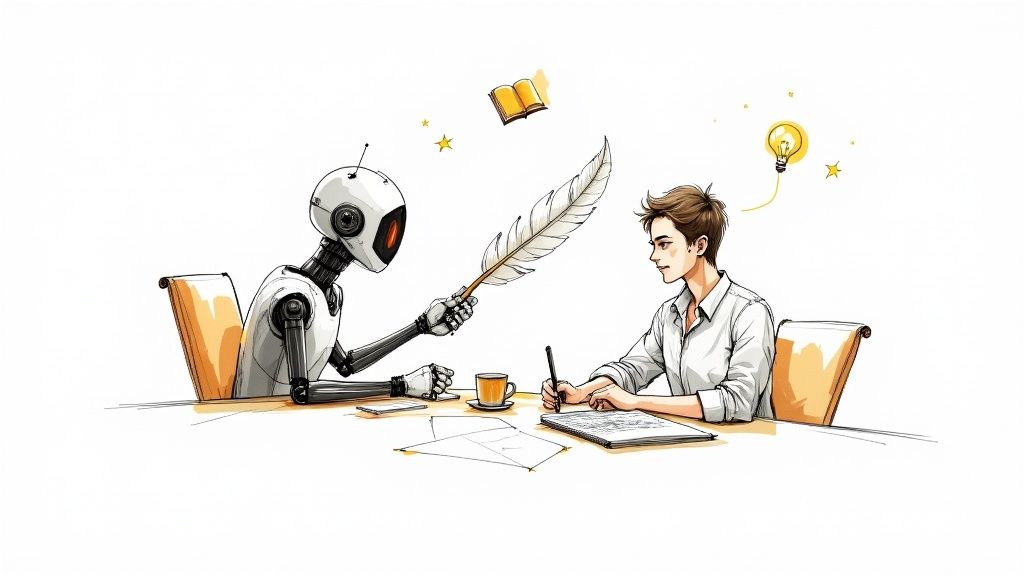
When we talk about "humanizing AI content," we're really getting at taking a generic draft and breathing life into it. It’s about adding your unique voice, your personal stories, and the kind of emotional connection that makes someone stop scrolling and actually read. This isn't just a light edit; it's a hands-on process where you step in as the final author, making sure the text truly speaks to another human being.
Why Humanizing AI Content Is No Longer Optional
Let's be clear: the debate over "AI vs. human" is over. The new standard is all about smart collaboration, where AI's incredible efficiency is guided by human authenticity. The best content creators aren't using AI as a writer—they're using it as a brilliant assistant to handle the grunt work of research and first drafts.
The data backs this up completely. While AI tool adoption is through the roof, raw, unedited AI content just doesn't perform. It falls flat with your readers and search engines alike. Your personal touch—your insights, your stories, your specific way of phrasing things—is what adds the credibility and emotional depth that algorithms can't yet touch.
The Rise of AI and the Authenticity Gap
AI content tools have become incredibly popular, and for good reason. They give you a level of speed and scale that was unimaginable just a few years ago. As more content creators, marketers, and students rely on tools like the best AI for social media content creation tools, the need to add a human layer has become absolutely essential.
The numbers here tell a fascinating story. Recent studies show that 78% of organizations now use AI in their content workflows, a trend driven by the demand for efficiency. This has led to a massive increase in the sheer volume of content being published online.
But that efficiency comes at a cost. Despite the massive output, research indicates that content with a clear human touch outperforms purely AI-generated text by a staggering 47% in key engagement metrics. This gap exists because people crave connection and want to know there's a real person behind the words.
This is the authenticity gap, and you, the writer, are the only one who can fill it. Your experiences, your voice, and your genuine perspective are what turn generic text into something memorable.
Why Your Human Insight Matters More Than Ever
An AI can string words together, but it can't share a lesson learned from a decade of experience. It can't feel empathy for a customer's problem, and it can't build genuine trust. Those are human qualities, and they are the foundation of content that doesn't just inform, but also influences.
Here’s what you, the human editor, bring to the table:
- Emotional Nuance: You can weave in subtle humor, a moment of vulnerability, or a passionate take that makes your reader feel something.
- Credibility and Trust (E-E-A-T): Your personal stories, industry anecdotes, and hard-won insights are what prove your expertise and make people believe you.
- Brand Voice Consistency: You are the guardian of your brand's personality, ensuring every sentence sounds like you and not a generic chatbot.
To see how these differences play out, let's compare the characteristics of a typical AI draft with content that has been thoughtfully humanized.
Raw AI Output vs Humanized Content at a Glance
| Characteristic | Raw AI Content | Humanized AI Content |
|---|---|---|
| Tone & Voice | Often generic, formal, or overly enthusiastic. Lacks a distinct personality. | Consistent with brand voice. Can be witty, empathetic, or authoritative as needed. |
| Credibility | States facts but lacks firsthand experience. Relies on common knowledge. | Builds trust with personal anecdotes, unique insights, and real-world examples. |
| Emotional Connection | Logically sound but emotionally sterile. Doesn't evoke strong feelings. | Connects with the reader through storytelling, empathy, and shared experiences. |
| Sentence Structure | Repetitive sentence patterns and predictable flow. Can feel monotonous. | Varied sentence lengths and structures create a more engaging, natural rhythm. |
| Specificity | Tends to be vague and abstract. Uses general terms and placeholder examples. | Packed with concrete details, specific numbers, and vivid, memorable examples. |
| Engagement | Lower engagement rates, higher bounce rates. Readers may skim or leave. | Higher user engagement, more time on page, and better overall performance. |
This table makes it clear: the editing and refinement process is where you create the real value. Navigating this new era of content creation means using AI for what it's good at while understanding its limits.
Part of that is being aware of how your content might be perceived by algorithms, which is why we created our guide on whether AI detectors are accurate. Ultimately, humanizing AI text isn't about fooling an algorithm; it's about genuinely serving your reader.
Spotting the Robotic Footprint in Your AI Drafts
Before you can fix AI-generated content, you have to get good at seeing it for what it is. Think of yourself as a detective looking for clues. Raw AI drafts have a distinct "footprint"—a set of tell-tale signs left by the algorithm—and learning to spot them is the first step toward creating something that truly connects.
The most obvious giveaway is a flat, predictable sentence structure. AI often churns out sentences of roughly the same length and pattern, creating a monotonous rhythm that can bore a reader to tears. For example, you might see a blog post where every sentence starts with a simple subject-verb construction, lacking the natural variety of human speech.
Uncovering Common AI Writing Habits
Another big clue is a sterile, overly formal tone. Because large language models (LLMs) are trained on vast datasets including academic papers and technical documents, their default voice can sound cold and impersonal. The draft might read like a user manual when you were aiming for a friendly, helpful conversation with your audience.
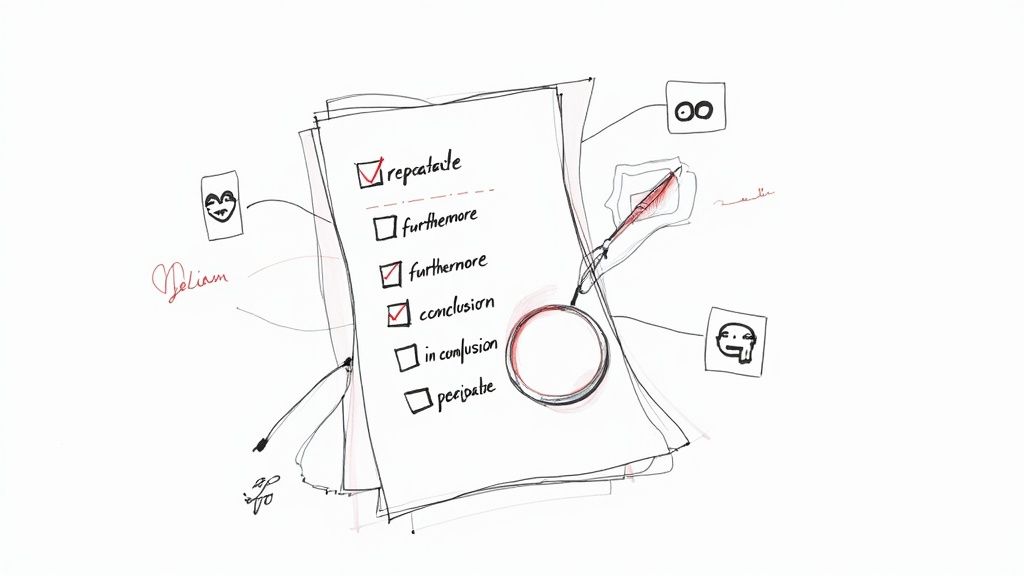
You also have to watch out for the AI’s addiction to certain transition words. If you see an overabundance of phrases like "furthermore," "moreover," "in addition," and the classic "in conclusion," you're looking at a classic AI habit. While these words aren't wrong, their relentless repetition feels clunky and is a huge red flag for machine-generated text.
Here are a few more robotic footprints to look for:
- No Personal Stories: AI can’t share a genuine experience. If your content is all facts and no "I remember when..." moments, it’s missing that vital human touch.
- Vague, Unsupported Claims: You'll often see broad statements like "many experts agree" without mentioning who those experts are. This kind of vagueness kills credibility.
- Zero Brand Voice: Your brand has a personality—it might be witty, serious, or empathetic. A raw AI draft is none of those things; it's just a blank slate.
The Problem with Predictable Patterns
These patterns aren't just minor style issues; they signal to readers (and to algorithms) that the content may lack real depth. In an academic setting, these are the exact traits detection tools are built to find. We get asked all the time about this, which is why we wrote a guide on whether Turnitin can detect AI.
The root of the problem is that AI writing can lack what's called "information entropy"—a technical term for unpredictability. Human writing zigs and zags; it surprises you. AI text, by contrast, tends to have lower entropy, which is why it can feel so robotic. Technical analysis often looks at "perplexity" and "burstiness" to measure sentence complexity and variation, which are typically lower in AI-generated text.
Key Takeaway: Spotting the robotic footprint isn't about hunting for mistakes. It's about recognizing the absence of human messiness, personality, and lived experience in your draft.
Your Diagnostic Checklist
To put this into practice, here’s a quick checklist to run through with every AI draft. Ask yourself these actionable questions:
- Sentence Variety: Are my sentences all the same length? Do they all start the same way?
- Tone & Personality: Does this sound like a real person talking, or like an encyclopedia entry?
- Specifics: Are my examples vivid and memorable, or are they generic placeholders?
- Transitions: Am I leaning too heavily on formal words like "furthermore" or "thus"?
- Voice: Does this actually sound like me or my brand?
Answering these honestly will give you a clear roadmap for your edits. Once you've identified the machine's footprints, you can begin breathing life and authenticity into the text. At PureWrite, we actually built our tool to fast-track this whole process, turning your diagnosis into actionable edits in just a few clicks.
Finding Your Voice in the AI Draft
Alright, you've learned to spot the robotic fingerprints an AI leaves on a piece of writing. Now for the best part: turning that sterile, machine-made text into something that actually sounds like you. This is where you inject your unique personality, transforming a bland data dump into a compelling article that builds real credibility.
This isn't just about tweaking a few words here and there; it's about reshaping sentences so they reflect your natural tone—whether you're witty, empathetic, or straight to the point. This is how you stop sounding like a generic chatbot and start building a genuine connection with your audience.
From Generic to Genuine: Add Your Personal Touch
The single most effective way to humanize AI content is to weave in your own stories and experiences. An AI can list facts, but it can't share that anecdote about a marketing campaign that went sideways or a tough lesson you learned from a client. These personal moments are your secret weapon for creating authentic, engaging content.
Think about the articles you truly enjoy reading. Chances are, the writers aren't afraid to share their perspectives, opinions, or even their mistakes. That kind of authenticity is magnetic.
Here are a few practical ways to put your stamp on the content:
- Share a Relevant Story: Did a client project teach you something crucial? Tell that story. Did you make a mistake that others can learn from? Share it.
- Insert Your Real Opinions: Don't be afraid to have a point of view. If you disagree with a common industry belief, explain why. Your unique perspective is what makes you valuable.
- Use Your Industry’s Lingo: Use the vocabulary your audience actually uses every day. This instantly signals you're an insider, not a machine scraping the web for generic terms.
Define and Master Your Writing Tone
Your tone is the feeling your words create, and it’s a massive part of your voice. An AI draft usually defaults to a bland, neutral tone, so your job is to give it one that matches your brand and connects with your readers. If you want to dive deeper, we explain this concept in our guide on what is tone in writing.
A consistent tone across your content makes your work instantly recognizable. Whether your style is humorous, formal, inspiring, or a bit skeptical, make a deliberate choice and own it.
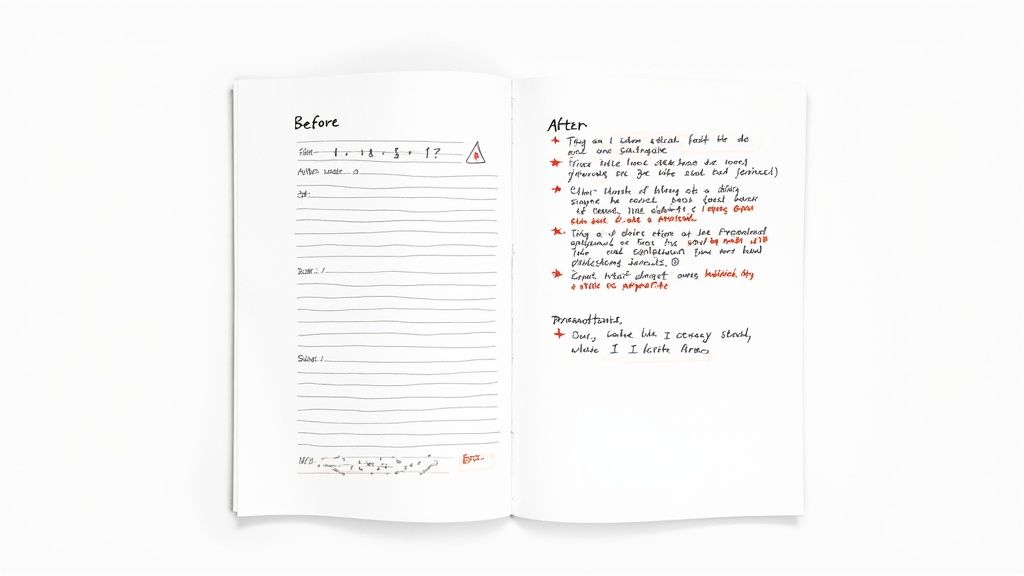
Before (AI-Generated): "It is important to utilize social media for marketing purposes. Businesses can increase their reach by posting regularly."
After (Humanized with a Witty Tone): "Still treating social media like an afterthought? If you're not posting consistently, you're basically leaving money on the table for your competitors to scoop up."
See the difference? The "after" example has a personality. It's direct, a little provocative, and way more memorable. These are the kinds of micro-edits that have a huge impact.
Weave in Conversational Elements
To truly make AI content feel human, write like you speak. AI often produces grammatically perfect but stiff prose. You can fix this by adding conversational touches that make the writing flow naturally and feel more approachable.
Start with your sentence structure. Mix short, punchy sentences with longer, more descriptive ones. This creates a rhythm that keeps people reading, avoiding the monotonous drone of a typical AI draft.
Don't be afraid to use rhetorical questions. Tossing in a "But what does that actually mean for your bottom line?" or "Sound familiar?" pulls your reader into a conversation. It feels like you're talking with them, not at them.
This is exactly what we built PureWrite to do. You can drop in your sterile AI draft, and our tool will give you concrete suggestions to inject personality, vary your sentence structure, and lock in your chosen tone. Try PureWrite and see how quickly you can make your content sound authentically human.
Weaving a Story Your Readers Can't Put Down
Adding a personal touch is a great start, but truly human writing does more than just sound like a person—it tells a story. An AI can line up facts like soldiers in a row, but it rarely creates a real narrative that pulls a reader from one sentence to the next. Your job is to take that logical but lifeless draft and turn it into a journey for your reader.
This means zooming out from the sentence level and looking at the whole picture. Does the intro immediately grab you? Do the ideas flow together like a good conversation? Does the conclusion actually stick with you? These are the elements that separate a forgettable list of facts from a powerful piece of content.
The Art of the Irresistible Hook
You have about three seconds to convince someone to stick around. AI introductions are notoriously bad at this; they often lead with snoozers like "In the world of digital marketing..." The first thing you should do is delete that robotic opening and start fresh.
Instead, lead with something that triggers genuine curiosity or a flicker of emotion. A killer hook could be:
- A provocative question: "What if half of what you believe about SEO is actually holding you back?"
- A shocking statistic: "Did you know 8 out of 10 readers bail before they even finish the first paragraph?"
- A quick, relatable story: "I’ll never forget the first time a client told me my writing sounded like a textbook. It stung, but they were right."
The goal here is to make an immediate human connection. It signals to your reader that this isn't just another generic article; it’s a piece with a real perspective that's worth their time.
Building Bridges Between Your Ideas
Clunky transitions are a dead giveaway of an AI draft. The model loves to lean on crutches like "Additionally" or "Furthermore," which makes the whole thing feel stiff and academic. To create a smooth, effortless read, you need to build better bridges between your paragraphs and ideas.
A simple, effective trick is to use the final sentence of one paragraph to tee up the next. For instance, after a section on spotting AI's robotic voice, you could end with: "But spotting the problem is only half the battle. Now for the fun part: fixing it." This creates a natural pull, guiding the reader right into your next section.
Pro Tip: Read your draft out loud. Seriously. Every time you stumble or a sentence feels awkward, you’ve found a transition that needs work. It’s a low-tech trick that works every single time.
Cutting the Fluff for a Leaner Message
AI models are chronic over-explainers. They often say the same thing three different ways, bloating your article with repetitive fluff. As the human editor, you need to be ruthless and cut everything that doesn't add value.
Comb through the draft and ask these questions for every sentence: Does this add anything new? Have I already said this? Is there a shorter, punchier way to say this? Chopping just 10-15% of the bloat can make your message twice as powerful. This focus on clarity is a cornerstone of our advice on how to write engaging content.
Structuring for Skimmers and Scanners
Let’s be honest: people don't read online; they skim. A solid wall of text is an instant turn-off, no matter how brilliant the writing is. You have to use formatting as a guide to lead the reader’s eye to the good stuff.
Break up long paragraphs into short, digestible chunks of two or three sentences. Use clear, descriptive subheadings so people can find exactly what they're looking for. And sprinkle in bullet points, numbered lists, and blockquotes to make key takeaways pop. When you pair a strong narrative with smart formatting, you get an article that’s not just enjoyable but incredibly easy to absorb.
Using the Right Tools to Humanize Your Content
Let's be honest, staring at a raw AI draft and trying to wrestle it into something human can feel like a chore. While your unique insight is irreplaceable, you don't have to do all the heavy lifting manually. The right tools can act as a bridge, helping you turn robotic text into something that actually connects with your reader.
That's exactly why we built PureWrite. We got tired of the clunky phrasing, the unnatural sentence flow, and the generic vocabulary that AI often spits out. We designed it to be your editing partner—one that helps you find your voice, not just apply another layer of AI.
A Smarter Workflow for Humanizing AI Content
A practical workflow looks like this: let the AI handle the initial draft. Then, instead of jumping into a blank doc and editing from scratch, pull that text into an AI humanizer like PureWrite to streamline the process.
This simple step immediately refines your workflow. You can use features to tweak the tone with a click, break down overly complicated sentences, and ensure the whole piece sounds genuine.
As you edit, keep a simple narrative structure in mind. You need a strong hook to grab attention, a logical build-up of your ideas, and a takeaway that sticks.
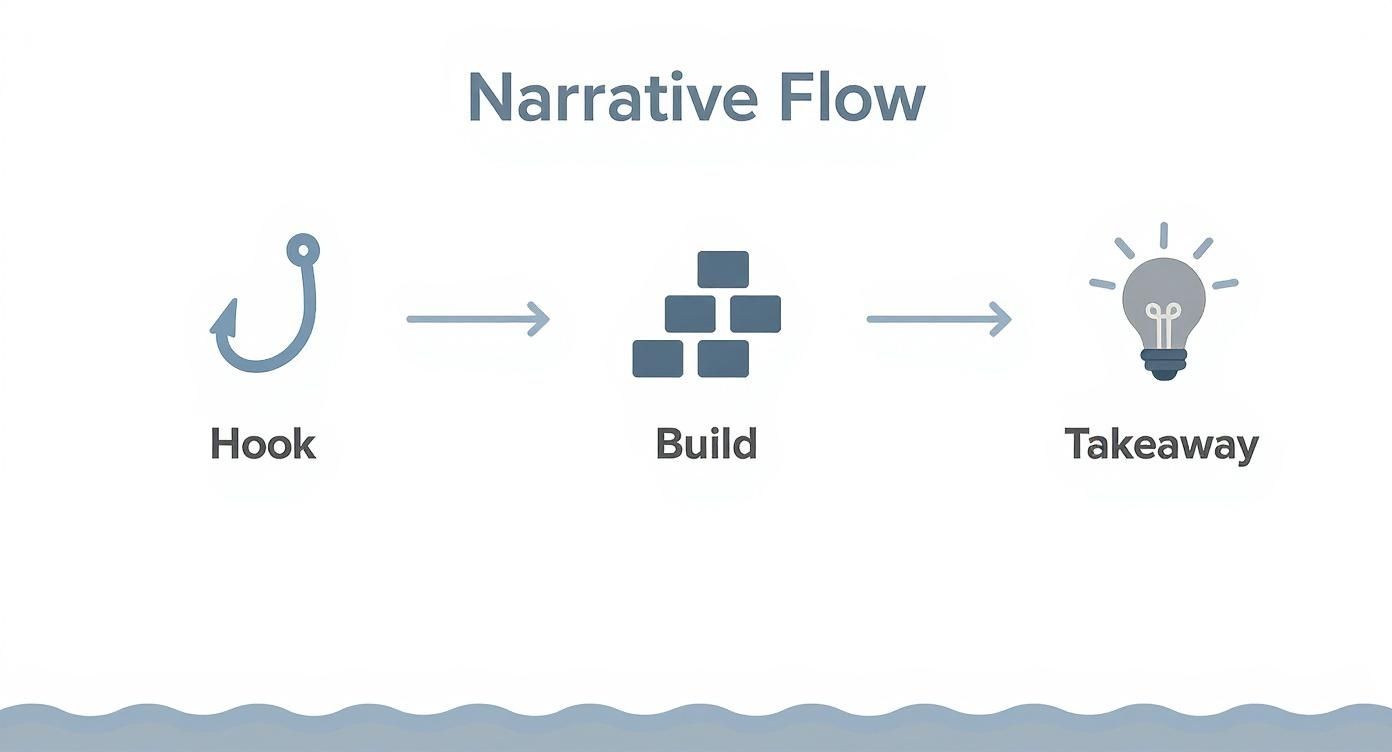
This isn’t just about swapping out a few words; it’s about ethically guiding the reader from a compelling start to a satisfying finish.
The Rise of Ethical AI Humanizers
The appearance of dedicated ‘AI humanizer’ tools was a game-changer for content creators, students, and professionals. These platforms were built specifically to translate stiff, AI-generated text into natural, human-sounding language. The best ones integrate smoothly into your existing process, making it easy to ethically polish AI drafts while preserving your authentic voice.
This becomes even more important as the generative AI market explodes, with some projections expecting it to top $66.62 billion. As a content creator, it's also useful to understand the bigger picture. Knowing how AI tools like ChatGPT can assist with SEO gives you context for using them effectively, ensuring your final output has that essential human touch.
When you bring a humanizer tool into your workflow, you stop being a line editor correcting every single mistake. You become a creative director who shapes the final story. You get to focus on strategy and storytelling while the software handles the more mechanical fixes.
This approach lets you keep your quality and authenticity high without giving up the speed that made AI attractive in the first place.
Common Questions About Humanizing AI Content
As you start weaving AI into your writing workflow, you're bound to have questions. This is new territory for a lot of creators, students, and marketers. Let's tackle some of the most frequent questions we hear about turning AI drafts into genuinely good, human-sounding content.
How Much Editing Does an AI Draft Really Need?
Honestly, there's no magic number; it depends on the context. A technical guide for professionals might need a lighter touch than a personal essay that's supposed to be full of heart and unique perspective.
Instead of chasing a certain percentage of changes, we suggest a practical, ethical approach. First, fact-check everything. Every number, claim, and source the AI provides needs verification to ensure your content is accurate and trustworthy.
Next, scrap the AI’s intro and conclusion and write them yourself from scratch. These are your handshake and your lasting impression—they have to be in your authentic voice. For the body of the article, add at least one unique example, a personal story, or an expert insight to every major section. This is where you layer in real value that only you can provide.
Your goal isn't to rewrite every word. It's to strategically infuse your own expertise and personality onto the AI's foundation, making sure the final piece is undeniably yours.
Can AI Detectors Still Flag Humanized Content?
Let's be real about AI detectors: even after a thorough edit, there's no ironclad guarantee. If the core sentence structures from the original AI draft remain, some sensitive tools might still pick up on those patterns.
But here’s what’s more important: your focus should be on creating amazing content for your readers, not just trying to outsmart a piece of software. Google has been clear that its guidelines are about helpful, expert-driven content, regardless of how it was created.
When you truly humanize your writing—by adding real stories, unique takes, and a consistent voice—you're naturally creating something that both people and search engines will value. At PureWrite, our tool is built to help with this, restructuring sentences and varying your prose to boost its authenticity.
What Is the Most Important Element to Add to AI Writing?
You can tweak the tone, fix the flow, and vary the sentences all day long, but the single most important element you can add is genuine Experience, Expertise, Authoritativeness, and Trustworthiness (E-E-A-T). An AI simply cannot fake this.
This is what makes your content worth reading. It means digging deeper than surface-level edits and embedding your real-world experience right into the text.
- Experience: Tell a story about a project. For a student, this might be a challenging research paper; for a marketer, a campaign that failed spectacularly. What was the lesson?
- Expertise: Share an opinion that goes against the grain or challenges a common assumption in your field.
- Authoritativeness: Back up what you're saying. Cite primary sources or, even better, share data you've gathered yourself.
- Trustworthiness: Be honest and transparent about your process. Admit what you don't know.
An AI is a sophisticated pattern-matcher, working from a massive library of existing content. It has no lived experience. By grounding your content in your own journey, you make it more relatable, trustworthy, and valuable than the flood of generic AI articles out there.
Ready to transform your AI drafts into content that truly connects? Stop wrestling with robotic text and start creating authentic, engaging articles with ease. Try PureWrite today and see how our advanced humanizer can help you find your voice, streamline your editing, and produce high-quality content faster than ever before. Visit us at https://purewrite.io to get started.
Ready when you are.
Paste your draft, get writing that reads as yours.
No card required.