How to Humanize AI Content and Truly Connect with Your Audience
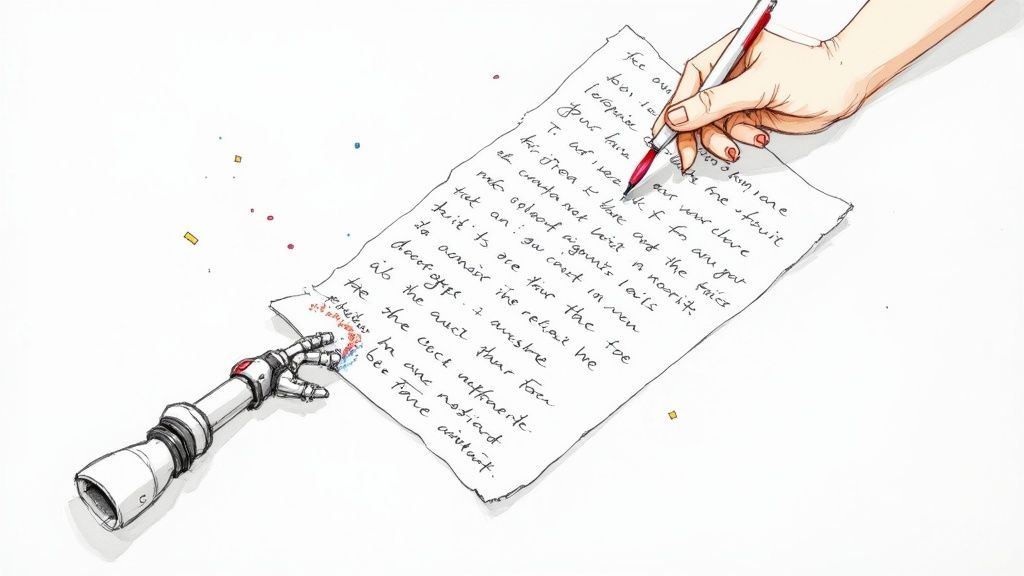
To humanize AI content means transforming the raw, often robotic output from a machine into something with warmth, personality, and the subtle quirks of human writing. It's about layering in your authentic voice, weaving in personal stories, and forging an emotional connection that AI simply can't replicate on its own.
This crucial editing process is what turns sterile text into compelling content that resonates with people, builds trust, and ultimately drives results for you.
Why Robotic AI Content Fails to Connect
You've felt it before. You're reading an article, and something just feels… off. The grammar is perfect and the sentences are technically correct, but the text is completely hollow. This is the biggest hurdle with unedited AI output—it lacks the soul that makes content memorable.
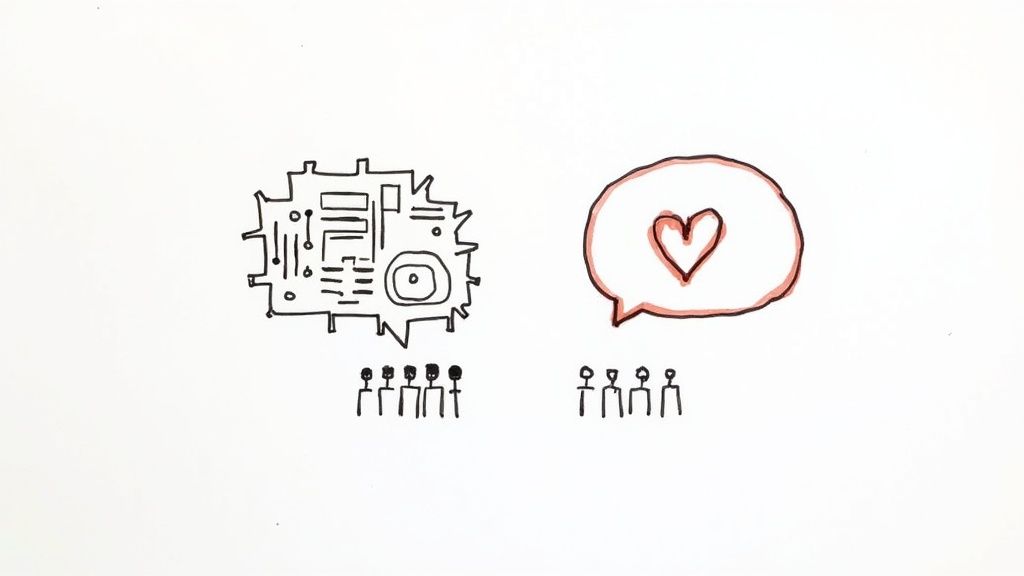
AI models are trained on vast amounts of data, making them great at producing factual, well-organized text. However, what they can't do is replicate a human experience, convey genuine emotion, or master the delicate art of storytelling. This creates a chasm between you and your reader, making it nearly impossible to build the rapport needed for a loyal audience. A good starting point is understanding AI-powered content creation to see where these gaps exist.
The Trust and Engagement Gap
Your readers are smart; they can spot disingenuous content from a mile away. An overly formal tone, predictable sentence patterns, and a complete lack of personal insight are all red flags that scream "robot." When a reader senses this, they immediately disengage, and any trust you were hoping to build crumbles.
The statistics back this up. Recent studies show that human-authored content can drive up to 47% higher user engagement than purely AI-generated text. That’s a significant difference, stemming from the authenticity and emotional connection that readers instinctively crave.
"AI can help you develop the idea, but you have to intervene to convey the feeling you want to convey to your audience."
This isn't just about feeling good; it has a direct impact on your goals. Low engagement means:
- Higher bounce rates because people get bored and leave your site.
- Lower time-on-page, which signals to search engines that your content isn't helpful.
- Fewer conversions, since uninspired writing rarely convinces anyone to take action.
Aligning with Modern SEO Standards
Not long ago, SEO was a game of keywords and backlinks. Those days are gone. Google's standards have evolved to prioritize Expertise, Experience, Authoritativeness, and Trustworthiness (E-E-A-T).
Robotic content fundamentally fails to meet these criteria, especially the "Experience" component.
An AI cannot share a genuine story about a lesson learned, a mistake made, or a unique perspective gained from years of hands-on experience. That’s why learning to humanize AI content isn’t just a stylistic choice anymore—it's a critical step for sustainable SEO success. At PureWrite, we believe AI should be your assistant, not the author.
Finding Your Authentic Brand Voice
The first step to humanize AI content is to give it a distinct personality—yours. By default, AI-generated text pulls from a massive, generalized data pool, resulting in a flat, neutral tone. Your unique brand voice is the secret weapon that turns that bland text into something memorable.
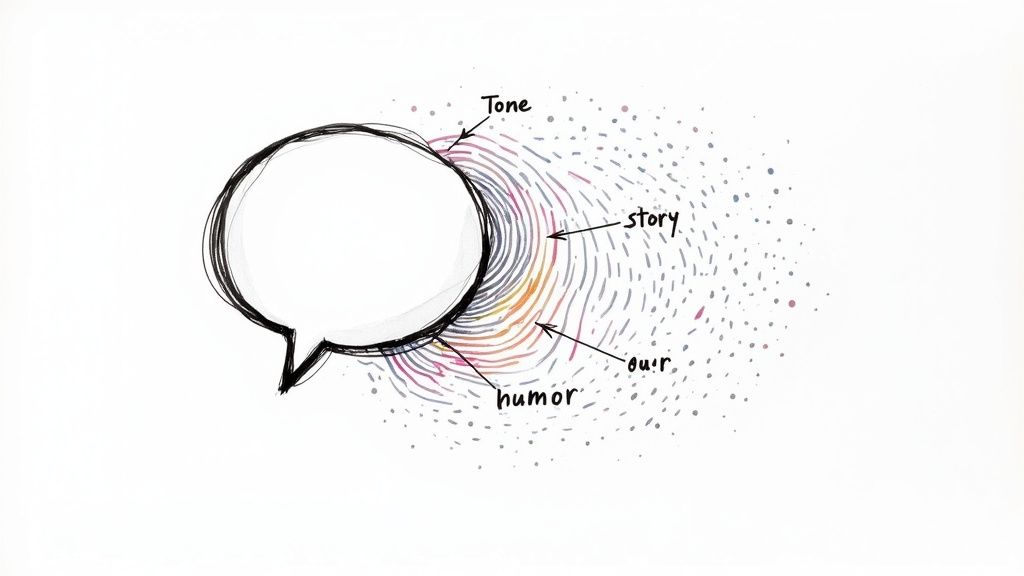
Think of your brand voice as your content’s character. Are you witty and informal, or more authoritative and professional? Do you want to sound like an empathetic friend or a straightforward expert? Answering these questions is the first practical step toward transforming generic AI output into something your audience will actually connect with.
Defining Your Voice
Before you can edit effectively, you need a clear target. A well-defined brand voice is consistent and instantly recognizable, which is how you build a loyal following. It's the special quality that lets people know it’s you before they even see your name.
To get started, consider these core elements:
- Personality: Can you describe your brand in three to five adjectives? For example, a student-focused educational blog might choose "Supportive, Clear, and Encouraging."
- Pacing: Is your style built on short, punchy sentences, or do you prefer more descriptive, flowing prose?
- Vocabulary: What words do you use? Do you keep it simple and direct, or do you use industry-specific terminology?
Documenting this is crucial. For a solid framework, we recommend creating effective brand voice guidelines. This document ensures your entire team—and your AI tools—are aligned and speaking the same language.
Infusing Personality and Stories
With your voice defined, you can start applying it to your AI drafts. This is where you move beyond simple grammar fixes and begin weaving in the human elements that make your content stand out. This is less about a complete rewrite and more about making strategic, personal edits.
The goal isn't just to sound "like a human." It's to sound specifically like you. Your experiences, opinions, and stories are things an AI cannot authentically replicate.
Let's take a real-world example. A marketer using AI to draft a case study could add a personal anecdote about the initial client meeting, detailing the specific problem the client faced. That small story adds a huge layer of authenticity and makes the entire piece far more engaging than a dry list of results.
At PureWrite, we're dedicated to making this process easier. Our tool helps you get a solid first draft quickly, then allows you to refine the tone until it’s a perfect match for your voice. This saves you valuable time while keeping you in full control of the final, polished piece. Ready to make your content truly yours? Try PureWrite today and feel the difference.
Polishing Your Draft for a Human Touch
You have your brand voice defined. Now it's time for the practical editing work. Raw AI text often sounds robotic due to its repetitive sentence structures and overly formal tone. Here’s an actionable checklist to spot and fix these giveaways so your content flows like a natural conversation.
Think of yourself as an editor, not just a proofer. The AI has provided the raw material, but you are the one adding the personality—the rhythm, anecdotes, and thoughtful details that make the writing feel human. Your job is to smooth out that robotic stiffness and create an engaging experience for your reader.
Vary Your Sentence Structure
One of the biggest giveaways of AI writing is a monotonous rhythm. AI models often produce paragraphs where every sentence is roughly the same length and follows a similar structure. This can be incredibly boring for your readers. The solution is simple: mix it up.
Weave short, punchy sentences with longer, more descriptive ones. This creates a dynamic pace that keeps people engaged and makes the text feel more like you're speaking to them directly. For a deeper look at this, our guide on compound and complex sentences offers some great techniques.
- Short Sentences: Use these to make a strong point. They grab attention. They create impact.
- Longer Sentences: Use these to explain complex ideas, add rich detail, or provide necessary context in a single, flowing thought.
This simple adjustment can make a night-and-day difference in readability, transforming your content from machine-like to human-centric.
Inject Conversational Language
AI often defaults to a formal, academic tone. It avoids contractions, uses unnecessarily complex words, and steers clear of casual phrasing. This is one of the easiest and most impactful issues for you to fix.
Scan your draft for opportunities to sound more natural and approachable:
- Use Contractions: Change "do not" to "don't" and "it is" to "it's." This instantly makes your writing feel warmer.
- Simplify Your Words: Why write "utilize" when "use" works just as well? Swap "commence" for "start." If there’s a simpler word, choose it.
- Add Idioms (Carefully): A well-placed idiom or a bit of culturally relevant phrasing can add a layer of authenticity. Just ensure it aligns with your brand voice and won't confuse your audience.
The point isn't to dumb down your content. It's about making it accessible and relatable by removing the wall of formality that AI often builds.
We built PureWrite to help with these exact edits. Our platform is designed to help you refine your text, adopt a more conversational tone, and fix awkward phrasing until the final piece sounds like it came from you, not a prompt. If you're tired of fighting with robotic drafts, give PureWrite a try and see how quickly you can humanize AI content.
A Practical Workflow for Humanizing AI Content
Theory is great, but practical application is what delivers results. Let's walk through an actionable workflow you can use to take a raw AI draft and turn it into a polished, genuinely authentic piece of content. This isn't about tricking an AI detector; it's about making your writing more effective and building a real connection with your audience.
With a solid system, you can consistently and efficiently humanize AI content while retaining the speed that makes AI tools so valuable. We built PureWrite to be the engine for this exact process, helping you refine text with just a few clicks.
Start with a Solid Foundation
When you receive a first draft from an AI writer, resist the urge to immediately start editing sentences. First, take a moment to look at the big picture. Does the overall structure make sense? Is the main point clear and logical?
Once you have a feel for the piece, copy and paste the entire text into the PureWrite editor. Doing this upfront sets the stage for a much faster and more effective editing session. It’s how you can go from a clunky, robotic draft to a nearly finished piece in just a few minutes.
Here’s a look at the simple PureWrite interface where the transformation from AI text to human-centric writing happens.
As you can see, we designed it to be straightforward, removing the friction between you and a great final draft.
Execute the One-Click Humanization
This is where the magic happens. Once your text is loaded into PureWrite, you can choose from different modes to instantly improve it. For most drafts coming straight from an AI tool, our "Humanize" mode is exactly what you need.
With one click, this mode targets the most obvious AI tells:
- Repetitive sentence structures: It breaks up the monotony, introducing a more natural rhythm.
- Predictable vocabulary: It swaps out overused AI words for more interesting and engaging alternatives.
- Stiff and formal tone: It breathes life into the text, giving it a more conversational and approachable feel.
Modern AI humanization is remarkably effective. Studies show that a high-quality humanizer can achieve up to a 98% success rate in passing AI detection, while boosting readability scores by an average of 73% in seconds. For more on the numbers, you can explore this detailed statistical breakdown.
Final Polish and Personalization
After PureWrite has done its work, your draft is about 90% of the way there. That last 10% is where you come in. This is your opportunity to add your unique voice, expertise, and personality.
This is the perfect moment to weave in a quick personal story, share a specific data point from your own research, or offer an opinion that an AI could never generate on its own. For example, a student might add a personal reflection on how a particular study technique worked for them, making an academic article instantly more relatable.
This final, personal touch is your most powerful tool. It’s what separates great content from good content and ensures your expertise shines through, building trust and authority.
This is also the perfect time to ensure your article is fully optimized. If you’re looking to round out your content process, we put together a guide on the best content optimization tools that work perfectly with this workflow.
Following this simple, three-step process gives you an efficient and effective system. You get the speed of AI combined with the essential touch of human creativity. Ready to see it in action? Try PureWrite and see how easy it is to humanize your AI content.
Your Final Pre-Publish Quality Check
Before your article goes live, this last review is absolutely essential. Think of it as your final line of defense against any stiff, robotic language that might have slipped through, ensuring your message is clear, authentic, and ready for your audience.
This isn't about chasing perfection; it's about professionalism. A few extra minutes here will pay off by ensuring your content reflects your high standards and truly helps your readers. It’s the final step to humanize AI content.
Check for Readability and Clarity
First, run your text through a readability tool. These applications provide a quick assessment of how easy your writing is to understand, often assigning it a grade level. The goal isn't to "dumb down" your work, but to make sure complex ideas are accessible.
This check helps you spot overly long sentences or niche jargon that might confuse some of your readers. Remember, clear and direct writing always wins because it respects your audience's time.
The infographic below shows how you can move from a rough AI draft to a polished, reader-friendly piece with a little help from PureWrite.
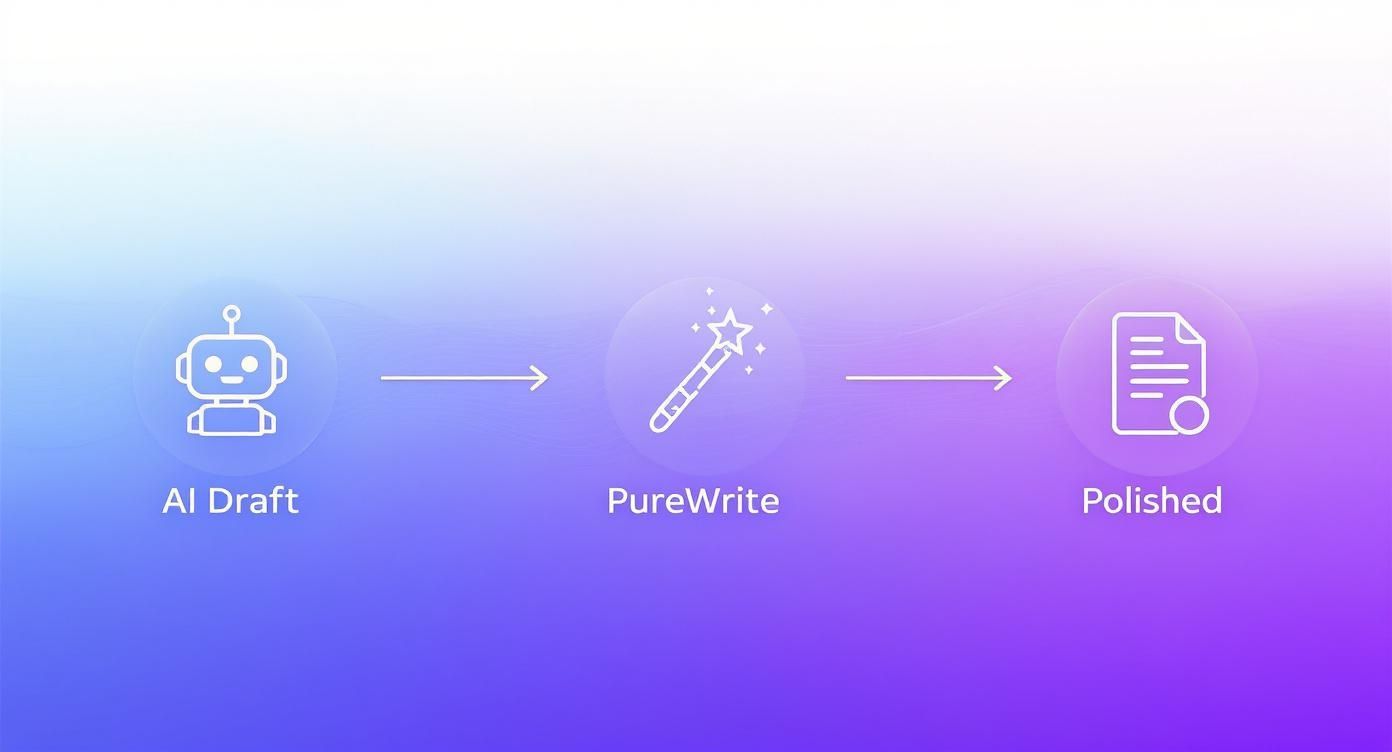
As you can see, our platform is designed to be that critical bridge, turning sterile text into something that just needs your final, personal touch.
Review AI Detection Scores Thoughtfully
Next, it’s a good practice to see what an AI detector thinks. The goal here isn't to obsess over achieving a 100% human score. Instead, use these tools as a diagnostic to find spots that might still sound a bit robotic. If a paragraph gets flagged, read it out loud. Does it sound natural, or does it feel clunky?
This is a smart quality control step, especially since many universities and workplaces use similar software. For students, understanding how Turnitin detects AI is increasingly important. But always remember, your primary objective is to connect with a human reader, not just to bypass a tool.
The ultimate test of your content isn't a software score, but whether a real person finds it valuable, engaging, and trustworthy.
Let's face it, trust in purely AI-generated text is still low. A recent report on AI and user trust revealed that only 6% of users have high trust in AI summaries. This statistic alone highlights why human oversight is non-negotiable for building credibility.
The Irreplaceable Human Proofread
Finally, never skip the manual proofread. No tool can fully replace the human eye. This is your chance to catch the subtle tone shifts, awkward phrases, and minor typos that AI and grammar checkers often miss.
This final pass ensures the article truly reflects your voice and meets your quality standards. It’s the last polish that turns a good piece of content into a great one. And when you're ready to make this whole process faster, try PureWrite to perfect your final draft.
Got Questions About Making AI Sound Human?
Diving into AI writing tools can feel like exploring a new world, and it's natural to have questions. At PureWrite, we've helped countless creators navigate this space. Here are our answers to the questions we hear most often about how to humanize AI content.
Will Humanizing AI Content Actually Help My SEO?
Yes, absolutely—and likely more than you think. While AI can produce a structured draft, Google's algorithms are increasingly sophisticated. They prioritize content that demonstrates real expertise, experience, and authority (E-E-A-T).
When you humanize AI content, you are injecting the very elements that prove your credibility: personal stories, unique perspectives, and genuine opinions that an AI cannot invent. This process sends a massive quality signal to search engines, showing them your article is a valuable resource, not just another generic piece.
What’s the Quickest Way to Make AI Text Sound More Natural?
If you're short on time, focus on a few high-impact edits. First, read the text out loud. Your ears will instantly catch the clunky phrases and awkward rhythms that your eyes might miss.
Next, swap stiff, formal words for their simpler, everyday equivalents. Use contractions (like "don't" instead of "do not") and vary your sentence lengths. A few short sentences followed by a longer one creates a much more natural, conversational flow.
Pro Tip: For a true shortcut, a dedicated tool is your best bet. We built the "Humanize" mode in PureWrite for this exact purpose. It handles these stylistic tweaks in a single click, freeing you to focus on adding your unique insights.
Is It Wrong to Use AI for Writing?
This is a big question, and the answer comes down to ethical usage. Using AI for writing is not inherently wrong; it all depends on how you use it. If you generate articles on topics you know nothing about and pass them off as expert advice, you are misleading your audience. That's where you cross an ethical line.
However, using AI as a brainstorming partner or a tool to overcome writer's block and create a first draft is a smart, efficient, and ethical way to work. The crucial part is that you remain in control. You must always add your own expertise, fact-check everything, and ensure the final version authentically represents your voice and knowledge. It's about augmenting your skills, not replacing them.
Ready to turn those robotic drafts into something genuinely compelling? PureWrite is built to help you refine your text, nail the right tone, and make sure your message lands just right. Try PureWrite today and feel the difference.
Ready when you are.
Paste your draft, get writing that reads as yours.
No card required.