Mastering Tone and Voice in Writing: A Practical Guide for Creators
Great writing often feels like it has a certain magic, but what you're really sensing are two fundamental elements working in harmony: voice and tone. Understanding the difference is your first step toward creating content that truly connects.
Think of it like this: your voice is your writing’s personality. It's the core of who you are as a writer or brand, and it stays consistent across everything you create. Your tone, on the other hand, is your mood in a specific piece of content. It’s the emotional inflection you use to adapt your message for a particular audience, platform, or purpose.
Getting both right is the secret to building trust and connecting with readers on a truly human level.
The Unseen Force Behind Powerful Writing
Ever read an article or an email that just stuck with you? It wasn't just what was said, but how it was said. That feeling of connection is the direct result of a masterfully handled tone and voice in writing. These aren't just literary terms; they're practical tools that turn flat text into an experience that builds real trust.
Without a distinct voice, your content blends into the background, lost in a sea of look-alike articles. If you use the wrong tone, you risk confusing or alienating your audience, even if your information is valuable. Imagine a blog post announcing a new feature—its tone should feel energetic. A support document, however, needs to be calm and reassuring. Same voice, completely different tones.
Why Your Voice and Tone Matter
Nailing your voice and tone isn't just about sounding good—it's a core part of your strategy. A consistent voice makes your brand recognizable and builds loyalty, forming the bedrock of any successful digital content strategy. A carefully chosen tone ensures your message lands exactly as you intend, every single time.
Here's why you, as a creator, should be obsessed with this:
- It Builds Trust and Authenticity: When your voice is consistent, you come across as reliable and genuine. Readers learn what to expect from you, and that familiarity builds a powerful sense of trust.
- It Creates Deeper Connections: The right tone strikes an emotional chord. It makes your audience feel like you get them, turning passive readers into loyal followers and advocates.
- It Drives Engagement and Action: Content that speaks to people in a familiar voice and an appropriate tone is simply more persuasive. A study by Nielsen Norman Group found that a casual and respectful tone made 68% of consumers feel more positive toward a brand, encouraging them to comment, share, and take action.
Here at PureWrite, we believe authentic human communication is more important than ever, especially with AI-generated content becoming so common. An AI can produce words, but it can't ethically replicate your unique perspective or your brand’s personality without your guidance.
That’s what our platform is built for. We help you take that AI-generated draft and ethically infuse it with your distinct voice, ensuring your content always sounds like it came from a real person—you.
Ready to make your writing undeniably human? Try PureWrite to easily refine your content's tone and voice.
Distinguishing Between Voice and Tone
It’s a common mix-up, even for seasoned writers. People often use "voice" and "tone" interchangeably, but they're two distinct pieces of the communication puzzle. Getting this right is the first step to connecting with your audience.
Here’s a simple, practical way to think about it: Your voice is your personality, but your tone is your mood.
Your personality—your voice—doesn't change from day to day. It’s who you are at your core. Your mood, however, shifts depending on who you're talking to and what you're talking about. You wouldn't talk to your boss the same way you talk to your best friend; you're still you, but your tone changes.
Your Voice Is Your Constant Identity
In writing, your voice is the consistent, recognizable personality that your readers come to know. It's the foundation of your brand. Are you witty and rebellious? Scholarly and authoritative? Or warm and empathetic? That’s your voice, and it should feel familiar across everything you publish.
This diagram helps visualize how your core voice acts as an anchor while your tone adapts to the message.
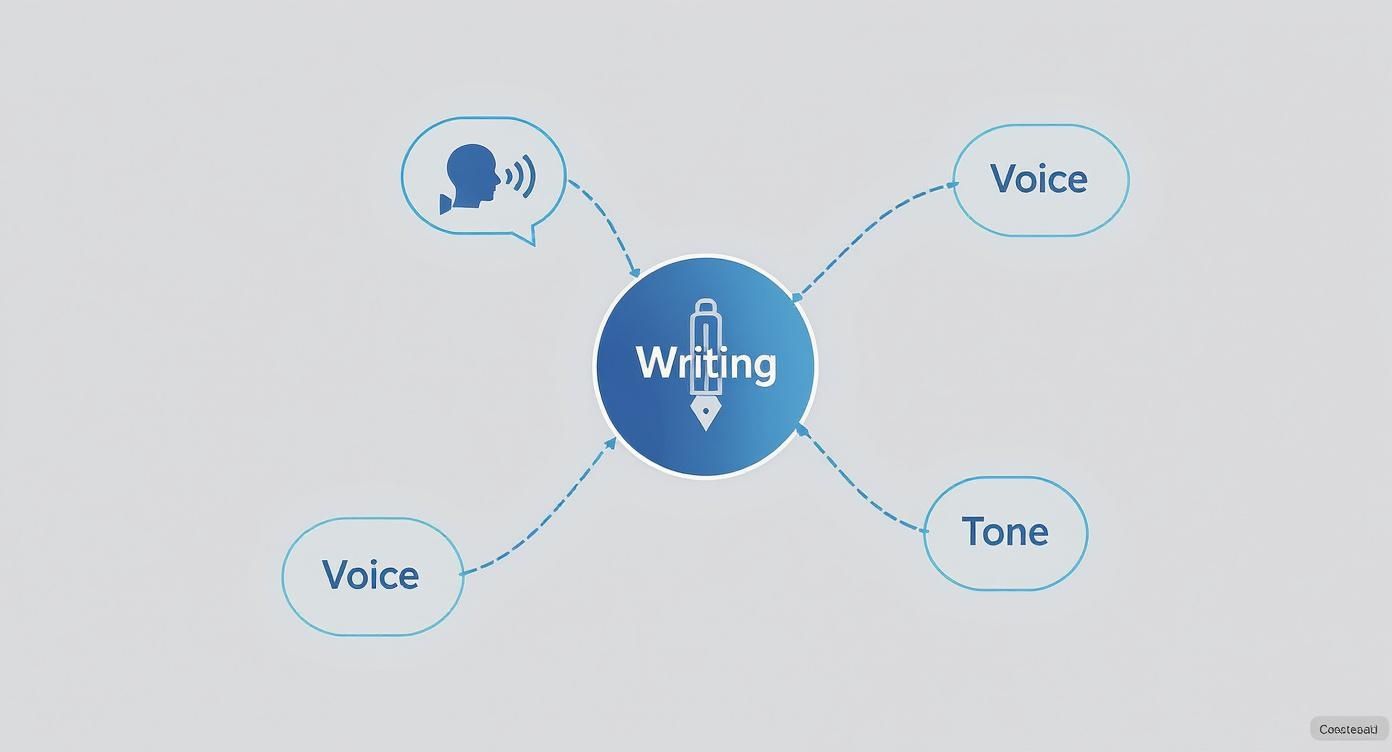
As you can see, voice is a fundamental part of who the writer is, while tone is a flexible tool used to shape the message.
Your Tone Is Your Situational Mood
If voice is who you are, tone is how you express yourself in a specific situation. It's the emotional color you add to your writing to match the context, the audience, and your goal.
Let’s say a brand like Mailchimp has a friendly and empowering voice. They might use a humorous and upbeat tone on social media. But when responding to a customer complaint, that same brand would switch to a reassuring and helpful tone. The personality is the same, but the delivery is adapted for the moment.
Key Takeaway: Your voice is who you are. Your tone is how you express yourself in a specific moment. A strong voice provides consistency, while an adaptable tone creates relevance and emotional connection.
To help you get a handle on the key differences, here's a quick breakdown.
Voice Versus Tone: A Quick Comparison
This table clearly outlines the fundamental differences between writing voice and tone, helping you distinguish between these two critical concepts.
| Attribute | Voice | Tone |
|---|---|---|
| Definition | The unique personality of the writer or brand. | The emotional attitude toward the subject and audience. |
| Consistency | Consistent across all content. | Varies based on context, audience, and purpose. |
| Purpose | To build a recognizable identity and trust. | To convey a specific feeling or mood in a piece. |
| Analogy | Your personality. | Your mood. |
| Example | A brand is always witty and informal. | That same brand is humorous in an ad but serious in a crisis statement. |
Thinking through these attributes makes it much easier to apply both concepts strategically in your own work. Learning to master tone and voice in writing isn't about faking it. It’s about being thoughtful, strategic, and empathetic. For a closer look, you can explore our guide on what is tone in writing.
Practical Examples of Voice vs. Tone
Let's imagine a brand with an "empowering and clear" voice. See how the tone shifts for different situations:
- Blog Post Announcing a New Feature: The tone would be enthusiastic and celebratory. The writing would feel exciting and focus on how the new feature benefits you, the user.
- Customer Support Article: Here, the tone needs to be calm and helpful. The language would be simple, patient, and direct, aiming to solve a problem without any fuss.
- LinkedIn Post About Industry Trends: For this professional audience, the tone would be authoritative and insightful. The content would be professional and backed by data to establish expertise.
In every example, the core voice—empowering and clear—shines through. Only the tone is adjusted to fit the moment.
This is especially critical when you're working with AI writing tools. An AI can generate text, but it’s up to you to give it the human touch by infusing it with your unique voice and the perfect emotional tone.
That’s exactly where PureWrite comes in. We built our platform to help you take a functional AI draft and transform it into something that sounds authentically human. You can easily layer in your distinct voice and fine-tune the tone until it’s just right.
How a Consistent Voice Builds Trust
Knowing the difference between tone and voice is one thing, but using that knowledge is where the magic happens. A consistent voice isn't just a "nice-to-have"; it's how you build something essential for any brand or creator: trust.
When your audience knows what to expect from you every time they read your work, they start to see you as stable and reliable. That predictability is the bedrock of any strong relationship, turning casual readers into a loyal community.
Creating a Recognizable Brand Identity
What are some of your favorite brands? You can likely hear their voice in your head without seeing a logo. Mailchimp is a classic example—they’ve nailed a friendly, encouraging voice that shows up everywhere, from their homepage copy to their technical documentation. This consistency makes users feel supported.
This kind of reliability carves out a memorable identity in a crowded digital world. When your voice is clear and steady, you graduate from being just another source of information to a trusted authority. It’s the difference between forgettable content and a brand with staying power.
Building trust is a long-term game, and your writing voice is one of your most valuable assets. It’s the constant, reassuring presence that tells your audience you’re authentic and dependable.
This isn't just a feeling, either. Research consistently shows that brand consistency can boost revenue by up to 33%. Why? Because people are far more likely to engage with and buy from brands they know and trust.
Fostering Loyalty Through Predictability
When we talk about consistency in your tone and voice in writing, we don't mean being robotic. It’s about being reliably you. Your audience gets to know your personality through your content, and every piece you publish either strengthens that connection or weakens it.
This consistency builds loyalty because it makes your audience feel secure. They know that whether they’re reading a blog post or a social media update, they'll get the same core personality they came for.
- For Marketers: A consistent voice reinforces brand messaging and builds a loyal customer base that feels genuinely connected to your mission.
- For Professionals: It cements your reputation as a credible expert in your field, making your insights carry more weight. This is key for improving workplace communication.
- For Students: It weaves a coherent, persuasive argument through an essay, projecting a clear and confident perspective.
Adapting Your Tone for Different Situations
While your voice should be constant, your tone must be flexible. When you get this right, you can de-escalate a customer complaint, persuade a hesitant client, or fire up your team.
For example, imagine a customer support chat. Your brand voice might be witty and fun, but your tone in that moment needs to be empathetic and reassuring. The personality is still there, but it's channeled in a way that respects the customer's frustration. It shows you’re a human who is listening, not just reciting a script.
This is where many AI tools fall flat, and it's a huge focus for us at PureWrite. A generic AI draft might lack the warmth you need for a welcome email or the firm authority required for a white paper.
That’s exactly why we built PureWrite—to help you infuse your unique voice and dial in the perfect tone. You can take a bland, functional piece of AI-generated text and ethically reshape it into something that sounds genuinely you. If you're working on strengthening your messaging, check out our guide on how to improve business communication.
Ready to build a more trusting relationship with your audience? Try PureWrite and see how easily you can humanize your AI content to reflect your true personality.
How to Define Your Unique Writing Voice
Alright, it's time to get practical. Defining your unique writing voice isn’t a mysterious art; it’s a deliberate process of figuring out who you are, who you’re talking to, and how you want them to feel. This is your hands-on workshop for crafting a clear guide to your brand's personality.
This framework will help you move from vague ideas to a concrete plan. By the end, you’ll have a solid definition of your voice that keeps everyone on the same page.
Start with Your Audience and Core Message
Before you write a word, get a crystal-clear picture of who you're writing for. Your audience’s expectations, challenges, and preferences will directly shape the voice that connects with them. Are they industry veterans seeking technical dives, or beginners looking for simple, encouraging advice?
Next, nail down your core message. What's the real reason you're writing? To educate, inspire, entertain, or persuade? A solid grasp of your goal is the bedrock of a purposeful voice. The right tone and voice in writing builds that bridge between your message and your audience.
Create a Personality Profile
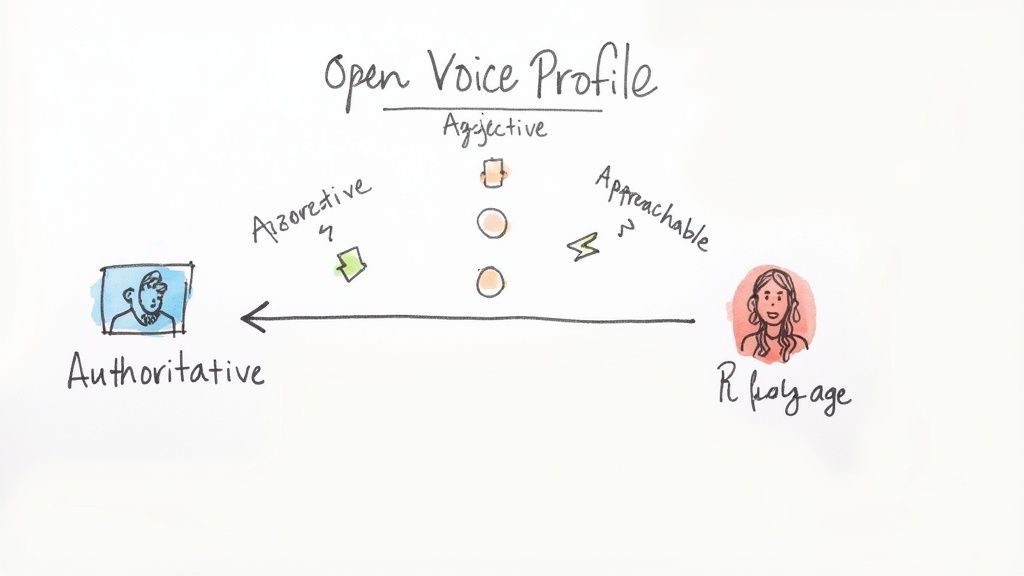
Here’s a practical way to make your voice feel real: treat it like a person. If your brand walked into a room, what would its personality be? Start by brainstorming adjectives that capture the vibe you're going for.
Don't be shy about getting specific. Instead of just saying "friendly," maybe you mean "warm and encouraging." Instead of "smart," you could aim for "insightful and clear."
Choose three to five core adjectives that best capture the soul of your desired voice. This simple exercise forces you to be decisive and gives you a powerful touchstone for every piece of content you create.
Here are a few combinations to get you started:
- Authoritative but approachable: You know your stuff and sound confident, but you're also open and easy to talk to.
- Playful and clever: You’re witty and fun, using a bit of humor to make your points stick.
- Empathetic and reassuring: Your style is calm and supportive, always focused on solving the reader's problems.
- Direct and bold: You're not afraid to take a strong stance and push back on conventional wisdom.
These pairings create a nuanced personality that feels human. This is a make-or-break step when you need to write engaging content, as it lays the groundwork for a compelling reader experience.
Build a Simple Voice Chart
Once you've locked in your core adjectives, translate them into real-world writing rules. A voice chart is an incredibly handy tool for this, giving you clear do's and don'ts. It's a simple guide that makes consistency much easier.
This is especially helpful for teams, as it ensures everyone is writing with the same personality. It’s also a lifesaver when you're trying to humanize AI content ethically, giving you a clear checklist to refine a generic first draft.
Here’s a sample voice chart built around the "Authoritative but approachable" profile:
| Our Voice Is... | This Means We Do This... | This Means We Don't Do This... |
|---|---|---|
| Authoritative | Back up claims with data and clear examples. Use confident, direct language. | Use weak phrases like "we think" or "it seems." Oversimplify complex topics. |
| Approachable | Use contractions and straightforward sentences. Address the reader directly as "you." | Use academic jargon or stuffy, formal language. Write long, dense paragraphs. |
| Clear | Prioritize clarity over being clever. Define technical terms simply. | Use buzzwords or vague corporate speak. Assume the reader knows everything. |
A chart like this cuts through the ambiguity and gives every writer a practical framework to work from.
The emotional feel of our writing often mirrors what's happening in the world. For instance, during the first few months of the COVID-19 pandemic, an analysis from Grammarly found that the use of an optimistic tone in the U.S. plummeted by 75%, while informative tones shot up by nearly 70%. This highlights why a defined voice is so critical—it gives you a steady personality, even as your tone shifts to fit the situation.
If you're working with AI-generated text, this process is even more important. At PureWrite, we’ve built our platform to help you ethically infuse your distinct voice into AI drafts, making them sound less like a robot and more like you.
Ready to put your new voice into action? Try PureWrite today to humanize your AI content and make sure every piece sounds like it came from a real person—you.
Humanizing AI Content with Your Voice
AI writing tools are fantastic for getting a first draft down quickly, but the output often feels generic and robotic. It completely misses the unique personality that makes people want to read your work. This is why applying your tone and voice in writing is so crucial if you're using AI.
A raw AI draft gets information on the page, but it rarely captures the warmth, wit, or authority you’ve worked so hard to build. That disconnect is the difference between a flat article and content that builds a real connection with your audience.

This image gets to the heart of what we do at PureWrite: bridging the gap between machine efficiency and human empathy. It’s not just about producing words; it's about breathing life and personality into them.
Bridging the Gap Between AI Speed and Human Touch
We built PureWrite to solve this exact problem. Our platform isn't just about bypassing AI detectors; it's designed to give you the power to weave your own voice and tone into AI-generated drafts. It provides the tools to take functional but flat content and polish it until it gleams.
For anyone working with AI content, knowing how to refine the output from tools like AI voice generator tools is key to sounding authentic. You want the technology to serve your personality, not erase it. This is true for both text and audio, ensuring your brand always sounds like itself.
At PureWrite, our philosophy is simple: ethical AI usage means treating technology as a collaborator, not a replacement. You bring the vision and the voice; we give you the tools to make your writing truly shine.
The data backs this up. A study from Acrolinx found that brands with a consistent, well-defined tone of voice saw a 35% increase in customer satisfaction and a 25% bump in conversion rates. Those numbers show the human element is a serious driver of business success.
Refining and Polishing Your AI Drafts
With PureWrite, you can take that initial AI draft and mold it into something that sounds undeniably like you. It’s all about making intentional, strategic edits that bring the final piece in line with your voice guidelines.
Here’s how PureWrite helps you get it done:
- Adjusting for Warmth and Personality: Our tools help you soften overly formal language, inject conversational touches, and make the text more approachable.
- Ensuring Voice Guideline Alignment: Pull out that voice chart you created and use it as your guide. Tweak the AI output to perfectly reflect your brand's personality.
- Improving Readability and Flow: We help you break down clunky sentences and fix awkward phrasing, making your content a pleasure to read.
This isn’t just editing; it’s about taking back authorship of your content. To learn more specific techniques, check out our guide on how to humanize AI text.
AI is an incredibly powerful assistant, but you are the writer. PureWrite helps you maintain that essential balance, letting you benefit from AI's speed without losing the authentic human connection that truly matters.
Ready to make your content sound more like you? Give PureWrite a try and see the difference for yourself.
Common Questions About Tone and Voice
We've walked through the what, why, and how of building a distinct tone and voice in writing. But putting it into practice can bring up new questions. Let's dig into some of the most frequent ones creators ask, especially when working with teams or across different platforms.
How Do I Keep My Voice Consistent with Multiple Writers?
This is a classic challenge for content teams. How do you stop your content from sounding like it was written by a committee? The answer is a solid system.
Your single most powerful tool here is a clear, easy-to-use brand style guide. Think of it as your brand's "source of truth"—the document everyone can turn to for a reminder of who you are and how you sound. It doesn't need to be a 100-page novel; even a simple voice chart can be a game-changer.
To get everyone on the same page, try these steps:
- Make a Voice Chart: Pinpoint 3-5 adjectives that define your voice (e.g., "Knowledgeable but not stuffy") and show what that looks like in action.
- Hold Content Reviews: Set up quick, regular meetings to look over recent content together. It's a great way to spot drift and reinforce the shared voice.
- Use Shared Templates: Give your writers a head start with pre-built templates for common formats like blog posts or newsletters.
How Do I Adapt Tone for Different Platforms?
Changing your tone for LinkedIn versus Instagram doesn't mean changing your core personality. Your voice should stay the same, but the way you express your emotions—your tone—needs to fit the room.
Think of your voice as the anchor and your tone as the sail. The anchor keeps you grounded in who you are, while the sail adjusts to the winds of each platform.
Imagine a brand whose voice is "insightful and witty." Here’s how that might play out:
- On LinkedIn: The tone would lean professional and authoritative. The wit might show up in a sharp, clever analysis of an industry trend.
- On Instagram: The tone would be more casual and visual. That same wit could come through in a funny caption on a photo or a clever Reel.
The Key Idea: You hold onto your brand identity by keeping your voice steady while shifting your tone to match what people expect on each platform. It’s just about being yourself in different social situations.
The goal is to always sound like you, just in a way that feels natural for the space you're in.
Does Tone and Voice Really Impact SEO?
This one comes up a lot. While tone and voice in writing aren't direct ranking factors—Google isn't scanning for "witty" prose—they have a massive indirect impact on your SEO. Why? Because search engines are obsessed with user experience.
When your content has a compelling voice and the right tone, it's simply more engaging. People enjoy reading it, and that behavior sends all the right signals back to Google.
Good writing has a direct effect on metrics that search engines care about:
- Longer time on page: If your writing pulls people in, they'll stick around to finish the whole piece instead of getting bored and leaving.
- Lower bounce rates: A strong opening that connects with the reader makes them far less likely to hit the "back" button.
- More shares and backlinks: People share and link to content they find genuinely useful, entertaining, or insightful—not dry, robotic text.
All these positive signals tell Google that your page is a high-quality result, which can help boost your rankings over time.
Ready to make sure every piece of content—whether from a human or AI—truly sounds like your brand? PureWrite helps you humanize AI text, dial in the perfect tone, and maintain a consistent voice across everything you publish. Try it now and see how easy it is to make your writing sound authentically you.