
Mastering the APA footnotes format is simpler than you might think once you get the hang of it. At PureWrite, we believe the key isn't just how to format them, but understanding when to use them in the first place. APA style prioritizes a clean, easy-to-read paper, which is why it favors in-text citations, making footnotes the exception, not the rule.
When to Use Footnotes in APA Style
Unlike other citation styles that might use footnotes for every source, APA uses parenthetical citations—like (Smith, 2023)—directly in the text. This practical approach keeps your reader focused on your argument without constantly glancing down the page.
So, when do you add that little superscript number? Think of it as a discreet aside to your reader.
An APA footnote is the perfect tool for sharing a quick, helpful tidbit that doesn’t quite fit into the main flow of your writing. Using them correctly is a subtle sign that you have a real handle on academic writing, showing you can provide value without distracting from your core message.
The Two Main Scenarios for APA Footnotes
The Publication Manual of the American Psychological Association, 7th Edition, is very clear on this: there are really only two good reasons to use a footnote. We've broken them down for you.
Here’s the breakdown:
- Content Footnotes: You'll use these for adding a brief, supplemental thought or clarifying a point without bogging down your main paragraph.
- Copyright Permission Footnotes: These are an absolute must for ethical and academic integrity. You'll use them when you reprint long quotes, scales, figures, or tables from another source.
This decision tree gives you a quick visual for when to go with a footnote.
As you can see, it all comes down to one question: is this information essential to my core argument? If yes, it belongs in the main text. If it's a helpful aside, a footnote is your best bet.
Key Takeaway: The golden rule in APA is to keep your main text as clear and uncluttered as possible. Footnotes are there to add value without breaking the reader's concentration.
What if you have more to say? If the information is too long for a short note, it likely belongs in an appendix. For more on organizing your work, check out our guide on how to structure a research paper.
The Two Types of APA Footnotes: Content vs. Copyright
APA footnotes come in two distinct flavors, each with a very different job. Knowing when to use a content footnote versus a copyright footnote is fundamental to mastering APA style and making your writing both professional and ethically sound.
One is like sharing a fascinating but slightly off-topic detail with a colleague, while the other is a formal acknowledgment required by academic ethics. This distinction is crucial for authentic and responsible writing.
Content Footnotes: The "By the Way" Aside
A content footnote is your secret weapon for adding extra information that’s helpful but would clutter your main text. It’s the perfect place to drop a quick definition, offer a brief clarification, or point out an interesting side note.
The key here is brevity. A good content footnote delivers a single piece of valuable information and gets out, giving your reader a little something extra without sending them down a rabbit hole.
You might use a content footnote to:
- Define Jargon: If you use a specialized term like "allostatic load"¹ in a paper for a general audience, a footnote provides a simple definition.
- Expand on a Point: You could mention a study and use a footnote to briefly note its surprising methodology.
- Provide Extra Context: If you reference a historical event, a footnote can add a specific date or relevant detail.
This idea of clear formatting isn't new. The first APA style guide emerged in 1929 to solve "information overload" in academic journals. You can read more about the history of APA style and its evolution to see how these rules came to be.
Copyright Permission Footnotes: Giving Credit Where It's Due
The second type, the copyright permission footnote, is an absolute must for maintaining academic integrity. You are required to use one whenever you reproduce a significant portion of someone else's copyrighted work, like a long quote, table, or figure.
This is a big deal. It's not just academic courtesy; it’s a legal necessity. For most published works, you need explicit permission from the copyright holder, and the footnote is your proof.
This footnote acts as the official record of that permission and usually states:
- The title of the original work.
- The author and copyright year.
- The magic words: "Reprinted [or Adapted] with permission."
Getting copyright footnotes right is a cornerstone of avoiding plagiarism. Before submitting a paper, it's smart practice to use a reliable plagiarism checker for students to catch any potential issues.
Content Footnote vs Copyright Footnote
Here’s a quick-glance table we've put together to help you keep the two types of footnotes straight.
| Feature | Content Footnote | Copyright Permission Footnote |
|---|---|---|
| Purpose | To provide supplemental, non-essential information. | To provide legally required attribution for reproduced material. |
| When to Use | When an idea is interesting but would disrupt the text. | When reprinting long quotes, tables, figures, or scales. |
| Typical Content | Definitions, clarifications, brief asides, further reading. | Source info, author, copyright year, "Reprinted with permission." |
| Is it Optional? | Yes, entirely up to your discretion. | No, it is mandatory for ethical and legal compliance. |
Ultimately, content footnotes add depth, while copyright footnotes ensure your work is built on a foundation of integrity.
Getting the Details Right: Core Formatting for APA Footnotes
In academic and professional writing, precision is non-negotiable, and the APA footnotes format is a perfect example. Nailing the formatting shows your reader you're serious and makes your arguments clearer. Let's walk through the core rules for getting every footnote right under the APA 7th edition guidelines.
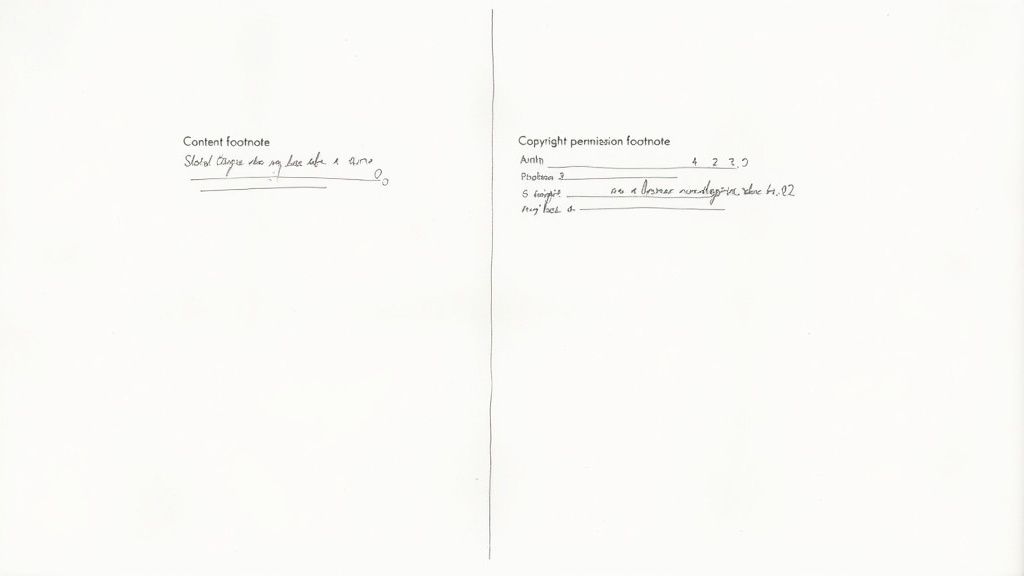
It all starts in your main text with a small, superscript number, like this¹. These numbers appear sequentially throughout your paper, starting from 1. The trick is knowing exactly where to place them: right after the punctuation mark at the end of the clause or sentence it relates to.
Where to Place Footnote Numbers in Your Text
This might seem like a tiny detail, but the placement of that superscript number is a critical signpost for your reader. It's a non-intrusive way to say, "Hey, I have a little something extra for you here."
Here’s a quick guide on where those numbers go:
- At the end of a sentence: The number should follow the period directly.²
- Within a sentence: It comes after the punctuation for that specific clause, like a comma.³
- Inside parentheses: If the note only refers to the information in the parentheses, the number goes inside (like this⁴).
- With em dashes: In the rare case you’re using em dashes, the number goes before the second dash—like this⁵.
These rules are designed to keep your writing clean and uncluttered. For a deeper dive, you can discover more insights about APA footnote formatting on Scribbr.com.
How to Format the Footnote Text Itself
After you've placed the number in your text, you must write the corresponding note. APA gives you a choice: place the notes at the bottom of the page where they're mentioned, or compile them on a separate page at the end of your document.
Pro Tip: At PureWrite, we almost always recommend putting all your footnotes on a dedicated "Footnotes" page after your reference list. It’s the standard for most formal manuscripts because it looks cleaner and simplifies editing.
If you go with the separate page approach, just follow this simple checklist:
- The Title: Center the word Footnotes in bold at the top of the page.
- Indentation: Indent the first line of every footnote by 0.5 inches.
- Spacing: The entire page should be double-spaced, just like the rest of your paper.
- Numbering: Begin each note with its matching superscript number, followed by a space.
AI writing tools often get these nuanced rules wrong, which can make your work feel less credible. That’s why we always suggest double-checking any AI-generated draft for APA compliance. If your AI-assisted writing sounds stiff, you can try PureWrite to humanize your content and ensure it meets high academic standards.
Putting APA Footnotes Into Practice: Real-World Examples
It’s one thing to read about the rules, but seeing them in action makes all the difference. Abstract formatting guidelines can feel fuzzy until you see clear examples. Let's walk through a few so you can see exactly how to handle APA footnotes in your own work.
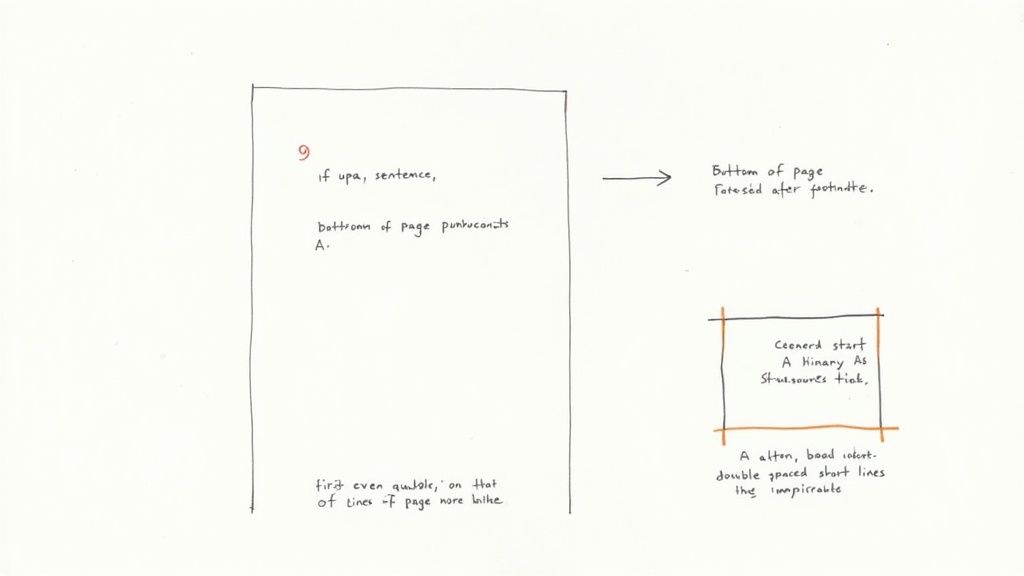
We'll look at a sample sentence with a superscript number, then break down precisely what the corresponding footnote should look like. This hands-on approach helps eliminate guesswork.
Example of a Content Footnote
A content footnote is your best friend when you have a useful, related thought that would interrupt your main argument. It's a practical way to provide extra value for the interested reader without breaking the flow.
For instance, say you're writing a report on cognitive assessments and you write this sentence:
Initial screenings often rely on well-established tools to identify early signs of cognitive decline.¹
The sentence works perfectly on its own. The footnote lets you offer more without derailing your point. On your "Footnotes" page, the note would look like this:
¹For a comprehensive list of common screening tools, see the resources provided by the National Institute on Aging.
See how that works? The footnote provides a valuable resource without cluttering the core text, making your work more helpful for your audience.
Example of a Copyright Permission Footnote
Unlike content footnotes, copyright footnotes are not a stylistic choice—they're a must for ethical writing. Anytime you reprint a long quotation (over 40 words), a table, or a figure from a copyrighted source, you are required to include one.
Let's imagine you’ve gotten permission to include a direct quote from a psychological test in your paper:
The assessment asks participants to rate their agreement with a series of statements, including, "I find it easy to understand others' perspectives and feelings."²
That little superscript "2" signals a required acknowledgment. The corresponding footnote gives the proper attribution:
²From the Global Empathy Questionnaire. Copyright 2018 by the Center for Psychological Assessment. Reprinted with permission.
This format is specific and essential for maintaining academic integrity. AI-generated text is notorious for missing these nuanced formatting rules, which is why we built PureWrite. You can try PureWrite to humanize your content and ensure every detail meets professional standards.
How to Add Footnotes in Word and Google Docs
https://www.youtube.com/embed/r9_dw_CxG6w
Knowing the theory behind APA footnotes format is great, but putting it into practice in your word processor is what matters. Thankfully, you don't have to do this manually. Both Microsoft Word and Google Docs have built-in tools that handle the heavy lifting for you.
Think of it this way: the software places the superscript number and creates the space for your note. All you have to do is write the content.
Adding Footnotes in Microsoft Word
Microsoft Word makes this process incredibly simple. It’s just a couple of clicks, and you're done.
- Place your cursor exactly where you want the superscript number to appear in your text.
- Head up to the References tab in the main ribbon.
- Click Insert Footnote. Word immediately drops the correct number into your sentence and takes your cursor to the footer so you can start typing.
If you're a fan of efficiency, you might be interested in dictating in Word to get your initial draft down quickly before polishing and adding citations.
Adding Footnotes in Google Docs
The process is just as painless in Google Docs, so you can keep your workflow smooth no matter which platform you prefer.
- Put your cursor right where you need the footnote reference to go.
- Click Insert from the top menu.
- Choose Footnote from the dropdown list. For keyboard shortcut fans, just hit Ctrl+Alt+F.
It's that easy. Both programs create the note at the bottom of the page. From there, it's on you to ensure the note itself follows APA 7 rules—meaning it should be double-spaced with the first line indented.
Key Takeaway: These built-in tools are fantastic for the mechanics, but you're still responsible for the content and final formatting touches like double-spacing and indentation.
Checking every detail manually can be a grind. For anyone deep in academic work, it’s worth looking into the best academic writing software to make the whole process easier. We built PureWrite to spot these kinds of errors, helping you turn a rough AI draft into something polished and ready for submission.
Common APA Footnote Mistakes to Avoid
It’s easy to get tangled up in the details of APA formatting, and footnotes are a classic stumbling block. Nailing these makes your paper look sharp and professional; getting them wrong can signal a lack of care. Knowing what to look for is half the battle when proofreading your work.
The number one mistake we see is people using footnotes for standard citations. APA just doesn't work that way. Unlike a style like Chicago, APA relies on in-text parenthetical citations, like (Smith, 2023), for sourcing.
Incorrect Formatting and Placement
Tiny formatting errors can undermine the quality of your work. Here are the most common offenders we come across.
- Wrong Superscript Placement: A classic error is putting the footnote number before the punctuation. The superscript number almost always follows the word and the punctuation it refers to.¹
- Improper Indentation: It’s easy to forget, but the first line of every footnote needs a 0.5-inch indent. This is true whether the notes are at the bottom of the page or on a separate page.
- Incorrect Spacing: Remember, your entire paper should be double-spaced, and that includes the footnotes section.
These nuanced formatting rules are exactly where automated writing tools often fall flat. A recent study found that AI-generated content often contains subtle formatting inconsistencies that human writers catch. For more insight, you can read our guide on what Turnitin checks for.
Confusion Between Footnotes and Endnotes
The terms are often used interchangeably, but there's a key difference: location. Footnotes live at the bottom of the page where the reference appears. Endnotes are gathered on their own page after the reference list.
Key Takeaway: The APA 7th edition gives you the choice. However, the standard for professional manuscripts is to collect everything on a dedicated "Footnotes" page for a cleaner, less cluttered document.
Dodging these common mistakes shows you really know your way around APA style. AI might be great for a first draft, but it often trips up on these rule-based tasks. That's precisely the gap we built PureWrite to fill. You can try PureWrite to humanize your content, ensuring every detail is polished and perfect.
Your Questions on APA Footnotes Answered
It’s completely normal to have a few lingering questions when dealing with the finer points of any style guide. The rules around APA footnotes can seem a bit tricky at first.
To help you out, we’ve put together answers to some of the most common questions that come up. Think of this as a final check to ensure you've got everything right before you submit your work.
Can I Use Footnotes Instead of Citations in APA?
This is easily the number one question, and the answer is a straightforward no.
In APA style, you must use parenthetical in-text citations—like (Smith, 2023)—to give credit to your sources. Footnotes have a different job; they’re for adding extra information or copyright permissions. Swapping them for citations is a classic mistake.
What Is the Difference Between a Footnote and an Endnote?
The only real difference here is placement. It’s all about where the note lives.
A footnote appears at the bottom of the same page where you see its superscript number. An endnote is collected with all the others on a separate "Footnotes" page that comes after your reference list. APA 7th edition allows either, but always check with your professor or publisher.
Key Takeaway: While both are technically correct in APA 7, gathering all your notes on their own page after the references is often the standard for academic papers. It keeps the main pages less cluttered.
How Do I Format a Footnote Longer Than One Line?
If your note spills over into a second line, just treat it like a regular paragraph in your paper.
The first line of the footnote needs to be indented by 0.5 inches. The entire note, no matter how long, should be double-spaced and in the same font as your main text (like 12-point Times New Roman). It's as simple as that.
Getting formatting right is just one piece of the puzzle. To sharpen your skills, check out our guide on how to improve academic writing or find some fantastic general writing tips for students.
Even when you know the rules, getting every detail perfect can be a grind. AI-generated drafts often stumble on these specific formatting requirements, leaving you with text that feels off. PureWrite helps you polish that content, making sure it’s not only formatted correctly but also sounds like it was written by a thoughtful, experienced person. Try PureWrite today to bring that authentic clarity to your work.