The 12 Best Writing Style Guides for Flawless Content in 2026
In a world of fast-paced content creation, consistency and clarity are what make your writing stand out. Whether you’re a student crafting a research paper, a marketer developing brand messaging, or a professional using AI to draft reports, a reliable style guide is your blueprint for success. It eliminates guesswork, ensures professionalism, and creates a seamless experience for your reader.
A style guide is more than just a set of rules; it's a tool for building authority and trust. When your commas, citations, and capitalization are handled uniformly, your audience can focus on your message without distraction. A recent survey highlighted that over 75% of readers notice grammatical errors, which can negatively impact brand credibility. For those aiming for truly flawless content, even after applying these guides diligently, professional assistance can be invaluable. Considering freelance book editors can help ensure your work meets the highest standards of consistency and style adherence.
However, with so many options available—from the academic rigor of APA and Chicago to the digital-first focus of Microsoft and Google—how do you choose the right one for your specific needs? This article cuts through the noise. We've curated the definitive list of the best writing style guides to help you navigate academic, professional, and technical standards with confidence.
You'll find detailed breakdowns of each guide, including their best-use cases, pros, and cons. Each entry includes screenshots and direct links to get you started immediately. Let’s explore which guide will become your go-to resource for creating polished, authoritative, and truly authentic content.
1. The Chicago Manual of Style Online (CMOS)
Often considered the gold standard in publishing, The Chicago Manual of Style Online is one of the best writing style guides for authors, editors, and academics. Its digital platform provides full, searchable access to the 18th and 17th editions, making it a comprehensive resource for any editorial question you might have in book publishing or professional writing.
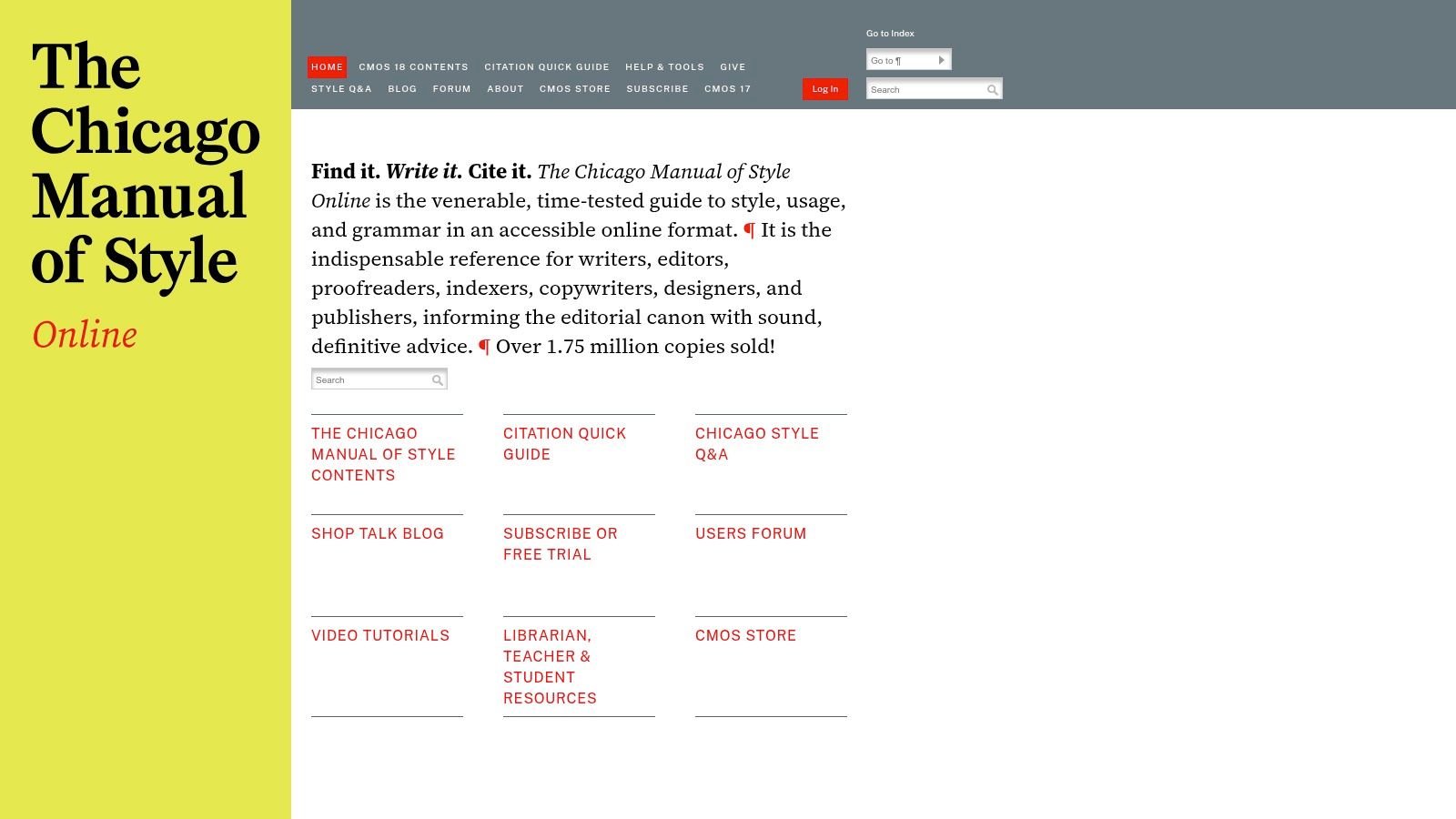
The platform’s strength lies in its authority and depth. Your subscription includes access to the popular CMOS Q&A, a rich, searchable archive of nuanced editorial advice from the manual's editors. This feature is invaluable for tackling tricky grammar and style questions not explicitly covered in the main text.
Key Details & Access
- Best For: Academic researchers, book authors, editors, and publishers.
- Access: Full access requires a subscription. CMOS offers a 30-day free trial, followed by individual, group, and institutional plans.
- Pros: Highly authoritative and comprehensive; powerful search function and Q&A archive; scalable for individuals or large teams.
- Cons: Behind a paywall, and the user interface is more functional than modern.
How to Use It: We recommend bookmarking the CMOS Q&A for quick access. For a practical example, if you're writing a novel and need to format a character's text message, you can search the Q&A for modern, real-world examples that the core manual might not cover.
Website: https://www.chicagomanualofstyle.org
2. AP Stylebook (Associated Press)
As the definitive resource for journalists, PR professionals, and content marketers, the AP Stylebook is one of the best writing style guides for clear, concise communication. Its online platform provides essential guidance for news-driven content, prioritizing brevity and accuracy. If you're writing a press release or blog post, this is your go-to standard.
The strength of the AP Stylebook Online lies in its timeliness and accessibility. The digital version is updated throughout the year to reflect changes in language and current events. For instance, it provides timely guidance on how to refer to emerging technologies or global events, a crucial feature for modern writers.
Key Details & Access
- Best For: Journalists, content marketers, PR teams, and corporate communicators.
- Access: Available as a print book or through a subscription to AP Stylebook Online. Organizational licenses are available for teams.
- Pros: The clear standard for news writing; strong on headlines and numbers; widely adopted in media and brand content.
- Cons: Online subscription costs vary by user count; less focused on book-length academic conventions compared to CMOS.
How to Use It: Use the "Ask the Editor" feature to clarify nuanced rules. For example, you can find specific guidance on whether to use "e-commerce" or "ecommerce." This focus on directness is a masterclass in what is concise writing.
Website: https://www.apstylebook.com
3. MLA Handbook (Modern Language Association)
The MLA Handbook is the definitive guide for students and scholars in the humanities, particularly in literature, languages, and composition studies. The 9th edition provides crucial guidance on formatting manuscripts and citing sources. The MLA style is renowned for its straightforward author-page in-text citation system.
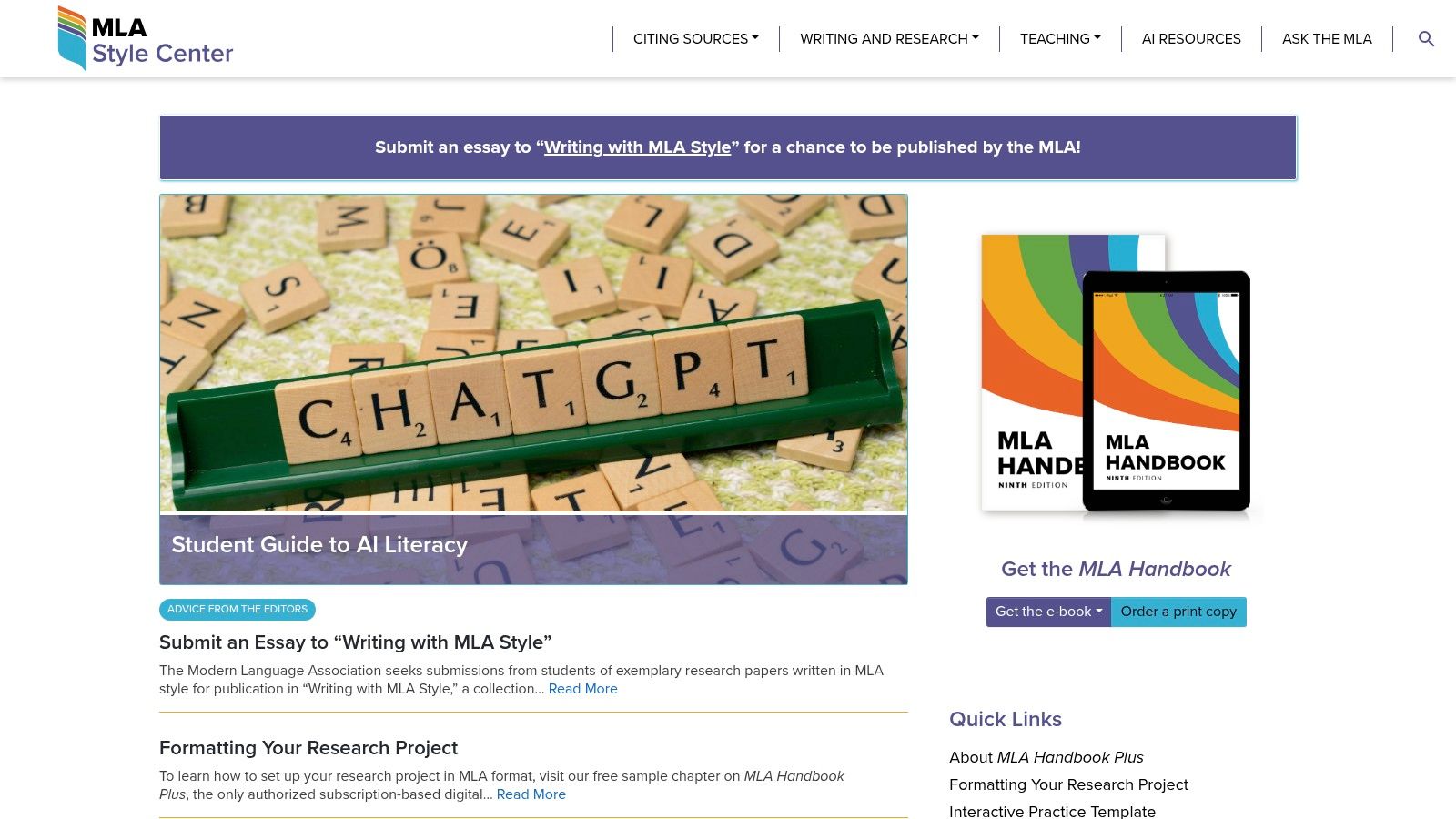
This guide’s main advantage is its focus on the specific needs of academic writing in the liberal arts. It offers comprehensive instructions for citing a vast range of modern and digital sources. If you need to cite a TikTok video or a podcast in your research paper, MLA provides a clear template for doing so ethically and accurately.
Key Details & Access
- Best For: Undergraduate and graduate students, academic researchers in the humanities, and literary scholars.
- Access: The handbook is available in print and e-book formats. Full online access is available via MLA Handbook Plus, which requires an institutional subscription.
- Pros: The established standard for humanities writing; clear, example-driven guidance; excellent coverage of citing digital sources.
- Cons: Online access is primarily designed for institutions, not individuals; provides less guidance on publication workflows than CMOS.
How to Use It: Refer to the official MLA Style website for quick answers in the "Ask the MLA" section. When creating your works-cited list, use the core elements template to correctly format citations for any source type, simplifying otherwise confusing rules.
Website: https://style.mla.org
4. Publication Manual of the American Psychological Association (APA, 7th ed.)
The Publication Manual of the American Psychological Association is the definitive style guide for writing in the social and behavioral sciences. Now in its 7th edition, APA Style is essential for students and professionals in fields like psychology, education, and business. Its official website is a hub for purchasing the manual and accessing supplemental resources.
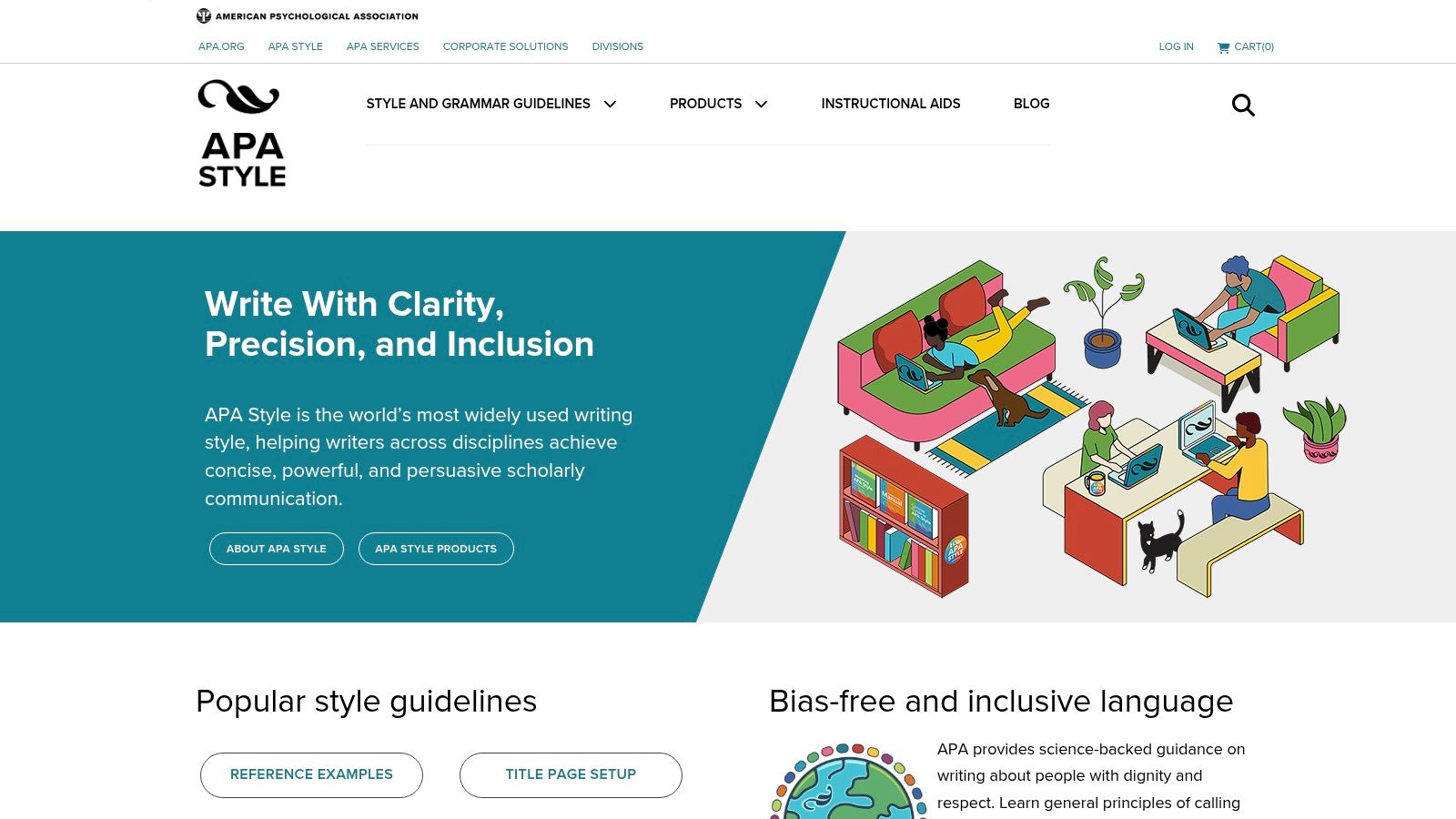
The strength of APA lies in its clear guidelines for everything from formatting manuscripts to citing sources. It places a significant emphasis on bias-free language, providing comprehensive instructions to ensure your writing is inclusive and respectful. This makes it one of the best writing style guides for producing ethical research papers.
Key Details & Access
- Best For: Students, academic researchers, and professionals in social sciences, nursing, business, and education.
- Access: The manual is available in paperback, hardcover, and e-book formats. The site also offers free supplemental resources like tutorials and a blog.
- Pros: The gold standard for many research disciplines; provides extensive examples; strong emphasis on inclusive, bias-free language.
- Cons: Not offered as a searchable web edition for individuals; its field-specific focus is less useful for creative or humanistic writing.
How to Use It: We suggest using the physical or e-book manual as your primary reference. For a real-world use case, a student writing a case study in psychology would use APA's guidelines to structure their paper, format tables of data, and ensure participant anonymity is respected.
Website: https://apastyle.apa.org
5. AMA Manual of Style Online (American Medical Association)
The definitive resource for medical and health-science publishing, the AMA Manual of Style Online is an indispensable tool for writers, editors, and researchers in the medical field. It provides fully searchable online access to find guidance on everything from patient confidentiality to the correct nomenclature for genes and proteins.
The website's primary strength is its specific focus. Unlike broader guides, the AMA Manual offers detailed examples tailored to the complexities of scientific communication. This makes it one of the best writing style guides for ensuring precision and integrity in health-related content.
Key Details & Access
- Best For: Medical researchers, academic journal editors, health communicators, and students in health sciences.
- Access: Full access requires a subscription. AMA offers plans for individuals and institutions.
- Pros: The unquestioned authority for medical writing; robust coverage of specific nomenclature and ethical guidelines; regularly updated online.
- Cons: Highly specialized and less applicable outside of health and medical contexts; full pricing is not visible without starting the purchase process.
How to Use It: Use the search feature to instantly clarify standards for citing clinical trials or formatting complex medical data tables. A health blogger, for instance, could use this guide to ensure they are using medical terms accurately and ethically when explaining a new study to the public.
Website: https://www.amamanualofstyle.com
6. ACS Guide to Scholarly Communication (American Chemical Society)
For scientists, particularly in chemistry and related fields, the ACS Guide to Scholarly Communication is an indispensable digital resource. This guide moves beyond simple citation rules to cover the entire spectrum of scientific communication, from data presentation to publishing ethics.
The platform’s core strength is its direct alignment with the standards of the American Chemical Society, a leading scientific publisher. Its digital-first format means that guidance is always current, reflecting the latest trends in open access and data integrity. This makes it one of the best writing style guides for ensuring your scientific manuscript meets rigorous journal expectations.
Key Details & Access
- Best For: Chemists, materials scientists, researchers in related STEM fields, and editors of scientific journals.
- Access: Full access is primarily available through institutional subscriptions. ACS provides a free, viewable "ACS Style Quick Guide."
- Pros: Deep, current coverage that aligns with ACS publishing standards; guidance extends beyond citations to broader scholarly communication.
- Cons: Full access is typically licensed by institutions, not individuals; its focus is highly specific to STEM.
How to Use It: We recommend using the freely available "Quick Guide" for immediate citation questions. When drafting a manuscript, a researcher would refer to the full guide’s chapters on data visualization to create charts that are clear, accurate, and publication-ready.
Website: https://pubs.acs.org/doi/book/10.1021/acsguide
7. IEEE Editorial Style Manual
For authors in engineering, computer science, and other technical fields, the IEEE Editorial Style Manual is an essential resource. It provides the specific editorial guidance required for submitting manuscripts to IEEE journals and conferences. This is one of the best writing style guides for ensuring your technical documents meet rigorous standards.
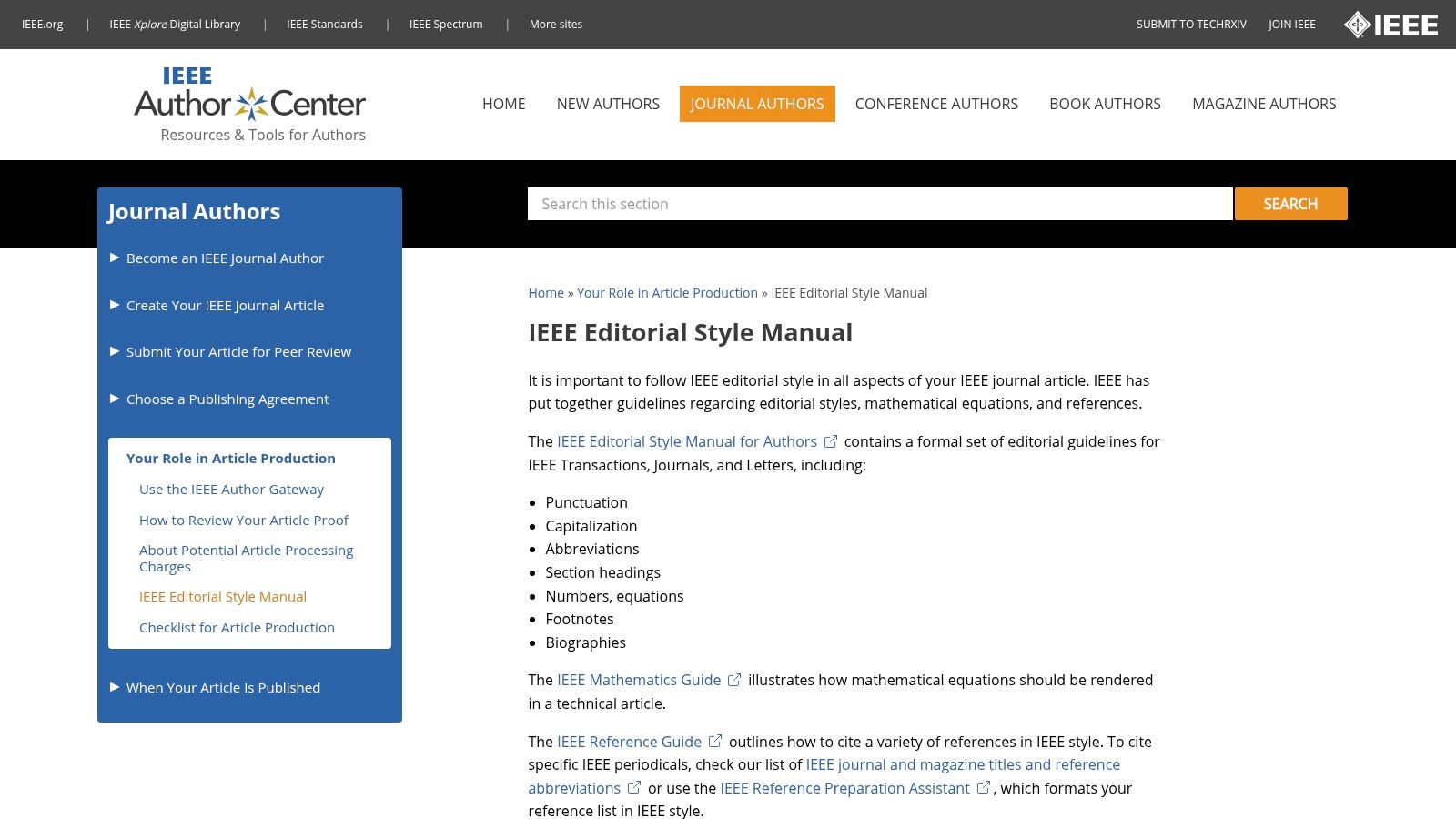
The manual's core strength is its focus on the unique conventions of technical writing. It offers clear rules on everything from formatting complex mathematical equations and using SI units to properly structuring references and author bios.
Key Details & Access
- Best For: Engineers, computer scientists, academic researchers, and technical writers preparing manuscripts for IEEE publications.
- Access: Completely free. The manual is available as a downloadable PDF from the IEEE Author Center website.
- Pros: Authoritative standard for engineering and technology fields; provided free of charge; focuses specifically on technical manuscript preparation.
- Cons: Very narrow scope, unsuitable for non-technical writing; the location of PDFs can sometimes shift across IEEE's websites.
How to Use It: We recommend downloading the latest PDF to keep as a local reference. A software engineer writing a conference paper would use this guide to correctly format code snippets and ensure all mathematical notations are consistent with IEEE standards.
8. New Oxford Style Manual (includes New Hart’s Rules)
For writers and editors working with UK or international English, the New Oxford Style Manual is an indispensable resource. It combines New Hart’s Rules for editorial style and the New Oxford Dictionary for Writers and Editors. This makes it one of the best writing style guides for navigating the nuances between British and American English.
The manual’s strength lies in its definitive guidance on UK conventions, covering everything from punctuation and citation to hyphenation. For global content teams, it’s a crucial companion for ensuring consistency across different markets.
Key Details & Access
- Best For: Editors, publishers, and writers creating content for UK or international audiences.
- Access: Available as a hardcover print edition or as an e-book. There is no first-party online subscription platform.
- Pros: Authoritative standard for British English; combines editorial rules and a writers' dictionary; excellent for comparing UK/US usage.
- Cons: Not a live, searchable web platform; UK focus may not be suitable for US-only content teams.
How to Use It: Use the index or e-book search to quickly resolve specific queries. For instance, a marketer adapting a US campaign for the UK would use this guide to check spellings ("color" vs. "colour") and idiomatic phrases to ensure the content resonates locally.
Website: https://global.oup.com
9. The Economist Style Guide
For those aiming for clarity, conciseness, and an authoritative tone, The Economist Style Guide is a compact powerhouse. Rooted in the publication's editorial standards, this guide champions lucid, economical prose. It is a practical handbook for business writers, analysts, and marketers who need to convey complex ideas with precision.
The guide’s main strength is its prescriptive advice on usage, punctuation, and style, all geared toward impactful communication. It cuts through academic debates to offer direct guidance on common writing pitfalls, from avoiding clichés to using numbers correctly.
Key Details & Access
- Best For: Business professionals, financial analysts, journalists, and content marketers.
- Access: Widely available as a paperback or e-book. It is not a subscription-based web service.
- Pros: Excellent for developing a crisp and economical writing style; portable and easy to consult quickly; provides strong guidance on tone.
- Cons: Not a continuously updated online platform; its UK-centric rules may differ from US conventions.
How to Use It: Keep a copy on your desk for quick reference when drafting reports. A financial analyst could use its advice on presenting statistics to make a quarterly report more direct and understandable for stakeholders.
Website: https://www.economist.com/books
10. GOV.UK Style Guide (Government Digital Service)
A benchmark for clarity in digital content, the GOV.UK Style Guide is one of the best writing style guides for web writers and content designers. Developed by the UK's Government Digital Service, its mission is to make information simple and clear for everyone, setting a high standard for plain language.
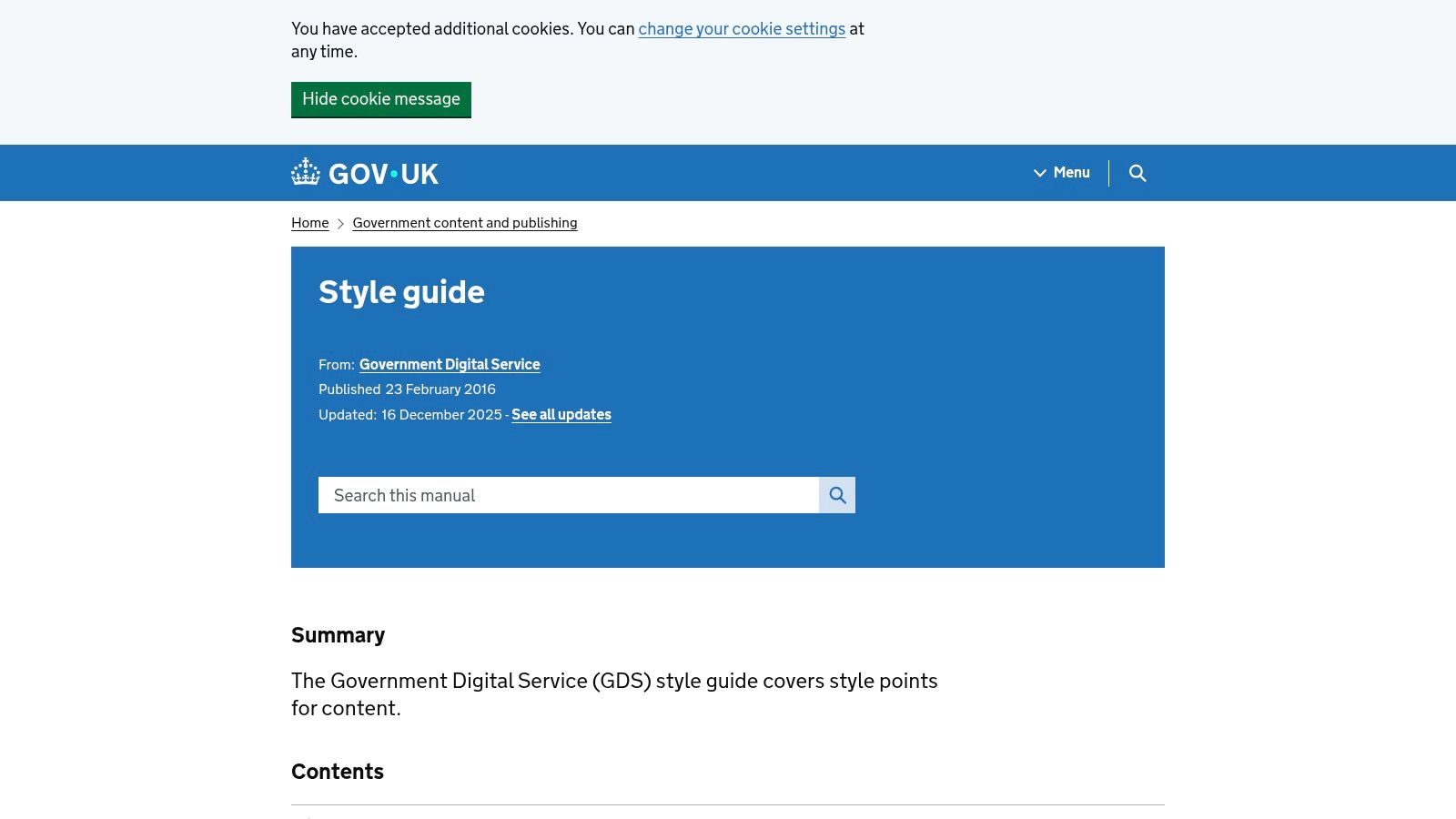
The guide's influence extends far beyond government. Its strength is its practical, no-nonsense approach to everyday writing challenges, from choosing the right words to structuring content for scannability. It provides specific, actionable rules in an A-Z format, making it an invaluable resource for any team committed to user-centric content.
Key Details & Access
- Best For: UX writers, content designers, web developers, and public sector communicators.
- Access: Completely free and openly available online. The guide is continuously updated.
- Pros: Gold standard for accessibility and plain language; free and constantly updated; excellent A-Z format for quick lookups.
- Cons: Spelling and conventions are UK-centric; it is not a citation style guide for academic work.
How to Use It: Use the A-Z list to quickly resolve debates on common web writing issues, like whether to use "e.g." or "for example." A UX writer designing a new app would consult this guide to write button text ("Sign up" vs. "Register") that is clear and user-friendly.
Website: https://www.gov.uk/guidance/style-guide
11. Microsoft Writing Style Guide
For those writing about software and technology, the Microsoft Writing Style Guide is an essential and practical resource. Hosted on the Microsoft Learn platform, this free guide provides clear principles on voice, tone, and creating user-friendly documentation. It focuses on the specific challenges of technical communication, such as writing clear error messages.
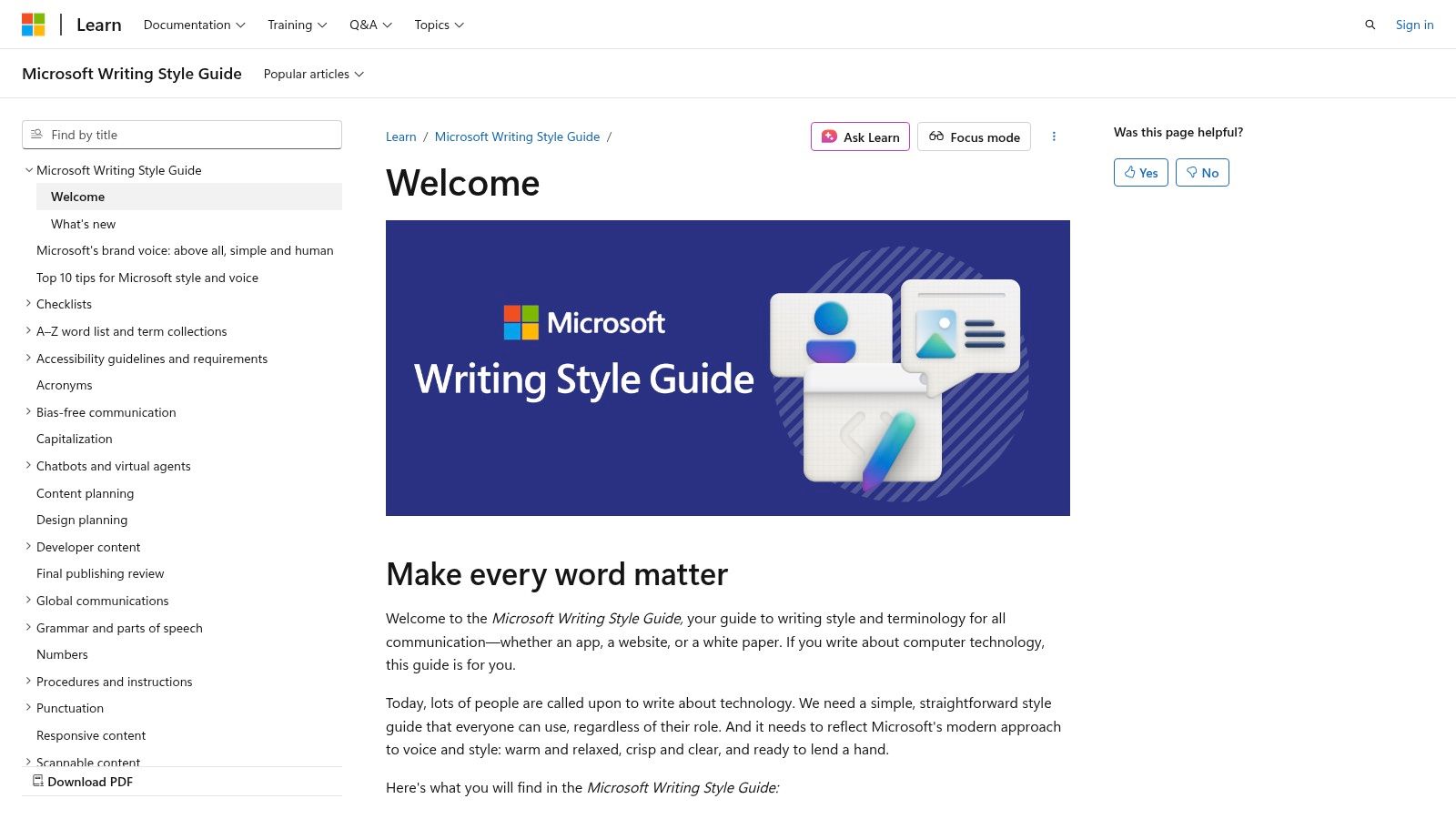
The guide's strength is its pragmatic, developer-centric approach. It offers an extensive A-Z word list and a top 10 tips section that are invaluable for day-to-day writing tasks. Its guidance on bias-free communication ensures that technical content is inclusive for a global audience.
Key Details & Access
- Best For: Technical writers, UX writers, developers, and content creators working on product documentation or software-related content.
- Access: Completely free and publicly available online through Microsoft Learn.
- Pros: Free to access and highly practical for its niche; excellent guidance on inclusive language and accessibility; regularly updated.
- Cons: Highly specialized for technology, making it less relevant for academic or literary writing; it is not a citation style.
How to Use It: Use the A-Z word list as a quick reference for common tech terminology like "sign-in" versus "logon." When drafting UI text, consult the voice principles to ensure your writing is warm, crisp, and ready to help the user.
Website: https://learn.microsoft.com/style-guide
12. Google Developer Documentation Style Guide
For those in the world of software and technical writing, the Google Developer Documentation Style Guide is an essential, free resource. It provides clear, actionable guidance for creating documentation for developers. The guide is actively maintained, ensuring its advice remains current in the fast-paced tech industry.
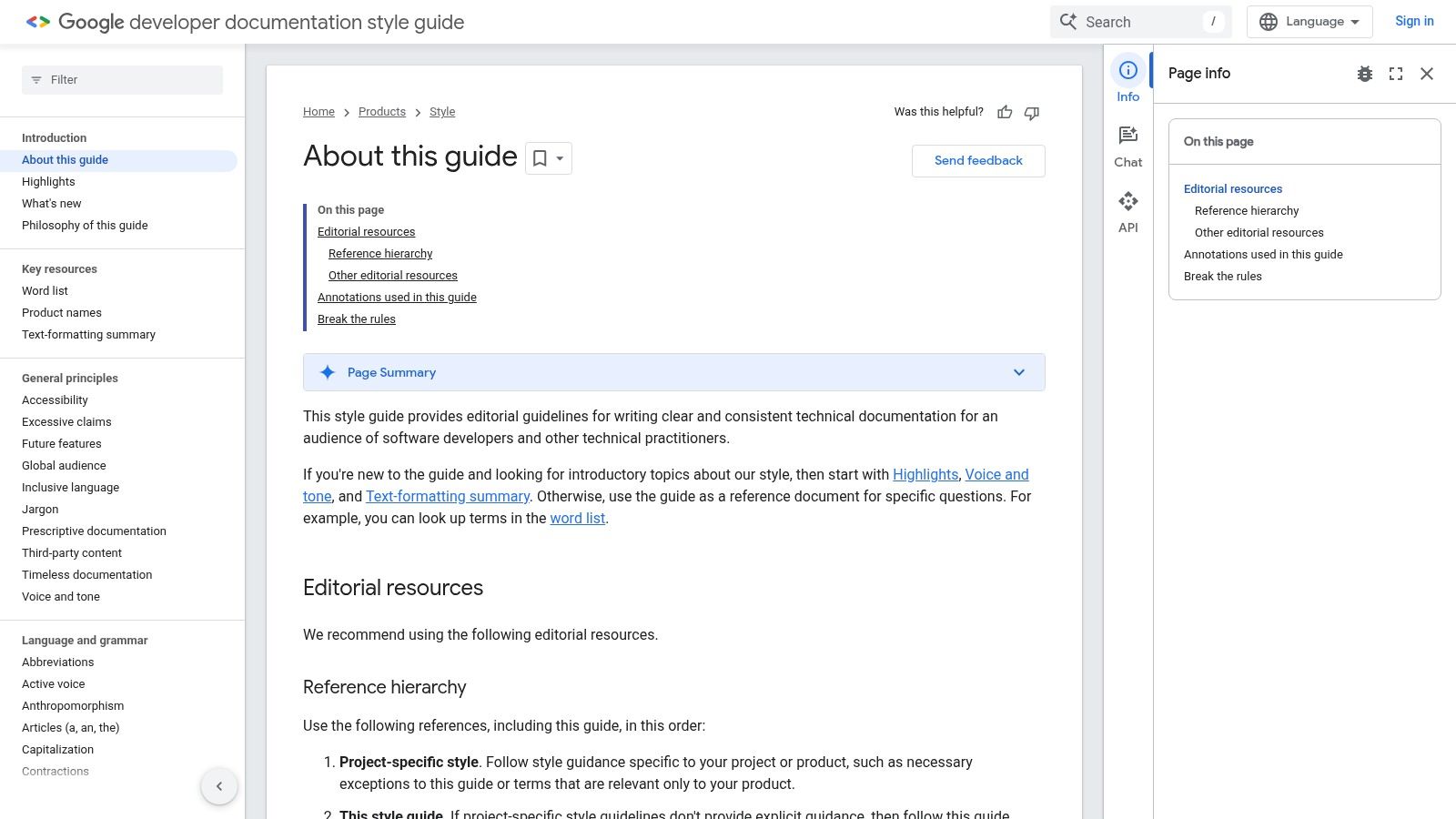
This guide's strength is its practicality and focus on clarity for a global, technical readership. It offers specific rules for referencing UI elements, formatting code snippets, and writing inclusive content. Its extensive word list is particularly useful for maintaining consistency across large documentation projects.
Key Details & Access
- Best For: Technical writers, software developers, and anyone creating API or developer documentation.
- Access: Completely free and publicly available online. No subscription or login is required.
- Pros: Free and widely referenced across tech writing communities; frequently updated with practical examples; strong emphasis on inclusive language.
- Cons: Highly specialized for developer documentation; may defer to other guides for general, nontechnical questions.
How to Use It: Use the "Word list" as a primary reference to ensure consistent terminology. For example, a developer documenting an API would use this guide to decide whether to write "click" or "select" when describing user actions, ensuring the instructions are unambiguous.
Website: https://developers.google.com/style
Top 12 Writing Style Guides Comparison
| Guide | Core features | UX / Quality | Price / Value | Target audience | Unique selling points |
|---|---|---|---|---|---|
| The Chicago Manual of Style Online (CMOS) | Comprehensive publishing rules; searchable 17th/18th eds; editorial Q&A | ★★★★★ — authoritative, dense | 💰 Subscription (individual/group; trial) | 👥 Book authors, academic & publishing editors | ✨ Deep book/journal guidance; 🏆 US publishing standard |
| AP Stylebook (Associated Press) | Newsroom conventions: headlines, datelines, numbers, titles | ★★★★☆ — newsroom‑focused, practical | 💰 Subscription / print (org licensing) | 👥 Journalists, PR, comms teams | ✨ Timely news style; 🏆 Industry standard for media |
| MLA Handbook | Works‑cited & in‑text citation rules; inclusive language | ★★★★ — clear examples for humanities | 💰 Purchase / institutional access | 👥 Students, literature & humanities scholars | ✨ Strong citation examples; clear teaching focus |
| APA Manual (7th ed.) | Bias‑free language, tables/figures, reference rules | ★★★★ — research‑oriented, methodical | 💰 Purchase (print/e‑text); library support | 👥 Social & behavioral science researchers | ✨ Detailed formatting for research; 🏆 Discipline standard |
| AMA Manual of Style Online | Medical nomenclature, ethics, examples for health writing | ★★★★ — authoritative, specialized | 💰 Subscription (personal/institutional) | 👥 Medical writers, journals, clinicians | ✨ Medical/ethical focus; trusted in health publishing |
| ACS Guide to Scholarly Communication | Citation & scholarly comms, data & ethics, chapter DOIs | ★★★★ — up‑to‑date, STEM‑centric | 💰 Institution‑licensed (select guides free) | 👥 Chemists, STEM authors & institutions | ✨ Data/open‑science guidance; aligns with ACS publishing |
| IEEE Editorial Style Manual | Rules for math, units, equations, technical refs | ★★★★ — concise, practical | 💰 Free | 👥 Engineers, CS researchers, technical authors | ✨ Free IEEE‑aligned technical guidance; practical quick refs |
| New Oxford Style Manual | Spelling, hyphenation, UK/US usage, citations | ★★★★ — comprehensive print resource | 💰 Purchase (book/e‑book) | 👥 International editors, UK audiences | ✨ Strong UK usage guidance; broad editorial coverage |
| The Economist Style Guide | Tone, brevity, clear business/analysis prose | ★★★★ — concise, editorially polished | 💰 Purchase (paperback) | 👥 Business writers, analysts, content marketers | ✨ Emphasis on brevity & tone; easy quick consult |
| GOV.UK Style Guide | Plain English, accessibility, content design A–Z | ★★★★★ — clear, updated, UX‑driven | 💰 Free | 👥 UX/content teams, public sector writers | ✨ Plain‑language & accessibility focus; continuously updated |
| Microsoft Writing Style Guide | Voice/tone for tech, UI terms, bias‑free language | ★★★★ — pragmatic, developer friendly | 💰 Free | 👥 Product writers, technical communicators | ✨ Terminology for software/UI; developer focus |
| Google Developer Documentation Style Guide | Grammar, code formatting, UI refs, changelogs | ★★★★ — practical, frequently updated | 💰 Free | 👥 Developer docs writers, API teams | ✨ Code & API doc specifics; extensive word lists |
| IEEE Editorial Style Manual (duplicate entry) | See IEEE above | ★★★★ — concise, practical | 💰 Free | 👥 Engineers, CS researchers | ✨ Free IEEE‑aligned technical guidance; practical quick refs |
Bridge the Gap Between AI Drafts and Polished Prose
Navigating writing standards can feel overwhelming, but choosing from the best writing style guides is your first step toward clarity and authority. Whether you need the academic rigor of APA, the journalistic precision of AP, or the technical clarity of the Google Style Guide, each framework offers a proven path to consistency. Your choice defines your communication architecture and ensures your message is received as intended.
However, in an era where AI writing tools accelerate content creation, adhering to a style guide is only half the battle. AI drafts, while structurally sound, often lack the nuanced rhythm and authentic tone that captivate a human audience. AI-generated text can be easily flagged by detectors, with some studies showing detection rates as high as 95% for unedited content. This is the new frontier for writers and content creators: bridging the gap between rule-based correctness and genuine human connection.
From Compliance to Connection: Your Actionable Next Steps
Making your content truly resonate requires you to move beyond simple compliance. The goal is to internalize your chosen guide's principles while infusing the text with your unique voice. This is where your human oversight becomes irreplaceable.
Consider these final steps as you integrate these guides into your workflow:
- Audit Your Needs: Don't just pick the most popular guide. Revisit the "best for" scenarios we discussed. Are you a marketer needing broad appeal (AP)? A developer writing documentation (Google/Microsoft)? Let your audience and purpose dictate your choice.
- Create a "Quick-Reference" Sheet: No one memorizes an entire style guide overnight. Distill the top 10-15 rules most relevant to your work onto a single document. Focus on common sticking points like serial commas, title capitalization, and number formatting.
- Embrace the Human Touch: Always use AI as a starting point, not a final destination. Your role is to ethically guide, refine, and humanize the output. Challenge awkward phrasing and ensure the tone aligns perfectly with your brand. This human-centric editing is vital, a topic explored in discussions on the preservation of literary style in AI versus human translation.
- Build a Feedback Loop: Ask a trusted peer to review your work against your chosen style guide. A fresh set of eyes can catch inconsistencies you’ve overlooked and provide invaluable feedback on tone and readability.
Ultimately, the best writing style guides are not rigid cages but flexible scaffolding. They provide the structure needed to build trust, giving you the freedom to focus on the heart of your message. By pairing these standards with thoughtful, human-centric editing, you can transform functional drafts into compelling prose that not only informs but also connects.
Ready to ensure your AI-assisted content sounds genuinely human while adhering to your chosen style guide? At PureWrite, we help you refine your drafts for tone, flow, and authenticity, ensuring your content passes AI detection and connects with your audience. Elevate your writing from correct to compelling by trying Pure Write today.