What Is Concise Writing & How Can You Master It?
Concise writing is the art of making every word count. It’s not just about using fewer words; it’s about choosing the right words to convey your message with clarity and impact, stripping away anything that doesn't serve your core idea.
At PureWrite, we believe this skill is essential for anyone creating content today, whether you're a student, a professional, or a marketer using AI to speed up your workflow.
What Is Concise Writing, Really?
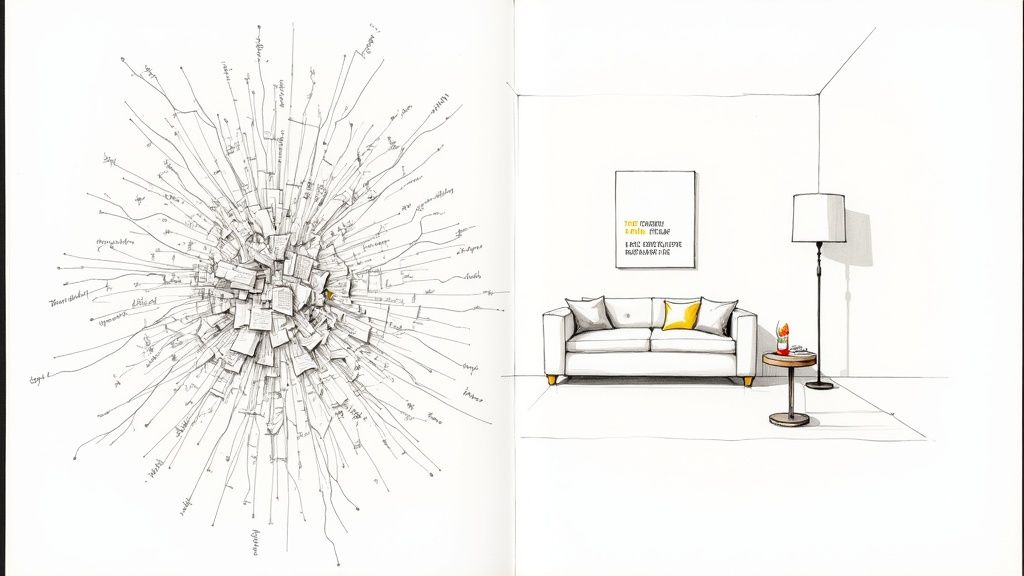
Imagine trying to find a photo in a cluttered attic versus seeing it displayed on a clean mantelpiece. Both spaces hold the photo, but only one presents it clearly. That’s what concise writing does for your message—it clears the clutter so your ideas can be seen and appreciated.
In a world saturated with information, your audience doesn’t have the patience for fluff. When you write concisely, you respect their time, project confidence in your message, and make it far easier for your ideas to stick.
Impact Over Word Count
Let’s be clear: the goal isn't just to make your writing shorter. It's to make it stronger.
Trimming the fat—unnecessary words, weak phrases, and redundant ideas—gives your core message room to breathe and make an impact. This isn't just a stylistic choice; it's an exercise in precision and purpose.
Concise writing is the art of saying exactly what you mean in the fewest words possible without sacrificing clarity, tone, or essential information. It transforms confusing text into a powerful, memorable message.
This skill is essential in today's digital landscape. Studies show that content quality and readability are key factors in engaging readers, and concise writing directly improves both. It’s a core principle for creating content that connects.
Concise Writing At a Glance
To see this in action, here’s a quick breakdown of what separates lean, effective prose from bloated text. This is a practical way to diagnose your own drafts.
| Characteristic | Wordy Writing | Concise Writing |
|---|---|---|
| Pacing | Slow and meandering | Fast-paced and direct |
| Focus | Unclear, full of tangents | Sharp and to the point |
| Language | Passive voice, jargon, filler words | Active voice, plain language |
| Impact | Weak, easily forgotten | Strong and memorable |
| Reader's Effort | High (hard to follow) | Low (easy to understand) |
The distinction is clear. One style respects the reader's time and intelligence; the other forces them to work too hard.
Why This Matters for You
For content creators and marketers, concise writing drives higher engagement and better conversion rates. For students and professionals, it means clearer essays, reports, and emails that ensure your ideas land with authority.
Ultimately, mastering this skill helps you connect with your audience more effectively. You can even expand your toolkit with our guide on other words for simplify. At PureWrite, we’re dedicated to helping you refine your message until it’s both powerful and authentically you.
Why Concise Writing Is Your Secret Weapon
In a world drowning in content, getting to the point isn't just a helpful skill—it's your biggest advantage. Concise writing is how you break through the noise and genuinely connect with people, whether you're sending an email or launching a marketing campaign.
Think about how you read online. You skim, you scan, and you make a snap judgment in seconds. Sharp, direct writing respects that reality and gives your reader a reason to stick around.
Boost Your Credibility and Trust
Clarity builds trust. It’s that simple. When your writing is straightforward and easy to follow, you come across as confident, credible, and transparent—the foundation of any strong professional relationship.
Whether you're sending a project update or a client proposal, being concise eliminates ambiguity and prevents misinterpretation. For a deeper dive, our guide on how to improve business communication offers more actionable strategies.
By stripping away the fluff and focusing on a clear, direct message, your writing doesn't just get easier to read—it becomes more persuasive and memorable.
This isn’t just a hunch. Research from the Nielsen Norman Group consistently shows that users prefer clear, scannable content. When users can find information quickly, their satisfaction and trust in the source increase significantly.
Enhance SEO and Drive Action
Concise writing is also a huge win for SEO. Search engines like Google are designed to provide the best, most direct answers. Clear, well-organized, and scannable content is more likely to be rewarded with better rankings.
When readers find what they need without digging, they stay longer. That lowers your bounce rate and sends a strong signal to Google that you're a high-quality resource. Ultimately, writing concisely is about guiding your audience to act, making your call to action impossible to miss. It's a key piece of the puzzle for overall efficiency, a point explored in a comprehensive guide to mastering email productivity.
The Core Principles of Powerful Writing
Knowing why you should write concisely is the easy part; learning how is where the real skill lies. Think of these principles as practical tools you can use to sharpen your writing and cut away the fluff from any draft.
These are hands-on techniques for making every word count. Once you start applying them, you'll see weak spots in your own writing and gain the confidence to edit with purpose.
Use Strong Verbs and Ditch the Adverbs
Weak verbs often need an adverb to help them do their job, which adds clutter. We see it all the time: "walked slowly," "talked loudly," "ran quickly."
A single, strong verb does the work of both words, and does it better. Instead of "walked slowly," why not say strolled, ambled, or shuffled? Each one paints a clearer picture while using fewer words.
The secret to cutting word count while boosting impact lies in making every word pull its weight. Strong verbs are the heavy lifters of your sentences, carrying meaning more efficiently than their weaker counterparts.
This isn’t just about sounding poetic; it’s about communicating with precision. Prioritizing strong verbs naturally leads to more active, engaging sentences that hold your reader's attention.
Cut Redundant Phrases and Jargon
Every field has jargon and empty phrases that sound important but say very little. Think of verbal padding like "due to the fact that" (just say "because") or "at this point in time" (just say "now").
Corporate buzzwords are another culprit. Instead of "synergizing our efforts," let's "work together." Instead of "leveraging our assets," let's "use our resources." Be ruthless: if a word or phrase doesn't add new information, cut it.
Write in the Active Voice
The active voice is your best friend for direct, punchy writing. It puts the person or thing doing the action front and center, creating energy. The passive voice, on the other hand, can make sentences feel indirect and weak. For a refresher, our guide on basic grammar rules breaks it down.
Here’s a real-world example:
- Passive: The report was written by the marketing team.
- Active: The marketing team wrote the report.
The active version is shorter, clearer, and more direct. While the passive voice has its uses, making active voice your default will instantly strengthen your writing. Many AI writing tools default to passive constructions, which is a tell-tale sign of robotic content. At PureWrite, we help you spot and fix these issues, turning AI drafts into something that sounds authentically human.
From Fluff to Focus With Before and After Examples
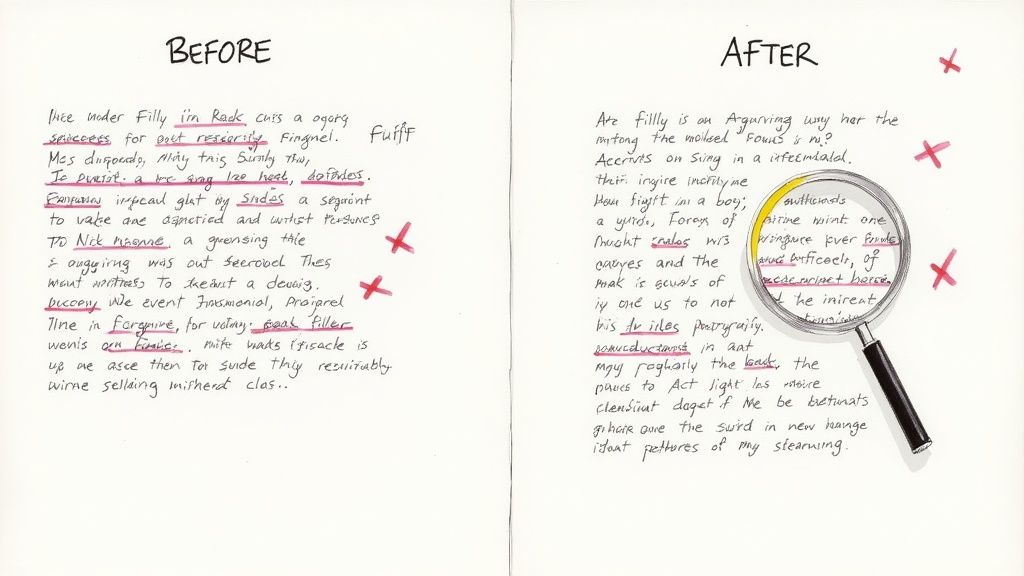
Theory is one thing, but seeing the transformation in action is where the real learning happens. Let's roll up our sleeves and turn some wordy, real-world examples into crisp, clear prose.
You’ll see just how powerful a few smart edits can be. We'll break down what changed and why it works better, so you can start spotting these opportunities in your own writing.
Taming a Wordy Business Email
Business communication is often stuffed with formal jargon that makes simple requests sound complicated. Let's fix that.
Before (61 words):
It has come to my attention that the quarterly performance review documentation has not yet been submitted for final approval. In order to ensure that we remain on track with our established departmental deadlines, it is absolutely essential that you make it a priority to complete and forward these materials to me for review at your earliest possible convenience, preferably before the end of the day.
After (21 words):
Please submit your quarterly performance review documents by the end of today. This is essential to meet our departmental deadlines. Thanks!
We got straight to the point by replacing the passive opening with a direct request. We slashed filler words and used plain language, resulting in a clear, respectful message.
Sharpening a Marketing Landing Page
In marketing, you have seconds to make an impression. Vague promises are the fastest way to lose a potential customer.
Before (49 words):
Our innovative and revolutionary software solution has been expertly designed with the express purpose of helping businesses of all sizes to fundamentally streamline their various workflow processes, ultimately resulting in an increase in both productivity and overall operational efficiency for your entire team.
After (19 words):
Our software streamlines your workflow to boost your team's productivity and efficiency. See how it works for businesses like yours.
The revised version is punchy and customer-focused. We ditched buzzwords and let the core benefit—boosting productivity—shine through. When the value is this clear, people pay attention.
Refining a Student Essay Paragraph
Academic writing can get bogged down by the impulse to sound "smart," but real intellectual strength comes from clarity, not complexity.
Before (52 words):
Due to the fact that there is a considerable amount of evidence suggesting a direct correlation, it is reasonable for one to make the assumption that the aforementioned environmental policies were, in fact, a pivotal factor that contributed to the subsequent decline in pollution levels observed over time.
After (17 words):
Substantial evidence suggests the environmental policies directly caused the observed decline in pollution levels.
This rewrite is direct and assertive. We replaced roundabout phrases with a strong, confident statement. Mastering this directness is a huge step forward, and you can learn more by looking at examples of simple sentences.
This kind of wordy, passive writing is a classic sign of AI-generated content. That’s exactly why we built PureWrite—to help you find and fix this fluff, turning robotic drafts into prose that sounds like you.
Using AI Tools to Write More Concisely
AI can be an incredible ally in your quest for concise writing. Think of it as an instant editor, ready to spot redundancies and suggest crisper phrasing. It's fantastic at highlighting clunky sentences you might have overlooked, freeing you up to focus on your core message.
But there's a catch. Over-reliance on AI can strip your writing of its personality. While these tools are masters of efficiency, they often miss the nuances of tone and rhythm that make writing feel authentic. You can end up with prose that's grammatically correct but completely sterile.
At PureWrite, we advocate for an ethical, balanced approach: use AI as a tool to refine your writing, not to replace your voice. This way, you get the speed of technology and the authenticity of a human writer.
The Smart Way to Use AI for Brevity
The most effective workflow is a collaborative one where you bring the ideas and the AI helps you polish them. This process respects your authorship while making your writing stronger.
Here’s a practical, actionable workflow:
- Draft First, Refine Second: Get your thoughts down without worrying about perfection. Once the draft is done, bring in an AI tool to help you trim the fat.
- Review Every Suggestion: Never blindly accept an AI's changes. Ask yourself: "Does this suggestion keep my original meaning? Does it still sound like me?"
- Focus on Humanizing: After making your edits, read the text aloud. If it sounds robotic, tweak it until it flows naturally. This is the crucial step where you ensure your voice remains intact.
This approach is becoming more critical as AI detection technologies evolve. According to a 2023 survey, over 70% of educators are concerned about students using AI to write essays. Creating authentic, human-sounding content is no longer just a stylistic choice—it's an ethical one.
Finding the Right AI Writing Partner
Not all AI tools are created equal. Many simply shorten sentences at the expense of context, leaving you with awkward text. The key is to find a platform designed for refinement, not just replacement. For a broader look, you can explore the top AI tools for productivity that cover writing.
We built PureWrite specifically for this purpose. It’s designed to help you humanize AI-generated content, ensuring your final piece is concise, engaging, and genuinely yours. If you're looking for that perfect blend of AI power and human touch, check out our guide on the best content optimization tools. Ready to find that balance? Try PureWrite and see how our tool can help you refine your drafts.
Your Practical Concise Writing Checklist
Alright, we’ve covered the theory. Now it’s time for practical application. The best way to improve your concise writing is to become a better self-editor, and a simple checklist makes it much easier.
Here are five questions to ask yourself to tighten up any piece of writing, from a quick email to a long-form article. Think of it as your final quality check before you hit publish.
The Self-Editing Workflow
The goal here isn't to strip out your personality, but to make your message land with maximum clarity and impact. Run your draft through these five simple questions.
Does every single word serve a purpose? Hunt for filler words like “really,” “just,” “basically,” and “actually.” If a word isn’t adding real meaning, it’s just noise. Cut it.
Can I use a stronger verb? Instead of pairing a weak verb with an adverb ("walked slowly"), find a single, more descriptive verb. Did he "stroll"? "Amble"? "Trudge"? One strong word is better than two weak ones.
Is this in the active voice? Passive sentences can feel clunky. Flip "The report was written by me" to the much clearer "I wrote the report." This small change adds instant energy.
Could this sentence be shorter? Long, winding sentences can lose your reader. See if you can break them into two or three shorter, punchier ones. Your readers will thank you.
Am I using jargon or clichés? Ditch the corporate buzzwords and overused phrases. Simple, direct language always wins because it shows respect for your audience.
This quick review can make a massive difference. For a workflow that blends efficiency with your authentic voice, we recommend a three-step approach.
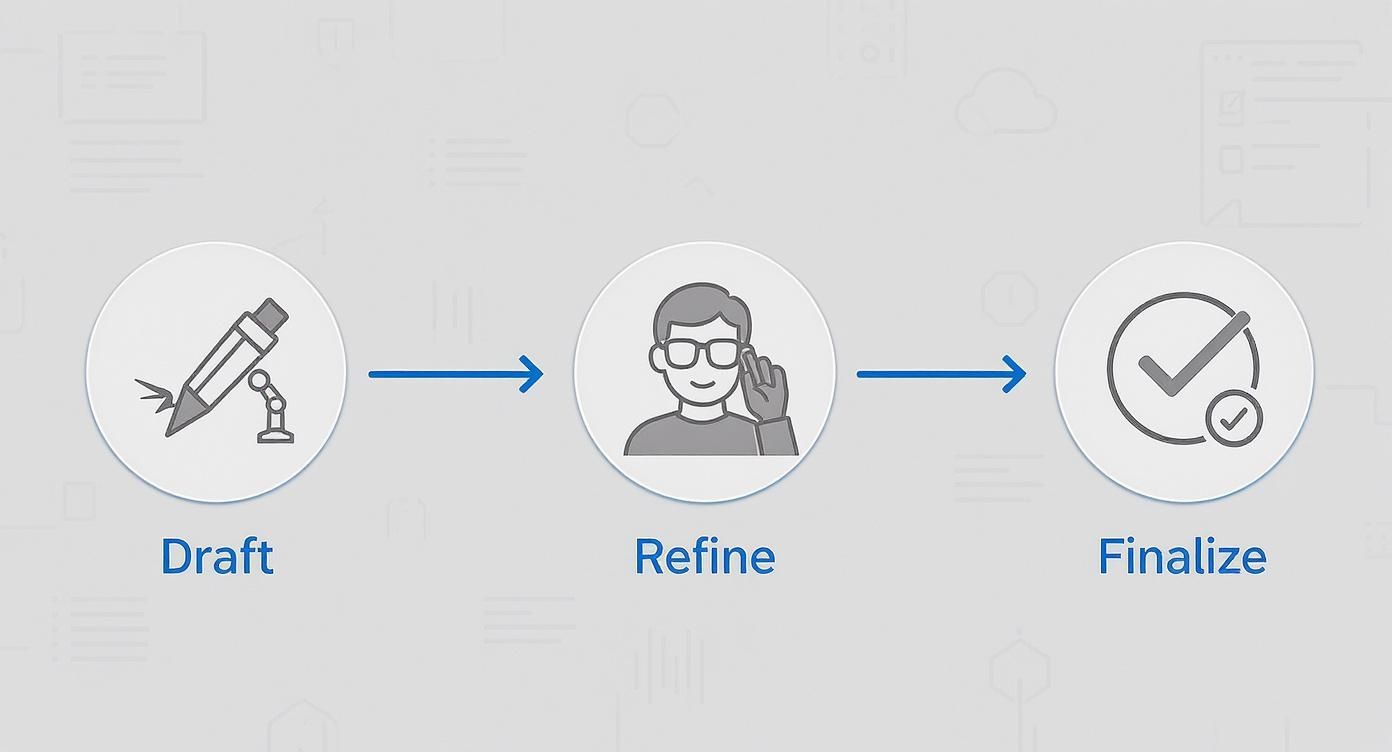
You can start with a rough draft (even one from an AI), but the real magic happens in the human refinement stage. That's where you add nuance, tone, and authenticity to make the piece truly yours.
Bringing It All Together
This checklist is all about respecting your reader. We all know the feeling of hitting a wall of text—it’s intimidating. By cutting the fluff, you make your ideas more accessible and engaging.
Concise editing is not about erasing your personality; it's about clearing the clutter so your unique voice can shine through more clearly.
While AI is great at spotting an extra word, it often misses the stylistic touches that make writing feel genuinely human. That’s where tools designed for writers, not just for machines, come in.
At PureWrite, our entire focus is on helping you humanize your content. We built it to ensure your final copy is not only concise but also engaging and true to your voice. Try PureWrite for free and see how it can help turn your good drafts into great ones.
Your Concise Writing Questions, Answered
As you put these ideas into practice, you'll naturally run into a few questions. Let's clear up some of the most common ones that writers face when editing for conciseness.
Think of this as a quick reference guide to help you navigate those finer points with confidence.
Does Being Concise Mean I Have to Use Simple Words?
Not at all. The goal is precision, not oversimplification. Concise writing is about picking the right word, whether simple or complex. If a technical term is the most accurate way to convey your meaning to an expert audience, then you should use it.
The real aim is to eliminate words that don't add value. Every single word should be there for a specific reason, pulling its own weight.
How Can I Be Concise and Still Sound Like Myself?
This is a great question. Think of conciseness as a tool that reveals your voice, rather than hiding it. Your unique style comes from your word choice, sentence structure, and rhythm—not from filler phrases.
By cutting the clutter, you let your true voice come through more clearly. When using AI to help with this process, it's crucial to use a tool like PureWrite that helps you refine suggestions to ensure they still sound authentically like you.
Concise writing is a balance between being brief and being complete. The goal is clear communication, not just brevity for its own sake.
Can My Writing Be Too Concise?
Absolutely. You've gone too far when your writing becomes so short that it loses critical information, sounds rude, or confuses the reader. If your message feels abrupt or incomplete because you’ve cut too much, it's time to add back some context.
The best way to check is to step back and ask: "Is my meaning crystal clear? Have I given my reader everything they need to understand my point?"
Ready to turn your drafts into clear, compelling, and authentically human content? At PureWrite, we built our tool to help you find that perfect balance between AI efficiency and your own unique voice. Try PureWrite for free and see the difference for yourself.