How to Correct the Sentence From Good to Great Writing
When we talk about correcting a sentence, we're looking at something much deeper than a simple grammar check. It's about taking a functional sentence and transforming it, making it clearer, more impactful, and grammatically sound. The goal is to polish your words so your message truly connects with your audience.
Why Sentence Correction Is More Than Just Grammar
Mastering sentence correction is a crucial skill for everyone who writes—from students polishing essays to content creators trying to hook customers with ad copy. It’s the art of turning a basic piece of text into a message that feels sharp, powerful, and authentic. After all, strong sentences are the bedrock of credibility.
In a world overflowing with AI-generated content, the ability to fine-tune language has become a real advantage. A thoughtfully constructed sentence can stop you in your tracks, change your mind, or leave a lasting impression. This is where the human touch really shines.
The Human Element in an AI World
The explosion of AI writing assistants has certainly changed the game, but it's also thrown a spotlight on the value of human oversight. These tools are incredible for kickstarting ideas and generating first drafts, but they often miss the subtle nuances and genuine feel that connect with people.
Think about it: while many content marketers use AI writing tools, a significant number report that the quality is just ‘good,’ not great. That gap is where your opportunity lies as a writer. There’s a massive need for human-like refinement to take standard AI text and make it something special.
Here at PureWrite, we believe that all great writing begins with a single, well-crafted sentence. This means going beyond just fixing typos. It’s about making sure your writing has:
- Clarity: Can someone get your point on the first read-through?
- Impact: Does your sentence make the reader pause and think?
- Authenticity: Does it sound like a real person wrote it?
By focusing on these core elements, you elevate your editing from basic proofreading to the true art of revision. This is how you transform a passive skimmer into an engaged reader who trusts what you have to say.
Our mission is to help you close that quality gap, turning those AI drafts into compelling articles that sound like you. Ready to transform your AI-generated text? Try PureWrite for free and see the difference.
Finding and Fixing Common Sentence Errors
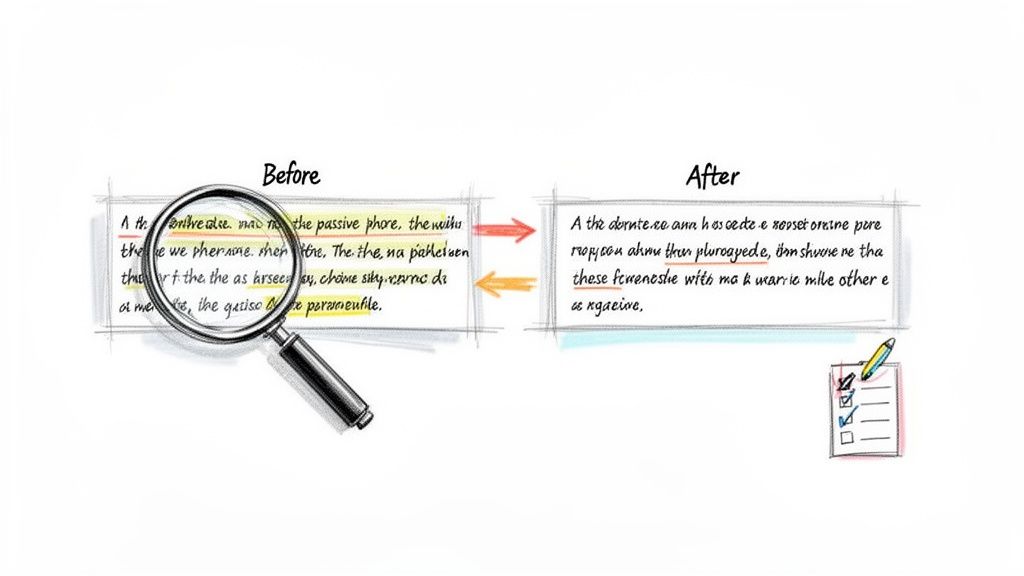
Before you can fix a sentence, you have to play detective. The real skill isn't just catching obvious typos; it's spotting the subtle issues that secretly weaken your writing. Many people, especially when cleaning up AI drafts, stop after a quick grammar check. But the most damaging errors aren’t always about rules—they’re about impact.
We’re talking about things like passive voice, wishy-washy language, and clunky phrasing. These are the classic fingerprints of unrefined AI content. Learning to spot them is the first real step in turning robotic text into something genuinely persuasive.
Spotting the Passive Voice
One of the sneakiest culprits behind weak and indirect writing is the passive voice. It happens when the subject of the sentence gets acted upon instead of doing the action. The result? Your writing feels detached and less energetic.
Here's a real-world example from a business report:
- Before (Passive): The report was written by the marketing team.
- After (Active): The marketing team wrote the report.
See how the active version hits harder? It's more direct and has more energy. To find passive voice in your own work, look for a form of the verb "to be" (is, are, was, were) followed by a past participle, like written or approved.
Eliminating Vague Language and Filler Words
Vague terms and filler words are the enemies of clear communication. They’re like static on the line, adding clutter without contributing any real meaning and forcing your reader to guess what you’re trying to say. This is a massive problem in first drafts and raw AI outputs.
Think about words like "very," "really," "just," and "basically." Most of the time, they don't add anything valuable and can be removed.
The goal is to be precise. Instead of saying a product is "very good," describe why it's good. Use specific, descriptive language that paints a clear picture for your audience.
Let's look at another example a content creator might write:
- Before (Vague): We should basically try to do things to improve our overall engagement in the near future.
- After (Specific): We should launch a weekly customer newsletter in Q3 to increase engagement.
The second version is confident and lays out a clear, actionable plan. It's that kind of detail that builds trust with your readers.
Correcting Awkward Phrasing and Redundancy
Clunky phrasing usually comes from sentences that are too complex or from using redundant word pairs. You’ve probably seen them before: "final outcome," "added bonus," or "completely unique." In each case, one word is unnecessary. Cutting these out makes your writing much cleaner.
Targeted resources can be a huge help here, like this practical guide with English lessons for Spanish speakers. And make no mistake, these issues aren't just for non-native speakers—they creep into everyone's writing.
Lingering grammar and style errors in unpolished AI content are a serious bottleneck. In fact, studies show that a large percentage of raw AI outputs need heavy editing before they're ready to publish. At PureWrite, we help you catch these problems instantly, humanizing your text with a single click.
A Practical Framework for Revising Your Sentences
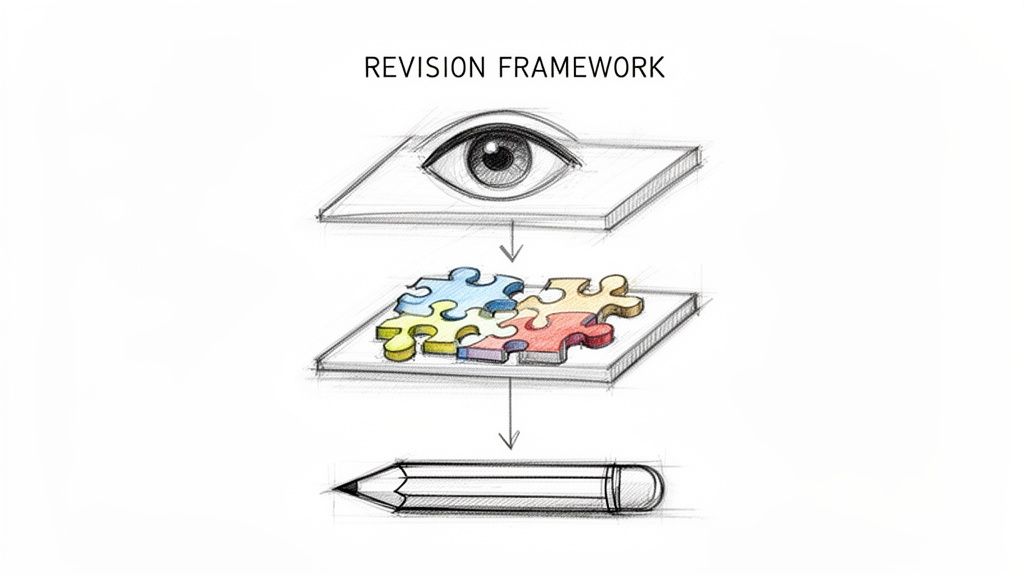
Editing can feel like staring at a messy room—where do you even begin? The natural impulse is to try and fix everything at once, but that’s a recipe for frustration. A much smarter way to work is in layers, starting with the big-picture issues and moving down to the finer details.
We’ve found that a structured framework makes the revision process feel less chaotic and much more effective. This layered approach stops you from wasting time perfecting a word in a sentence that’s fundamentally confusing or out of place. It’s a system for turning good sentences into truly great ones.
First, Nail Down the Core Meaning and Clarity
Before you touch anything else, make sure the core message of every single sentence is absolutely clear. Ask yourself one simple question: "What is the one thing I'm trying to say here?" If you hesitate for even a second, your reader is already lost.
A great trick is to read each sentence out loud. Does it make sense in isolation? This is a classic pitfall of AI-generated text; sentences are often grammatically flawless but logically weak or just plain confusing.
- Is the subject obvious? We need to know who or what is doing the action.
- Is the main verb strong? A powerful verb can rescue a murky sentence.
- Is there any ambiguity? If a sentence can be read two ways, rewrite it so it can only be read one way.
Getting the clarity right first is like pouring a solid foundation. There’s no point polishing the grammar on a sentence that doesn't clearly communicate its meaning.
Next, Refine the Structure and Flow
Once the meaning is solid, you can zoom out a little and look at sentence structure and flow. This is all about how your sentences connect and how they sound when read together. The goal is to create a rhythm that pulls you along, not a choppy, monotonous drone.
Try mixing things up by varying your sentence lengths. A long, descriptive sentence can be incredibly effective when followed by a short, punchy one. This kind of contrast creates a dynamic reading experience that keeps people engaged. For more ideas, check out our guide on editing and revising.
Finally, Fine-Tune Word Choice and Tighten Up
This is the final polish. With your sentences now clear and well-structured, you can get granular and focus on individual words. It's time to hunt down filler phrases, swap weak words for powerful ones, and trim every ounce of fat.
Always be on the lookout for ways to be more concise. Can you say the same thing in fewer words without sacrificing impact? More often than not, the most powerful way to correct the sentence is simply to simplify it.
Just look at the difference a professional might make in an email:
- Before: It is imperative that we take into consideration the various factors before moving forward.
- After: We must consider the factors before proceeding.
This "Clarity, Structure, Polish" process turns revision from a chaotic headache into a methodical task. When you want to accelerate this workflow, tools like PureWrite can apply these same principles instantly, helping you humanize your writing.
Taking Your Writing From Good to Great
Getting the grammar right is just the first step. Once your sentences are clean and correct, the real art of writing begins. This is where you move past the basics and start crafting prose that has style, personality, and a genuine human feel.
Think of it as the difference between a functional sentence and one that truly connects with a reader. Mastering these techniques will help you create a natural rhythm that pulls people in, making your content not just readable, but memorable.
Find Your Rhythm by Varying Sentence Structure
Nothing puts a reader to sleep faster than sentence after sentence with the same length and structure. It’s monotonous. To keep your audience engaged, you need to create a sense of flow, and the best way to do that is by mixing things up.
Try combining short, punchy sentences with longer, more descriptive ones. A quick, sharp sentence can land a key point with impact, while a longer sentence can build out the context. This back-and-forth creates a cadence that’s much more interesting to read.
A great piece of writing feels almost like a conversation. It ebbs and flows, using different rhythms to hold the listener's—or in this case, the reader's—attention from start to finish.
Use Strong Verbs and Cut Every Needless Word
Powerful verbs are the engine of good writing. They're what create action and paint a clear picture. Instead of leaning on weak verbs propped up by adverbs (like "walked slowly"), hunt for a single, more evocative verb. Did he "stroll," "shuffle," or "stride"? Each one tells a different story.
At the same time, get ruthless with your editing. Look for fluffy, filler phrases that add words but no meaning. Phrases like "in order to" and "due to the fact that" can almost always be cut. When you correct the sentence for conciseness, your message hits harder.
- Weak: The team will make a decision about the project.
- Strong: The team will decide on the project.
Adapt Your Tone for Your Audience
Your tone is essentially your writing's attitude. Are you formal and academic? Casual and witty? Your ability to shift your tone to match your audience and purpose is what makes your writing truly effective.
You wouldn't use the same tone for a research paper that you would for a marketing email. For writers using AI like the GPT-4 API, adjusting tone is a key step. At PureWrite, we specialize in refining those AI drafts, helping you dial in the perfect tone so your content sounds less like a machine and more like you.
Using Writing Tools The Right Way
AI writing assistants can be fantastic partners, but let's be clear: they can't replace your writer's intuition. The real magic happens when you use these tools ethically to sharpen your work, not to create it from scratch. Think of them as a hyper-efficient proofreader, catching technical hiccups so you can focus on the message.
When you use a tool like PureWrite, you’re not just outsourcing the work. It’s a collaboration. We're here to help you pinpoint that classic robotic phrasing in AI drafts and give you suggestions to make the text sound like it came from a real person. Authentic and readable—that's the goal.
Your Voice Is Your Greatest Asset
The best way to correct a sentence with AI is to treat it like a teammate. You bring the ideas, the voice, and the critical thinking; the tool brings the polish. This ethical partnership ensures the final piece is still, fundamentally, yours.
It’s all about staying in control. You should always be the one making the final decision on what to keep and what to change. That's how you maintain the authenticity that connects with readers and builds trust.
It's worth noting that with the rise of AI detectors, the stakes are higher. One study from The Digital Elevator found that while 84% of readers couldn't spot AI writing after it was properly humanized, raw AI text gets flagged much more frequently. This can have real consequences for students and professionals.
From Autopilot to Co-Pilot
Viewing a writing assistant as your co-pilot, not the autopilot, is the key. Your expertise and personal touch are what make your writing unique, and no machine can replicate that. Use AI to refine your own ideas into polished, original content that truly reflects your perspective.
After you have a first draft, for example, a good tool can help you spot common AI tells:
- Repetitive sentence structures: AI loves to fall back on the same patterns over and over.
- Awkward word choices: It might use a word that’s technically correct but feels stuffy or out of place.
- An inconsistent tone: You might find the tone shifts unnaturally from one paragraph to the next.
This method keeps you in the driver's seat. If you're curious about the tech that powers these checks, we did a deep dive on whether AI detectors are accurate and what that means for writers today.
Ready to see it in action? Paste your AI-generated text into PureWrite. You'll be surprised how it transforms into clear, engaging, and human-sounding prose. Try it now!
Your Questions on Sentence Correction Answered
Jumping into the world of writing can feel complex, especially now with AI tools changing the game. We get a lot of questions from writers of all stripes—content creators, students, and professionals—all trying to figure out how to write well without sounding like a robot.
Let's dive into some of the most common questions we hear about getting sentence correction right and using modern writing tools smartly.
What Is the Biggest Mistake People Make When Correcting Sentences?
Hands down, the most common pitfall we see is getting bogged down in minor grammar rules while completely ignoring the bigger picture: clarity and flow. It's so easy to agonize over a comma, but if the sentence itself is confusing, perfect punctuation won't fix it.
We always tell writers to start with one simple question: "What am I really trying to say?" Once you've nailed that core meaning and you're sure it's crystal clear, then you can zoom in to polish the grammar and style.
How Can I Correct My Sentences Without Losing My Voice?
This is a fantastic question, and it gets right to the heart of what good writing is all about. The trick is to think of editing not as erasing your voice, but as refining it. Your unique perspective is your most powerful tool, and sentence correction should make it stand out, not sand it down.
When you're using a tool that flags an awkward phrase, you're still the one in the driver's seat. Make the final call based on what sounds like you. For example, if a tool suggests a stuffy, formal word for your casual blog post, trust your gut and stick with what feels authentic.
Sentence correction should sharpen your voice, not erase it. Every change should serve your original intent, making your message clearer and more impactful while still sounding like you.
This mindset keeps your writing genuine. It’s all about enhancing your natural style, not forcing it into a bland, generic template.
Can I Just Rely on an AI Tool to Correct Everything?
AI tools like PureWrite are incredibly helpful for spotting errors and offering smart alternatives, but we’d never recommend relying on them 100%. Think of AI as a brilliant proofreader—it’s amazing at catching technical mistakes we might overlook. What it can't do is understand the subtle context, nuance, or emotion behind your words.
The best approach is a partnership. Let an AI tool be your first pass, catching the obvious grammar slips and clunky sentences. After that, it’s your turn. Use your own judgment and expertise to fine-tune the style and tone.
This human-AI collaboration gives you the best of both worlds: writing that’s technically sound and authentically human. Your final touch is what turns a merely correct sentence into a truly compelling one.
Ready to elevate your writing with the perfect human-AI partnership? PureWrite can help you spot and fix awkward phrasing in seconds, transforming your AI drafts into clear, engaging, and authentic content. Try our AI text humanizer today at https://purewrite.io.