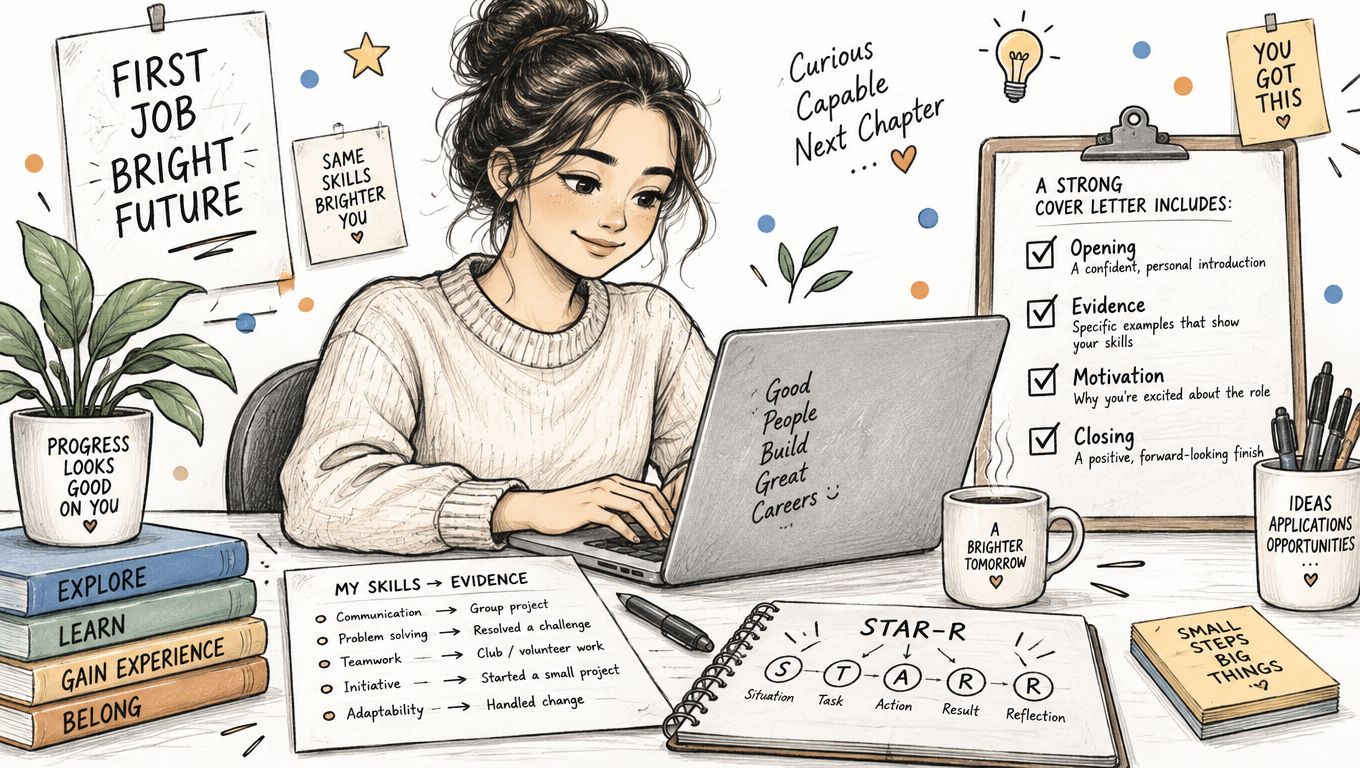
You've found a first job that looks right, but the application asks for a cover letter and your résumé feels painfully short. Maybe your strongest examples come from class projects, volunteering, a campus group, or a part-time job rather than a role with the same title. That's enough to work with. Your letter needs to show how what you've done connects to what this employer needs.
A strong cover letter for a first job isn't a personality pitch or a résumé rewritten in paragraphs. It's a compact skills-evidence document: a clear case that you understand the role, can contribute, and have real examples to back up your claims.
What a First Job Cover Letter Actually Does
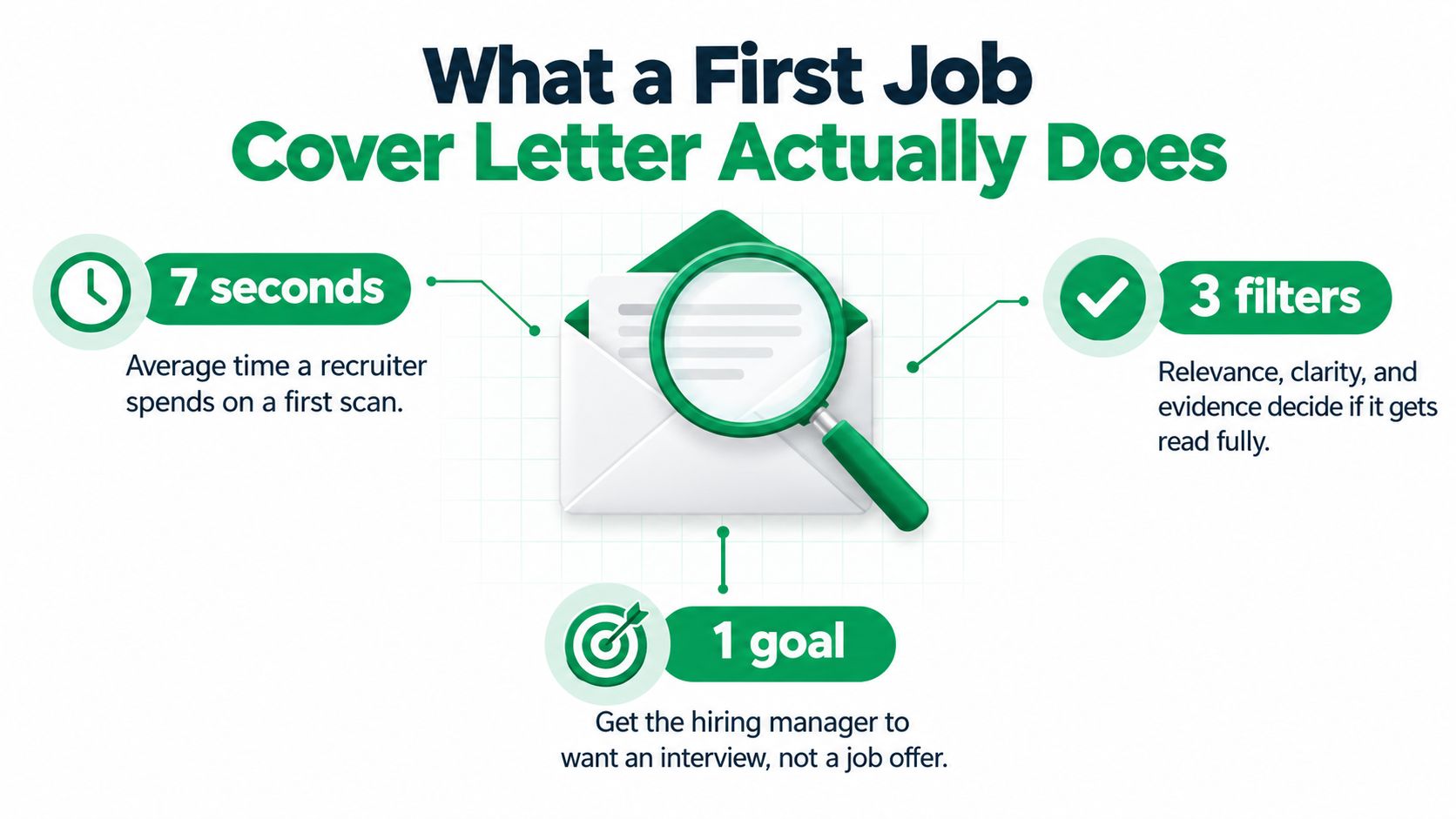
A first-job cover letter gives the hiring manager context that a résumé can't. Your résumé lists qualifications and experience; your letter connects selected items to the employer's needs and explains why you want this particular role. If you don't have a long work history, that connection matters even more. A class project can be relevant, but only if you explain what you did and why it prepares you for the work.
The modern cover letter developed alongside the growth of white-collar and service-sector jobs. Historical accounts trace its employment use to the 1930s, when the share of white-collar jobs nearly doubled as the U.S. economy shifted away from manufacturing and toward service work. A short document could help employers understand the person behind a résumé's qualifications, especially when a candidate's abilities weren't as directly observable as those of a factory or trade worker. The term spread gradually, with a documented employment use in a 1956 classified ad and broader use by the late 1950s (historical account of the cover letter's development).
That original purpose still applies: qualify the person behind the achievements. Don't use your letter to say you're hardworking, passionate, or eager to learn and expect the reader to take those claims on trust. Show where you've demonstrated a relevant skill, then connect it to the job.
Treat it as a conditional screening asset
A cover letter isn't a guaranteed requirement, and sending one won't guarantee an interview. Read the application instructions first. If the employer asks for a letter, submit one. If it's optional, consider writing one when it can explain a nontraditional background, demonstrate role-specific interest, or make your best evidence easier to understand.
One field experiment cited in hiring research reported callback rates of 10.7% for applications without a letter, 12.5% for generic letters, and 16.4% for customized letters. That's a meaningful difference in that experiment, not a promise of the same outcome for every applicant, occupation, or country (field-experiment findings on cover-letter customization). The practical lesson is to avoid submitting a generic letter just to check a box. A weak letter can add little; a customized one can give the reader useful evidence.
Your first job is also competing for attention in a crowded market. The Institute of Student Employers reported an average of 140 applications per graduate job, with particularly high competition in digital and IT roles and in financial and professional services (graduate application figures). If you're exploring different kinds of work, browsing stream selection and job options can help you compare roles before tailoring an application. Once you choose a target, make your letter specific to that job.
Stop Apologizing and Start Proving
“I don't have much experience” is a poor opening, and it's usually unnecessary. It directs attention to what you lack before you've shown what you can do. Hiring managers considering entry-level applicants expect to assess potential and transferable ability. Give them evidence to assess.
Skills-based hiring makes that evidence especially useful. Nearly two-thirds of surveyed employers reported using skills-based hiring for new entry-level employees, and more than half of those employers use it always or most of the time (NACE's entry-level hiring findings). That means a relevant example doesn't need to come from a formal job. It does need to show what you did.
A student applying for an office role might draw on coordinating a group assignment with competing deadlines. Someone with caregiving responsibilities might describe how they kept appointments and household tasks organized. A volunteer who helped run a community event can show communication, planning, and follow-through. For a career-changer or international applicant, freelance work, a family-business contribution, or unpaid coordination can all be relevant when the connection to the job is clear.
Use STAR-R to turn an ordinary experience into a concise example: situation, task, action, result, relevance. First, establish the context. Then state the responsibility you took on, the action you performed, and the result. Finish by explaining how that experience relates to the role. The result doesn't have to be revenue or a workplace metric. It could be a completed deliverable, a smoother process, a solved problem, or a team that met its deadline.
The standard: Don't claim a skill you can't demonstrate. Pick a real situation, explain your contribution, and make the job connection explicit.
For example, “I'm a strong communicator” gives the reader nothing to evaluate. “For a student-organized event, I drafted social posts, coordinated revisions with the team, and kept the schedule current” gives them something concrete. Use precise action words to make your contribution clear. If you need help choosing them, this guide to action verbs versus linking verbs can help you replace vague phrasing with direct descriptions.
Here's a short example of the method in practice:
Requirement: Manage competing priorities.
Evidence: Coordinated a group project with overlapping assignment deadlines.
Action and result: Set up a shared task list, clarified responsibilities, and delivered the presentation on time.
Relevance: Ready to track tasks and communicate progress in a fast-moving team.
A first-job letter shouldn't apologize for unpaid or informal experience. It should label that experience accurately and explain what it proves. Don't imply that a class project was paid employment or inflate your role in a group effort. Honest, specific evidence is more persuasive than a grand claim you can't defend in an interview.
The same approach works across different backgrounds. Students can use coursework and campus leadership; international applicants can highlight relevant projects and communication skills; career changers can connect previous responsibilities to the new role. The source of the experience matters less than the evidence and the relevance.
If you want a visual walkthrough of how to build this kind of application, watch the video below with your own target job description in mind.
The Requirement to Evidence Workflow
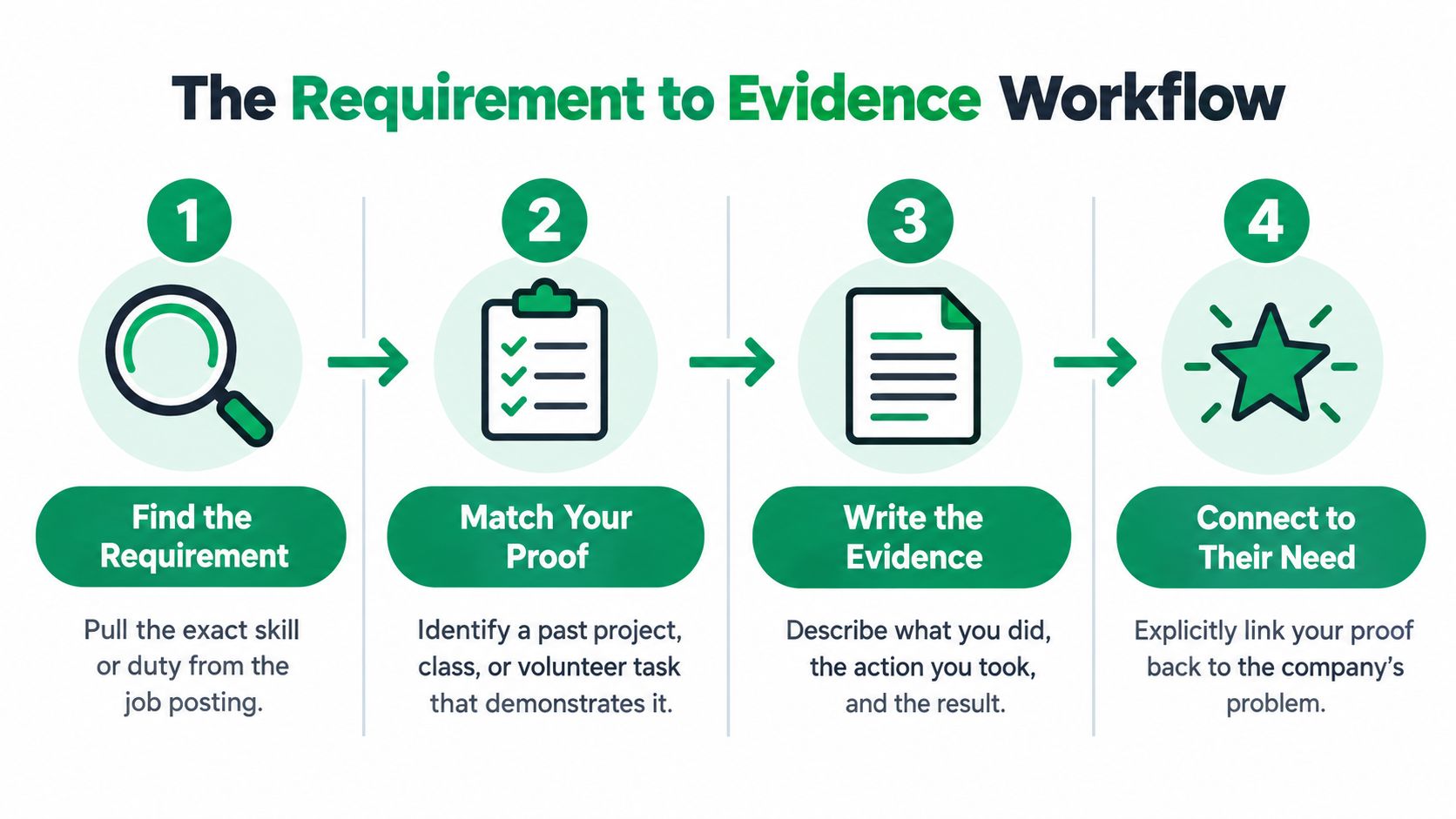
Don't start by writing an impressive-sounding introduction. Start with the vacancy. The job description gives you the employer's language and priorities, so use it to decide which examples belong in your letter.
Hiring-manager preferences support that approach. In iHire's survey of 603 U.S. hiring managers and recruiters across 56 industries, 77.3% said candidates should customize cover letters for the specific position, and 76.5% said they always read a letter when an applicant includes one (iHire's cover-letter survey results). Customization isn't decorative. It helps the reader understand why your evidence belongs in this application.
Build your evidence before your paragraphs
Pull three to five capabilities from the posting. Look for repeated skills, day-to-day duties, tools, or responsibilities. Then match each one with a real example from coursework, an internship, volunteering, a project, a campus role, or part-time work. Write down the action you took and the result, even if the result is finishing a deliverable or resolving a problem.
You won't necessarily include every example. Choose the strongest evidence for the job, not the experiences you're most proud of in the abstract. A clear example of organizing a team may beat a more impressive-sounding accomplishment that has little to do with the role.
Assemble the four blocks
Opening: Name the position and give a brief value proposition. Don't bury the role under a story or a string of general compliments. State what you're applying for and identify the most relevant preparation you bring.
Evidence paragraph: Choose one or two requirements and connect them to concrete examples. Explain your role, action, and result, then make the link to the employer's need. That step is what earns the letter a place alongside your résumé.
Motivation and fit: Explain why you want this role at this organization. Refer to a real feature of the work, team, product, service, or mission that matters to you. Generic praise such as “your company has an excellent reputation” doesn't show that you understand the job.
Closing request: Thank the reader and ask to discuss your application or how you could contribute. Keep the wording confident and professional, without implying that an interview is owed to you. For ideas on making an argument concise and convincing, see these persuasion techniques in writing.
Keep it readable and genuinely tailored
For a nonacademic position, keep the letter to one page. A half-page can be enough if your evidence is focused: survey evidence found 49% of hiring managers preferred half-page cover letters and 26% preferred a full page (iHire survey on cover-letter value). The University of Pennsylvania Career Services recommends a standard 11- or 12-point font, tailoring the letter to the employer and role, and using the same name-and-contact-information header as your résumé (Penn Career Services cover-letter guidance).
Use a professional salutation when you can identify the recipient. If you can't, choose a relevant department or role-based greeting rather than an awkward guess. Save the file in the format the application requests, use a clear filename, and keep your dates and job titles consistent with the résumé.
A letter is meaningfully customized only when the substance changes. At minimum, adjust the target role, employer-specific motivation, two requirement-linked examples, and closing sentence. Swapping the company name in an unchanged template isn't tailoring.
Two Sample Letters for Real First Job Situations
A useful sample shows how evidence works, not just how a letter looks. These two examples use the same basic scaffold but draw on different experiences: a student project and informal work. Replace the details with your own facts. Don't borrow a claim you can't support.
Student applying for a marketing internship
Dear Hiring Manager,
I'm applying for the Marketing Intern role at Brightside Studio. My coursework in digital marketing and my work on a student-organization social-media project have prepared me to support campaign planning and content measurement.
For a class campaign, I worked with a team to define an audience, develop post concepts, and present a channel plan. In our student organization, I drafted social posts and coordinated revisions with other members before publication. These experiences taught me to adapt content to an audience, respond to feedback, and keep work organized around shared goals.
I'm interested in Brightside Studio because the role combines content development with campaign analysis. I'd welcome the opportunity to bring my writing and project coordination skills to your team and learn from its marketing work.
Thank you for considering my application. I'd be glad to discuss how my coursework and project experience could support the internship.
Sincerely,
[Your Name]
The first paragraph names the job and the preparation. The second gives two examples, with actions rather than a vague claim of passion. The third makes the motivation specific to the work, while the closing asks for a conversation without overstating the applicant's experience.
Career-changer or international applicant with informal experience
Dear Hiring Manager,
I'm applying for the Operations Assistant role at Northline Services. My experience coordinating volunteer schedules and supporting a family business has built practical strengths in organization, communication, and keeping routine work on track.
While coordinating volunteers for a local event, I collected availability, updated the schedule, and communicated changes to participants. In the family business, I helped organize customer requests and maintain records. Those responsibilities required careful follow-through and clear communication, skills I'm ready to use in an operations role.
I'm drawn to Northline Services because the position combines team coordination with customer support. I'd value the opportunity to contribute my organizational experience while learning your internal processes.
Thank you for reviewing my application. I'd welcome a conversation about how my background could support the operations team.
Sincerely,
[Your Name]
This candidate doesn't disguise volunteer work or family-business help as formal employment. Instead, the letter accurately describes responsibilities and connects them to the target role. If you're adapting the visual style for a creative application, you can find cover letter templates for designers, then keep the content focused on evidence and fit. Choose a greeting that suits the recipient; this guide to professional email salutations can help you avoid a greeting that sounds stiff or too casual.
Using AI Without Sounding Interchangeable
AI can make a draft smoother and less truthful at the same time. Those are separate risks. A letter can sound polished but generic, or it can make claims that don't match your actual experience. Your job is to prevent both.
A 2025 survey found that nearly 20% of hiring managers would reject a candidate for using an AI-generated résumé or cover letter, while 52% considered AI acceptable for proofreading or support if the applicant produced the final document (iHire survey on AI use in job searches). The distinction is straightforward: using AI to edit your own material is different from asking it to invent your qualifications or write a personal story you didn't provide.
Keep authorship honest: AI can help organize and polish your account. It can't turn an experience you never had into a valid qualification.
Use this editing boundary
First, draft your evidence and motivation in your own words. You can start with rough notes: what the job asks for, what you did, what happened, and why you want this employer. Don't ask AI to invent a story or generate accomplishments to fill the page.
Next, use a writing tool for a narrow task. Ask it to improve clarity, organize your existing examples, correct grammar, or flag repetitive phrasing. Review every change and reject any sentence that exaggerates your role, adds an unsupported result, or no longer sounds like something you'd say.
Then verify every factual claim against your actual experience. Check names, dates, tools, responsibilities, and outcomes. Read the letter aloud. If you wouldn't use a sentence in an interview, rewrite it in your natural voice.
Generic praise and inflated adjectives are warning signs. So is a paragraph that could be pasted into another person's application without changing anything. Repeat the job's terminology where it accurately describes your experience, but don't stuff keywords into sentences that sound unnatural. For a practical approach to humanizing AI text, keep your own details and voice at the center of the editing process.
Pure Write can help refine wording, tone, clarity, and flow in an AI-assisted draft. Use it as a polishing tool, not as a substitute for choosing real evidence or making the final letter your own.
Common Mistakes and How to Fix Them
A cover letter usually weakens because it's vague, repetitive, or unsupported, not because the applicant lacks a perfect writing style. Hiring managers have reported that cover letters affect their interview decisions: a ResumeGenius survey reported 94% said letters influence those decisions, 25% called them very important, and 49% believed a strong letter could secure an interview (ResumeGenius cover-letter survey findings). Treat the document as consequential, then fix the parts that make it hard to trust.
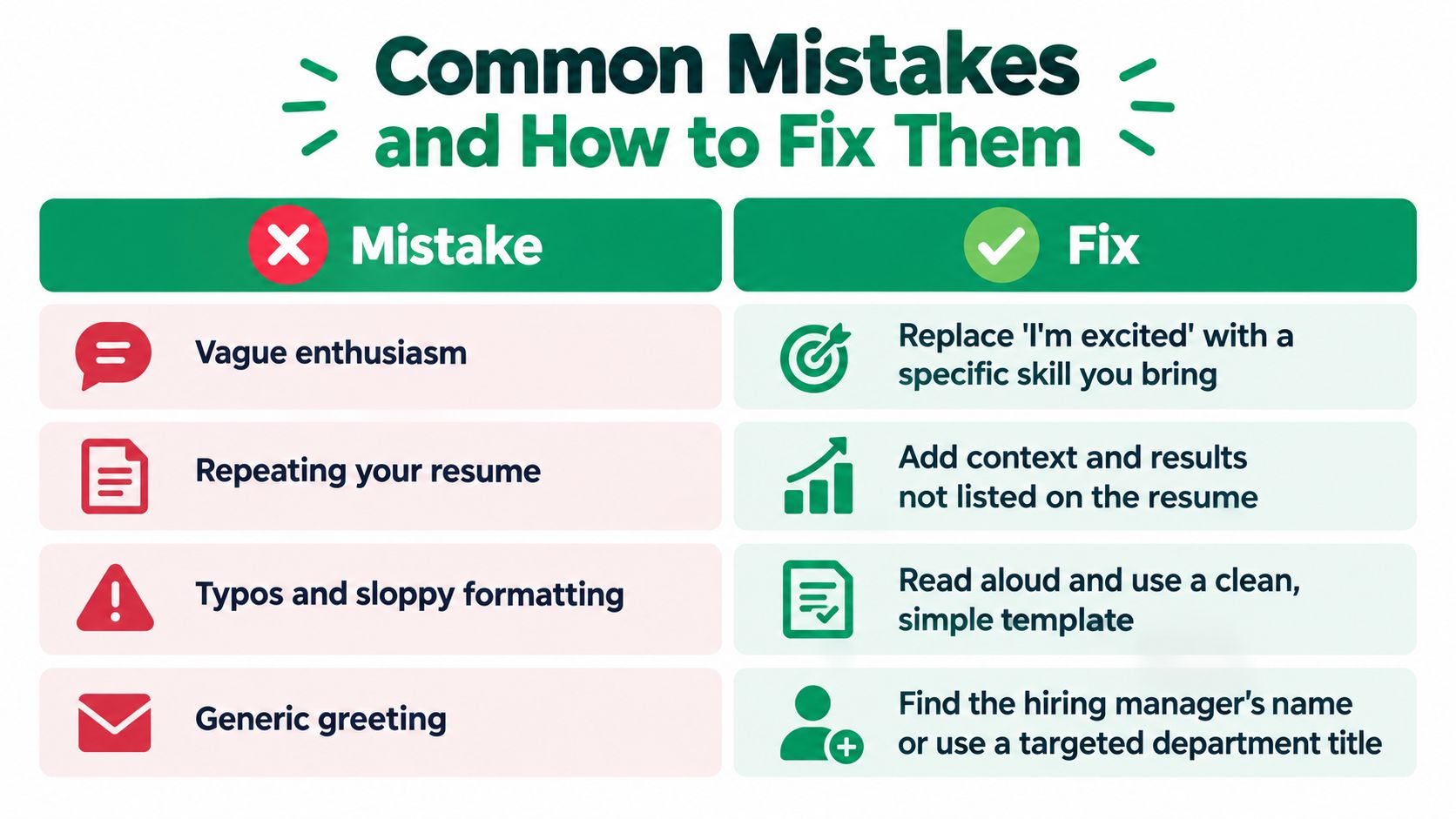
| What weakens the letter | What to do instead |
|---|---|
| Generic opening: “I'm excited to apply for this opportunity.” The sentence could fit any job. | Name the role and relevant preparation: Say what you're applying for and identify the skill or experience that connects you to it. |
| Résumé repetition: The letter restates your education and activities without explaining their relevance. | Add context: Explain what you did, what you learned, or how the experience matches a requirement. |
| Unsupported adjectives: “Passionate,” “driven,” and “hardworking” appear without evidence. | Show a specific action: Replace “I'm organized” with an example of how you tracked tasks or coordinated work. |
| Apologizing for limited experience: The letter focuses on what you haven't done. | Translate what you have done: Use coursework, projects, volunteering, caregiving, or part-time work to prove job-relevant skills. |
| Inflated or invented claims: A result or responsibility can't survive a follow-up question. | Correct the record: Use only claims you can explain clearly. Describe your own contribution to group work. |
| Keyword stuffing: The same job terms recur in unnatural sentences. | Use the posting's language accurately: Include a term only when it describes your real experience. |
| Closing that trails off: “I hope to hear from you” ends without a clear request. | Ask for a next step: Say you'd welcome a conversation about your fit or contribution. |
Make these edits directly in your draft. Replace vague praise with a real example, remove duplicated résumé details, and check every claim for accuracy. A clean, specific letter doesn't need to pretend that you've already had the career you're applying to begin.
Your Pre-Send Checklist and Final Edit
Before you send the letter, run four quick checks. They catch the errors that can make a good example look careless.
- Integrity: Is every claim true and supportable? Are all examples yours, and have you avoided borrowed phrasing?
- Structure: Does the opening name the role and your strongest relevant qualification? Does the body connect two or three requirements to real evidence? Does the motivation paragraph refer to this employer?
- Close: Does the final paragraph make a clear, professional request for a conversation or consideration?
- Formatting: Is the letter within one page? Does the contact header match your résumé? Is the salutation appropriate, the file readable, and the employer's name correct?
Now read the letter aloud. If a sentence sounds unlike something you'd say in an interview, rewrite it. If you need help tightening the draft without losing its meaning, use this guide to editing and revising.
Your first-job cover letter is a compact skills-evidence document, not a personality letter. Apply the workflow to your next application, choose proof that matches the role, and send only a version you can stand behind.
Pure Write helps you refine AI-assisted drafts for clarity, tone, grammar, and natural flow while keeping your real experience at the center. Try Pure Write to polish your cover letter, then review every claim and make the final wording sound like you.