Persuasion Techniques in Writing: Master Copy That Converts Readers

Persuasive writing isn't about some secret formula or magic trick. It's the art of using your words to guide a reader's thoughts, feelings, or decisions. Think of it as a toolkit filled with everything from rock-solid logic and heartfelt appeals to simple credibility boosters, all designed to make what you're saying actually land.
Why Persuasion Is Your Most Powerful Writing Skill
Imagine writing something that doesn't just get read, but gets felt. Something that sparks a thought, triggers an emotion, or inspires someone to take action. That's what persuasion does for your content.
It’s not about manipulating people; it’s about connecting with them on a genuine level. You're building a bridge of understanding and trust, ensuring your message doesn't just get heard but truly resonates. In a world overflowing with content, persuasive writing is what makes your voice stand out.
This skill is a game-changer whether you're crafting a business proposal, polishing a blog post, or trying to add a human touch to AI-generated text. For content creators and marketers, it's the engine that drives results. In fact, content that uses strong persuasive elements can boost reader engagement by over 30%.
Building Connection Through Intentional Writing
At its core, persuasive writing is all about empathy. To truly connect with your audience, you have to understand what they care about, what keeps them up at night, and what truly drives them. This means going beyond just listing facts and tapping into shared emotions and goals. If you want to dive deeper into this crucial first step, our guide on audience analysis is the perfect place to start.
Persuasion is the art of getting people to do things they might not want to do, in a way that makes them feel good about doing it. It’s about creating a win-win scenario where your message provides genuine value to the reader.
The end goal is always to move your reader, and you can see fantastic examples of this in action with effective social media copywriting that actually converts.
This human-first approach is especially vital when you're working with AI writing tools. An AI can generate a logical argument, but it almost always misses that authentic voice and emotional depth that builds real trust.
And that’s where we come in. Here at PureWrite, we believe technology should amplify your unique voice, not erase it. Our platform is built to help you take robotic AI drafts and infuse them with the personality and empathy that makes writing truly persuasive.
Ready to make your content connect? Try PureWrite to humanize your AI text and make every word count.
Understanding Aristotle's Timeless Trio: Ethos, Pathos, and Logos
To really master persuasive writing, we have to go back to its roots in ancient Greece. It was the philosopher Aristotle who first mapped out the fundamental ways to connect with an audience. His three core appeals—Ethos, Pathos, and Logos—are just as relevant for today's content creators as they were thousands of years ago.
Don't let the Greek names intimidate you. Think of them as the three essential tools in your writer's toolkit: Ethos (your credibility), Pathos (your reader's emotions), and Logos (your logic). When you balance these three, your writing won't just be good; it will be truly convincing.
Ethos: Building Your Credibility
Before anyone listens to what you have to say, they need to trust you. That's Ethos in a nutshell. It’s all about establishing your authority and proving you're a credible source. You build it by demonstrating expertise, being transparent, and showing good character.
For example, when a software company features a glowing testimonial from a big-name industry leader, that’s Ethos at work. They’re borrowing that leader’s credibility to boost their own. Citing solid data, quoting respected experts, or sharing your own hard-won experience are all powerful ways to show your reader you’re the real deal.
Pathos: Connecting Through Emotion
Logic can convince the mind, but it's emotion that moves the heart—and drives people to act. Pathos is the art of tapping into your reader's feelings, values, and beliefs. It's about making them feel something, whether that's hope, anger, empathy, or excitement.
One of the most effective ways to do this is through storytelling. Instead of just stating that a problem is serious, tell a story about a real person struggling with it. Non-profits are masters of this, sharing the personal journey of someone they’ve helped to turn a dry statistic into a powerful human story. If you want to dig deeper into how emotion shapes your writing, our guide on what tone is in writing is a great place to start.
This concept map breaks down how these three appeals work together to form the foundation of truly persuasive writing.
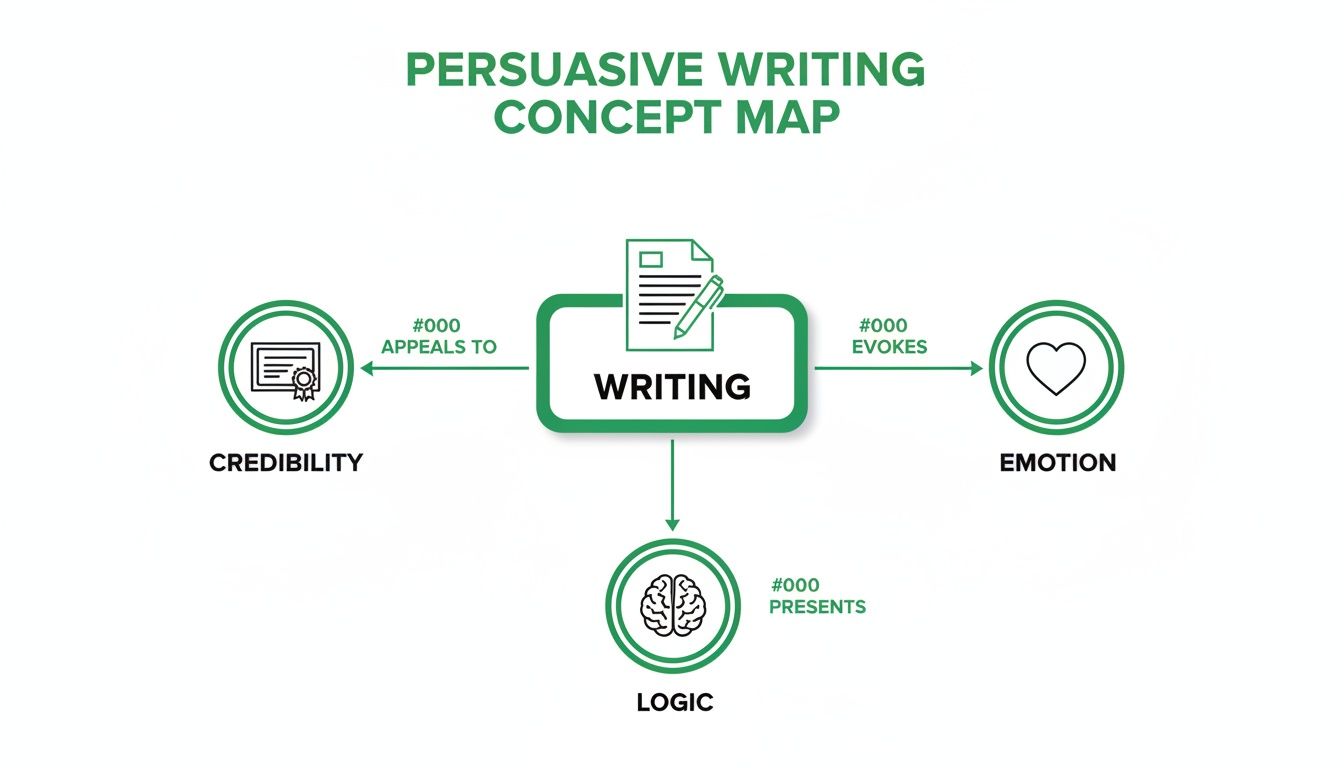
As you can see, the magic isn't in using just one. It's in weaving them together to create a message that's not just heard, but felt and believed.
Logos: The Power of Logic and Reason
Finally, your argument needs a solid backbone. That's where Logos comes in. This is where you bring out the facts, data, and clear reasoning to build a case that's tough to argue with. Logos appeals to your reader's rational side, giving them the proof they need to be convinced.
Presenting a step-by-step argument, referencing a scientific study, or showing statistics in a clear chart are all examples of Logos. It's the "show me the evidence" part of your writing. Without it, even the most emotional appeal can feel flimsy and unsubstantiated.
There's a reason Aristotle's framework has lasted so long—it mirrors how our brains are wired. Modern neuroscience shows that emotional appeals (Pathos) activate the brain's amygdala 40% more than facts alone, while sound logic (Logos) engages the prefrontal cortex, which helps with message retention. It's no wonder that marketers who skillfully blend all three can see conversion rates climb by as much as 37%.
To help you put this all together, here’s a quick-reference table.
Applying Aristotle's Trio in Your Writing
| Persuasion Mode | Core Principle | Practical Example in Writing |
|---|---|---|
| Ethos | Establish trust and authority. | "With 15 years of experience in cybersecurity, I've seen firsthand how..." |
| Pathos | Evoke an emotional response. | "Imagine the frustration of losing hours of work to a system crash. That’s a reality we’re working to end." |
| Logos | Appeal to logic and reason. | "Our platform reduces processing time by an average of 60%, as verified by an independent Q3 study." |
This table shows just how easily you can start weaving these appeals into your own sentences to make your arguments stronger and more resonant.
Tapping into Modern Psychology: Cialdini’s Principles of Influence
If Aristotle gave us the foundational building blocks, modern psychology has handed us the tactical playbook. Dr. Robert Cialdini identified six universal principles that steer our decision-making. As a content creator, you can think of them as the mental shortcuts we all take every day.
By learning to weave these principles into your work, you can make your message stickier, your arguments stronger, and your calls to action far more effective. It's a practical way to apply proven persuasion techniques in your writing.
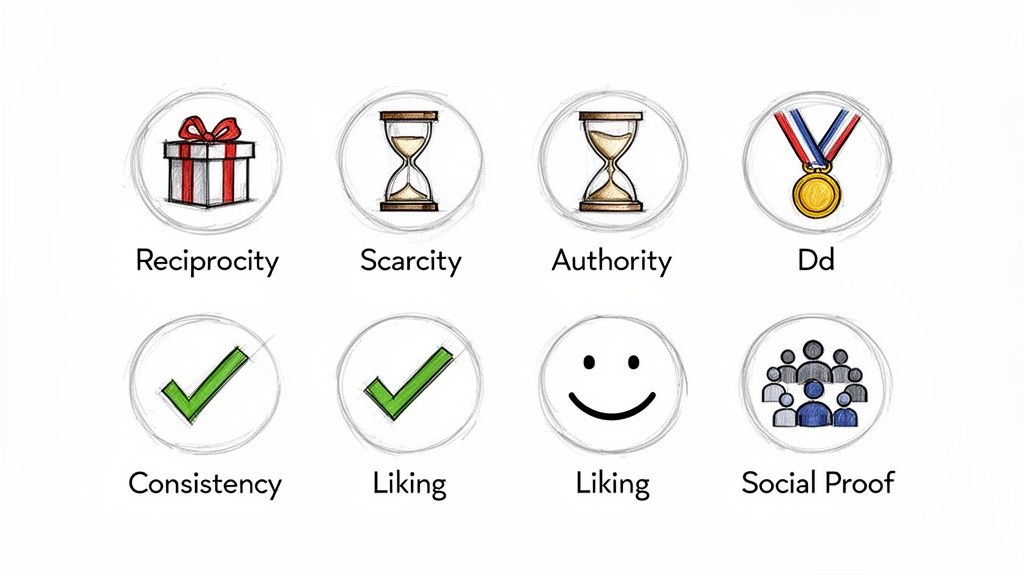
These aren’t manipulative tricks; they’re patterns of human behavior backed by science. When you understand them, you can frame your message in a way that aligns with your reader’s natural instincts, guiding them toward a decision without feeling pushy.
Reciprocity: The Power of Giving First
It's a simple, human truth: when someone does something nice for us, we feel an itch to return the favor. This is Reciprocity. For writers, this means leading with generosity. Give away real value before you ever ask for anything.
This could be a free downloadable checklist, a genuinely useful newsletter, or a comprehensive guide that solves a real problem for your reader. By offering a gift with no strings attached, you create goodwill. Later, when you ask them to subscribe or buy, they’re naturally more inclined to say yes.
Scarcity: Highlighting What People Might Lose
We’re all wired to want things more when we think we might miss out. That nagging feeling of FOMO (fear of missing out) is a powerful driver of action. As a writer, you can tap into this by highlighting what’s limited.
Here are a few ways to do it ethically:
- Time-based: "This discount vanishes at midnight."
- Quantity-based: "Only 50 spots left in the workshop."
- Exclusive access: "A special guide, just for our subscribers."
When used ethically, scarcity creates a gentle urgency that nudges people to act now. Some studies even show that scarcity can make a product seem up to 25% more valuable.
Authority: Leaning on Credibility
Just like Aristotle’s Ethos, Cialdini's principle of Authority is all about establishing expertise. We’re simply more likely to trust and be persuaded by people who know what they’re talking about.
You can build authority in your writing by:
- Citing well-known studies and reputable sources.
- Mentioning your credentials or years of hands-on experience.
- Showcasing testimonials from respected figures in your field.
When your message is backed by real authority, it carries more weight. It's the difference between an opinion and an expert conclusion.
Consistency: The Small “Yes” That Leads to a Big One
We all have a deep desire to be consistent with what we’ve said or done in the past. The principle of Consistency shows that if you can get someone to make a small, initial commitment, they're far more likely to agree to bigger requests later.
A perfect example is asking readers to answer a simple question in the comments. That small act of engagement reframes them in their own mind as an active participant. Because they want to remain consistent, they become more likely to subscribe or share later on.
By encouraging tiny, low-effort interactions, you pave the way for more significant commitments. A simple "yes" can build momentum toward a bigger one as people act in alignment with their past behavior.
Liking: Building a Real Connection
It’s no secret: we listen to people we like. The Liking principle is about more than just being friendly; it’s about building genuine rapport with your audience.
You can cultivate this connection in your writing by:
- Sharing personal stories that show you’re human.
- Using a warm, conversational tone instead of corporate jargon.
- Finding common ground on shared values, goals, or even frustrations.
When your readers feel like they know you and like you, they’ll be more receptive to what you have to say. For more on this, our guide on how to write a persuasive essay offers great tips for forging that connection.
Social Proof: The Comfort of the Crowd
When we’re uncertain, what do we do? We look to see what everyone else is doing. That, in a nutshell, is Social Proof, and it’s one of the most powerful persuasive tools a writer has.
You see it everywhere for a reason:
- "Join 20,000+ other subscribers."
- "Rated 4.9/5 stars by over 1,500 people."
- Customer stories, case studies, and glowing testimonials.
By showing that others already trust you, you lower the perceived risk for new readers. It makes saying "yes" feel like a safe, smart decision.
AI-generated text struggles to create this genuine social context on its own. It often sounds hollow and lacks the nuance needed to build trust.
That’s where we can help. With PureWrite, you can take a robotic first draft and infuse it with these essential human elements. Our platform helps you adjust your tone to build Liking, suggest phrasing that highlights Social Proof, and make sure your entire piece feels like it was written by a person, for a person.
Crafting Narratives That Actually Persuade
Facts and figures have their place, but stories are what create a genuine human connection. This brings us to one of the most potent persuasion techniques in writing: storytelling.
A good story can take a dense, complicated idea and make it feel personal and relatable. It grabs your reader’s attention and holds it in a way a list of bullet points never could.
Think of it this way. Which hits you harder? A statistic that says 2% of the local population is homeless, or the story of a single mother’s journey from her car to her first apartment? Stories bypass the analytical part of our brain and go straight for the heart, making your message not just understood, but felt.
A Simple Story Structure: The PAS Model
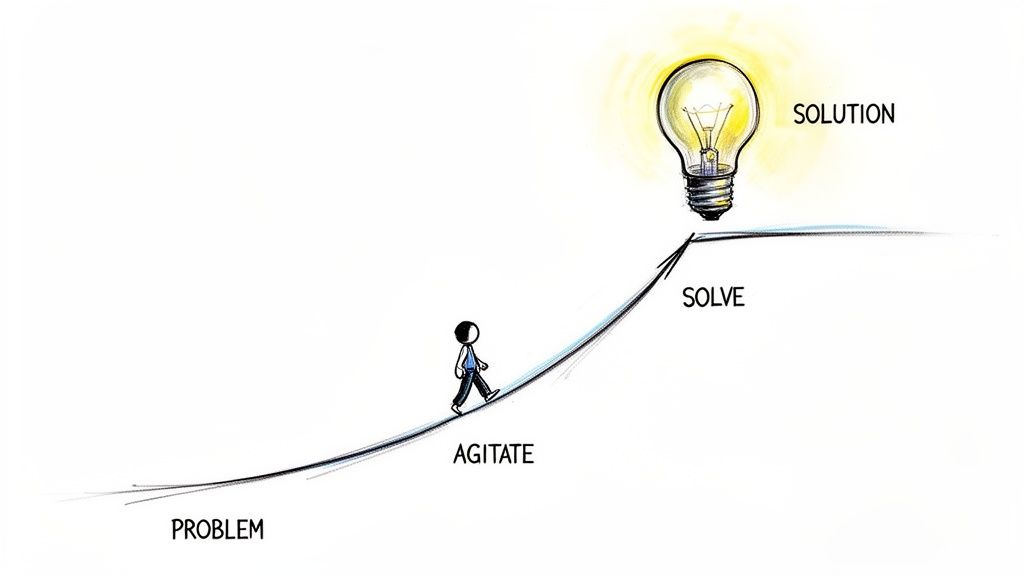
You don't need to be a bestselling novelist to weave a powerful narrative. One of the most effective frameworks for persuasive writing is the Problem-Agitate-Solve (PAS) model. It’s a simple, three-act structure that taps directly into your reader’s motivations.
Here's the breakdown:
- Problem: Start by identifying a pain point your reader experiences. A real-world use case might be: "Trying to keep track of a dozen different projects at once means crucial details inevitably slip through the cracks."
- Agitate: Now, you pour a little salt in the wound. You dig into that problem, highlighting the frustration to make the need for a solution feel immediate. For example: "That leads to blown deadlines, unhappy clients, and that constant, nagging feeling that you’re always one step behind."
- Solve: Finally, you introduce your idea as the hero of the story—the clear solution to that painful problem. For instance: "Our new management tool brings all your communication into one place, so you can track every last detail and finally get back in control of your workday."
This structure is effective because it meets people where they are, validates their frustrations, and then offers them a clear way out. If you're looking for more ways to structure your content, our guide on how to write engaging content has some great ideas.
Shaping Perceptions with Framing
Storytelling has a close cousin called framing. It’s all about how you present information to guide how people perceive it. The context you build around a fact can be even more persuasive than the fact itself.
Let’s use a real-world example. A gym membership costs $600 a year, which might make someone hesitate. But what happens when you frame it differently?
- Frame #1: "For less than the price of two lattes a day, you can invest in your long-term health."
- Frame #2: "Get unlimited access to every class and all our top-tier equipment for just $50 a month."
The price is the same, but the perception is completely different. By connecting the cost to smaller, familiar expenses, the investment suddenly feels manageable and far less daunting.
Framing isn’t about trickery. It's about presenting the truth through the most helpful and persuasive lens, allowing your audience to see the genuine value.
Putting It All Together for Maximum Impact
These persuasion techniques shine when you combine them. You can embed framing within a PAS-structured story to create a powerful one-two punch. Start with a relatable problem, agitate those pain points, and then frame your solution in the most appealing way possible.
For anyone using AI to generate content, this is where your human touch is non-negotiable. An AI can outline a PAS structure, but it often fumbles the nuanced emotional language needed to truly agitate a problem or the creative context required for brilliant framing.
This is precisely the gap we built PureWrite to fill. You can bring us a functional, AI-generated draft and use our platform to inject authentic emotion, discover more powerful ways to frame your solution, and polish your story until it connects with readers on a deeply human level.
Ready to tell stories that persuade? Try PureWrite and see how you can transform your drafts into compelling narratives.
Using Persuasion Ethically in the Age of AI
Powerful persuasion techniques come with great responsibility. Now that AI can generate content instantly, the line between ethical persuasion and manipulation can get blurry. The goal should never be to trick your reader; it's about building trust by being genuinely helpful and honest.
Think of AI as a partner, not a shortcut. AI writing tools are fantastic for getting a fact-based first draft on the page, establishing the Logos of your argument. But that’s just step one.
An AI draft on its own often misses the very things that make writing persuasive: a credible voice and a real emotional connection. This is where your human expertise comes in.
The Human Touch in an AI World
Authenticity is the bedrock of ethical persuasion. When your writing feels real, people are far more likely to trust what you have to say. And this is where AI tends to fall short—it can string facts together, but it can’t tap into your lived experiences or unique perspective.
Your job is to treat that AI draft as raw clay. Shape it by infusing it with your own voice (Ethos) and adding the emotional resonance that connects with your audience (Pathos). Without these human elements, even the most logical argument can feel cold and unconvincing.
When you're trying to create engaging content that captivates audiences, you have to refine your tone, inject vivid language, and make sure the final piece sounds like it came from an actual person.
From Robotic to Relatable with PureWrite
At PureWrite, we built our platform to bridge this very gap. We believe AI should amplify your voice, not replace it. Our tools are designed to help you take a robotic draft and transform it into something that feels genuinely human.
Here’s how you can use PureWrite to apply these techniques ethically:
- Refine Your Tone: Easily adjust the tone of your AI draft to match your personal style. This helps build a consistent and trustworthy persona.
- Add Emotional Depth: We help you spot opportunities to weave in vivid language and relatable examples, creating that all-important emotional connection.
- Strengthen Your Arguments: Using stats is a classic Logos technique, and our platform helps you work them into your writing naturally. For example, a HubSpot study found that copy backed by statistics boosted conversions by 37%. Our tools help you turn dry data into a compelling point.
Your unique perspective is your greatest asset. Ethical persuasion isn't about hiding behind technology; it's about using technology to let your authentic voice shine through, making your message both powerful and principled.
By focusing on this human-AI partnership, you can ensure your writing is not just effective, but also responsible. You can learn more about this approach in our guide on how to humanize AI content and build genuine connections.
The future of writing isn’t about choosing between human and AI; it’s about combining the strengths of both. Use AI for its speed, then add your empathy and creativity—with a little help from us at PureWrite—to make your message truly connect.
Frequently Asked Questions About Persuasive Writing
As you start weaving these techniques into your work, you'll naturally have some questions. Let's walk through a few common ones so you can move forward with confidence and write with real impact.
What Is the Real Difference Between Persuasion and Manipulation?
This is a big one, and it really boils down to a single word: intent. Ethical persuasion is all about creating a win-win. You’re laying out a clear, honest case to help someone make a decision that will genuinely benefit them.
Manipulation, on the other hand, is a one-sided game built on deception. It’s about hiding facts or using pressure to corner someone into a choice that only benefits the manipulator. The goal of persuasion is shared value; the goal of manipulation is selfish gain.
True persuasion builds long-term trust. It respects the reader’s intelligence and freedom to choose, giving them everything they need to make an informed decision. Manipulation torches that trust by chasing a short-term win.
Ultimately, your writing should empower your audience. It should leave them feeling smart and confident about their decision, not confused, cornered, or filled with buyer's remorse.
How Can I Be Persuasive Without Sounding Salesy?
Nobody likes feeling pressured. The secret to avoiding that aggressive, "salesy" vibe is to shift your mindset from selling to helping. Make your mission solving a real problem for your reader, not just moving a product.
When your writing comes from a place of genuine empathy, your arguments will feel authentic and helpful, not pushy. Instead of hammering them with aggressive calls-to-action, focus on demonstrating real value and building a case that logically leads them to your solution.
Here are a few practical ways to keep your tone authentic:
- Lead with Empathy: Acknowledge your reader’s struggles before you ask them to consider something new.
- Give First, Ask Later: Offer valuable advice or insights with no strings attached. This builds immense goodwill and positions you as a trusted expert.
- Write Like You Talk: Imagine explaining an idea to a friend. That natural, conversational rhythm builds rapport and makes your message feel more human.
This is an area where AI-generated content often stumbles, falling back on robotic language that feels disconnected from a reader's needs. We actually built PureWrite to tackle this exact problem. Our platform helps you fine-tune your tone, making it more conversational so your persuasive writing connects on a human level.
Which Persuasion Techniques Work Best for Formal Writing?
Persuasion is crucial in formal and academic writing, but the approach is more subtle. For reports, research papers, or business proposals, Ethos and Logos are your go-to tools.
- Ethos (Credibility): Your authority is everything. You build it by meticulously citing credible sources, presenting a balanced perspective, and maintaining a professional, objective tone.
- Logos (Logic): Your argument must be rock-solid. Use hard data, compelling evidence, and crystal-clear reasoning to guide your reader step-by-step. A logical, easy-to-follow structure is non-negotiable.
So, what about Pathos? While you’ll want to avoid dramatic emotional appeals, a subtle touch of pathos can be incredibly effective. You can achieve this professionally by:
- Using Precise Language: Choose words with subtle emotional weight. Describing an issue as a "significant bottleneck" is more impactful than calling it a "problem."
- Highlighting the Stakes: Frame your argument around its real-world consequences. Explaining the positive impact of your proposal or the tangible risks of inaction creates a sense of urgency.
Even in the most buttoned-up documents, you're still writing for a human being. A well-reasoned argument that also connects with the human side of the equation will always be the most powerful.
Ready to make your writing more compelling without losing your voice? PureWrite helps you humanize AI drafts, refine your tone, and apply these persuasion techniques ethically and effectively. Try it today and see how powerful your words can be.