10 High-Converting Email Subject Lines for 2025
Your email's journey to being read is a series of hurdles. It must navigate spam filters, stand out in a crowded inbox, and earn a click against dozens of competitors. The single most important factor in this battle? The subject line.
This small snippet of text is the gatekeeper to your entire message. It determines whether your hard work gets seen or ignored. A great subject line can achieve open rates above 40%, while a poor one languishes below 10%. With over 376 billion emails projected to be sent daily by 2025, winning this initial impression is non-negotiable for anyone looking to communicate effectively.
At PureWrite, we understand that crafting these crucial first impressions is both an art and a science. Whether you're a marketer driving conversions, a content creator building an audience, or a professional communicating vital information, mastering email subject lines is key. To truly maximize the impact of your emails, it's essential to understand and implement the 8 essential email subject line best practices.
This guide moves beyond theory to offer practical, actionable advice. We will break down 10 proven, high-converting templates you can adapt and use immediately. You will learn:
- The Question Format: How to engage your audience instantly.
- The Curiosity Gap: Why leaving something unsaid is so powerful.
- Personalization Tactics: Simple ways to make your readers feel seen.
- Urgency & Scarcity: How to drive immediate, ethical action.
Each section provides real-world examples and the psychological principles that make them work, helping you turn every email into a genuine opportunity. Let's transform your inbox performance.
1. The Question Format
Framing your email subject lines as a direct question is a powerful technique for sparking immediate curiosity. This approach works by directly addressing the recipient, posing a problem or an opportunity that resonates with their goals. A question invites a conversation and psychologically primes you to seek an answer, which lies inside the email.
The core principle here is engagement. A well-phrased question makes the interaction feel personal and less like a one-way broadcast. It compels you to pause and reflect, significantly increasing the likelihood that you'll open the message to find the solution.
Implementation and Examples
To implement this effectively, focus on questions that highlight a potential gain or an unresolved issue relevant to your audience. The question should be specific enough to be intriguing but open-ended enough that the answer isn’t immediately obvious.
- For B2B Sales:
Are you leaving money on the table with your current software? - For E-commerce:
What if you could get your favorite products 50% off? - For Content Marketing:
Why are your competitors outranking you in Google? - For Professionals:
Ready to get 10 hours back in your week?
Key Insight: The most effective questions often imply that the sender already knows the answer or has a solution. This positions you as an expert and makes opening the email a logical next step for the reader.
Actionable Tips for Success
- Target Known Pain Points: Ask questions you know your audience is already thinking about for maximum relevance.
- Keep It Concise: Aim for 8-10 words to ensure the full question is visible on mobile devices.
- Avoid Simple Yes/No Questions: Questions like "Do you want more sales?" can be answered without opening the email. Instead, ask "How can you triple your sales this quarter?" to create intrigue.
- A/B Test Vigorously: Always test a question-based subject line against a traditional statement-based one to see what performs best for your specific audience.
2. The Curiosity Gap / Open Loop
Leveraging the "curiosity gap" is a classic yet highly effective psychological tactic for crafting compelling email subject lines. This technique works by presenting a piece of intriguing information but deliberately leaving out a key detail. This creates an "open loop" in your mind—a mental gap that your brain instinctively wants to close.
This method taps into the human need for completeness and resolution. When presented with a cliffhanger, however small, our curiosity is piqued, making the urge to click almost irresistible. It transforms a standard email into a mini-mystery that you feel compelled to solve, dramatically boosting open rates.

Implementation and Examples
To use the curiosity gap effectively, your subject line must create a compelling information void that is directly relevant to your audience's interests. The goal is to hint at valuable, surprising, or secret information that can only be accessed by opening the message. Mastering this is key to writing truly engaging content.
- For B2B Marketing:
The real reason your campaigns fail (and how to fix it) - For E-commerce:
We're not supposed to share this, but... - For Content Creators:
You won't believe what happened when we tried this - For Students & Professionals:
This one mistake is costing you top opportunities
Key Insight: The success of a curiosity gap subject line hinges entirely on the payoff. The email body must deliver a satisfying answer to the question posed; otherwise, you risk frustrating your audience and eroding trust. This is a core principle of ethical AI usage.
Actionable Tips for Success
- Promise and Deliver: Ensure your email content directly and satisfyingly closes the loop you opened. A weak payoff feels like clickbait and damages credibility.
- Use Sparingly: Overusing this technique can lead to "curiosity fatigue." Mix it in with more straightforward subject lines for a balanced approach.
- Align with Your Brand: A subject line like "This is INSANE" might work for a bold e-commerce brand but would feel out of place for a professional services firm. Authenticity is key.
- A/B Test Against Directness: Compare an open-loop subject line (e.g., "The secret to better meetings") against a benefit-driven one (e.g., "Cut your meeting time in half with these tips") to see what resonates.
3. The Personalization Template
Using your recipient's personal data in the subject line is one of the most effective ways to cut through the noise of a crowded inbox. This template moves beyond generic greetings by dynamically inserting specific information like a name, company, or location. This level of customization signals that you've done your research and value the recipient as an individual.
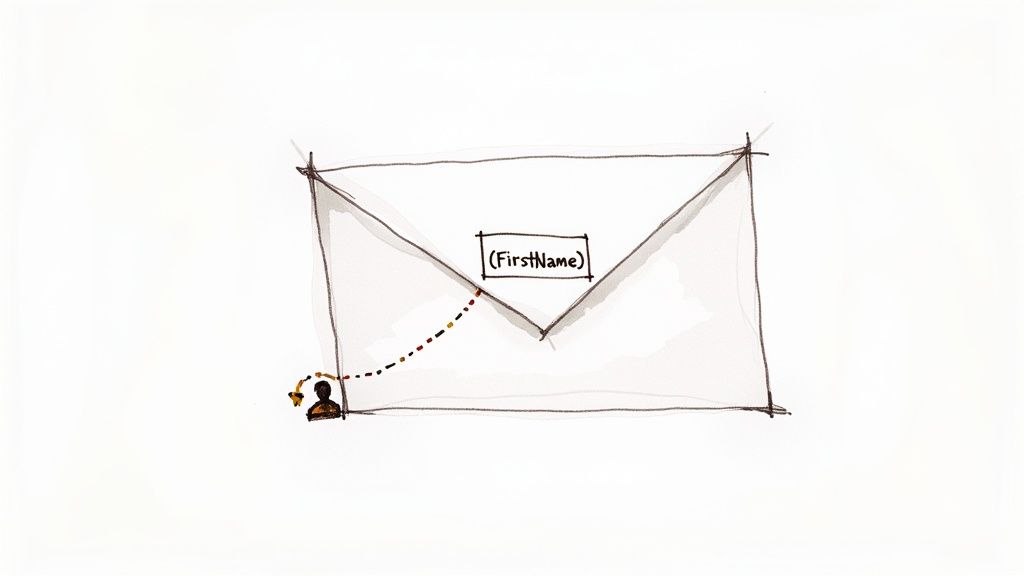
The psychological principle at play is relevance. When you see your own name or details you recognize, your brain flags the message as important and worthy of attention. Modern email platforms have made this sophisticated technique accessible, allowing for high-converting email subject lines that build immediate rapport and significantly boost open rates.
Implementation and Examples
To implement this template, you'll use merge tags or dynamic content fields provided by your email service provider. Start with simple data points and gradually incorporate more complex behavioral information. The key is to make the personalization feel natural and helpful, not intrusive.
- For B2B Outreach:
Sarah, your SaaS needs this before Q4 - For Content Creators:
Marketing leaders at [Company] are switching to... - For Local Offers:
[City] students save 40% with our new tool - For Customer Retention:
John, as a customer since 2021, you qualify for...
Key Insight: The power of personalization multiplies when combined with other techniques. A personalized question, for instance, (
[Name], are you leaving money on the table?) is often more compelling than either tactic used alone.
Actionable Tips for Success
- Start with the First Name: This is the easiest and most common form of personalization. Get it right before moving to more complex data.
- Use Behavioral Data: Leverage information like browsing history or past purchases to create hyper-relevant subject lines (e.g., "Still thinking about that blue widget?").
- Segment Your Audience: Group your contacts by relevant characteristics (job title, industry, location) to make your personalized messages even more targeted.
- Test Fallback Content: Always have a default value ready in case a data field is missing (e.g., "A special offer for you" instead of "A special offer for [Name]").
- Emphasize Ethical AI Usage: Be transparent about the data you collect and use it responsibly to build trust, not to come across as creepy.
4. The Number/Data-Driven Template
Using specific numbers, percentages, or data points in your email subject lines is a surefire way to capture attention. This template leverages a psychological principle where people perceive information with concrete numbers as more credible and valuable. A specific metric instantly communicates tangible value and promises a substantive payoff for opening the email.
The core principle at work here is credibility. While a subject line like "Improve your marketing" is easily ignored, "Cut your marketing spend by 40%" presents a specific, measurable outcome. Numbers ground your claim in reality, transforming a generic promise into a concrete result.
Implementation and Examples
To implement this template, identify a key quantifiable result or piece of data related to your product, service, or content. Lead with the most impressive number to make an immediate impact and frame it around a direct benefit to the reader. Ensure the data you present is accurate and reflects the value delivered inside the email.
- For Professionals:
5 mistakes costing your team $50k/year - For Marketers:
Join 10,000+ happy customers with this one trick - For Content Creators:
3 ways to double your leads in 6 weeks (case study) - For Students:
92% of users see better grades in just 30 days
Key Insight: Specific numbers create a "value anchor" in your mind. A number like "40%" or "$50k" establishes a tangible benchmark of what you stand to gain or lose, making the decision to open the email much more compelling.
Actionable Tips for Success
- Use Odd Numbers: Numbers like 7 or 9 often feel more authentic and less manufactured than round numbers like 10, which can increase perceived credibility.
- Lead with the Metric: Place the most impactful number at the beginning of the subject line to grab attention immediately, especially on mobile devices.
- Ensure Defensibility: Be prepared to back up any claims. If you state a statistic like "92% of users," ensure the data is accurate and verifiable within your email or landing page.
- Test Different Formats: A/B test percentages (%) versus dollar amounts ($) versus raw numbers to see which format resonates most powerfully with your audience. For example, test
Save $100againstGet 25% off.
5. The Urgency/Scarcity Template
Using urgency and scarcity in your email subject lines is a classic yet highly effective psychological trigger to prompt immediate action. This template leverages the Fear of Missing Out (FOMO), creating a sense that if you don't act now, you will lose a valuable opportunity. Highlighting time limits or limited availability interrupts the tendency to delay and encourages an immediate open.
The power of this method lies in its ability to bypass procrastination. When an offer is perceived as abundant, there's no compelling reason to act immediately. However, when you introduce constraints like a ticking clock, you transform a passive consideration into an active decision.

Implementation and Examples
To implement this template, clearly communicate the limitation in your subject line. Whether it's a deadline, a limited quantity, or an expiring offer, the message must be direct and unambiguous. This creates a clear incentive for you to prioritize this email over others.
- For E-commerce:
Ends tonight: 50% off our annual plan - For Webinars/Events:
Only 3 spots left for our workshop - For B2B Sales:
Last chance: Early bird pricing expires in 6 hours - For Flash Sales:
[48-HOUR FLASH SALE] It's happening now!
Key Insight: The most potent urgency-based subject lines are authentic. Using real, genuine scarcity builds trust and trains your audience to act quickly when they see these types of emails from you. This is a cornerstone of ethical marketing.
Actionable Tips for Success
- Use Real Scarcity: Avoid creating false urgency. If you say a sale ends tonight, make sure it does. Your credibility is paramount for building an authentic connection with your audience.
- Be Specific: Instead of "Limited time," use "Ends in 6 hours" or "Only 5 left." Specific numbers and deadlines are more believable and impactful.
- Segment for Genuineness: Send "last chance" emails only to subscribers who haven't yet taken the desired action. This makes the urgency feel more personal and relevant.
- Test Different Timeframes: Experiment with various deadlines (e.g., 24 hours, 48 hours, 1 week) to see which timeframe generates the best response from your specific audience.
6. The Benefit-Focused Template
This approach cuts directly to the core of what motivates you to act: self-interest. A benefit-focused subject line explicitly states the positive outcome or advantage you will gain by opening the email. Instead of describing a feature, it answers your subconscious question: "What's in it for me?"
By leading with the end result, you immediately make the email relevant and compelling. This method bypasses technical jargon, connecting with your goals and aspirations on a more personal level. It is one of the most effective email subject lines because it frames your message as a solution.
Implementation and Examples
To craft a powerful benefit-focused subject line, you must deeply understand your audience’s desires and pain points. What outcome do they value most? Focus on that single, most impactful benefit and articulate it clearly and concisely.
- For B2B Software:
Your team will ship projects 3x faster with this tool - For Wellness Content:
How to get home 2 hours earlier each day - For Financial Services:
Save $500/month on your current software stack - For Sales Teams:
Never miss a qualified sales opportunity again
Key Insight: The most persuasive benefit-focused headlines often use specific numbers or tangible outcomes. "Save $500" is far more compelling than "Save money" because it creates a concrete picture of value in your mind.
Actionable Tips for Success
- Lead with Recipient-Focused Language: Start with words like "Your" or "You" to make the benefit feel personal and immediate.
- Prioritize Outcomes Over Features: Don't sell the drill; sell the perfectly-hung picture frame. The outcome is always more appealing than the tool. For more on this, explore these email communication best practices.
- Use Specific, Measurable Results: Incorporate data, percentages, or time saved (e.g., "Increase revenue by 25%") to make your promise credible.
- Segment by Benefit Priority: Different audience segments may value different benefits. Tailor your subject lines to highlight the most relevant outcome for each group.
7. The Storytelling/Narrative Template
Using a story to frame your email subject lines is an incredibly effective method for building an immediate emotional connection. This approach draws you in by presenting the beginning of a compelling narrative, making your email feel less like a marketing message. People are naturally wired to respond to stories, and a good narrative hook creates an "information gap" that the brain wants to close.
The principle here is to trade a direct sales pitch for genuine intrigue. By hinting at a conflict, a surprising event, or a personal journey, you tap into empathy and curiosity. This makes your message stand out in a crowded inbox filled with generic offers, increasing the odds that you will click to find out what happens next.
Implementation and Examples
To use this template effectively, start your subject line in the middle of the action or at a pivotal moment. The goal is to present a hook that is relatable and raises questions. Ensure the story promised in the subject line is paid off quickly within the email's body to maintain trust and authenticity.
- For Consulting/Coaching:
We almost went out of business. Here's what saved us. - For B2B Case Studies:
My boss didn't believe me until I showed her the data - For Personal Brands:
When Sarah's startup hit 100 employees, everything changed - For Professionals:
This CEO's one decision cost her $1M (and how you can avoid it)
Key Insight: Powerful narrative subject lines often hint at vulnerability or a dramatic turning point. Sharing a challenge and its resolution positions you as an experienced guide who has overcome the same obstacles your audience faces.
Actionable Tips for Success
- Start with Relatability: The story's situation should mirror your recipient's own experiences or aspirations.
- Keep the Hook Concise: The entire narrative hook must fit into a single, compelling sentence that is fully visible on mobile devices.
- Ensure Content Alignment: The story you begin in the subject line must directly and clearly connect to the core message and call-to-action of your email.
- Use Authentic Narratives: Real stories resonate far more than unbelievable tales. Authenticity builds trust, especially when humanizing AI-generated content.
8. The Social Proof/FOMO Template
Leveraging social proof is a classic psychological tactic that translates exceptionally well into high-converting email subject lines. This approach capitalizes on the human tendency to trust and follow the actions of a larger group. By showing that others are already benefiting from your offer, you create a sense of validation and urgency.
The core principle at play is the Fear of Missing Out (FOMO). When you see that a significant number of people or key industry players have adopted a solution, you feel a compelling need to understand why. This instantly elevates the email from a simple pitch to an essential update on an important trend.
Implementation and Examples
To implement this template effectively, focus on using specific, impressive numbers and highlighting a community your recipient wants to be a part of. The key is to make them feel like they are on the verge of being left behind if they don't act.
- For B2B SaaS:
5,000+ marketers switched to our platform this month - For E-commerce/Retail:
See what everyone is buying this season - For Content Creators:
Join 50,000+ writers getting this daily insight - For Industry-Specific Offers:
Why thousands of agencies are now using this tool
Key Insight: The power of this template lies in its ability to combine validation with exclusivity. The subject line suggests that a select, intelligent group has already made a decision, inviting you to join an "in-the-know" community.
Actionable Tips for Success
- Use Real, Verifiable Numbers: Authenticity is crucial. Use real data on customer counts, downloads, or sign-ups to build trust.
- Segment Your Audience: Make the social proof hyper-relevant. Instead of "10,000 users," try "10,000 marketing professionals" to create a stronger connection.
- Update Your Numbers: Keep your data fresh. A subject line that says "5,000 joined this month" is more powerful than a static "5,000 users."
- Test Against Authority: Pit a social proof subject line (e.g., "Join 10,000 marketers") against an authority-based one (e.g., "A message from our CEO") to see which resonates more with your audience.
9. The Command/Action-Oriented Template
Using a direct command or an action-oriented verb in your email subject lines is a surefire way to drive immediate action. This template cuts through the noise by telling you exactly what we want you to do. By starting with a strong, imperative verb, you create a sense of urgency and clarity.
The psychology here is simple: you're providing a clear, direct path to value. Instead of hinting at an offer, we are guiding you to take a specific, beneficial step. This approach positions your email as a task to be completed rather than just another message, which can dramatically improve click-through rates.
Implementation and Examples
To make this template work, you must pair a powerful verb with a clear and desirable benefit. The command should feel like an opportunity, not a chore. Keep the language concise and focused on the value you will receive upon opening the email.
- For Lead Generation:
Download your free marketing checklist now - For Webinars/Events:
Claim your spot in our Q4 workshop - For E-commerce Promotions:
Shop our flash sale before it's gone - For Content Promotion:
Get instant access to our ultimate guide
Key Insight: This template is most effective when the action required is low-friction and the reward is high-value. You should feel that by clicking, you are immediately gaining something tangible.
Actionable Tips for Success
- Lead with the Verb: Always start your subject line with the action word (e.g., "Download," "Join," "Save") for maximum impact.
- Be Specific: Instead of "Read our new blog," try "Learn the 5 strategies Apple uses." Specificity increases perceived value.
- Ensure Follow-Through: The landing page or email content must immediately deliver on the promise made in the subject line. Any disconnect will erode trust.
- Use Sparingly: Overusing commands can make your brand seem overly aggressive. Mix this template with other approaches for a balanced, authentic tone. You can learn more about using strong action verbs to make your writing more dynamic.
10. The Segmentation/Targeting Template
Leveraging segmentation in your email subject lines is a highly effective way to cut through inbox noise by signaling immediate relevance. This template works by explicitly calling out a specific audience segment, job title, or user behavior. This makes you feel the message was crafted just for you, instantly answering the subconscious question, "Is this for me?"
The principle here is hyper-relevance. In a world of generic email blasts, a subject line that speaks directly to your professional identity or interests stands out dramatically. This method shows that we understand who you are and what you care about, building trust and significantly boosting open rates.
Implementation and Examples
To use this template, identify a clear, well-defined segment of your audience and address them directly. This could be based on their industry, job function, or past behavior. The goal is to make the identification immediate and compelling.
- For SaaS CFOs:
Cut your churn by 30% - For Marketing Directors in Tech:
Your team needs this new framework - For Students:
A special discount for [University] students - For Specific Software Users:
If you use HubSpot, we have important news
Key Insight: This approach transforms a mass email into what feels like a personal, one-to-one communication. The more specific and accurate the segment identifier, the more powerful the subject line becomes.
Actionable Tips for Success
- Validate Your Data: Ensure your segmentation data is accurate. Calling someone a "Marketing Director" when they're in sales will backfire and damage your credibility.
- Use Their Language: Address segments using the terminology and acronyms they use themselves to create an authentic connection.
- Start with One Clear Segment: Don't overcomplicate things. Begin with your most valuable or largest segment and test different angles before expanding.
- Combine with Personalization: For maximum impact, pair a segmented subject line with personalized content inside the email. A message for "Marketing Directors" that also uses your first name is even more powerful.
10-Template Email Subject Line Comparison
| Template | Implementation Complexity 🔄 | Resource Requirements ⚡ | Expected Outcomes 📊 | Ideal Use Cases 💡 | Key Advantages ⭐ |
|---|---|---|---|---|---|
| The Question Format | Low — straightforward copy; needs audience insight 🔄 | Low — copywriting + A/B tests ⚡ | High open rates (studies ≈88%); strong curiosity-driven engagement 📊 ⭐⭐⭐ | Lead-gen, cold outreach, broad newsletters 💡 | Promotes mental engagement; easy to test ⭐ |
| The Curiosity Gap / Open Loop | Low–Medium — craft partial info; must align with content 🔄 | Low — strong copy + reliable follow-through ⚡ | Very high opens/engagement but risk of unsubscribes if undelivered 📊 ⭐⭐⭐⭐ | Teasers, content hooks, product reveals 💡 | Creates FOMO and memorable hooks ⭐ |
| The Personalization Template | High — data integration and dynamic logic required 🔄 | High — CRM, merge-tags, segmentation, privacy controls ⚡ | Higher opens/conversions (≈26% uplift); better retention 📊 ⭐⭐⭐⭐ | Lifecycle emails, retention, account-based campaigns 💡 | Feels one‑to‑one; increases relevance and trust ⭐ |
| The Number/Data-Driven Template | Medium — needs accurate metrics and validation 🔄 | Medium — analytics and source attribution ⚡ | Higher CTRs (studies show ~20–30% uplift); perceived credibility 📊 ⭐⭐⭐ | B2B, finance, case studies, performance-led offers 💡 | Specificity stands out and builds trust ⭐ |
| The Urgency/Scarcity Template | Low–Medium — deadline wording + cadence planning 🔄 | Low — promotional calendar and optional timers ⚡ | Boosts conversions/CTR (≈22% higher) but risk to trust if abused 📊 ⭐⭐⭐ | Flash sales, limited offers, registrations with caps 💡 | Drives immediate action and boosts short-term ROI ⭐ |
| The Benefit-Focused Template | Low — requires understanding audience outcomes 🔄 | Low–Medium — customer research to define benefits ⚡ | High conversions when benefit matches need; clear WIIFM 📊 ⭐⭐⭐ | Product launches, onboarding, value propositions 💡 | Directly answers "what's in it for me?" — clear value ⭐ |
| The Storytelling/Narrative Template | Medium–High — needs strong writing and coherent arc 🔄 | Medium — creative time and editorial review ⚡ | High memorability and emotional engagement; brand-building 📊 ⭐⭐⭐ | Newsletters, thought leadership, brand campaigns 💡 | Builds emotional connection and differentiation ⭐ |
| The Social Proof/FOMO Template | Medium — requires verifiable social metrics and updates 🔄 | Medium — testimonials, usage data, logos ⚡ | Improves trust and conversions for hesitant buyers 📊 ⭐⭐⭐ | New product adoption, credibility-focused campaigns 💡 | Leverages peer behavior and authority to reduce risk ⭐ |
| The Command/Action-Oriented Template | Low — short imperative copy; clear CTA needed 🔄 | Low — copy + readiness of offer/link ⚡ | Higher click rates (≈20–30% uplift) for engaged lists 📊 ⭐⭐⭐ | Time-sensitive downloads, gated content, CTAs in mobile 💡 | Extremely clear directive; performs well in previews ⭐ |
| The Segmentation/Targeting Template | High — precise persona definitions and rules 🔄 | High — segmentation tools, data hygiene, maintenance ⚡ | Substantially higher opens (14–100% uplift) and relevance 📊 ⭐⭐⭐⭐ | Account-based marketing, industry-specific campaigns 💡 | Maximizes relevance; reduces irrelevant sends and unsubscribes ⭐ |
From Template to Inbox: Crafting Authentic Emails that Connect
We’ve explored an arsenal of email subject line templates, from sparking curiosity to driving action with urgent commands. You now have the foundational blueprints for capturing attention, backed by proven psychological principles. But a template is just the starting point. The real magic happens when you infuse these structures with your brand’s unique, authentic voice.
The journey from a generic template to a high-performing email subject line is one of adaptation, testing, and humanization. The most successful content creators don’t just copy and paste; they iterate. They treat each subject line as a mini-experiment, a hypothesis about what will resonate most deeply with their subscribers.
Key Takeaways: From Theory to Action
Mastering the art of email subject lines isn't about memorizing a list; it's about internalizing the core principles. Let's distill the most critical lessons from this guide into actionable takeaways for content creators, students, and professionals alike:
Context is Everything: A subject line that works wonders for a flash sale will fall flat for a newsletter. Always align your template choice with the email's content, your goal, and your audience's expectations.
Emotion Drives Opens: Whether it's the fear of missing out (FOMO), the desire for a solution (Benefit-Focused), or the intrigue of a story, emotion is the engine of engagement. Your subject line's primary job is to make someone feel something compelling enough to click.
Clarity Trumps Cleverness: While a witty or mysterious subject line can be effective, it should never come at the expense of clarity. Your audience needs a general idea of the value waiting for them. If they have to work too hard to understand your message, they’ll simply move on.
Personalization is Non-Negotiable: In today's digital landscape, generic communication feels lazy. True personalization involves leveraging data about behavior and interests to craft subject lines that feel like they were written just for you. This is where ethical AI usage can provide immense value.
Your Next Steps: Building a System for Success
Knowing what to do is one thing; implementing it consistently is another. Here’s a simple, three-step process to put these insights into practice and continuously improve your email performance:
Brainstorm and Adapt: Start with the templates we've covered. For your next campaign, choose two or three that fit your goal. Brainstorm at least five variations for each, tailoring them to your specific offer and audience. For more inspiration, exploring high-impact survey email subject lines can provide valuable insights.
A/B Test Relentlessly: Never assume you know what will work best. Always be testing. Pit a question against a statement. Test an emoji-filled line against a plain-text one. Let your audience's behavior be your ultimate guide to authentic writing.
Analyze and Refine: Don't just look at open rates. Analyze click-through rates, conversions, and unsubscribe rates to get a complete picture. Use these insights to inform your next brainstorming session, creating a powerful feedback loop for perpetual improvement.
Ultimately, your email subject line is a promise of value, a solution, or an interesting story. Fulfilling that promise with high-quality, human-centric content is how you build a loyal, engaged audience that not only opens your emails but eagerly awaits them.
Ready to ensure your carefully crafted subject lines lead to emails that sound genuinely human? Even the best AI writing tools need a final touch. We created PureWrite to help you refine AI-generated drafts, polish your writing, and connect with your audience on a deeper level. Try PureWrite today to humanize your content and build lasting trust.