How to Find Your Writing Voice and Create Content That Connects

Finding your writing voice isn't about creating a persona from scratch. It’s about letting the one you already have shine through on the page. Think of it as the unique fingerprint of your personality, perspective, and style that makes your writing feel authentic and instantly recognizable.
What Is a Writing voice and Why Does It Matter?
Simply put, your writing voice is the personality a reader "hears" when they read your words. It’s the difference between saying "The results were positive" and "We knocked it out of the park." In a world flooded with content, a distinct voice is what helps you build a real connection and cut through the noise.
For Content Creators, marketers, or even students, a strong voice is non-negotiable. It transforms writing that merely informs into writing that engages, persuades, and builds a loyal audience. An authentic voice creates trust and makes people want to listen to what you have to say.
The Four Core Elements of Your Writing Voice
Your unique voice comes from a blend of four key ingredients. Once you understand them, you can be much more intentional about crafting and refining your style.
Let’s quickly break down these components. The table below gives you a simple overview of what each one means and a question you can ask yourself to start thinking about it more deeply.
The Four Core Elements of Your Writing Voice
| Element | What It Means | Example Question to Ask Yourself |
|---|---|---|
| Tone | The attitude or emotion you convey with your words. | Do I want to sound witty, serious, formal, or casual? |
| Diction | Your specific choice of words. | Do I prefer simple, direct language or more complex words? |
| Syntax | The way you structure your sentences and paragraphs. | Do I use short, punchy sentences or longer, flowing ones? |
| Perspective | Your unique point of view, shaped by your experiences, values, and beliefs. | What personal experiences or beliefs shape what I'm saying? |
Each of these elements works together to create something that is uniquely yours.
Tone, for instance, is the attitude you bring to a piece. Are you serious and authoritative, or funny and self-deprecating? While your tone might shift slightly depending on the audience or topic, it should always feel genuine to you.
Diction is all about the words you choose, while syntax is the rhythm and flow of your sentences. Your perspective is the "you" that nobody else can replicate—it’s the sum of your experiences and beliefs that makes your viewpoint valuable.
Your writing voice isn’t something you just discover one day. It’s something you build, practice, and refine over time. Every single piece you write is a chance to sharpen it.
It's no surprise that the global market for writing enhancement software is projected to hit USD 600.7 million by 2033. We're all trying to write better. In fact, one 2022 study showed that writers who used tools with style feedback improved their voice consistency by 42% in just six months.
As you work on your own voice, you might even turn to AI for inspiration. At PureWrite, we believe in using AI ethically—as a partner that helps you, not a machine that replaces you. Our platform is designed to help you humanize AI-generated drafts, making sure the final piece sounds exactly like you.
Discovering the Voice You Already Have

Here’s a secret many writers miss: finding your voice isn't about creating a persona from thin air. It's about uncovering what’s already there. Your most authentic style is hiding in plain sight—in your daily conversations, your unfiltered thoughts, and the topics that make you light up.
It's completely normal to worry that your writing sounds like someone else. The breakthrough happens when you stop looking outward for a voice you think you should have and start listening to the communicator you already are.
Let Your Thoughts Flow Without a Filter
One of the best ways to get out of your own way is free writing. Set a timer for ten minutes and just go. Write about anything that pops into your head. The only rule is you can’t stop, and you definitely can’t edit. This is about bypassing your inner critic and letting your raw thoughts spill onto the page.
Another great exercise is voice journaling. Pick a topic you’re genuinely passionate about—your industry, a hobby, a strong opinion—and just write for yourself. When you remove the pressure of an audience, your natural enthusiasm and vocabulary emerge. These exercises are foundational for improving your English writing skills because they build fluency from a place of authenticity.
Your writing voice isn't lost—it's just waiting to be excavated. You don’t need to find it; you need to create the conditions for it to reveal itself.
Listen to How You Actually Talk
Want a quick shortcut to your voice? Pay attention to how you speak. The way you chat with friends is often the purest expression of your personal style. Are you a natural storyteller? Do you use a lot of humor? Are you direct and to the point?
Think about it: technology is already leaning into this. With voice-to-text tools becoming more common, natural language is king. A survey of 5,000 creators found that 57% actually use voice dictation for their first drafts just to capture those spoken patterns.
Here’s a simple, actionable way to try this yourself:
- Record Yourself: Grab your phone and record yourself explaining a topic you love to a friend. Don't script it—just talk.
- Transcribe Your Words: Now, type out what you said. Get it all down, including the casual phrases and sentence fragments.
- Spot Your Patterns: Read through the transcript. Look for your go-to phrases, the rhythm of your sentences, and your unique cadence.
This transcript is a goldmine; it’s a blueprint of your authentic voice. From there, a tool like PureWrite can help you polish that raw material, ensuring your final text is clean, clear, and unmistakably you.
Learning from the Greats Without Sounding Like a Copycat
No writer is an island. We all stand on the shoulders of the writers we love, the ones whose work we devour. But there’s a fine line between inspiration and imitation. The goal is to learn from your heroes, not to create a watered-down version of their work.
Think about the writers you truly admire. Is it their sharp wit, the crystal-clear way they explain a complex topic, or their beautiful, poetic prose? Getting specific about what you love is the first step to incorporating those elements into your own style.
Take Their Writing Apart
To understand what makes great writing tick, you have to shift from being a passive reader to an active analyst. This isn't about stealing their moves; it's about reverse-engineering the magic so you can build your own.
Next time you read something that really grabs you, put on your detective hat and ask some specific questions:
- Sentence Structure: Look at the rhythm. Are the sentences long and winding, or short and sharp? For example, a marketer like Seth Godin often uses brief, punchy sentences for impact.
- Word Choice: Is the language simple and direct, or more academic? Notice the verbs they use—are they strong and specific?
- Tone: How does the piece make you feel? Are they building trust with humor? Authority? Raw vulnerability?
When you can answer these questions, you move from a vague "I love this!" to a powerful "I love how they do this."
The point isn’t to sound like your favorite author. It's to understand the tools they use to sound so uniquely like themselves.
Play Around and See What Sticks
Once you’ve identified a few techniques, it’s time to experiment in a low-pressure way. Think of it like a musician learning new chords. You’re just trying things out to see what feels right and what feels forced.
Let's say you admire a writer who uses short, punchy sentences for impact. Open a document and try writing about your morning coffee using only sentences that are ten words or less. It’ll probably feel weird at first, but exercises like this build new stylistic muscles.
This whole process of breaking things down and then trying them out for yourself builds a much richer writing toolkit. You start blending these new skills with your own natural inclinations, and that's where a truly distinct voice begins to emerge.
This is especially critical if you use AI to get a first draft down. A tool like PureWrite is perfect for this stage, helping you polish a generic AI draft until it not only sounds human but sounds specifically like you.
Practical Exercises to Strengthen and Refine Your Voice
Knowing your voice exists is one thing. Being able to wield it consistently and powerfully is another. This is where we stop talking about theory and start getting our hands dirty with practical exercises.
These aren't just generic writing prompts; they're more like a workout for your stylistic muscles. Think of them as targeted drills designed to build flexibility, consistency, and a deeper understanding of how your unique voice works in the real world.
Adapt Your Voice for Different Audiences
One of the quickest ways to find the core of your voice is to see how it bends without breaking. Start with a simple paragraph you've already written—maybe a description of your job or a summary of a recent project.
Now, rewrite that same paragraph for three completely different audiences:
- A Five-Year-Old: This forces you into simple words, short sentences, and fun analogies. For instance, explaining "SEO" might become "helping people find your lemonade stand on a busy street."
- A CEO of a Major Company: Now you have to be concise, professional, and laser-focused on the bottom line. It’s a test of authority and value.
- A Close Friend: This version usually feels the most natural. Pay attention to the humor, the casual rhythm, and the phrases you use without thinking.
Once you have all three, lay them out and compare. The personality that peeks through, the recurring phrases, the fundamental way you see the world—that’s the bedrock of your voice.
This whole process of learning from others (or your own variations) can be broken down into a simple loop: read, analyze, and then experiment.
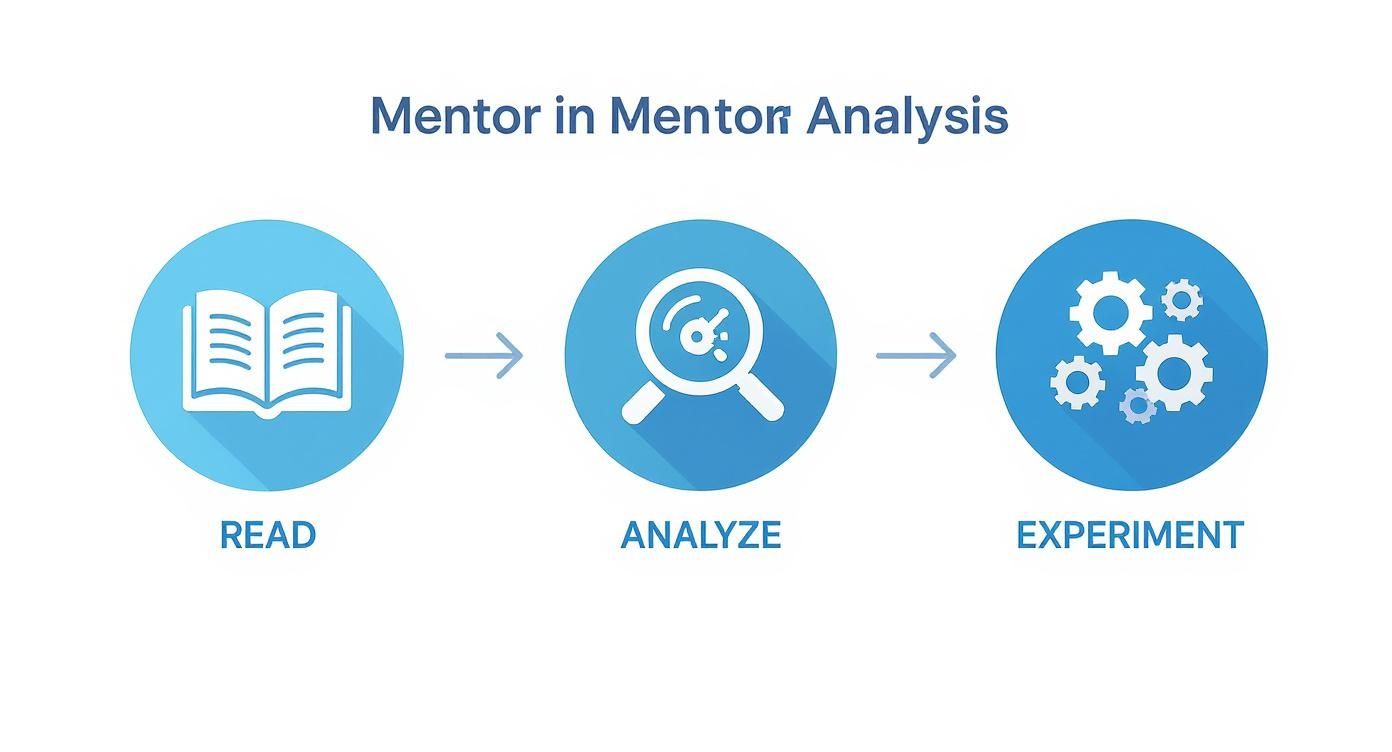
It’s a cycle of actively deconstructing style and then immediately putting what you’ve learned into practice.
Try On Another Brand’s Style
Here’s another great exercise: the "brand voice" challenge. Pick a subject you know inside and out, but this time, write about it in the voice of a brand you recognize instantly. Think Nike, Apple, or a quirky startup whose emails you actually enjoy reading.
The point isn’t to become a copycat. It's about feeling the deliberate choices they make in word selection, rhythm, and sentence construction. By stepping into another voice, your own "default settings" become glaringly obvious. To dig deeper into this, check out our guide on how to vary sentence structure.
A versatile voice isn't a chameleon that changes completely. It’s a voice that knows how to adjust its tone without losing its core identity. It’s still you, just speaking a slightly different dialect for the situation.
As you get more comfortable, you might want a bigger sandbox to play in. A project like learning how to make and sell an ebook is a fantastic way to put your voice to the test on a larger scale and build a real connection with readers.
This control is especially critical if you use AI to help with drafting. At PureWrite, we’re obsessed with helping you take that generic AI output and infuse it with your practiced, refined voice, making sure the final piece is unmistakably human.
Using AI Tools to Enhance Your Voice, Not Replace It
AI tools can be a fantastic partner in your writing process, but it's critical to stay in the driver's seat. At PureWrite, our philosophy is that technology should support human creativity, not erase it. The trick is to treat AI as an ethical assistant that helps you refine your voice—not a machine that dictates it.
For many writers, the biggest win with AI is overcoming the blank page. It's a great way to brainstorm ideas, create an outline, or get a messy first draft on paper. This frees you up to focus on the real work: injecting that text with your unique personality and perspective.
Get an Objective Look at Your Style
One of the most ethical ways to use AI is as an objective mirror for your own work. Try feeding it a sample of your writing and asking for an analysis. A simple prompt like, "Analyze this text and describe its tone, pacing, and overall voice. What are its defining characteristics?" can be incredibly revealing.
This gives you an unbiased take on how your voice comes across to a reader, helping you spot patterns you might have missed. Think of it as another data point you can use to be more intentional about the voice you're building.
It's no secret these tools are popular. The AI writing assistant market is on track to hit USD 4.88 billion by 2030, showing just how many people are leaning on them for support. A recent survey even found that 68% of users felt AI helped them strengthen their voice by offering feedback on tone and audience fit. You can dig into the numbers in this in-depth market report.
You are always the writer, and the AI is always the assistant. Treat its suggestions as possibilities, not commands. The final say on every single word belongs to you.
Critically Evaluate AI Suggestions
When you use AI for stylistic feedback, you have to put on your editor’s hat and evaluate every suggestion critically. Does that new phrase actually sound like something you would say? Does it fit the core voice you've been working so hard to uncover?
Here are a few practical ways to use AI for refinement without losing your authentic self:
- Ask for Alternatives: Highlight a sentence that feels a bit weak and ask for five different ways to phrase it. Pick the one that feels most like you, or mix and match ideas.
- Request a Tone Shift: Take a paragraph and ask the AI to rewrite it to be more humorous, more formal, or more empathetic. This is a great exercise to see your own ideas through a different lens.
- Identify Weaker Words: Prompt it to hunt down passive voice, generic verbs, or clichés hiding in your draft. It’s like having a second pair of eyes that never gets tired.
This is exactly where a tool like PureWrite comes in. Once you have a draft—whether from an AI or your own brain—our platform helps you humanize that robotic, clunky text into something natural and authentic. You can learn more in our guide to using an AI text humanizer.
Keeping Your Voice Consistent and Real for the Long Haul
Figuring out your writing voice is a fantastic achievement, but the real challenge is keeping it consistent. Consistency is how you build trust and make your audience feel a genuine connection with you, whether they're reading a blog post, an email, or a social media update.
Staying consistent doesn't mean your writing should sound static or never evolve. It’s about having a recognizable core that anchors all your content, no matter the topic or platform. One of the best ways to nail this is by creating a personal style guide.
Build Your Personal Style Guide
Think of a style guide as the blueprint for your voice. It’s a simple document that clearly defines the key elements of your communication style. It’s your go-to resource to keep your writing grounded and sounding like you.
Here’s what you might include in yours:
- Core Voice Principles: Jot down a few bullet points that capture your voice. For example: "Clear, witty, and encouraging," or "Authoritative but approachable."
- Favorite Words and Phrases: Make a list of words or phrases you naturally gravitate towards. This gives your writing its unique flavor.
- Stylistic No-Gos: Note any habits you want to avoid, like industry jargon, clichés, or a tone that just doesn't feel right.
This little document is incredibly powerful, especially as you produce more content or work with others. It becomes a central piece of a strong digital content strategy, making sure every single piece feels like it came from the same person.
Your writing voice isn't set in stone; it will absolutely evolve as you grow. The trick is to let it mature while holding onto the core of who you are.
Finally, don't be afraid to ask for a gut check. Share your work with a trusted friend or colleague who knows you well and ask them one simple question: "Does this sound like me?" An outside perspective can be a lifesaver, pointing out when you might have drifted away from your authentic self.
As you continue to write and refine your voice, we at PureWrite are here to help. Our platform is designed to help you polish drafts and humanize AI text, all while ensuring your unique voice shines through. Give PureWrite a try to keep your writing consistently and authentically you.
Got Questions? Let's Talk Voice.
We get a lot of questions about the whole "writing voice" thing. It can feel a bit abstract, so let's clear up a few common points.
So, How Long Does This Actually Take?
Finding your voice is a journey, not a destination you suddenly arrive at. For some writers, a distinct style clicks into place relatively early. For others, it’s a slower burn that emerges over years of putting words on the page.
There's no magic timeline. The best thing you can do is just keep writing. The exercises in this guide will definitely give you a shortcut, but remember your voice will always be a work in progress. It will shift and deepen as you do.
Can I Have More Than One Voice?
Yes, and you absolutely should. Think of it this way: you have one core personality, but you don't talk to your CEO the same way you talk to your best friend over coffee. You’re still you, but you adapt your tone.
It's the exact same with writing. You have a core voice—the fundamental rhythm and perspective that makes your writing yours. But you can apply different tones to that voice. The way you write a casual blog post will sound different from how you write a formal research paper, but the underlying authenticity should still be there.
Help! My Writing Is So Boring. What Do I Do?
First off, that's a common feeling. "Boring" writing usually comes from one place: fear of sounding dumb, getting it wrong, or being judged. It makes us write cautiously, and caution is the enemy of an interesting voice.
Go back to the 'free writing' exercise we talked about. It's designed to help you shut down that inner critic and just get raw ideas out. Another practical tip? Hunt down weak verbs, chop up long sentences, and inject more of you—your real opinions, your weird anecdotes, your genuine curiosity.
Ready to make sure your writing always sounds like you? At PureWrite, we’ve designed a tool specifically to help you analyze, refine, and protect your unique voice. Whether you're polishing your own drafts or humanizing AI content, our platform helps your style shine through.
See how it works at https://purewrite.io.