How to Vary Sentence Structure for More Engaging Writing

Varying your sentence structure isn't an academic trick; it's about mixing things up to create a better reading experience. You simply blend short, punchy statements with longer, more descriptive ones. It’s a surprisingly simple way to give your writing a natural rhythm, making it far more engaging and easier for your audience to read.
Mastering this skill is what separates functional text from truly captivating content. This guide will give you practical, actionable advice to transform your writing, whether you're a content creator, student, or a professional using AI writing tools.
Why Sentence Variety Is a Game Changer for Readability
Have you ever read a paragraph that felt robotic or just plain dull? The problem often isn't the ideas but a repetitive sentence structure. When every sentence is the same length and follows the same pattern, the text becomes monotonous, and your reader's attention is bound to drift.
By learning how to vary your sentences, you can transform a flat block of text into a dynamic conversation. This simple shift pulls readers in, making complex topics easier to digest and more enjoyable to follow. For a full picture of creating successful online content, understanding the ins and outs of writing good articles that rank is crucial, and sentence variety is a cornerstone.
The Human Touch in an AI-Driven World
This skill is especially critical now that AI writing tools are common. While fantastic for brainstorming and first drafts, AI often produces text with an overly uniform sentence pattern. In fact, studies show that over 60% of people are wary of content written by AI, often because that "flat sentence rhythm" creates a robotic feel.
Learning to add that human touch of variety is what elevates good content to great content—the kind that keeps readers hooked. At PureWrite, we champion ethical AI usage. We believe you should use tools to assist, not replace, the authentic writer behind the screen.
By intentionally mixing sentence lengths and structures, you guide the reader's experience. A short, direct sentence can deliver a powerful punchline. A longer, more detailed one can immerse them in a complex idea.
This strategic approach sharpens your clarity and impact. When you combine sentence variety with the principles of brevity, your writing becomes both engaging and efficient. You can dive deeper into this idea in our guide on what is concise writing, a perfect complement to the techniques here.
Beyond Readability: The SEO Connection
Varying your sentences isn’t just about sounding better; it directly impacts key engagement metrics that Google watches, like time on page and bounce rate. When your readers are engaged, they stick around longer, sending a powerful signal to search engines that your content is valuable. High-quality, readable content consistently correlates with better search rankings.
Struggling to make your AI-generated text sound more natural? We designed PureWrite to humanize your content, helping you easily introduce the kind of sentence variety that captures and holds a reader's attention. Try it and see the difference.
Mastering the Rhythm of Your Writing with Sentence Length
Think of sentence length as the beat behind your words. A steady, predictable rhythm can make your reader's eyes glaze over. But a dynamic rhythm? That pulls them in, holds their attention, and guides them through your ideas with purpose.
This is the art of intentionally mixing up your sentence lengths to control the pace and energy of your writing. It’s less about following a rigid formula and more about feeling the flow, making conscious choices to create a specific effect on your reader. You are in complete control.
The Power of Short and Long Sentences
Short sentences hit hard. They're direct, punchy, and incredibly easy to understand. You can use them to land a key takeaway, make a bold claim, or inject a bit of urgency. They stop the reader in their tracks.
Longer sentences serve a completely different purpose. They’re perfect for pulling a reader deep into a complex thought, weaving together related ideas, or painting a vivid picture. They encourage a slower, more immersive pace for your reader.
The real magic happens when you combine them. A short, sharp sentence immediately following a long, flowing one creates a powerful contrast that makes your main point unforgettable. It's like a spotlight, drawing the reader’s focus exactly where you want it.
For instance, you could build up an argument over several descriptive sentences and then—BAM—hit them with a short, declarative statement that seals the deal. This kind of contrast makes your writing feel confident and crystal clear.
Finding the Right Balance
So, what’s the sweet spot? There's no one-size-fits-all rule, but an average sentence length of 15 to 20 words keeps things readable for a general audience. This isn't about making every sentence 15 words long; it's about blending short, medium, and long sentences to hit that average.
This mix is crucial. Too many short, choppy sentences can feel simplistic or even childish. On the flip side, a wall of long, complex sentences can feel dense and overwhelming. The goal is a natural, conversational flow. A great way to get started is by mastering the basics, which we cover in our guide with examples of simple sentences.
To help you visualize how to use different sentence lengths effectively, here’s a breakdown of their impact:
The Impact of Sentence Length on Reader Experience
This table illustrates how different sentence lengths serve distinct purposes in writing, helping you choose the right length to achieve a specific effect.
| Sentence Length | Effect on Reader | When to Use It | Example |
|---|---|---|---|
| Short (3-8 words) | Creates emphasis, urgency, or clarity. | For key takeaways, bold statements, or transitions. | It was over. |
| Medium (15-20 words) | Feels natural and conversational; easy to follow. | For the main body of your text, explaining ideas. | The team worked tirelessly to meet the deadline, collaborating on every aspect of the project. |
| Long (25+ words) | Immersive and detailed; shows relationships. | For describing complex scenes or connecting multiple ideas. | While the initial data suggested a straightforward solution, further analysis revealed a web of interconnected variables that required a more nuanced approach. |
As you can see, each length has its place. The key is to orchestrate them in a way that serves your message and keeps your reader hooked.
Practical Techniques for Varying Length
Putting this into practice is simpler than it sounds. As you edit, just keep an eye out for opportunities to mix things up.
- Spot the Ramblers: Hunt for those extra-long sentences that try to do too much. Often, one long sentence is just two or three shorter, clearer ideas tangled together. Unravel them.
- Combine the Choppy Bits: Look for a string of very short sentences covering the same idea. Fusing them into a single, more fluid sentence can improve the flow and clarify the relationship between the thoughts.
- Read It Aloud: This is the ultimate test. Your ears won't lie. As you read, you’ll hear where the rhythm stumbles, rushes, or drags. That’s your cue to make a change.
Let’s see it in action.
Before:
The marketing team launched the campaign. It was a big success. The campaign generated many new leads. It also increased brand awareness significantly. Everyone was very happy with the results.
After:
The marketing team launched the new campaign, which was a big success. By generating a significant number of new leads and boosting brand awareness, it exceeded all expectations. Everyone was thrilled.
See the difference? The revised version combines the choppy sentences, adds a connecting phrase, and ends with a short, punchy sentence. The rhythm is far more engaging, and the message lands with more sophistication.
How to Mix Up Your Sentence Openings
If every sentence you write starts the same way—"The team did this," "He said that," "It was clear that"—your reader will get bored, fast. That rigid, predictable rhythm is a hallmark of robotic writing and a sure-fire way to make your reader’s eyes glaze over.
Breaking free from this subject-verb-object rut isn't just about sounding less monotonous. It's about taking control of your writing. When you intentionally vary how your sentences begin, you guide your reader's focus, create a natural flow, and make your message far more engaging.
Start with an Adverb
One of the quickest fixes is to lead with an adverb. These are the "-ly" words (and others) that tell you how something happened. Moving one to the front of a sentence instantly changes the rhythm and emphasis.
For a simple tweak, instead of this:
- The team quickly finished the project under budget.
Try this:
- Quickly, the team finished the project under budget.
See the difference? It’s subtle, but effective. This also works beautifully for setting a tone. Words like "Surprisingly," "Unfortunately," or "Ultimately" act like a lens, coloring the reader's interpretation of everything that follows.
Lead with a Prepositional Phrase
Here’s another powerful move: open with a prepositional phrase. Think of phrases like "in the morning," "under the surface," or "without a doubt." They add context about time, place, or manner right from the start, painting a richer picture for your reader.
For example, a standard sentence might look like this:
- The marketing report revealed surprising insights after weeks of research.
By front-loading the context, you add a little suspense and gravity:
- After weeks of research, the marketing report revealed surprising insights.
This little shift emphasizes the effort involved before you even get to the payoff. Research shows this kind of active sentence manipulation can significantly boost readability by breaking up mechanical patterns.
When you give your reader context first, you’re giving them a frame of reference for the main point. It’s a small change in word order that makes your writing feel far more dynamic.
Use a Dependent Clause to Build Interest
Ready for a more advanced technique? Start your sentence with a dependent clause. This is a group of words that can’t stand alone and usually kicks off with a word like "Although," "Because," "While," or "If."
Using this structure is perfect for weaving together complex ideas and creating a cause-and-effect relationship.
Instead of writing two separate ideas, you can connect them like this:
- Before: The product launch was a success, although the team faced several unexpected delays.
- After: Although the team faced several unexpected delays, the product launch was a success.
Starting with "Although" immediately signals a contrast, which makes the successful launch feel that much more impressive. This structure pulls your reader along, creating a natural tension that gets resolved by the main clause.
The Role of Transitional Phrases
And of course, don't forget your trusty transitional phrases. Words like "For example," "However," and "In addition" are the signposts of good writing. They guide your reader smoothly from one thought to the next.
Placing them at the beginning of a sentence is one of the most natural ways to vary your sentence openings while making your logic crystal clear. For more options, you can explore our list of transitional words and phrases to find the perfect connector.
Getting comfortable with varying your sentence openings is a skill that comes with practice. When you’re editing, just keep an eye out for paragraphs where two or three sentences in a row start the exact same way. That's your cue to jump in and rearrange things for a better rhythm.
Using Different Sentence Types for Greater Impact
Beyond changing up lengths and openings, real writing power comes from knowing your way around the four fundamental sentence types. When you understand how to use simple, compound, complex, and compound-complex sentences, you gain precise control over your message.
Each structure has a specific job. A short, simple sentence delivers a punch, while a complex sentence can elegantly show how two ideas are connected. Choosing the right tool for the job is how you build clear arguments and tell a story that keeps people reading.
The Four Core Sentence Structures
Let's dive into these four types. Instead of getting lost in technical jargon, we’ll focus on what each one actually does for your writing.
To make this easier, here's a quick breakdown of the four primary sentence structures, including what they're made of and when you'd want to pull them out of your toolkit.
A Practical Guide to the Four Sentence Types
| Sentence Type | Structure | Primary Use Case | Example |
|---|---|---|---|
| Simple | One independent clause. | Stating a clear, direct fact or creating emphasis. | The project is complete. |
| Compound | Two or more independent clauses joined by a conjunction. | Connecting two equally important, related ideas. | The team finished the report, and the client was thrilled. |
| Complex | One independent clause and at least one dependent clause. | Showing a cause-and-effect or conditional relationship. | Because the launch was successful, we celebrated with the team. |
| Compound-Complex | Two or more independent clauses and at least one dependent clause. | Expressing multiple, interconnected ideas in a single, fluid thought. | Although the deadline was tight, the team collaborated effectively, and the project succeeded. |
This table isn't about memorization; it's about recognizing the patterns so you can start using them intentionally to create a better reading experience.
For a deeper dive, our guide on compound and complex sentences is packed with more examples to help you master these essential structures.
Weaving in Complexity with Purpose
The last two types are where you can really start adding nuance and sophistication to your writing.
A complex sentence is your go-to for showing cause-and-effect. It has an independent clause (a full thought) and at least one dependent clause (an incomplete thought). See how "Because the market shifted" sets up the main point here: Because the market shifted, the company had to rethink its strategy.
A compound-complex sentence is a blend of the two. It contains at least two independent clauses and at least one dependent clause. You'll want to use these sparingly, but they're perfect for tying together multiple related ideas into one flowing statement. For example: Although the project was challenging, the team persevered, and they ultimately delivered a successful product.
This diagram highlights a few simple ways to vary your sentence openings, which is a great first step toward using more diverse sentence structures.
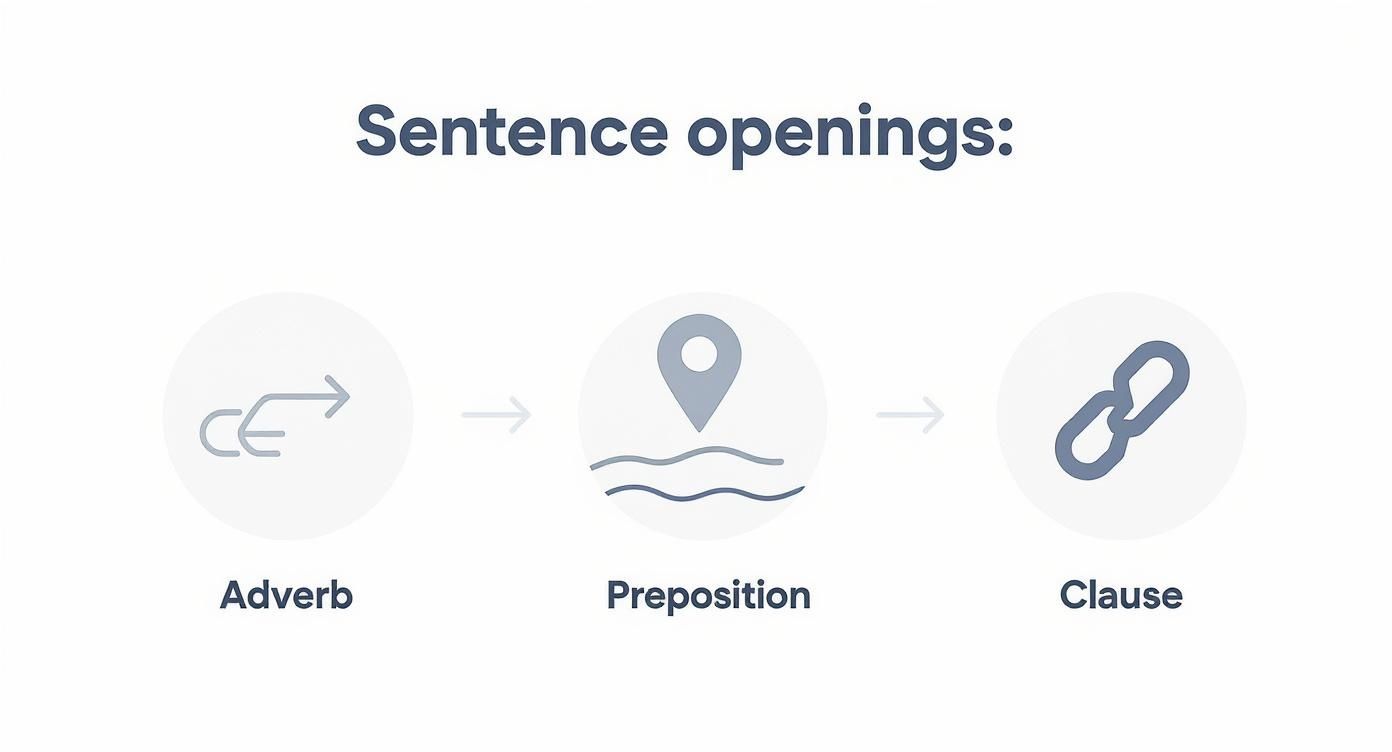
As you can see, just starting a sentence with an adverb or a prepositional phrase instantly changes its rhythm.
Avoiding the Simplicity Trap
It's natural to lean on simple sentences when trying to write clearly. However, one study found that writers often default to simple sentences, which can flatten their arguments and make the text feel monotonous. That’s why learning how to vary sentence structure is so crucial—it’s what separates basic writing from truly impactful communication.
The goal isn't to make every sentence complicated. It’s to choose the structure that best serves your idea. Sometimes, a simple sentence is the most powerful tool you have. The art is in the mix.
You might notice that AI writing tools often make the same mistake, defaulting to simple structures to prioritize readability. This can strip the nuance from your work. We built PureWrite to fix this. It helps humanize AI content by suggesting more sophisticated structures where they’ll improve flow and add depth, all without losing your authentic voice.
Think about the skill involved in crafting impactful meta descriptions. That's a perfect micro-example of how sentence variety makes even the shortest text more engaging.
A Practical Checklist for Editing Your Sentences
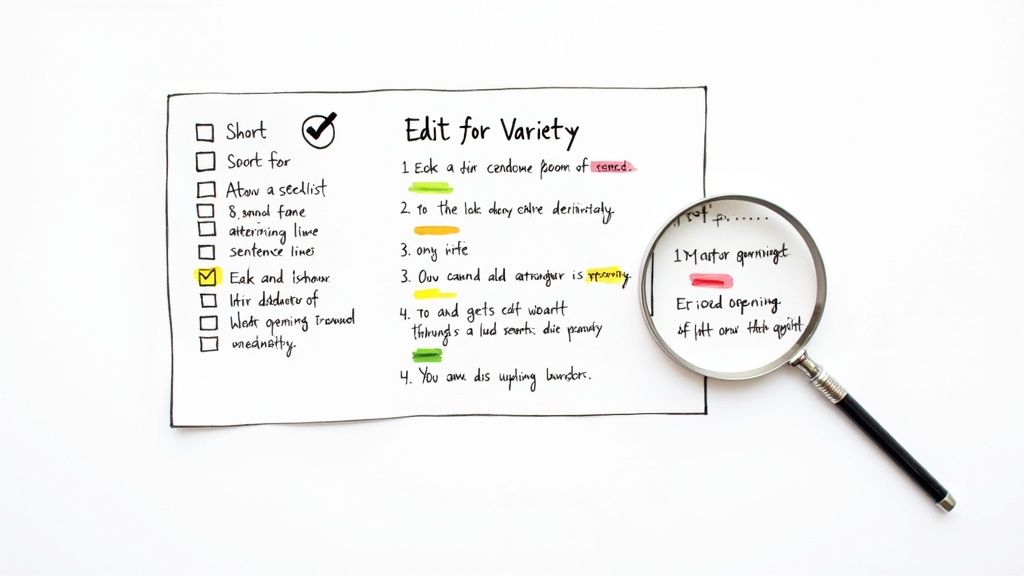
Knowing the theory is great, but real improvement happens when you roll up your sleeves and edit. This practical checklist helps you spot weak points in your drafts and make your writing more dynamic. Think of it as your final quality check before hitting "publish."
This step is critical if you're working with AI-generated drafts. AI often produces text with a flat, predictable rhythm. Learning how to vary sentence structure is how you transform a functional draft into something that feels genuinely human and authentic.
Start with a Read-Aloud Test
Before you touch a single word, read your entire piece out loud. Seriously. It's the single best way to catch awkward phrasing and monotonous pacing that your eyes just skim over.
As you read, listen for a few specific things:
- Choppy Sections: Does it sound like you're reading a grocery list? That's a classic sign of too many short, simple sentences stacked together.
- Breathless Moments: If you find yourself gasping for air mid-sentence, you’ve found a runaway train that needs to be broken up.
- Repetitive Cadence: Does every sentence have the same beat? Subject-verb. Subject-verb. That’s the robotic rhythm you’re trying to eliminate.
This simple auditory check gives you a roadmap for your edits, showing you exactly where the flow breaks down.
The Highlighter Trick for Sentence Openings
Next up, grab a highlighter (virtual or real, your choice). Go through your text and highlight just the first word of every single sentence. It’s a simple visual trick, but it makes repetitive sentence starts impossible to ignore.
Seeing a sea of highlights on words like "The," "It," or the same subject over and over again? That's your cue to shake things up. Try kicking off one of those sentences with a prepositional phrase, an adverb, or even a dependent clause to instantly break that pattern.
This isn't about avoiding subject-first sentences entirely. It's about breaking up the monotony. A simple reordering can make your paragraphs feel more sophisticated and less predictable, which is exactly what you need to hold a reader's attention.
Analyze Your Sentence Lengths
Now, step back and look at the visual shape of your paragraphs. Do all the sentences look like they're roughly the same length? You can often spot the problem with a quick glance. You're aiming for a healthy mix of short, medium, and long sentences.
Here's a quick checklist to run through:
- Spot the Longest Sentence: Is it trying to do too much? See if you can split it into two or three shorter, punchier sentences for clarity.
- Find the Shortest Sentences: Got a bunch of them in a row? Try combining two related ideas into a single, more fluid complex or compound sentence.
- Check for Contrast: Is there a long, descriptive sentence followed by a short, impactful one? That's a powerful way to create emphasis.
These steps help you consciously sculpt the rhythm of your writing. If you need a refresher on the fundamentals, our guide on basic grammar rules is a great place to start.
Let PureWrite Handle the Heavy Lifting
Manually checking every sentence can be a grind, especially on a deadline. This is where a good tool becomes your best friend. We actually designed PureWrite to tackle this exact problem, especially for those working with AI drafts that often lack variety.
Our tool analyzes your text and flags repetitive patterns for you. It then suggests structural variations that improve the flow while keeping your unique voice intact. It’s about empowering you to polish your content and turn a functional draft into a final piece that sounds authentically like you.
Ready to see how it works? Give PureWrite a try and turn your editing process from a tedious chore into a creative partnership. You can humanize your content in a few clicks and be confident that your writing is engaging, natural, and truly yours.
Answering Your Questions About Sentence Structure
Even when you know the techniques, putting them into practice can feel tricky. Let's tackle some of the common questions that pop up when writers start focusing on sentence variety. Think of this as a quick-and-dirty guide to keep handy during your editing phase.
These are the kinds of questions we hear all the time, whether someone is polishing their own draft or wrestling with clunky AI-generated text.
How Often Should I Mix Things Up?
There's no magic number here. The real goal is to create a rhythm that sounds natural and conversational.
The single best way to gut-check your work? Read it out loud. If you start to sound robotic, or if the flow feels choppy and disconnected, that’s your signal to shake things up.
As a general guideline, try not to use the exact same sentence length or opening more than two or three times in a row. You're using a mix of sentence types to guide your reader through your ideas, not just to check a box.
What’s the Easiest Way to Get Started?
Start with sentence length. It’s the simplest change with the biggest impact on readability and flow.
After you write a paragraph, just give it a quick visual scan. Do all the sentences look like they're the same size? If so, you've found a perfect spot to make a quick improvement.
Here are two easy wins:
- Split a long sentence. A long, rambling sentence is often just two or three shorter, clearer ideas fighting to get out. Break them apart.
- Combine two short sentences. Got a couple of short, choppy sentences back-to-back? Join them with a simple conjunction (like "and," "but," or "so") to create a smoother, more connected thought.
Another dead-simple fix is to watch your sentence beginnings. If you notice three sentences in a row all starting with "The," just rework one of them. A tiny tweak, like kicking it off with a prepositional phrase ("In the end...") or an adverb ("Ultimately..."), can make a world of difference.
Can You Vary Sentence Structure Too Much?
Oh, absolutely. The number one rule of good writing is clarity. If your quest for variety ends up making your sentences convoluted, confusing, or just plain hard to read, you've officially gone too far.
Writing that’s stuffed with too many long, overly complex sentences will feel dense and intimidating. Your reader will tune out.
Remember, variety is there to serve your message, not to show off your grammatical gymnastics. A short, punchy sentence can land with just as much impact as a long, elegant one. Balance is everything.
Feeling like you're spending way too much time manually tweaking every single sentence? PureWrite was built to do that heavy lifting for you. Our tool intelligently scans your text, suggests natural-sounding variations, and helps you humanize AI content in a fraction of the time. It keeps your writing clear, engaging, and genuinely yours. Try PureWrite today and see the difference!