How to Paraphrase Without Plagiarizing: A Practical Guide for Creators
Learning how to paraphrase without plagiarizing is more than a technical skill. It's about genuinely understanding an idea and explaining it in your authentic voice. The key is to shift from "rewording" to "re-explaining," conveying the original concept from your perspective while always giving credit.
This guide provides actionable advice for content creators, students, and professionals using AI tools, emphasizing ethical practices for authentic writing.
Paraphrasing Is More Than a Word Swap
Let's get one thing straight: true paraphrasing isn't just plugging a sentence into a thesaurus. Many fall into the trap of changing a few words, a practice known as "patchwriting." This shortcut is easily spotted by plagiarism checkers and can seriously damage your credibility.
The goal is to digest the author's point so thoroughly you could explain it to a friend without looking at the source. It’s about grasping the core message, not just rearranging the words. This mental shift is your most important first step.
Building on a Foundation of Integrity
When you focus on the meaning behind the text, you naturally move away from the original sentence structure and vocabulary. This not only protects you from plagiarism but also makes you a better writer. It forces you to think critically and articulate ideas in your own way.
Key Takeaway: Strong paraphrasing is a sign of true understanding. It proves you’ve done more than copy—you’ve learned something and can now teach it to others in your own words.
This process—restating an idea while preserving its meaning and citing the source—is what sets good paraphrasing apart. It's crucial because modern plagiarism detectors identify similar text strings, not just stolen ideas. For a deeper dive, the experts at Purdue OWL offer excellent guidance on proper paraphrasing.
Before moving on, let's quickly break down the key differences between paraphrasing correctly and getting it wrong.
Paraphrasing vs. Plagiarizing At a Glance
This table highlights what separates an effective, ethical paraphrase from something that will get you flagged for plagiarism.
| Characteristic | Effective Paraphrasing (Good) | Plagiarism (Bad) |
|---|---|---|
| Structure | The sentence structure is completely different from the original source. | The sentence structure is identical or very similar to the original. |
| Wording | Uses your own vocabulary and phrasing to explain the concept. | Swaps out a few words for synonyms but keeps the core wording intact. |
| Attribution | Cites the original source properly, giving credit to the author. | Fails to cite the source, presenting the idea as your own. |
| Meaning | Accurately represents the original author's intended meaning. | Distorts or misrepresents the original meaning, even if by accident. |
| Example | Original: "The company's Q3 profits surged due to a new marketing strategy." Paraphrase: A fresh marketing approach drove a significant increase in the company's third-quarter earnings (Author, Year). |
Original: "The company's Q3 profits surged due to a new marketing strategy." Plagiarism: The business's Q3 earnings increased because of a new advertising plan. |
Looking at the table, it’s clear that the bad example is just a thinly veiled copy. That’s exactly what you want to avoid.
Why Surface-Level Changes Will Get You Caught
Simply swapping synonyms while keeping the original sentence framework is one of the fastest ways to trigger a plagiarism alert. AI-powered tools are incredibly skilled at recognizing these patterns.
For instance, if the source says, “The rapid advancement of technology significantly impacted global communication,” a weak paraphrase might be, “The fast progress of technology greatly affected worldwide communication.”
The words are different, but the sentence’s DNA is identical. This is why a deeper approach is essential to protect you from accidental plagiarism and help you create more authentic content.
At PureWrite, we believe tools should empower your original thinking, not replace it. Our platform helps you refine and humanize your drafts, ensuring your final work is unique and polished. Ready to elevate your writing? We invite you to try PureWrite.
A Proven Framework for Ethical Paraphrasing
Knowing what paraphrasing is and why it’s important is one thing; actually doing it well is another. Let's get practical. Following a simple, repeatable framework builds good writing habits and removes the guesswork.
At its heart, this isn't about swapping words. It's about internalizing an idea so thoroughly that you can explain it in your own voice, completely detached from the original phrasing. It’s less about mechanics and more about genuine comprehension.
This simple workflow breaks down the process of turning a source into your own original, ethical content.
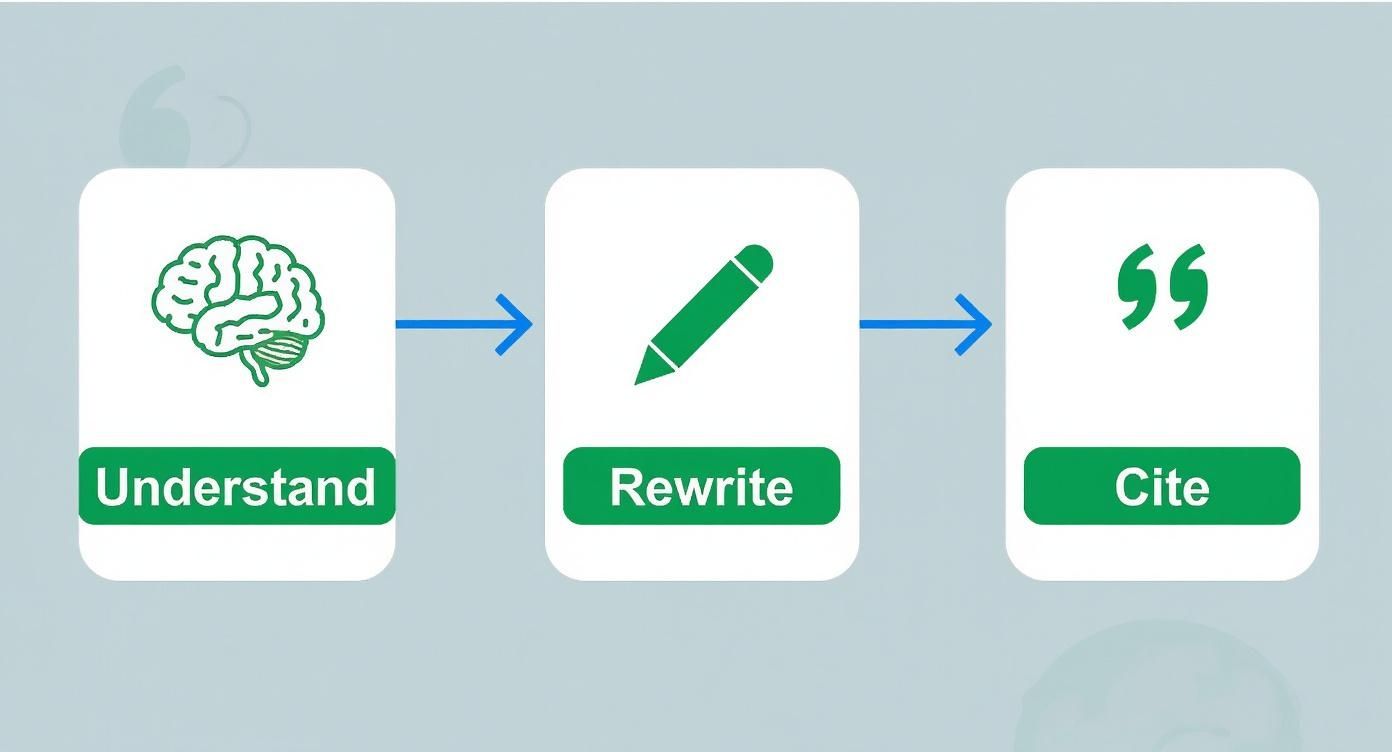
As you can see, the flow moves from deep understanding to independent creation, and it always finishes with proper attribution. This process protects your credibility and respects the original author's work.
First, Truly Master the Source Material
Before you type a single word, you must fully absorb the source. Read the sentence or paragraph you want to paraphrase several times. Don’t just skim—focus on the underlying message, the key data, and the author's main point.
The real test: can you look away and explain the concept out loud? If not, you haven't understood it deeply enough to paraphrase effectively. For more on this, check out our guide on how to improve academic writing.
Next, Use the "Set Aside and Write" Technique
This is the most critical part of finding your own voice. Once you're confident you understand the material, close the book, shut the browser tab, or minimize the window. Get the original text out of your sight.
Now, write your version from memory. The goal is to force your brain to reconstruct the idea using your vocabulary and sentence structures. This simple act is often the biggest difference between weak patchwriting and strong, original paraphrasing.
Pro Tip: Try explaining the concept into a voice recorder first. Speaking an idea naturally can help break the original text's structural hold on your brain, giving you a more authentic starting point for your written draft.
Then, Compare and Refine Your Draft
With your first draft complete, it's time to bring back the source for a side-by-side comparison. This is a quality control check for meaning and originality.
Ask yourself three key questions:
- Is my version accurate? Did I represent the author’s meaning faithfully?
- Is my phrasing original? Did I accidentally use the same unique phrases or sentence structures?
- Does the tone fit? Does my paraphrased version flow naturally with my larger piece?
If you spot phrases that are too close, revise them now. This is where tools can help. Running your draft through an AI humanizer like PureWrite can refine the language, further distancing it from the source while polishing your own voice.
Finally, Always Cite Your Source
This last step is non-negotiable. Even a perfect paraphrase is plagiarism if you don’t credit the original author. Proper citation shows respect and boosts your credibility by demonstrating your ideas are well-researched.
Citation styles vary (APA, MLA, Chicago), so always follow the guidelines for your context. The key is to make it crystal clear where the original idea came from.
Let's see this framework in action.
Original Text:
"The rapid proliferation of mobile devices has fundamentally transformed consumer behavior, granting individuals unprecedented access to information and reshaping the pathways through which they interact with brands."
Applying the Framework:
- Understand: Smartphones changed how people shop and connect with companies because information is always available.
- Set Aside & Write: "Because so many people have smartphones, customer behavior has changed. It’s easier to get info, which alters how they engage with businesses."
- Compare & Refine: The draft is good but a bit clunky. Let's polish it to be more professional.
- Cite: Add the citation according to the required style guide.
Final Paraphrased Version:
The widespread adoption of mobile technology has significantly altered how consumers engage with brands, providing them with constant access to information and creating new patterns of interaction (Author, Year).
This final version captures the original's essence using entirely new vocabulary and structure, all while giving proper credit.
Getting Your Hands Dirty: Transforming Sentences and Paragraphs
Now for the real work: taking apart the original text and rebuilding it as your own. Think of yourself as a mechanic, not a painter. You're changing the engine, not just the color.
This requires a good toolkit. You’ll learn to dissect ideas and rebuild them, ensuring your writing is fresh, original, and accurate.
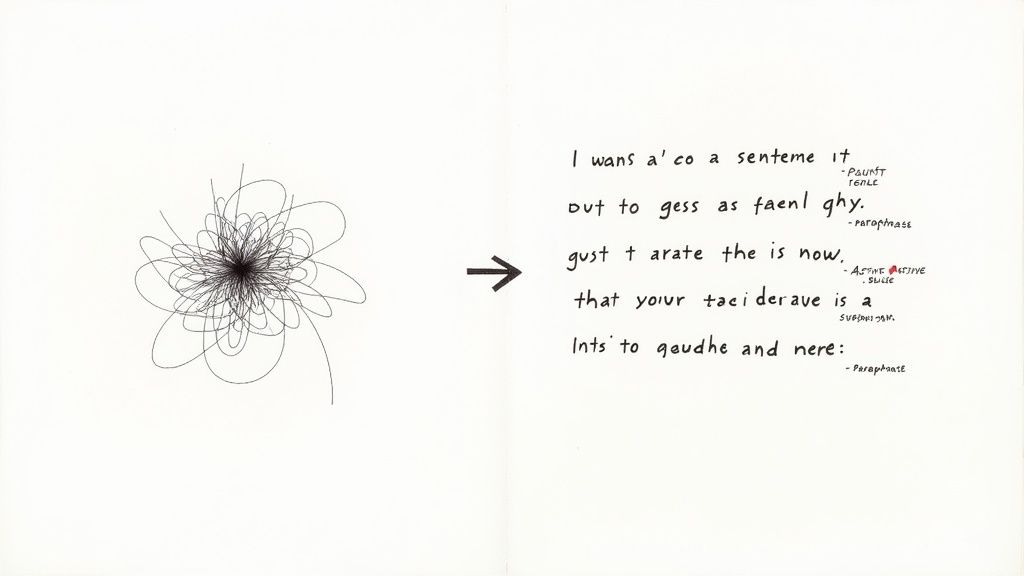
Play with the Sentence Blueprint
One of the most effective ways to avoid plagiarism is by completely changing the structure of a sentence. This isn’t just shuffling words around; it’s about redesigning the entire blueprint.
Here are a few practical ways to do that:
- Flip from Active to Passive Voice (and vice versa): This simple trick can immediately change a sentence's rhythm and focus.
- Combine Short Sentences: Weave together related short sentences into a more sophisticated sentence that shows how the ideas connect.
- Break Down Long Sentences: Unpack long, complex sentences into two or three shorter, clearer ones to improve readability.
Let's look at an example.
Original: "The marketing team launched the new campaign to increase brand awareness."
Paraphrased: "To increase brand awareness, a new campaign was launched by the marketing team."
This change is small, but when combined with other techniques, it creates real distance from the source text.
The Art of Combining and Splitting Ideas
Knowing when to merge ideas and when to break them apart separates good paraphrasing from great paraphrasing. It’s all about controlling the flow of information for your reader.
Let’s see it in action with a content marketing example.
Original Snippet:
"The company experienced rapid growth. This was due to a successful product launch. The launch captured a new market segment."
Paraphrased Version (Combined):
"By capturing a new market segment, the company's successful product launch fueled a period of rapid growth."
We’ve connected the dots for the reader, weaving three separate facts into one elegant sentence that explains the why behind the growth. This demonstrates true understanding.
Key Insight: Restructuring sentences isn't just a defensive move to avoid plagiarism. You’re taking control of the narrative and presenting information in a way that best serves your audience.
Using a Thesaurus Without Sounding Like a Robot
We’ve all seen it: paraphrasing that looks like someone just right-clicked every other word and picked a synonym. This almost always sounds clunky and can even change the original meaning. Context is everything.
Don't just grab the first synonym you find. Ask yourself: does this new word have the right nuance? Does it fit the tone?
Let’s break it down.
Original: "The research produced significant results."
Weak synonym swaps look like this:
- "The research produced notable results." (Too close.)
- "The research produced momentous results." (Too dramatic.)
A better approach is to rethink the whole phrase.
Stronger Paraphrase: "The findings from the research were highly consequential for the study's conclusions."
This version is superior because it rephrases the entire concept. It’s accurate, original, and demonstrates a real command of the topic.
Putting It All Together: A Real-World Example
Let's walk through a full transformation, taking a dense academic paragraph and turning it into something fresh and readable for a blog post.
Original Paragraph (from a journal):
"Cognitive biases, which are systematic patterns of deviation from norm or rationality in judgment, often lead individuals to create a subjective social reality. The influence of these biases is particularly pronounced under conditions of uncertainty, where heuristics are employed as mental shortcuts to simplify information processing."
This is dense. Our job is to make it clear and accessible for a marketing audience.
My Thought Process:
Deconstruct the Core Ideas:
- Cognitive biases are flaws in our thinking.
- They make us see the world based on our views, not logic.
- We use them most when we're unsure, as mental shortcuts.
Rewrite from Scratch for a Content Creator:
"We all have mental shortcuts, known as cognitive biases, that cause us to stray from logical thinking. These biases shape our unique perception of the world. People rely on these shortcuts most when facing uncertainty, as it helps them process complex information more easily."Polish and Refine:
This rewritten version is much clearer and uses a conversational tone suitable for a blog post (with proper citation, of course!).
As you practice transforming text, an AI paragraph rewriter can help you brainstorm phrasings, but the final touch should always be human.
Ultimately, great paraphrasing is a creative skill. At PureWrite, we help you refine that creativity. Give PureWrite a try and see how we can help you turn your drafts into polished, authentic content.
Using AI Paraphrasing Tools Ethically and Effectively
AI paraphrasing tools are fast and efficient, but they are not a magic bullet for creating original work. To use them ethically, you must treat them as a starting point—an assistant for brainstorming, not a ghostwriter. The danger lies in assuming an AI's output is inherently original.
That assumption can land you in serious trouble. Many AI models are trained on existing text from across the internet, and their paraphrased output can hug the source material too closely. This creates a high-tech version of patchwriting that plagiarism checkers will flag. It's your responsibility to use tools like AI text generation tools like Stealthgpt responsibly.
The Hidden Risks of AI-Generated Text
The explosion of AI has blurred the lines of traditional plagiarism. Research shows that AI-generated academic content can contain up to 60% plagiarized material when citations are missing. That's a huge risk for any writer, student, or marketer.
In some technical fields, certain GPT models have produced outputs with paraphrasing rates as high as 80.7%. Hitting "paraphrase" and copy-pasting is a recipe for disaster. The responsibility to ensure originality and give proper credit always rests with you.
Think of AI as providing raw clay. You're still the sculptor who shapes it into something unique and ethical.
A Smarter Workflow: AI and Human Collaboration
The most effective way to use AI is by making it part of a human-led process. Use its output as a rough first draft that you then critique, edit, and refine. This approach keeps you in control, ensuring the final message is accurate and your own voice shines through.
Here’s a practical, ethical workflow you can use today:
- Generate a First Draft: Use an AI tool to paraphrase source material or kickstart ideas on how to phrase a concept.
- Critically Review and Rewrite: Compare the AI's output with the original source. Did it capture the meaning correctly? Is the structure and wording different enough?
- Humanize the Content: This is where we at PureWrite can really help. Take that clunky, AI-generated draft and run it through our platform to humanize it. Our tool is designed to smooth out robotic phrasing and make the text sound genuinely authentic. You can learn more about how to rewrite AI text to human in our detailed guide.
- Check for Plagiarism and Cite: Run your final, humanized version through a trusted plagiarism checker. And, most importantly, add your citation to give proper credit.
This workflow transforms AI from a potential liability into a powerful and responsible partner in your writing process.
Key Takeaway: AI should serve your writing process, not dominate it. The best results come from a smart partnership where technology handles the initial work, and your human intelligence provides the critical thinking, ethical oversight, and final polish.
By embracing this collaborative mindset, you can use AI paraphrasers to work faster without cutting corners on quality or integrity. We invite you to try PureWrite for free and turn your AI drafts into polished, authentic writing.
Your Final Pre-Flight Check: Is Your Work Truly Original?
Before you hit “publish,” run one last check. This isn't just about avoiding trouble; it’s about protecting your credibility and ensuring the work you're putting out there is genuinely yours. Think of this as your personal quality control.
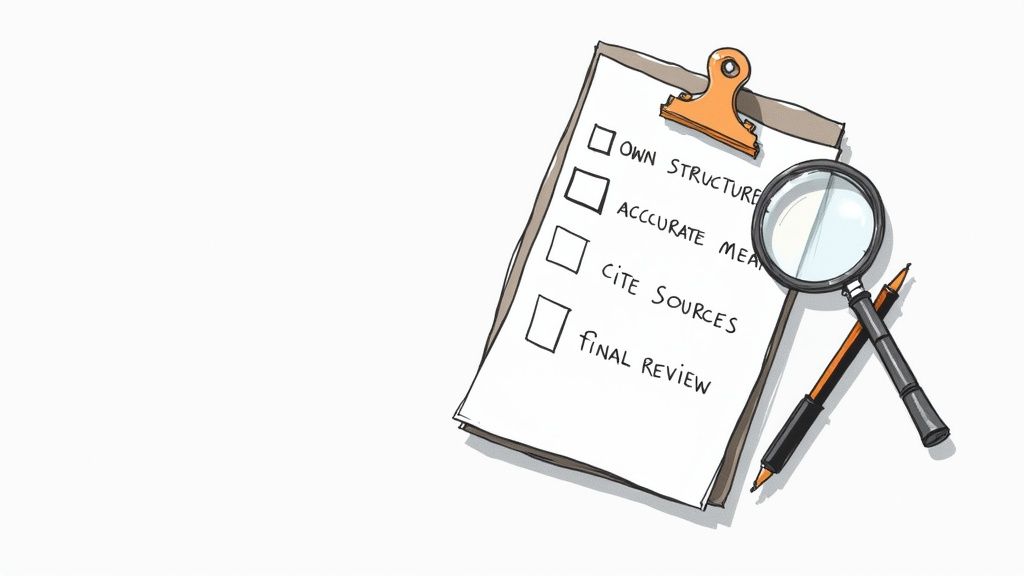
Running through these questions gives you that final dose of confidence. You'll know your content is ethically sound and ready for your audience.
The Originality and Accuracy Scan
First, look at the writing itself. The goal is to confirm your paraphrased content is a true re-articulation that honors the original meaning.
- Is the sentence structure mine? Compare your version to the original source. If the rhythm and clause sequence are the same, you need to restructure it further.
- Does my version preserve the original meaning? A good paraphrase never distorts the author's point. Double-check that your wording accurately reflects the source's intent.
- Did I accidentally keep any unique phrases? If the original author used a particularly memorable phrase, make sure you haven't borrowed it without putting it in quotation marks.
The Citation Check
Even a brilliantly paraphrased sentence is still plagiarism if you don't credit the source. This is non-negotiable.
The Golden Rule: If the idea, statistic, or concept didn't originate in your own brain, it needs a citation. Period.
Plagiarism is a bigger issue than many realize. Studies show that when students know their work will be scanned by plagiarism detectors, they produce more original content, as detailed in this report on plagiarism statistics. Having a system in place to check your work clearly makes a difference.
For students, it’s especially helpful to know how tools like Turnitin work. If you're curious, we have a complete guide that breaks down what does Turnitin check for.
The Final Polish and Tech-Assist
Once you've manually reviewed your work, let technology give it one last look. This is your objective safety net.
- Read It Out Loud: This old-school trick is surprisingly effective for spotting awkward phrasing or clunky sentences—often a giveaway of a weak paraphrase.
- Run a Plagiarism Scan: Use a reliable plagiarism checker as your final backstop to catch similarities the human eye might miss.
- Enhance for Authenticity: At PureWrite, we believe your work should sound like you. After writing and citing, our tool can polish your draft to ensure it flows with a natural, human voice.
Following this checklist helps build the habits of a thoughtful, ethical writer. For that final layer of polish, try PureWrite to make sure your content is as authentic as it is original.
Common Questions About Paraphrasing and Plagiarism
Even when you know the rules, tricky situations can pop up. Let's walk through some of the questions we hear most often from students, content creators, and marketers.
Getting these answers straight will help you write with confidence.
What Is the Difference Between Paraphrasing and Summarizing?
This trips many people up, but the distinction is simple.
Paraphrasing involves taking a specific, small piece of text—like a sentence or paragraph—and putting it into your own words. You keep the same level of detail, so your version is about the same length as the original.
Summarizing, on the other hand, is about taking a much larger work, like a whole article, and boiling it down to its core ideas. You only hit the main points, so the result is much shorter.
How Many Words Do I Need to Change to Avoid Plagiarism?
This is a common myth: there is no magic number. You can't just swap out a few words and call it a day.
Plagiarism checkers are smarter than that. They analyze sentence structure, the order of ideas, and unique phrasing. Trying to hit an imaginary word quota is a recipe for patchwriting, which is still plagiarism.
Key Takeaway: Real paraphrasing isn't about changing words; it's about re-forming the entire idea in your own voice, based on your own understanding. The structure and language should be yours.
What Happens if I Plagiarize Accidentally?
Unfortunately, intent doesn't matter. Accidental plagiarism is still plagiarism, and the consequences can be just as serious.
In college, it could mean a failing grade or even expulsion. Professionally, it can tank your reputation, lead to legal trouble, and erode your audience's trust. This is why building good habits and using a reliable checker is so important.
For anyone in academia, a good plagiarism checker is non-negotiable. You can learn more in our dedicated guide on plagiarism checkers.
When Is It Okay Not to Cite Something?
You don't need a citation for things considered "common knowledge." This includes undisputed facts available in countless general sources.
A few examples include:
- Widely known historical facts: Abraham Lincoln was the 16th U.S. President.
- Basic scientific facts: The Earth revolves around the Sun.
- General geographical information: The Amazon is the longest river in the world.
But be careful. What feels like common knowledge to you might be a specific finding from a researcher's work. When in doubt, just cite it. It's the safest route and makes your work more credible.
Getting the hang of ethical paraphrasing is a skill that grows with practice. At PureWrite, we're here to help you build that muscle. Our platform is designed to help you turn AI drafts into unique, polished writing that passes checks and sounds like you. When you're ready to make sure your work is both original and engaging, give PureWrite a try.