Master the Craft: How to Scale Content Marketing for Rapid Growth
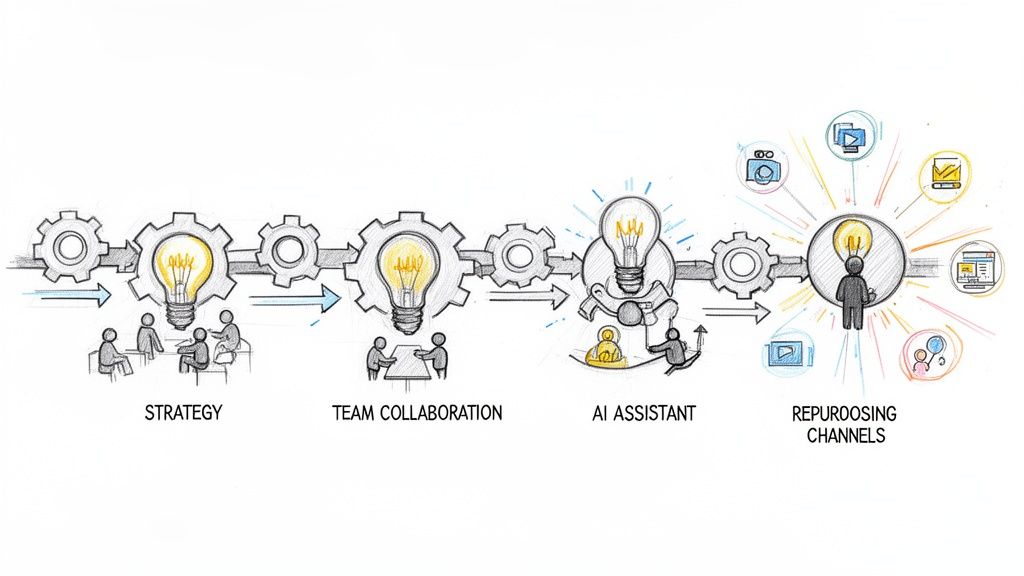
Scaling your content marketing isn't just about doing more. It's about shifting from random acts of content to building a predictable, system-driven growth engine. This means putting core content pillars and clear business goals in place first.
Then, you can build repeatable workflows that deliver quality and consistency, no matter how much you turn up the volume.
Laying the Groundwork for Sustainable Scaling
Before you can hit the accelerator, you have to build a solid foundation. We've seen so many teams try to scale and fail because they jump straight to increasing output. This almost always leads to burnout, inconsistent quality, and content that completely misses the mark.
To sidestep this common pitfall, you need a clear strategy that guides every single piece you create. This isn’t just about making a plan; it’s about architecting a predictable system for success.
A well-defined strategy ensures every blog post, video, or social update serves a specific, strategic purpose. This is how you avoid the "content for content's sake" trap and pour your resources into what actually moves the needle. To really get started, check out this ultimate Content Marketing for Startups: The Ultimate Playbook, which frames content perfectly as a scalable engine for growth.
Identify Your Core Content Pillars
Your content pillars are the big-picture topics your brand will own. These aren’t just keywords; they're the broad subject areas deeply relevant to your audience and your business. Think of them as the main categories on your blog or the central themes of your YouTube channel.
For instance, if you're a project management software company, your pillars might look something like this:
- Team Productivity: Covering everything from time management hacks to running more efficient meetings.
- Project Methodologies: Diving deep into frameworks like Agile, Scrum, and Kanban.
- Leadership & Management: Offering real-world advice on team motivation and resource allocation.
Defining three to five core pillars brings incredible focus to your efforts. It simplifies brainstorming, helps you build topical authority with search engines, and positions you as the go-to resource on these specific subjects.
Set Goals That Actually Matter
Let’s be honest: vanity metrics like page views and social media likes feel good, but they don't pay the bills. A truly scalable content strategy must be tied directly to business objectives. You have to push past the surface-level numbers and focus on goals that show a clear return on investment (ROI).
A saying that guides smart marketers today is: "Your job will not be taken by AI. It will be taken by a person who knows how to use AI." This underscores the importance of using technology to hit strategic goals, not just to mindlessly automate tasks.
So, instead of just tracking traffic, start setting goals like:
- Generating Marketing Qualified Leads (MQLs): How many new, qualified leads did your content bring in this quarter?
- Increasing Demo Requests: Can you directly attribute a spike in product demos to a specific content campaign?
- Driving Trial Sign-ups: Which articles or guides are most effective at turning readers into active users?
When you connect your content directly to these business-critical KPIs, you can finally prove its value and secure the budget you need to scale properly. Crafting this strong foundation is the crucial first step in building a complete digital content strategy that delivers results you can take to the bank.
Designing Your Content Assembly Line
To truly scale content marketing, you need to think less like a publisher and more like a manufacturer. It’s all about building your "Content Assembly Line"—a rock-solid, repeatable system that turns a raw idea into a polished, published asset, every single time.
This is the operational engine that powers your growth. Why the manufacturing analogy? Because scaling isn't just about writing more articles; it’s about mastering your resources. A whopping 66.5% of marketing specialists confess they have a hard time with resource allocation, which is a massive roadblock to growth.
A well-designed assembly line tackles this issue directly, making sure every person, tool, and hour invested pushes you toward your goals. You can see more data on this and other content marketing statistics over at SEOPROFY.com.
This process starts by laying the right groundwork, connecting your high-level strategy to your day-to-day execution.
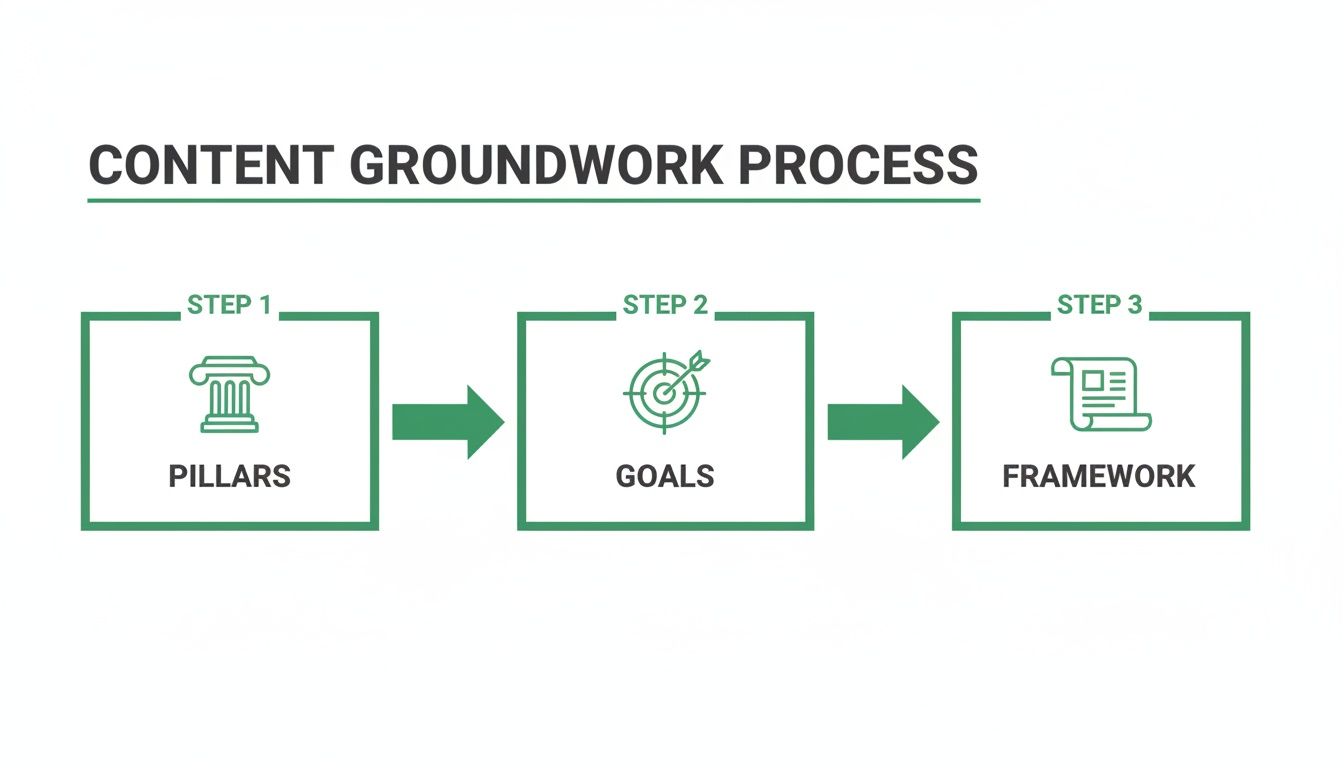
As you can see, your foundational content pillars and business goals are what inform the entire operational framework. This creates a clear line of sight from strategy to the actual work being done.
Building Your High-Performance Content Team
An assembly line is only as good as the people running it. The first step is to define the key roles. You don't need a massive team right away, but you absolutely need clarity on who does what.
Think about these essential roles for your content engine:
- The Strategist: This person is the architect. They answer the "why" behind every piece of content, setting the pillars, defining the goals, and making sure everything supports the company's big-picture objectives.
- The Creator: These are your builders—the writers, designers, and videographers. They take the blueprints (content briefs) and turn them into tangible assets. AI tools can be a fantastic creative partner here, spinning up first drafts to get the ball rolling.
- The Editor: The editor is your quality control inspector. They’re responsible for refining raw drafts, fact-checking, and ensuring every single piece aligns perfectly with your brand voice and style guide. Their job is to elevate good content to great content.
To start, you might bring in freelancers for specialized tasks like graphic design or video editing. But as your volume increases, bringing these roles in-house often leads to better consistency and faster turnaround times.
Creating Workflows That Actually Work
With the right people on board, you need a process that keeps the line moving. A well-documented workflow is your best defense against bottlenecks, missed deadlines, and chaos. This is where most scaling efforts fail—not from a lack of ideas, but from a broken process.
A common mistake is thinking scaling just means hiring more writers. In reality, scaling is about building a system that can handle more volume without breaking. Your process is more important than your headcount.
Your workflow needs to be written down, stored in a central place, and understood by everyone. The non-negotiable components are a living editorial calendar, hyper-detailed content briefs, and a comprehensive style guide. These tools guarantee consistency, even with multiple writers working on different projects. We get into the nitty-gritty of this in our guide on content creation best practices.
The Power of Airtight Content Briefs
If one document can make or break your assembly line, it's the content brief. A great brief is the blueprint that guides the creator, ensuring the final piece is strategically sound from the start. A vague or lazy brief is a one-way ticket to revision hell.
At a minimum, your brief must include:
- The target audience and the specific problem you're solving for them.
- The primary keyword and a handful of secondary keywords for SEO.
- The core message and the key takeaways the reader should leave with.
- Specific instructions on tone of voice and any formatting requirements.
- A few examples of top-ranking competitor content for analysis.
When you start using AI to generate drafts, a meticulously detailed brief becomes even more crucial. The quality of AI output is a direct reflection of the quality of your input.
If you find your AI-assisted content is coming out a bit flat or generic, it probably needs a human touch to give it life. That’s where we come in. You can try PureWrite to refine AI-generated text, weaving in the authentic voice and nuance that truly connects with readers.
Using AI as Your Content Co-Pilot
Let's be honest: trying to scale content marketing today without the right tech is like trying to build a house with just a hammer. It’s slow, exhausting, and your competitors with power tools will leave you in the dust. Automation and smart tooling aren't just nice-to-haves; they're the engine that drives a modern content operation.
This is where AI comes in, acting as an incredibly powerful co-pilot for your content team.

When you use it thoughtfully, AI can drastically cut down the time spent on the early, often tedious, stages of content creation. It’s brilliant at the stuff that typically bogs writers down—coming up with a fresh angle, structuring an outline, or doing initial research. Think of AI as your tireless brainstorming partner or an assistant that can digest a 50-page report and give you the highlights in seconds.
Moving Beyond the First Draft
The real trick with AI isn't just getting it to write. It's getting it to write well. If you just copy and paste raw AI output, you’ll end up with generic, soulless content that sounds like a Wikipedia article and fails to connect with anyone. This is where your human team becomes absolutely essential.
The goal is to play to each side's strengths. Use AI for speed and structure, then let your human writers and editors weave in their creativity, empathy, and strategic insights.
AI should be the starting block, not the finish line. Its job is to produce a solid first draft—a lump of clay that a skilled writer can shape into something truly compelling. This partnership is the secret to increasing your output without your quality taking a nosedive.
This approach lets you move faster without losing the authentic brand voice you’ve worked so hard to build.
The Ethical AI Workflow
To make this work, you need a clear and ethical workflow. It’s all about being transparent with your team and ensuring every piece of content is original, factual, and genuinely valuable. This is how you avoid the trap of churning out AI spam and instead build a process that elevates your human talent.
A solid workflow usually looks something like this:
- Human-Led Strategic Brief: It all starts with a detailed content brief created by a human strategist. This document is the blueprint, outlining the target audience, primary keyword, core arguments, and desired tone.
- AI-Assisted Drafting: Next, use an AI writing tool to generate the initial draft from that comprehensive brief. This is the heavy lifting—getting the basic structure and information down on the page.
- Humanization and Refinement: This is the most crucial step. The AI draft gets handed over to a human writer or editor who fact-checks everything, refines the language, injects personality, and adds personal stories or unique insights.
- Final Polish and QA: The nearly-finished piece goes through a final quality check to catch any lingering grammar issues, ensure it follows the style guide, and confirm it reads beautifully.
This process keeps AI in its proper role: a tool for efficiency, not a shortcut that compromises your integrity.
Humanizing AI Content for Authentic Connection
The biggest risk of scaling with AI is that your content starts sounding robotic. AI detection tools are getting smarter, but more importantly, your audience can feel when they're reading something written without a human touch. That’s why that humanization step is non-negotiable.
Here at PureWrite, we built our entire platform around this very challenge. We know that a great article needs more than just keywords and correct grammar; it needs rhythm, nuance, and a voice that resonates with real people. When you run an AI draft through our platform, you're not just cleaning it up—you're breathing life back into it.
For instance, an AI might spit out a dry, technically correct sentence like: "Utilizing our software solution can result in increased operational efficiency."
After running it through a humanization tool like PureWrite, it becomes something like: "Our software helps your team get more done with less stress, freeing you up to focus on the work that truly matters." The second version connects on an emotional level, something AI still struggles with. If you're looking to really nail this, our guide on using an AI text enhancer breaks down the practical steps.
And it’s not just about generation anymore. Learning how to optimize content for ChatGPT and other AI search interfaces is quickly becoming a critical skill for marketers who want to stay visible.
Ultimately, the key is finding that perfect balance between machine efficiency and human creativity. By establishing a clear workflow and using tools designed to restore authenticity, you can scale your content marketing without sacrificing quality. Ready to see it in action? Give PureWrite a try and discover how our platform can help you turn generic AI drafts into content that truly connects.
Working Smarter with Content Repurposing
Creating genuinely great content takes a serious amount of time and expertise. If you want to scale your content marketing, you can't just keep feeding the machine with brand-new ideas from scratch. The real secret is to embrace the "Create Once, Distribute Forever" mindset, squeezing every last drop of value from the hard work you've already done.
This isn't just a time-saving hack. It’s a strategic move to meet your audience where they are, using formats they actually enjoy. Not everyone has time to read a 3,000-word blog post. Some prefer a quick video, others listen to a podcast on their commute, and many will only see your work if it pops up in their social feed.
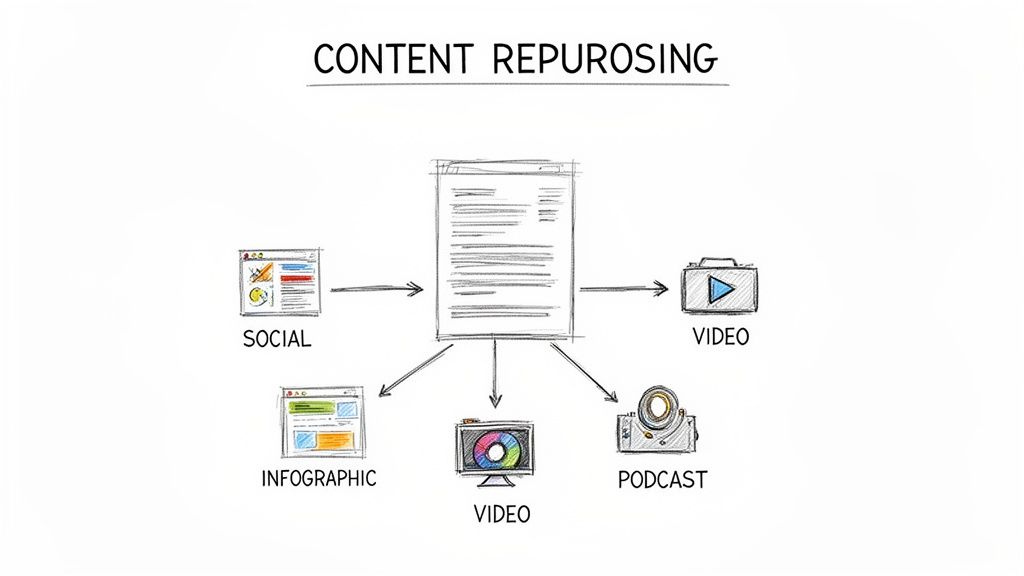
Repurposing takes a single content asset and explodes it into a whole ecosystem of content. Suddenly, your message is amplified across dozens of channels, but your workload hasn't multiplied along with it.
Building Your Content Ecosystem
Think of your big, comprehensive articles or guides as your "pillar" assets. These are the gold mines. From one pillar, you can extract dozens of smaller, bite-sized "micro" content pieces. This approach turns one big launch into a sustained campaign that keeps delivering results for weeks or even months.
Let’s walk through a real-world example. Say you just published a massive piece: "The Ultimate Guide to Remote Team Productivity."
Instead of just moving on to the next topic, you can atomize it like this:
- Key stats become an infographic. Pull the most compelling numbers and have a designer turn them into a sharp-looking infographic. These are incredibly shareable on visual platforms like Pinterest and LinkedIn.
- Each section becomes a social media series. A chapter on virtual meetings can be broken down into a handful of tips for LinkedIn. A powerful quote about focus can become a slick graphic for Instagram.
- Condense the takeaways into a short video script. You can easily pull the main points and craft a 2-minute script for a YouTube Short, TikTok, or Instagram Reel. It's the perfect format for grabbing attention fast.
- Use the outline for a podcast episode. The article's structure is a ready-made outline for a more conversational podcast. Here, you can add personal stories to connect with your listeners.
This isn't just about re-posting links to the original article over and over. It’s about re-packaging the actual value into native formats that feel right for each specific platform. You’re delivering the same core insights, just in different wrappers.
The Content Repurposing Framework
To make this process a repeatable part of your workflow, it helps to have a clear framework. Below is a simple table showing how one core asset can be transformed to hit different goals on various channels.
| Core Content Asset | Repurposed Format | Target Channel | Key Goal |
|---|---|---|---|
| Definitive Guide | Blog Post Snippets | LinkedIn, Twitter/X, Facebook | Drive traffic to the original article & spark conversation. |
| Definitive Guide | Infographic | Pinterest, Company Blog, Email Newsletter | Make complex data digestible & encourage social shares. |
| Definitive Guide | Quote Graphics | Instagram, Facebook | Increase brand visibility with visually appealing content. |
| Definitive Guide | Short Video (2-min) | YouTube Shorts, TikTok, Instagram Reels | Capture a younger audience & boost engagement with dynamic video. |
| Definitive Guide | Podcast Episode | Spotify, Apple Podcasts, YouTube | Build authority & connect on a more personal level through audio. |
By building this type of system, repurposing becomes a core function of your content engine, not just a random task. It’s one of the most powerful levers you can pull to scale your reach without burning out your team.
Modern tools can give you a massive leg up here. AI can help you generate initial summaries, scripts, or social post drafts in seconds.
The trick is adding that crucial human layer on top. An AI-generated summary is a fantastic starting point for a video script, but it needs your voice and unique perspective to truly resonate. At PureWrite, we help you refine those AI-generated drafts, making sure your repurposed content sounds just as authentic as the original piece.
Give PureWrite a try and see just how fast you can humanize your scripts, social posts, and more.
Maintaining Quality Control as You Grow
When your content volume skyrockets, your biggest risk isn't a dry well of ideas—it's a decline in quality. To scale your content marketing right, you have to build in guardrails to protect your brand's reputation. Think of these governance systems as non-negotiable; they're what ensure your strategy keeps building trust.
The stakes have never been higher. The global content marketing industry ballooned from $36.8 billion to a staggering $413.3 billion by 2022. With that kind of competition, audiences have zero patience for sloppy or inconsistent content. You can dig into more of these stats and trends over at Reboot Online's content marketing growth report.
Define Your Brand Voice with a Style Guide
Your style guide is the single source of truth for quality. It’s much more than a list of grammar rules; it's the document that defines your brand’s personality. This living document ensures that whether an in-house writer, freelancer, or an AI tool is drafting, the final product always sounds distinctly you.
A truly useful style guide should clearly outline:
- Tone of Voice: Are you authoritative and academic? Witty and conversational? Give concrete examples of what to do and, just as importantly, what not to do.
- Grammar and Formatting: Settle the big debates now. Do you use the Oxford comma? How do you format titles and subheadings (e.g., Title Case vs. sentence case)?
- Industry-Specific Terminology: Create a list of approved terms and define any jargon your audience needs to understand. This keeps your writing precise and consistent.
A great style guide doesn't just tell writers what to do—it shows them. Including real examples of on-brand and off-brand sentences is the fastest way to get everyone on the same page.
Implement a Multi-Stage Editing Process
A quick "once-over" before hitting publish is a recipe for disaster. As you scale, you absolutely need a multi-stage quality assurance (QA) process. This creates a safety net, catching different types of errors before your audience ever sees them.
A solid editing workflow usually involves two key stages. First comes the developmental or copy edit, which focuses on the big picture: flow, clarity, and the strength of the argument. After that, a final proofread serves as a meticulous check for typos, broken links, and formatting glitches. To really grasp the difference, check out our guide on copy editing vs proofreading.
Establish a Content Audit and Refresh Cadence
The work isn't over when an article goes live. To maintain quality over the long haul, you need a regular schedule for auditing and refreshing your existing content. This ensures your entire library stays accurate, relevant, and continues to perform in search.
Get started with a simple spreadsheet to track your most important content. Then, every six to twelve months, review these key pieces for:
- Outdated Information: Are the statistics still current? Have industry best practices evolved?
- Performance Declines: Has a once-popular article started slipping in the rankings? It probably needs a refresh to compete again.
- New Opportunities: Can you add new internal links to other relevant content or a stronger call-to-action to boost its impact?
This proactive maintenance turns your blog into a reliable, evergreen asset instead of a graveyard of forgotten posts. And when you're using AI to help update that old content, don't forget the final human touch. Give PureWrite a try to quickly humanize any AI-generated updates and make sure they align perfectly with your established brand voice.
Measuring What Matters: Turning Your Content into a Growth Engine
If you’re not measuring your content's performance, you’re just guessing. Pushing out more articles without knowing what works is like throwing money into the wind. The only way to turn your content operation from a cost center into a real, predictable growth engine is by getting serious about data.
This isn't just about reporting numbers; it's about creating a powerful feedback loop. The data you collect should directly inform your next move, ensuring every dollar you invest is aimed squarely at what drives actual business results—leads, new customers, and revenue.
Building Your Content Marketing Dashboard
First things first, let's move past vanity metrics. Sure, page views are nice, but they don't pay the bills. The real goal is to draw a straight line from your content efforts to tangible business outcomes. A central dashboard is the perfect tool to keep your team laser-focused on the numbers that actually matter.
The most effective content teams we've seen live and breathe their data. They don't just report on it quarterly; they use it to make daily decisions, from tweaking a headline to deciding which topic cluster to build out next.
Your dashboard should give you a clear view of the entire customer journey, not just one piece of it.
Here’s how to break it down:
- Top of Funnel (Awareness): Are people finding you? Look at organic traffic, new users, and keyword rankings. These metrics tell you if you're successfully capturing your target audience's attention.
- Middle of Funnel (Consideration): Is your content keeping them engaged? This is where metrics like time on page, newsletter sign-ups, and lead magnet downloads come in. They're a strong signal that your audience finds what you're saying valuable.
- Bottom of Funnel (Decision): Is your content driving business? Track demo requests, trial sign-ups, and the holy grail: content-attributed revenue. This is where you prove your ROI.
Using Data to Find Your Winners
Once you start tracking these KPIs, you can begin hunting for your "home run" content. Dig into the data and identify the articles that are driving a disproportionate share of your traffic, leads, or revenue. These winning pieces are your roadmap for what truly resonates with your audience.
Let's say you discover one particular guide is responsible for 30% of your total MQLs for the quarter. That’s a huge signal from your audience. Your next move is obvious: create more deep-dive content around that core topic and start repurposing that original guide into webinars, videos, and social media carousels.
This continuous cycle of create, measure, and iterate is the secret to sustainable, long-term growth. As you analyze performance, you'll uncover fresh opportunities and fine-tune your strategy over time. If you're looking for the right software to help you dig into this data, check out our guide to the best content optimization tools on the market.
Got Questions About Scaling Content?
As you start putting these strategies into practice, you're bound to run into some questions. Scaling content marketing isn't a one-and-done task; it’s a constant process of tweaking and improving. Here are a few answers to the most common questions we get, designed to help you get past those early roadblocks.
What’s the Biggest Mistake to Avoid When Scaling Content?
Hands down, the most common pitfall is sacrificing quality for quantity. It’s easy to get excited about scaling and start churning out dozens of generic, shallow articles. Often, this is where teams rely too heavily on unedited AI drafts, and the result is content that feels soulless.
This kind of content doesn't just fail to rank or engage readers; it can actively hurt your brand's reputation.
The real solution isn't to scale your raw output, but to scale your system. You need a rock-solid workflow with detailed briefs, quality checks, and a human touch at the center of it all. Think of AI as a first-draft assistant, not the final author. Your human editors are what will ensure every piece is authentic and up to your standards. That’s the key to sustainable growth.
How Much Should I Budget for This?
There’s no magic number here. Your budget really depends on your specific goals and where your company is right now. Instead of getting stuck on a dollar amount, think about your investment in stages.
- A startup might start lean, focusing on one killer, long-form article a week and getting smart about distributing it everywhere. The budget here is smaller, but maximized with smart tools.
- A mid-sized company might be ready to invest in a dedicated content manager, build out a team of specialized freelance writers, and put cash behind paid promotion.
The underlying principle is the same for both: invest enough to create genuinely high-quality, well-researched content consistently. Underfunding is one of the top reasons scaling efforts fizzle out.
Remember: Patience is everything. Meaningful results don't pop up overnight. They're the payoff for consistent, high-quality work over time.
How Long Does It Take to See Real Results?
If your strategy is built around SEO, you should plan on three to six months before you start seeing significant movement in organic traffic and keyword rankings. It’s a long game.
But you can score some quicker wins. Smart distribution on social media, in your email newsletter, or through partnerships can generate buzz and even leads within weeks.
Keep an eye on leading indicators like traffic spikes and new keyword rankings to know you're headed in the right direction. Over the six-to-twelve-month mark, you'll start to see the lagging indicators that your CFO cares about—things like qualified leads and content-attributed revenue. Consistency is what turns all that initial effort into tangible business results.
As you scale, your authentic brand voice is non-negotiable. If you're using AI to get first drafts done faster, you must ensure the final piece connects with your audience on a human level.
PureWrite is built for this exact problem. It helps you transform that robotic AI text into natural, engaging content that sounds like it was written by a person, for a person.
Try PureWrite today and see how easy it is to humanize your content at scale.