Copy Editing vs Proofreading: Key Differences for Polished Content
At its core, the distinction is this: copy editing is a deep dive into your writing to improve its clarity, flow, and consistency. Proofreading, on the other hand, is the final, surface-level check for typos and formatting errors before your content goes live.
Think of it like building a car. A copy editor is the engineer meticulously tuning the engine for peak performance. A proofreader is the final inspector giving it that last polish and wax before it hits the showroom floor. Both are essential for a high-quality result, but they perform very different jobs.
Understanding the Key Difference: Copy Editing vs Proofreading
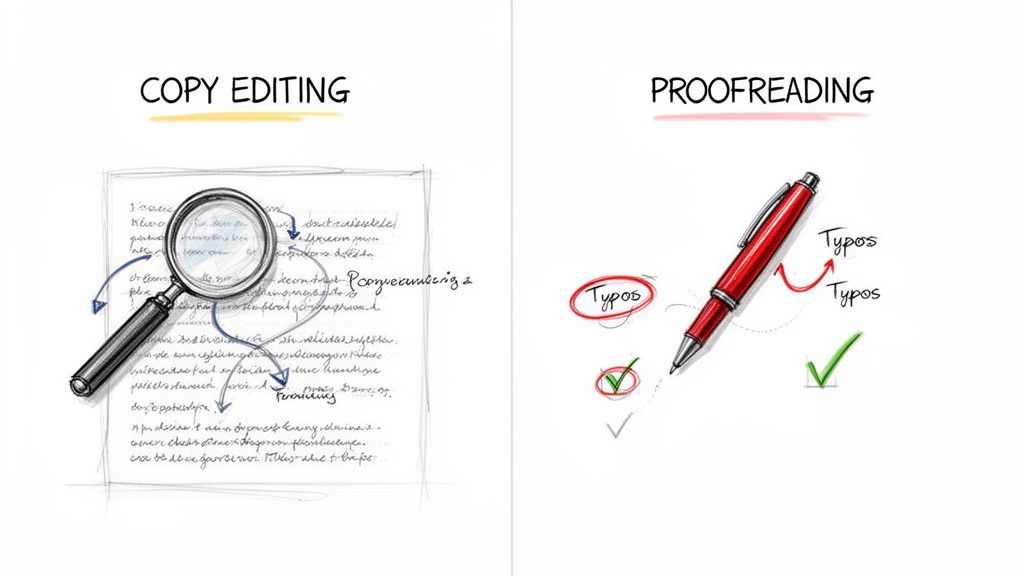
When you're creating content, knowing when to use a copy editor versus a proofreader is critical. Getting this wrong—or worse, skipping a step—can leave your work feeling clumsy or riddled with mistakes that hurt your credibility, especially if you're starting with AI-generated text.
Their Unique Roles in the Writing Process
A copy editor focuses on how you communicate your message. They dive into the nitty-gritty of sentence structure, smooth out awkward phrasing, and ensure your tone of voice is consistent from start to finish. Their main goal is to make your text as clear and effective as possible for your target audience.
For example, a copy editor might rephrase a convoluted sentence like, "The implementation of the new software was a catalyst for significant workflow enhancements" into the much clearer, "The new software greatly improved our workflow." This stage is about elevating the substance of your message. A big part of that is learning what concise writing is and how it sharpens your argument.
Proofreading is your absolute last line of defense before you hit "publish." This happens after all editing, design, and formatting are locked in. A proofreader hunts for objective, black-and-white errors: typos, grammatical slips, misplaced punctuation, and formatting issues like double spaces or wonky line breaks. They aren't there to rewrite your sentences; they’re there to perfect the final presentation.
Copy Editing vs Proofreading at a Glance
This quick table gives you an at-a-glance look at the distinct roles each plays in the writing process. It's a handy reference for understanding where each function fits.
| Aspect | Copy Editing | Proofreading |
|---|---|---|
| Primary Goal | Improve clarity, flow, readability, and consistency. | Catch and correct surface-level errors (typos, grammar, punctuation). |
| When It Happens | After the initial draft is complete but before formatting. | The final step right before publication, after editing and design. |
| Focus Area | The "big picture" of language style, tone, and sentence structure. | The "fine details" of spelling, formatting, and mechanical correctness. |
| Example Task | Rewriting an awkward sentence for better flow. | Correcting "teh" to "the" or fixing a misplaced comma. |
Essentially, one is about making your message better, while the other is about making the final product perfect. Both are necessary for creating truly professional work that builds trust with your audience.
What Is Copy Editing? A Deep Dive into Clarity and Style
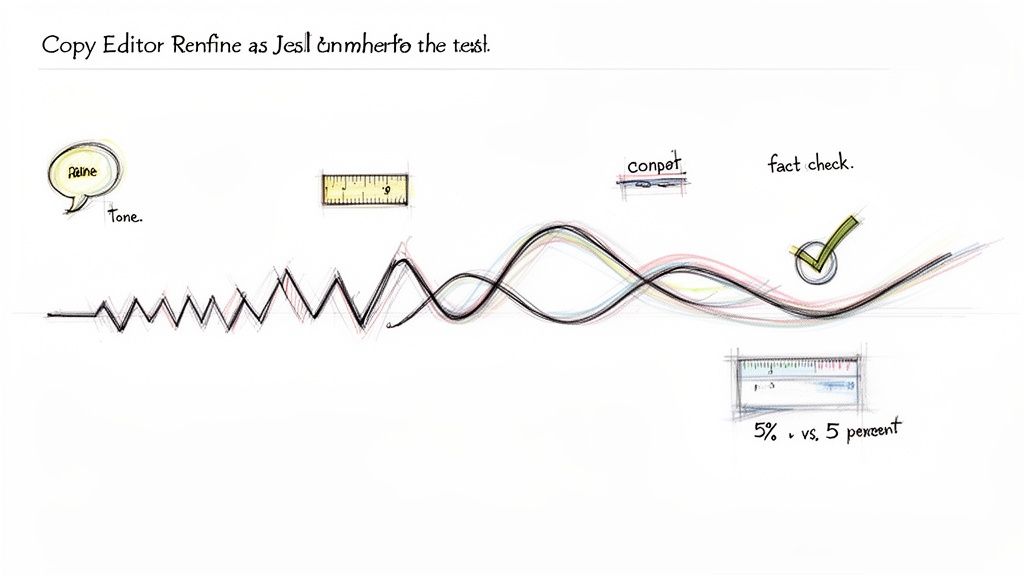
If proofreading is the final inspection on the assembly line, copy editing is where the machine is built and fine-tuned. It’s a deep, structural edit that sharpens your message, making sure every sentence pulls its weight. This is where you move past surface-level mistakes and get into the real mechanics of strong writing.
Think of a copy editor as your first truly critical reader. Their job is to elevate the entire reading experience by analyzing sentence structures, untangling awkward phrasing, and creating a seamless flow. They are the ones who turn a decent AI-generated draft into a compelling, professional piece that reflects your authentic voice.
The Core Responsibilities of a Copy Editor
A copy editor's role is a blend of art and science. They are the guardians of your content’s integrity, tasked with making it clear, consistent, and credible.
Here's what they do when they're in the weeds of your document:
- Enhancing Readability and Flow: This means rewriting clunky sentences and rearranging paragraphs so the logic holds up and the reader never gets lost.
- Ensuring Consistency: They’ll catch when you’ve used "e-commerce" on one page and "ecommerce" on another, or switched between writing "5 percent" and "5%." It's all about creating a smooth, uniform experience.
- Correcting Grammar and Syntax: This goes way beyond simple typos. They’re fixing complex grammatical issues, misplaced modifiers, and punctuation that changes the meaning of a sentence.
- Verifying Factual Accuracy: A good copy editor will double-check that names are spelled correctly, dates are accurate, and statistics are properly cited. It's a crucial step for building trust.
For anyone in content marketing, a solid copy edit is non-negotiable. Why? Polished, accurate, and clear content directly feeds into Google's E-E-A-T (Experience, Expertise, Authoritativeness, and Trustworthiness) signals. Better E-E-A-T often leads to better rankings.
Maintaining Your Authentic Voice
Many writers, especially those using AI writing tools, worry that an editor will scrub away their personality, leaving the text sterile. It's a valid concern. However, a great copy editor does the exact opposite—they amplify your voice by clearing out the clutter that was muffling it, helping your message land with more impact.
Keeping a consistent tone and voice in your writing is how you build a real connection with your audience. This is where both skilled human editors and sophisticated AI tools can be incredibly helpful. If you’re working with AI-generated drafts, you need a tool that understands the nuances of human language. At PureWrite, we built our platform to do just that: enhance clarity and flow ethically, without sacrificing the authenticity that makes your writing yours.
What Is Proofreading? The Final Polish Before You Publish
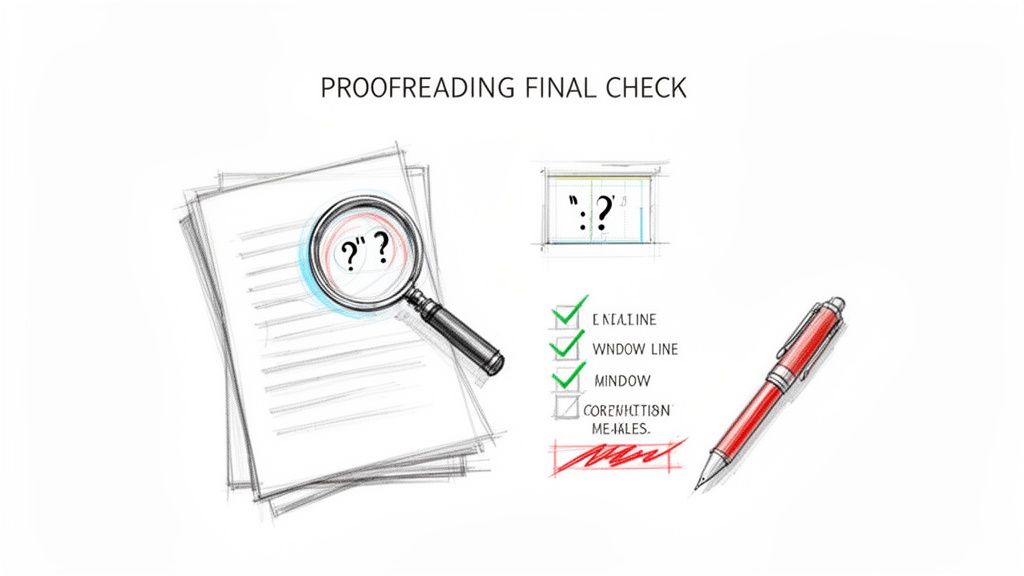
Think of proofreading as the final quality inspection before your content goes live. If copy editing is about refining the message, proofreading is about perfecting the presentation. This is your last line of defense against any mistakes that could slip through and tarnish an otherwise great piece of work.
It’s a meticulous, laser-focused review that happens after all the heavy lifting—writing, editing, and even design—is locked in. The goal here isn't to rework sentences or question word choice. Instead, it’s all about hunting down and stamping out any surface-level errors that managed to survive.
The Proofreader's Checklist: What They're Looking For
A proofreader is the ultimate gatekeeper, scanning the final, formatted document for objective errors. Their focus is incredibly narrow, which is exactly what you want at this stage.
Here’s a rundown of what a proofreader is trained to catch:
- Typographical Errors: Obvious misspellings, like "teh" instead of "the," or a simple keyboard slip.
- Grammar and Punctuation: Spotting misplaced commas, incorrect apostrophes, or other grammatical goofs. Our guide on capitalization and punctuation offers a good refresher on these rules.
- Formatting Glitches: Catching awkward extra spaces between words, inconsistent indentation, or weird paragraph breaks that pop up in the final layout.
- Layout Issues: Identifying problems like "widows" (a single word on its own line) or "orphans" (a single line of a paragraph stranded at the top of a new page).
- Numbering and Consistency: Making sure page numbers are in order and that headings follow a consistent style throughout the document.
In professional publishing, it’s not uncommon for a final proofread to catch hundreds of tiny errors in a manuscript that has already been through multiple rounds of editing. This is why a fresh set of eyes is absolutely vital for a truly polished final product.
Why Proofreading Is a Non-Negotiable Step
Skipping the proofread is like building a stunning piece of furniture but forgetting to wipe away the sawdust. Those small, nagging errors might not change your meaning, but they distract your audience and can make your work seem less authoritative.
Consider that 74% of consumers report paying close attention to spelling and grammar on company websites. In a competitive digital landscape, every detail matters for maintaining credibility. Whether you're a student submitting an essay or a marketer launching a campaign, a final, thorough proofread is what separates good content from great content.
Why the Professional Workflow Sequence Matters
In professional publishing, the order of operations is set in stone: edit first, proofread last. This isn't just a matter of preference; it’s a time-tested sequence that protects both quality and efficiency. Trying to proofread before you edit is a recipe for wasted time and a weaker final product.
Think of it like building a house. The copy editor is the architect, checking the blueprints to ensure the structure is sound and the rooms connect logically. The proofreader is the final inspector who does a walkthrough of the finished house, looking for cosmetic flaws—a scuff on the wall or a crooked light switch. You simply wouldn't call for that final inspection before the walls are even up.
The Correct Order of Operations
The content creation workflow is a logical funnel, moving from big, foundational changes down to the tiniest details. Why is this so critical? Because making a significant change late in the game can set off a chain reaction of new errors, especially once the text is formatted.
This is why the sequence is so important:
- Drafting: Get the raw ideas down on the page (often with AI assistance).
- Substantive & Line Editing: Shape the core argument, structure, and voice.
- Copy Editing: Refine the manuscript at the sentence level for clarity, consistency, and style.
- Design & Formatting: Pour the polished text into its final layout (a webpage, a PDF, etc.).
- Proofreading: The final, meticulous check for surface-level errors in the formatted version.
Knowing where copy editing and proofreading fit is just one piece of the puzzle. A deeper dive into understanding the broader content creation workflow will give you a better grasp of how each stage builds on the last, including the foundational five steps of the writing process.
A Real-World Example in Action
Let's walk through a quick example. A student using an AI writer for a research paper might get this initial sentence: "The experiment's data was indicative of a positive correlation."
The copy editor takes this robotic output and sculpts it into something clearer and more academic: "The experimental data indicated a positive correlation." The meaning is the same, but the sentence is now grammatically correct, concise, and sounds more authentic.
Once the copy editor has done their job, the text is ready for formatting. The proofreader then steps in as the final quality check, looking for any leftover typos or formatting glitches. Industry data suggests that a good copy edit catches the vast majority of issues, leaving the proofreader to hunt down the final 5% of errors that may have slipped through.
How to Choose the Right Service for Your Content
So, you have a draft. What’s next? Deciding between copy editing and proofreading really boils down to one simple question: where are you in the writing process? Getting this choice right is what separates an amateur draft from professional, polished work that connects with your audience.
If you’re sitting on a first or second draft—especially one that started as AI-generated text—it needs more than just a quick polish. You’re still shaping the core message and trying to get the tone just right. This is heavy-lifting territory, and copy editing is essential.
On the other hand, if your content has already been through the wringer, edited for clarity and style, and is ready to go live, you’re in a different place. Now, you just need a final, meticulous check for any lingering mistakes. That's a job for a proofreader.
A Practical Decision-Making Checklist
Let’s get practical. To figure out what you need right now, run your document through this quick mental checklist.
- Is the core message crystal clear and logical? If you have any doubt about the structure of your arguments or how one idea flows to the next, a copy editor is what you need.
- Are you worried about tone and style? A copy editor is your partner in refining your voice, making sure it stays consistent and hooks the reader. Proofreaders simply don't touch stylistic issues.
- Is the document in its final, formatted layout? If it’s not set in its final design—whether a webpage or a PDF—it’s too early for proofreading. Proofreading must happen after the design is locked down.
Here’s a good way to think about it: A copy editor is like an architect and an interior designer, making sure the building is structurally sound and beautifully appointed. A proofreader is the final inspector who walks through before the open house, checking for scuff marks.
This workflow chart lays it all out visually, showing exactly where each step fits into the journey from rough draft to finished product.
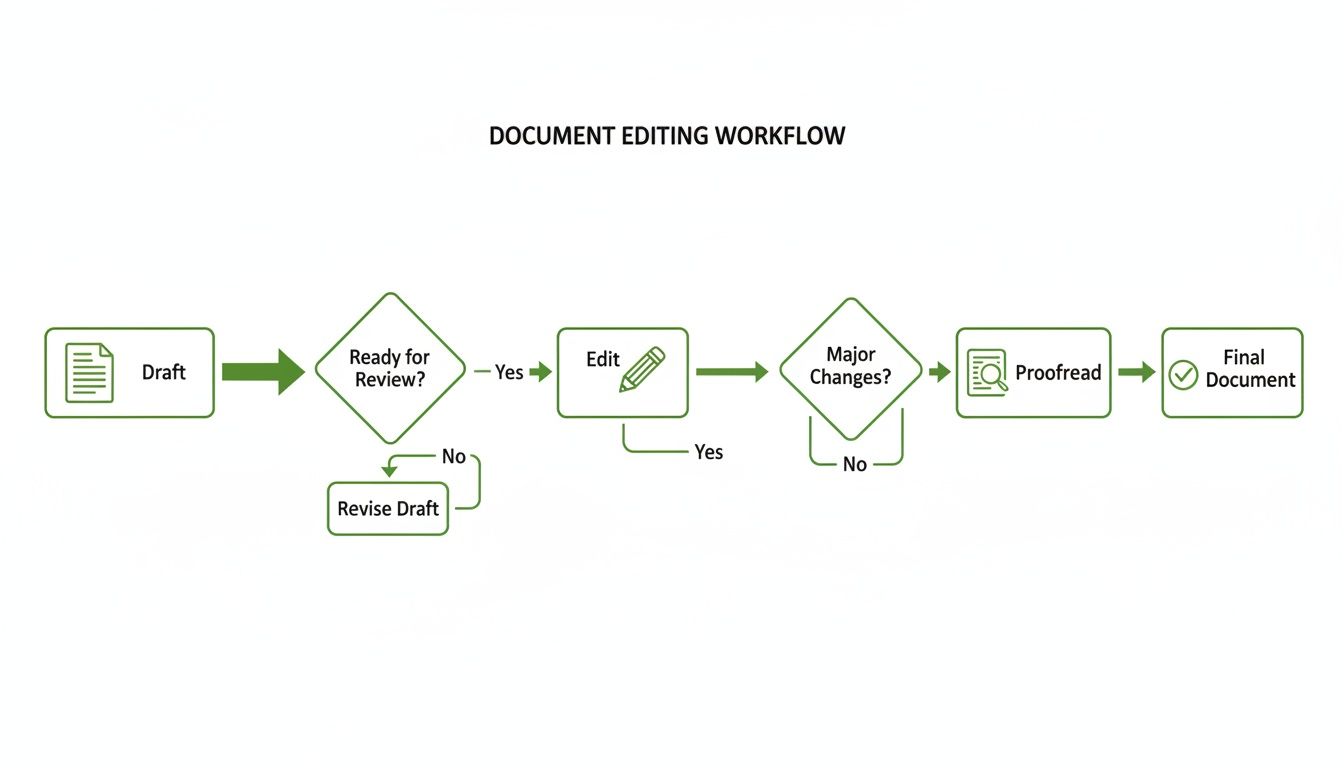
As you can see, proofreading is always the last line of defense. It’s the final quality-control check designed to catch any sneaky errors that slipped past the more intensive editing stages.
Which Service Do You Need? A Decision Guide
| Ask Yourself This Question | If Yes… You Likely Need Copy Editing | If No… You May Only Need Proofreading |
|---|---|---|
| Is this an early draft? | Yes, copy editing is your next step. | Your draft might be ready for the final check. |
| Am I concerned about clarity, flow, or awkward phrasing? | A copy editor will address all of these issues. | You're confident in the writing and just need error-checking. |
| Does the document's tone or style feel inconsistent? | A copy editor specializes in refining voice. | Your tone is consistent and just needs a final review. |
| Has the document been formatted for its final layout? | It's too early for proofreading. Stick with editing. | Yes, it's ready for a final proofread. |
| Are you unsure if your arguments are logical and well-supported? | This is a core function of a good copy edit. | You're confident the content is solid. |
Considering Your Budget and Timeline
Let's talk about the practical side of things: money and time. The two services are priced very differently for a reason. Copy editing is an intensive, analytical process. An editor is rewriting sentences and making deep improvements to clarity, which is why rates typically fall between $25 and $75 per hour.
Proofreading, on the other hand, is a much more focused task. The proofreader is purely hunting for objective errors, not improving the writing itself. This makes it a faster and more affordable job, usually costing between $20 and $50 per hour. For a closer look at the costs, you can read more about these key differences and what they mean for your budget.
This is where an ethical AI tool like PureWrite can transform your workflow. It performs many of the heavy-lifting tasks of a copy edit—fixing robotic phrasing, smoothing out the flow, and injecting a more natural tone—in seconds. By using our tool first, you can clean up the draft significantly, making it ready for a much faster and more affordable final proofread.
Streamlining Your Editing with AI and PureWrite
Whether you're working from an AI-generated draft or your own first pass, the editing process can be a grind. This is where understanding the difference between copy editing and proofreading becomes so valuable, especially when you bring technology into your workflow ethically.
At PureWrite, we built our platform to close the gap between a rough draft and a polished, authentic piece. Our tool works instantly to sharpen clarity, adjust tone, and fix clunky sentence structures so your writing sounds natural and human. It’s a huge help for students who need their essays to be authentic or marketers who need to scale content without sounding robotic. To see it in action, take a look at our guide on using an AI text enhancer to humanize your writing.
How PureWrite Fits Your Workflow
Think of PureWrite as a tool that automates the toughest parts of a copy edit. It smooths out awkward phrasing and corrects structural problems, handing you a clean draft that’s ready for one last human proofread. We believe in using AI as a partner to elevate your own authentic work.
Here’s a look at how our tool breaks down and improves text, focusing on readability and a more human feel.
This analysis lets you catch robotic language and improve your content before you even start a manual review. For those looking to tackle even more complex editing tasks, powerful large language models like the GPT-4 API offer advanced capabilities for developers and content creators.
Key Insight: Using an AI humanizer like PureWrite for the initial copy edit frees you up to focus your energy on the final proofread. This saves you time while ensuring your message comes across as authentic and clear.
When you bring PureWrite into your workflow, you’re handling the heavy-duty copy editing phase much more efficiently. Your final pass can then be a true proofread—just a quick check for perfection.
Ready to transform your content? Try PureWrite today and turn robotic text into remarkable writing.
Frequently Asked Questions
Even with a clear breakdown, the line between copy editing and proofreading can feel blurry, especially when you're using AI writing tools. Let's tackle some of the most common questions that come up.
Is It Necessary To Have Both a Copy Edit and a Proofread?
For any content that really matters, yes. They’re two different stages of quality control, and skipping one leaves a major gap. A copy edit is about shaping the core of your writing—making it clear, logical, and consistent. A proofread is that final, eagle-eyed check for any stray errors that were missed or introduced during formatting.
Think of it like building a custom piece of furniture. The copy edit is the sanding, staining, and assembly—making sure every joint is solid and the finish is smooth. The proofread is the final wipe-down to catch any dust specks or smudges before it goes on display.
Why Do I Need Another Person To Proofread My Work?
It's a frustrating but true phenomenon: we all get "text blindness" with our own writing. Your brain knows the message you intended to convey, so it often autocorrects mistakes on the page without you even realizing it. You read what you meant to write, not what's actually there.
A fresh pair of eyes doesn't have that built-in bias. They come to the text cold, which makes it far easier to spot the typos, duplicated words, and grammatical slip-ups you’ve glossed over a dozen times.
Can AI Tools Replace Human Editors or Proofreaders?
AI tools are fantastic co-pilots, but they aren't ready to fly the plane solo just yet. An AI-powered platform like PureWrite can do a huge chunk of the heavy lifting that a copy editor traditionally handles. It’s brilliant at restructuring sentences, boosting clarity, and making robotic-sounding text feel more human. In that sense, it’s a powerful partner for that initial, intensive editing stage.
But that final human proofread? We believe it’s still non-negotiable for professional-quality work. A person can spot subtle errors in context that an algorithm won’t understand and catch formatting glitches that only appear in the final layout. The smartest workflow combines the two: use AI ethically for the demanding copy editing phase and then bring in a human for that final, critical proofread.
Ready to take the grunt work out of editing and make your writing sound more authentic? PureWrite can handle the heavy lifting of a copy edit, turning your AI drafts into clear, engaging content that’s ready for a final polish. Try PureWrite today and feel the difference.