How to Type a Research Paper Outline That Actually Works
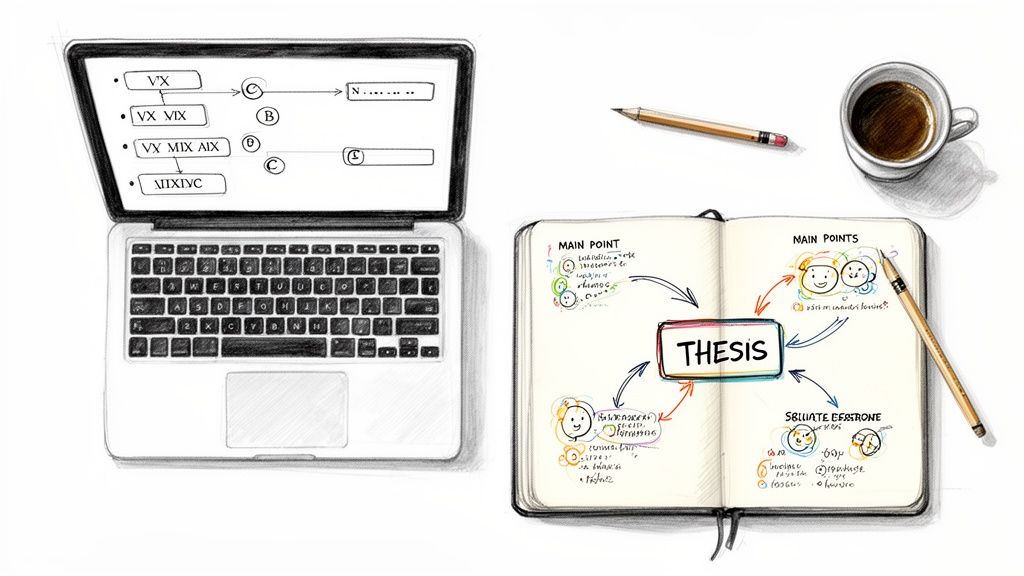
When you sit down to type a research paper outline, you’re creating the architectural plan for your arguments. The most common formats use an alphanumeric system (I., A., 1., a.) or a decimal system (1.0, 1.1, 1.1.1). You're essentially building a hierarchical roadmap.
You'll start with your thesis statement at the top. From there, you list your main arguments as the top-level points and then slot your evidence, examples, and supporting details as sub-points underneath each one. This framework is more than just a list; it’s the blueprint that ensures your final paper is coherent, logical, and persuasive.
Why Your Paper Needs a Solid Outline
Staring at a blank page is intimidating, even for seasoned content creators and writers. Before we get into the nitty-gritty of how to type your outline, let's cover why this is a non-negotiable first step. Don't think of it as a chore; think of it as the strategic plan for your entire paper.
A well-crafted outline guarantees a logical flow from your introduction to your conclusion. It forces you to organize your thoughts, structure your arguments, and line up your evidence before you start writing. This simple act of planning is your best defense against writer's block, which often stems from not knowing what to say next.
Building a Foundation for Success
Putting in the time to build a clear structure upfront pays off significantly later. It's like plugging a destination into your GPS before driving—the map lets you see the whole journey, spot potential dead ends (like gaps in your research), and ultimately build a much stronger, more convincing argument.
The numbers back this up, too. A study from the Journal of Educational Psychology found that students who outline can complete writing assignments up to 40% faster than those who don't. That's a huge boost in both efficiency and quality.
And this isn't just about finishing sooner; it's about producing better work. One university study found that 78% of outlined papers scored a B or higher, while only 52% of non-outlined papers did the same. This highlights the clear link between planning and performance.
From Ideas to Impact
Whether you’re a student, a professional researcher, or a marketer using AI tools, mastering the outline is the first step toward writing something impactful. To get a better handle on this, checking out a guide on how to do outlines effectively can give you some powerful techniques and help keep your unique voice front and center.
When you start with a solid plan, your writing is naturally more focused. If you're using AI for brainstorming, an outline provides the essential human-led structure needed to guide the technology. At PureWrite, we can help you turn those AI drafts into polished, human-sounding content that honors your original vision. Learn more in our guide on how to improve academic writing.
Building the Core Structure of Your Outline
Alright, you're convinced an outline is the way to go. So, where do you start? This is the stage where your scattered notes and research findings begin to form a solid skeleton for your paper. Every great research paper begins with this foundational work, and it all hinges on one powerful element: the thesis statement.
Your thesis statement isn't just a sentence that kicks things off; it's the core claim and the entire reason your paper exists. Think of it as a promise you're making to your reader. Everything that follows—every paragraph, every piece of evidence—is you making good on that promise. It must be specific and arguable.
Crafting a Strong Thesis
A weak thesis is a dead-end. It might state an obvious fact, like, "Social media marketing is important for businesses." There's nothing to argue there. A strong thesis, on the other hand, carves out a clear, debatable position.
For a content creator or marketer, a stronger thesis would be: "For B2B SaaS companies, investing in long-form, educational content on LinkedIn generates a higher ROI than short-form video content on TikTok due to audience demographics and platform intent."
See the difference? This one is specific, someone could actually debate it, and it lays out a crystal-clear roadmap for the paper. It tells your reader exactly what you’re going to prove. Every main point in your outline now has a job: to directly support this central claim.
From this solid foundation, you can start blocking out the main sections of your outline, usually marked with Roman numerals (I, II, III). These aren't just random topics; they are the main pillars holding up your argument.
The diagram below drives home how a well-built outline makes everything easier, leading to a clearer paper and better results.
This shows that spending time on the core structure isn’t just about being neat. It's about making the entire writing process faster and far more effective.
Developing Main Points and Sub-Points
Now for the details. Under each main point (your Roman numerals), you'll add sub-points (A, B, C) that break down the larger argument into digestible chunks. From there, you can drill down even further with specific evidence or data (1, 2, 3). This hierarchical structure is the secret to learning how to type a research paper outline that actually works.
Let's walk through a quick example for a marketing professional's research paper:
- Thesis Statement: For B2B SaaS companies, investing in long-form content on LinkedIn generates a higher ROI than short-form video on TikTok.
- I. Analysis of LinkedIn as a B2B Platform
- A. Professional audience demographics and user intent
- Statistic on decision-makers using LinkedIn
- Case study of a successful LinkedIn content strategy
- B. Effectiveness of long-form educational content
- A. Professional audience demographics and user intent
- II. Analysis of TikTok as a B2B Platform
- A. Audience demographics geared towards B2C
- B. Challenges in measuring direct B2B conversion
Notice how each level adds more detail, moving from a broad claim down to the specific evidence you'll use. If you find making these connections tricky, our guide on how to structure a research paper offers in-depth strategies.
Even if you use AI tools for initial ideas, this structural phase requires your human expertise. An AI can generate topics, but you are the architect who must arrange them into a logical structure. This is where a tool like PureWrite comes in—we help you refine raw, AI-generated text into an outline that carries your authentic voice.
Choosing the Right Outline Format
Knowing how to type a research paper outline is only half the battle. The key is picking the right kind of outline for your specific project and, just as importantly, for the way you think and work.
Making a smart choice here saves you from frustration later. A good outline is a flexible guide, not a rigid cage, and the format you use can make all the difference. The three most common types are the topic outline, the sentence outline, and the paragraph outline, each offering a different level of detail.
Finding Your Ideal Outline Style
A topic outline is your best friend during the early stages. It uses simple words or short phrases for each point, which is perfect when you're still brainstorming and ideas are flying around. This format is fast, flexible, and gives you a bird's-eye view of your paper's structure without bogging you down.
On the other hand, a sentence outline is a more serious commitment. Here, you write out every single point as a full, complete sentence. It takes more time, but that extra effort forces you to think more deeply about each idea. The payoff is a crystal-clear, highly developed plan that’s practically a first draft.
For example, a busy content marketer might use a topic outline for a quick blog post structure but a sentence outline for a detailed white paper that requires rigorous logic. To organize your thoughts before outlining, it can be helpful to look into different effective note-taking formats.
A Quick Comparison of Outline Formats
Not sure which one to pick? This table breaks down the core differences to help you decide which format best suits your needs for this particular research paper.
| Format Type | Structure | Best For | Example |
|---|---|---|---|
| Topic Outline | Uses brief phrases or single words for headings and subheadings. | Early-stage brainstorming, organizing main ideas quickly, and visual thinkers. | II. Main Point B A. Supporting Detail 1 B. Supporting Detail 2 |
| Sentence Outline | Each heading and subheading is a complete, declarative sentence. | Developing a detailed argument, ensuring logical flow, and complex papers. | II. The policy had a significant impact on urban development. A. It led to an increase in public housing projects. |
| Paragraph Outline | Each main heading is followed by a short paragraph summarizing that section. | Highly detailed planning for long, complex documents like dissertations or theses. | II. Economic Factors This section will analyze the primary economic drivers... |
As you can see, the right choice really depends on how much detail you need upfront. For most research papers or long-form content, a topic or sentence outline will do the trick perfectly.
Aligning with Academic and Professional Standards
Beyond your personal preference, there are formatting rules to consider. Style guides like MLA and APA often have specific requirements for how an outline should be formatted. Following these demonstrates professionalism and attention to detail.
You’ll generally run into two main systems:
- Alphanumeric System: This is the one you probably know best. It uses Roman numerals (I, II, III), then capital letters (A, B, C), and then numbers (1, 2, 3). It’s classic, easy to follow, and widely understood in both academic and business contexts.
- Decimal System: This format uses a series of numbers (1.0, 1.1, 1.2, then 1.1.1). You’ll see this more often in scientific and technical writing where there are many complex layers of information.
For most papers you write, the alphanumeric system is the way to go. But always double-check your assignment or project guidelines. Following the correct format is crucial. If you want to see exactly what this looks like, check out this example of an APA outline.
Practical Tips for Typing Your Outline
Alright, you've got a format in mind. Now it's time to actually type this thing out. The good news is, you don’t need fancy software. The tools you already use—like Microsoft Word or Google Docs—are more than powerful enough.
The secret weapon here is the multilevel list feature. Instead of manually typing "I," then hitting tab and typing "A," you let the program handle the hierarchy. It keeps your formatting consistent and your indentation perfect, which makes a world of difference when you’re organizing your thoughts.
Mastering Your Tools for Speed and Consistency
The real magic comes from a couple of simple keyboard shortcuts. Once you have a multilevel list going, you can rearrange your ideas without ever touching your mouse. This is a game-changer when you’re in a creative flow and need to move things quickly.
- To indent (or demote a point): Just hit the
Tabkey. This instantly turns a main point (likeII.) into a subpoint (A.). - To un-indent (or promote a point): Use
Shift + Tab. This bumps a subpoint back up the hierarchy.
Learning these two commands turns outlining from a static task into a dynamic one. You can restructure an argument on the fly and watch your paper’s skeleton take shape. If you're looking for even more powerful tools, we've put together a guide on the best academic writing software that might help.
A Note on Using AI Ethically
Staring at a blank page is tough. If you’re stuck, AI can be a fantastic brainstorming partner to get initial ideas flowing. But we believe its job should end there.
At PureWrite, we champion ethical AI usage—using it as a tool that assists your thinking, not one that replaces it. Let it generate a raw list of concepts, but then it's your turn. You need to refine that output, organize it into a logical structure, and ensure it reflects your unique voice and perspective.
A well-typed outline is a map of your critical thinking. It guides your writing process, not locks you into a rigid box. Your goal is to create a clear, logical path before you start writing prose.
If you find that your AI-generated text feels robotic, try PureWrite. Our tool specializes in humanizing AI content, making it sound more authentic and engaging while preserving your core message.
Common Outlining Mistakes to Avoid
Even seasoned writers can fall into a few common traps when outlining. Knowing how to type up a research paper outline is the easy part; sidestepping these pitfalls is what makes it a genuinely useful tool. Your outline should be a flexible blueprint, not a rigid cage.
One of the biggest hurdles is getting the level of detail just right. It's a classic Goldilocks problem.
Go too vague, and your outline offers no real direction. But get too granular, and you leave no room for the new ideas that emerge during writing. The sweet spot is a structure that guides you but still lets you explore.
Think of your outline as a living document. It should evolve as you dig deeper into your research and your understanding of the topic sharpens.
Straying from Your Thesis
This one is huge. An outline with points that, while interesting, have nothing to do with the main argument will derail your paper. Your thesis statement is the anchor for the entire project. If a point doesn't directly support or defend it, that point needs to go.
As you build your outline, constantly ask yourself these questions:
- Does this point directly prove my thesis? There must be a clear line from every section back to your core claim.
- Is this the best evidence I have? Ensure your data, quotes, or examples are strong and relevant.
- Does this flow logically? Your points need to build on each other, creating a narrative that pulls the reader along.
Imagine you're a lawyer in a courtroom. Every piece of evidence you present must be directly relevant to winning your case. Anything else just weakens your argument.
Misusing AI as a Crutch
It’s tempting to ask an AI to spit out a complete outline for you. While AI tools are fantastic for brainstorming, letting them build the entire structure is a mistake. You often end up with a generic, soulless outline that lacks your unique insight. Recent data shows that over 60% of content flagged by AI detectors suffers from this kind of formulaic structure.
The key is to use AI as a collaborator, not a replacement for your own critical thinking. At PureWrite, we’re all about finding that balance. Use an AI to generate initial ideas, but then it’s your job to take that raw material and shape it with your own voice.
Building an outline is an act of thinking. It’s how you decide on the most compelling way to present your information. If you're ever worried about your work sounding too much like its source material, a great skill to develop is learning how to paraphrase without plagiarizing, which keeps your voice front and center.
Common Questions We Hear About Outlining
Even with the best intentions, a few questions always seem to pop up once you sit down to actually type out a research paper outline. Let's tackle some of the most common ones we hear from students and professionals to get you on the right track.
How Long Should My Outline Be?
There's no magic number, but a solid rule of thumb is to aim for your outline to be roughly 10-15% of your paper's target word count.
For a standard 10-page paper (about 2,500 words), you’re probably looking at a detailed outline that’s one to two pages long. The real goal isn’t hitting a specific length but including enough substance to steer your writing. You want a clear view of your main arguments, key evidence, and logical flow.
What's the Real Difference Between a Topic and a Sentence Outline?
This one trips a lot of people up, but it's simpler than it sounds. Think of it as a sketch versus a blueprint.
- A topic outline is your sketch. It uses short phrases or single words and is fantastic for quick brainstorming.
- A sentence outline is your detailed blueprint. Every point is a full sentence, forcing you to think through each idea more carefully.
Many seasoned writers use both. They'll start with a messy topic outline to brainstorm and then build it into a more robust sentence outline as their research comes into focus.
Is It Okay to Change My Outline After I've Started Writing?
Not only is it okay, but you absolutely should. As you dive into writing, you'll engage with your ideas on a deeper level. It's inevitable that you'll uncover a new perspective or realize an argument needs restructuring.
Your outline is a living document, not a contract set in stone. If you feel your initial plan is boxing you in, that's your cue to pause, step back, and adjust the outline. This flexible process is what separates good writing from great writing.
Struggling to turn a messy brainstorm or a robotic AI draft into a clean, human-sounding outline? PureWrite can help you organize your ideas and polish your structure, all while keeping your authentic voice front and center. Give your outline the clarity it needs at https://purewrite.io.