How to Write a Literature Review: An Actionable Guide
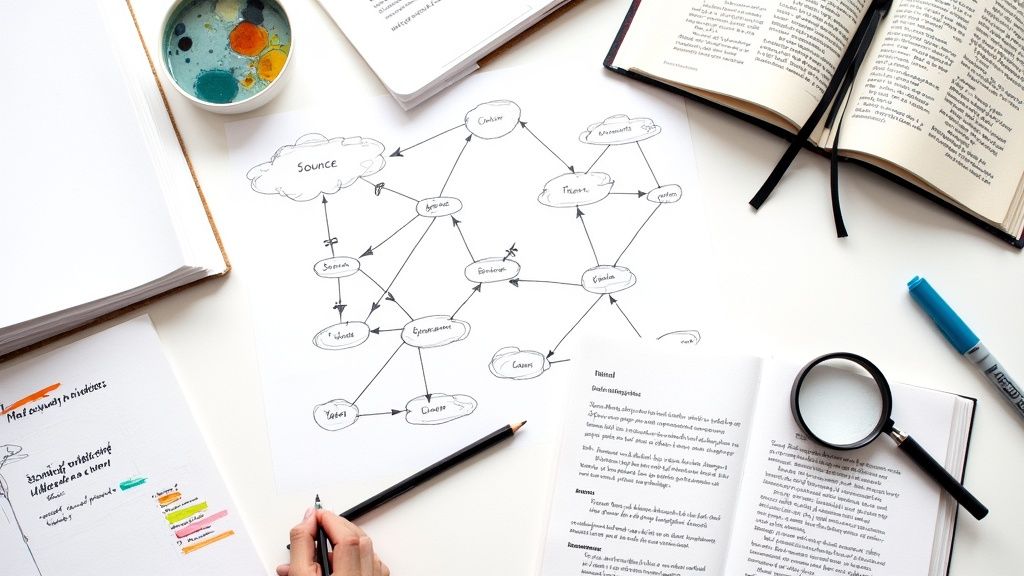
A literature review is more than just a summary of articles. It's your entry into a scholarly conversation, a chance to show you understand the key debates, the major players, and—most importantly—where the gaps are. You're not just reporting; you're building a narrative that positions your own work within that existing landscape.
For content creators, students, and professionals, a strong literature review provides the foundation for credible, authoritative content. It proves you've done your homework and are ready to contribute something new.
Building a Strong Foundation for Your Review
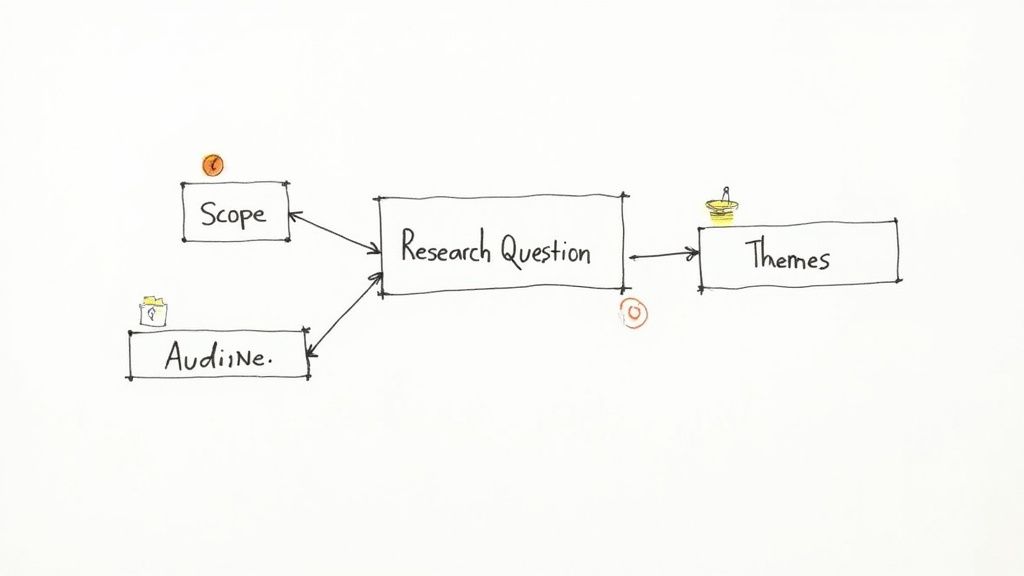
Before you type a single keyword into a database, you need a plan. The best literature reviews start with a solid foundation, not a scattergun search for sources. This initial stage is all about defining your purpose and setting clear boundaries for your research.
Think of it like building a house: you wouldn't start putting up walls without a blueprint. Your review needs a well-defined research question and a manageable scope to guide every decision you make.
Defining Your Research Question
Your research question is the north star for this entire project. It must be specific, focused, and something you can realistically answer within the scope of your work. A vague question like, "What's the deal with AI content?" is a recipe for disaster, as you'll drown in irrelevant articles.
Let's get practical. A stronger question is: "How does the use of AI writing assistants impact the SEO performance of B2B blog content?" This focus immediately tells you what to look for and, crucially, what you can safely ignore.
A tight research question helps you:
- Stay on track: It’s your guardrail, keeping you from wandering into interesting but unrelated territory.
- Search strategically: You’ll know exactly which keywords and concepts to use in your searches.
- Build a coherent story: The question becomes the central thread you use to weave all your findings together.
Setting a Realistic Scope
With a clear question, your next step is to define your scope by setting practical limits. Without them, you’ll quickly find yourself buried under an impossible mountain of literature—a classic mistake we see all too often.
First, think about your time frame. In fast-moving fields like tech and marketing, sources older than 5 years might be outdated. In the humanities, however, your review might need to cover decades of scholarship to provide proper context.
A quick checklist can be incredibly helpful for getting your bearings.
A Quick Checklist for Defining Your Scope
Use this table to establish the key parameters for your literature review before you begin your research.
| Parameter | Guiding Question | Example |
|---|---|---|
| Time Frame | How far back does my research need to go to be relevant? | "I will only include studies published from 2018 to the present." |
| Source Types | What kinds of materials are credible in my field? | "My review will focus on peer-reviewed journal articles and industry reports." |
| Geography | Is my topic specific to a certain region or population? | "I will focus on studies conducted in North America." |
| Methodology | Am I only interested in certain research methods? | "I will prioritize quantitative studies, but include qualitative for context." |
This simple exercise can save you hours of wasted effort by creating a clear roadmap from the very beginning.
Key Takeaway: Setting a clear scope isn't about limiting your work; it's about making it manageable and impactful. A focused review that thoroughly covers a specific area is far more valuable than a superficial one that tries to cover everything.
Deciding on your source types is also a big part of this. Will you stick to peer-reviewed journal articles? Or will books, conference papers, and government reports also play a role? For a deeper dive, you can explore some great expert tips and strategies on writing literature reviews.
Navigating this planning stage can feel daunting, but the right tools can be a game-changer. Our guide to the best academic writing software is a great place to start for finding ways to keep your research organized. When you're ready to write, PureWrite can help with that crucial final polish, ensuring your authentic voice shines through.
Finding and Evaluating Your Sources
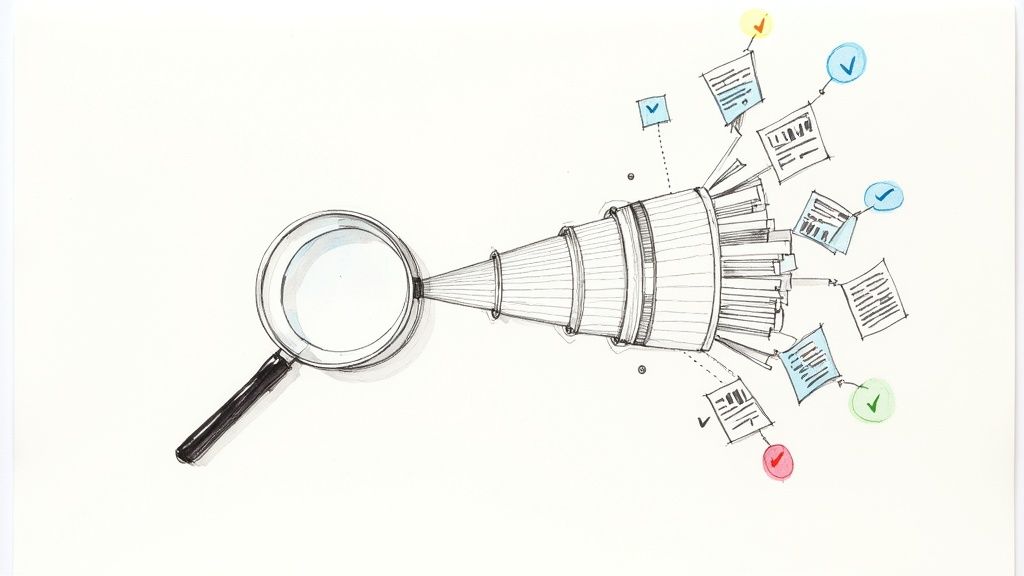
Now comes the part that feels like a treasure hunt: finding the right sources. Your goal isn't just to collect articles, but to unearth the right ones. This means getting comfortable with academic databases like JSTOR, PubMed, or Google Scholar without getting lost in an endless sea of irrelevant studies.
Precision is your best friend here. Instead of just throwing your entire research question into the search bar, break it down into its core concepts. This is where Boolean operators—simple commands like AND, OR, and NOT—become your secret weapon for narrowing the field.
For instance, searching for "AI content" AND "SEO" AND "B2B marketing" NOT "social media" is infinitely more powerful than a vague query. This strategic approach separates a focused, manageable search from an overwhelming one.
Mastering Your Search Strategy
Think of a good search strategy as your map and compass. You wouldn't wander into a vast library without a plan, and the same goes for digital databases. A solid strategy is easily the most valuable tool in your literature review arsenal.
First, figure out where the experts in your field "live." A marketer might look at industry reports and journals, while a historian might be more at home on JSTOR. Once you know you're in the right place, you can start playing with your keyword combinations.
Here are a few practical tricks to make searches more effective:
- Embrace Quotation Marks: When you put a phrase in quotes (like
"content marketing"), you're telling the database to find that exact phrase, filtering out tons of noise. - Use the Asterisk: This is called truncation. Searching for
market*will pull up market, marketing, and marketable. It’s a huge time-saver. - Follow the Breadcrumbs: Found a really great article? Check its reference list. This "citation chaining" can lead you to foundational studies. Then, see who has cited that article to find more recent research on the topic.
This systematic approach ensures your review is built on a solid foundation of relevant, important scholarship.
Evaluating Sources for Credibility and Bias
Finding sources is one thing; judging them is another. This is where your critical thinking skills come into play. Not all research is created equal, and skipping this step can undermine your entire review.
A study published in a top-tier, peer-reviewed journal simply carries more weight. As you read, put on your skeptic's hat and constantly ask yourself:
- What's the author's core argument?
- Is their evidence strong enough to support it?
- Was their methodology sound and appropriate for the question they were trying to answer?
- Can I spot any potential conflicts of interest or biases that might be coloring their conclusions?
A Key Insight: Critically evaluating a source doesn't mean you have to tear it apart. It’s about understanding its strengths, its limitations, and its place in the broader conversation so you can represent it accurately.
Staying Organized from the Start
An organized researcher is a happy researcher. Trying to juggle dozens of PDFs and notes without a system is a one-way ticket to chaos. We recommend using a reference management tool like Zotero, Mendeley, or EndNote from day one.
These tools let you build a central library for all your sources, attach notes, and generate citations automatically. It’s also crucial for maintaining academic integrity. To get a better sense of what to avoid, it helps to know how a plagiarism checker for students identifies potential issues.
Finally, when you start writing, you'll inevitably hit sentences that just sound clunky or overly academic. That's exactly why we built PureWrite. Our tool can help humanize your writing and improve its flow, all while keeping your critical analysis and unique voice intact.
Structuring Your Narrative and Synthesizing Ideas
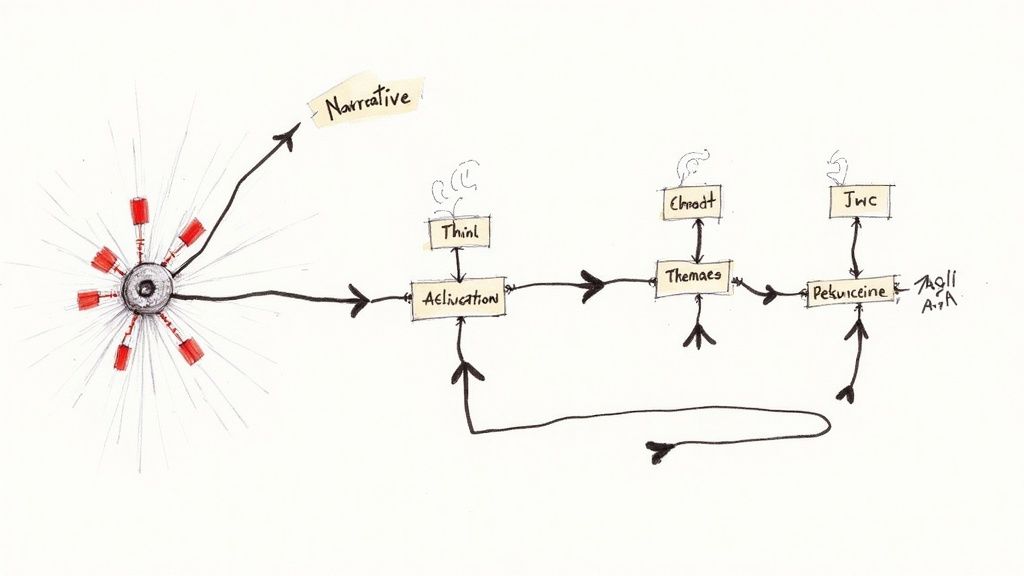
This is where the real magic happens. Up to this point, you've been a detective, digging up clues. Now, you need to become a storyteller. Your job is to weave those individual sources into a coherent narrative that guides your reader through an ongoing academic or professional conversation.
A great literature review is never just a laundry list of summaries. Instead, it synthesizes information—it pulls together themes, contrasts different viewpoints, and reveals the hidden connections between studies. This is how you transform a pile of research into a powerful, insightful argument.
Choosing Your Organizational Framework
The structure you pick is the skeleton of your review. It dictates how you present the information and has to be chosen deliberately to best answer your research question. There’s no single "right" way, but a few tried-and-true approaches work well for different goals.
Think about the story you want to tell. Are you trying to show how an idea evolved over the decades? Or do you want to compare different schools of thought? Your answer will point you toward the best structure.
Let’s walk through the most common options:
- Thematic: This is often the most powerful approach. You organize the review around key ideas or recurring themes. For a review on remote work, you might create sections like "Impact on Productivity," "Employee Well-being," and "Challenges in Team Collaboration."
- Chronological: This structure traces the development of a topic over time. It’s perfect for showing how a field has grown, highlighting major breakthroughs or shifts in thinking.
- Methodological: Here, you group studies by the research methods they employed (e.g., qualitative vs. quantitative). This is useful when the methodologies themselves are a core part of the debate.
If you want a deeper dive into organizing the pieces, our guide on how to structure a research paper offers a great framework you can adapt.
Moving From Summary To Synthesis
With a structure in mind, the real art is in the synthesis. This is where you stop thinking about individual papers and start thinking about the conversation between them. A simple way to get started is to physically (or digitally) group your sources. Which studies reached similar conclusions? Which ones are in direct conflict?
From there, you can identify the major debates. For example, in your remote work research, you might notice one cluster of studies argues it boosts productivity, while another group claims it stifles innovation. Your job is to present both sides, explore the nuances, and suggest why those differences exist.
When dealing with studies that use interviews or observations, knowing how to properly analyze qualitative research data is crucial for pulling out these nuanced themes accurately. This process is what shows your critical thinking. You aren't just a reporter; you're an interpreter making sense of the landscape for your reader.
Key Takeaway: Synthesis is all about making connections. Keep asking yourself: "What's the bigger picture here?" The answer to that question is the story your literature review needs to tell.
Identifying Gaps In The Research
The final, and perhaps most important, step in synthesis is to identify the "gap." After mapping out what researchers know, you have to point out what they don't know. This is how you build the justification for your own research or content project.
A research gap isn't just something no one has studied. It can be:
- A specific population that has been overlooked.
- A theory that hasn't been tested in a new context.
- A conflict in the existing findings that needs to be resolved.
- A new question that emerges from the current body of research.
Clearly articulating this gap is the climax of your literature review. It’s the moment you shift from discussing everyone else's work to positioning your own, showing the reader exactly where your contribution fits and why it’s so important.
Bringing Your Literature Review to Life: The Drafting Phase
You've done the heavy lifting—the searching, reading, and synthesizing. Now it's time to transform that outline into a cohesive draft. This is where your organized thoughts become a narrative that guides your reader and establishes your authority on the topic.
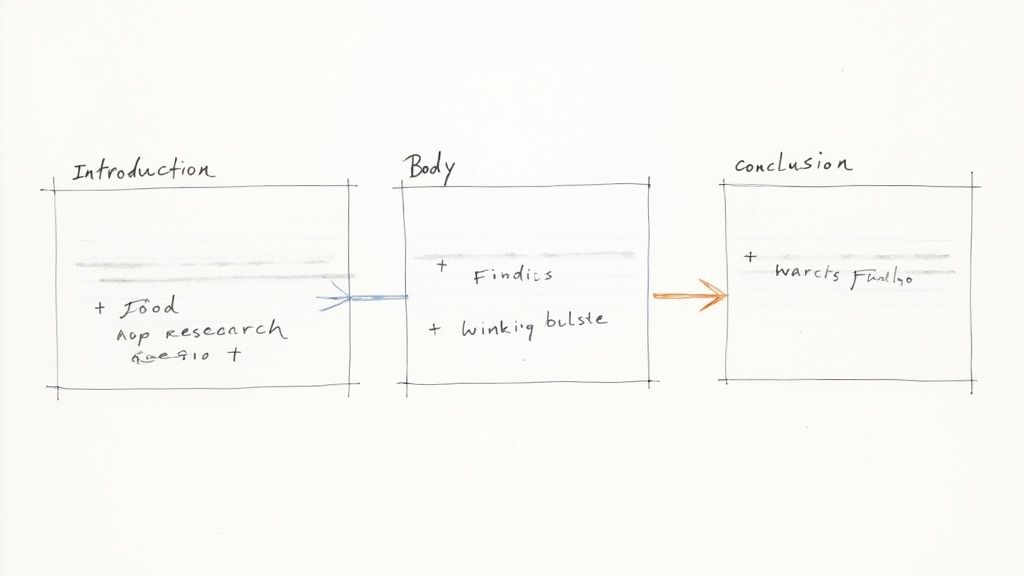
Your draft should have three distinct parts: the introduction sets the stage, the body lays out the evidence, and the conclusion brings it all home while pointing to what's next.
The Art of the Introduction
Your introduction is your first and best chance to grab your reader's attention. The goal is to quickly establish why this topic is important and give them a clear roadmap of the journey ahead. Our advice? Skip the vague statements and get right to the point.
An effective introduction usually has three core parts:
- The Hook: What's the problem or question that makes this field of research so compelling? Start there.
- The Context: Briefly touch on the key debates or major themes you’ll be covering.
- The Thesis: End with a sharp, clear statement that articulates the main takeaway from the literature, highlighting the specific research gap you've uncovered.
Nailing this structure tells your reader exactly what to expect and why it matters, projecting confidence from the start.
Building an Analytical Body, Not a Laundry List
This is the heart of your review. Using the framework you already decided on, you'll flesh out each major idea in its own subsection. A common mistake is simply listing summaries: "Author A said this... then Author B found that..." This weakens your analysis and bores your reader.
Your voice needs to drive the narrative. You're not just a reporter; you're the expert guide.
A Critical Reminder: Your job is to lead the discussion. Use sources as the evidence to back up your claims about the research landscape, not the other way around.
Start each paragraph with a strong topic sentence that makes a clear point. Then, use your sources to support, contrast, or expand on that point. Use transitions to show you're thinking critically, such as, "While Smith's study suggests X, Jones' research complicates this by showing Y..."
Crafting a Conclusion With Impact
A good conclusion does more than just repeat what you've already said. This is your final word, your chance to reinforce the importance of your review and leave a lasting impression.
First, quickly recap the major insights, key debates, and the research gap your review has exposed. From there, explain the implications of that gap. Why does it matter that this piece of the puzzle is missing?
Finally, pivot to the future: your own research. This is where you explain how your study will address that gap and contribute something new to the field. Our guide on how to improve academic writing has some great advice on maintaining a professional tone throughout.
Once your first draft is down, the real work of refining begins. This is where a tool like PureWrite can be a game-changer. It helps you smooth out awkward phrasing and boost clarity without compromising your academic voice.
Understanding Advanced Review Types
Not all literature reviews are created equal. Once you get the hang of the basics, you may encounter specialized types that are essential for more advanced research projects. Knowing them helps you choose the right approach for your goals.
While most reviews are about weaving existing studies together to find themes and gaps, some are far more rigorous. Methods like systematic reviews and meta-analyses follow incredibly strict rules and represent a huge leap in analytical power.
Standard vs. Systematic Reviews
A standard literature review—often called a narrative review—gives you a broad overview of a topic. You have a lot of freedom to select sources that help you build an argument or point out what's missing in the current research. It’s like painting a picture of the research landscape as you see it.
A systematic review, on the other hand, is much more like a scientific experiment. It aims to answer a very specific research question by finding, evaluating, and synthesizing all the relevant evidence that meets a strict, pre-defined set of criteria. The process is transparent and meticulously documented so another researcher could replicate it.
The Power of a Meta-Analysis
A meta-analysis goes one massive step beyond a systematic review. It uses complex statistical methods to combine the quantitative data from many different studies.
By pooling all that data, a meta-analysis can produce a single, powerful estimate of an effect. For example, it can tell you with much greater certainty whether a specific medical treatment actually works. This combined result is far more reliable than what any single study could show on its own.
This statistical muscle is why the meta-analysis is often considered the gold standard in fields like medicine and public health. It’s an incredible tool for settling debates and building an evidence-based consensus.
Key Insight: Moving from a standard review to a systematic one, and then to a meta-analysis, is a shift from interpretation to aggregation. You go from telling the story of the research to calculating its collective, statistical truth.
This kind of heavy-duty quantitative work has serious technical requirements, so you'll mostly see it at advanced academic levels. If you're curious, you can explore more about this specialized method to see how these techniques fit into the bigger picture of academic research.
Even if you never conduct one yourself, understanding what a meta-analysis is makes you a much smarter consumer of research. As you put together your own literature review, keeping your analysis clear is everything. If your sentences start to feel tangled, PureWrite can help humanize your writing while keeping your insights front and center.
Revising and Polishing Your Final Draft
Getting that first draft down is a massive win, but don't close the laptop just yet. The real work—and where your review truly comes alive—happens in the revision process. This is your chance to step back, look at the big picture, and sharpen your argument into a powerful piece of writing.
Think of it less as fixing mistakes and more as strengthening your analysis. One of the oldest tricks is still one of the best: read your work aloud. You'll be amazed at how quickly you spot clunky sentences that your eyes glide over on the screen.
From Good to Great
As you dig into editing, keep two words in mind: clarity and impact. Does your argument unfold logically? Every single paragraph should build on the one before it, carrying your reader smoothly toward your conclusion.
Challenge every sentence. Does it really need to be there? Is it just summarizing a source, or is it actively supporting your central thesis? This is where you make sure your voice is the loudest one in the room.
A polished draft demonstrates not just what you've read, but how deeply you've thought about it. The revision process is where your intellectual contribution truly takes shape.
Using Technology Ethically
Once you’ve done the heavy lifting of research, critical thinking, and drafting, technology can be a fantastic partner for the final polish. The key is to use it ethically to enhance your own authentic work, not replace it. Recent studies show that over 80% of students have used AI in their assignments, making ethical guidelines more important than ever.
For instance, a tool like PureWrite can help you rephrase sentences that sound stiff or overly academic, making your writing flow more naturally without changing your core ideas. It’s about making your work more engaging while preserving your academic integrity. On that note, we recommend you read our guide on what Turnitin checks for to understand how originality is evaluated.
In the end, your literature review is a direct reflection of your hard work. When you're ready to give your draft that final layer of polish and make sure your unique voice is crystal clear, try PureWrite today.
Common Questions About Literature Reviews
As you get started, a few questions always seem to pop up. Let's tackle some of the most common ones we hear from researchers, writers, and students.
So, How Long Does This Thing Need to Be?
That's the million-dollar question, and the honest answer is: it depends. For a doctoral dissertation, the literature review is often a beast of its own chapter, easily running 20 to 40 pages. A standalone review article for a scholarly journal will likely fall in that same ballpark.
For a master's thesis or an undergraduate paper, you're probably looking at a much more manageable 5 to 15 pages. The golden rule is to always check your assignment guidelines or the journal's submission requirements. They'll give you the final word.
Can I Just Get AI to Write It for Me?
Tread very carefully here. The short answer is no—you should never use AI to write the whole thing from scratch. That's a fast track to academic dishonesty, and it completely misses the point of the exercise, which is to sharpen your own critical thinking skills.
Where AI can be a useful sidekick is in smaller, more tedious tasks. It can help you brainstorm search terms, get the gist of a long article, or polish your grammar. This is where we see tools like PureWrite fitting in ethically.
Once you've done the hard work of thinking, analyzing, and drafting, our platform can help you smooth out awkward sentences and improve the overall flow. We help your original ideas shine without changing your core arguments.
A literature review is your stage to demonstrate expertise. Using AI to ghostwrite it doesn't just risk plagiarism—it robs you of the chance to master your topic. Think of AI as a tool to enhance your writing, not replace your thinking.
What's the Difference Between This and an Annotated Bibliography?
It's easy to get these two mixed up, but they serve very different purposes. An annotated bibliography is a structured list of sources. Each citation is followed by a short paragraph (around 150 words) that summarizes and briefly critiques that single source.
A literature review, on the other hand, is a cohesive, flowing essay. It weaves together ideas from many sources to tell a larger story. You’re synthesizing them to build an argument and identify what's still missing. It’s a narrative about the ideas, not just the articles.
Your literature review is a testament to your hard work and deep thinking. When it's time for that final polish, PureWrite can help you refine your language for maximum clarity and impact, making sure your expert voice comes through loud and clear. Give your draft the professional finish it deserves at https://purewrite.io.