How to write a persuasive essay: Win with strong arguments
When you write a persuasive essay, your goal is to build such a strong, logical case that your reader can’t help but see things your way. It’s a delicate dance, blending solid evidence with clear reasoning and a confident tone to guide your audience from their perspective over to yours.
The Art of Writing to Persuade
This guide is all about mastering that dance. Unlike an informative paper that just lays out facts, a persuasive essay has a mission: to win your reader over. This requires a smart mix of logic, credible evidence, and just the right amount of emotional connection.
Thinking of this as just another academic exercise is a mistake. As content creators and professionals, the ability to persuade is a genuine power skill, whether you're pitching a project, crafting a marketing email, or advocating for a cause that matters to you.
We'll start by helping you find a topic that actually fires you up. Why? Because genuine conviction is contagious, and an essay built on something you truly care about will always be more powerful than one written just to check a box.
Why Structure Is Your Best Friend
A well-organized essay is a convincing one. When your argument flows logically from one point to the next, it’s simply easier for your reader to follow along and buy into what you’re saying.
The standard 5-paragraph structure is a fantastic starting point for content creators and students alike because it gives both you and your reader a clear roadmap. Each piece has a specific job to do, ensuring your message is delivered with maximum impact.
Let's break down that classic blueprint. This structure ensures every part of your essay serves a purpose, from grabbing attention to leaving a lasting impression.
The 5-Paragraph Persuasive Essay Blueprint
| Section | Core Purpose | Key Elements |
|---|---|---|
| Introduction | Grab the reader's attention and state your position. | Hook, brief background, and a clear, arguable thesis statement. |
| Body Paragraph 1 | Present your first supporting point. | Topic sentence, evidence (facts, stats, examples), and explanation. |
| Body Paragraph 2 | Present your second supporting point. | Topic sentence, different evidence, and analysis of that evidence. |
| Body Paragraph 3 | Present your third supporting point or a counterargument. | Topic sentence, more evidence or a rebuttal, and logical connection to your thesis. |
| Conclusion | Summarize the argument and leave a lasting impact. | Restate thesis (in new words), summarize main points, and a final thought or call to action. |
Following this structure helps keep your argument tight and focused, making your persuasive efforts much more effective.
The Power of Well-Developed Arguments
Persuasive writing demands more than other essays. You can't just state your opinion; you have to defend it with detailed arguments and strong proof that resonates with your audience.
It’s interesting to note that as writers get better, their persuasive essays tend to get longer than other work. It simply takes more words to build a case that can change someone's mind, as shown in studies on expository writing development.
At PureWrite, we believe your unique voice is your greatest asset. While AI tools can organize ideas, your authentic passion and reasoning are what truly persuade. If your draft feels robotic, try PureWrite to humanize the text and make your conviction shine through.
Finding Your Angle and Forging a Thesis
Behind every powerful persuasive essay is a single, razor-sharp sentence: your thesis statement. It's the compass that guides every word you write. But before you can build that compass, you need to find your true north—a topic you genuinely care about.
The secret to persuasion is authentic curiosity. If you’re bored, your reader will be too. Start by jotting down subjects that get a reaction out of you. What recent news story, classroom debate, or workplace problem made you feel something? That’s your starting point.
Once you have a couple of ideas, do a quick search. Are there enough credible sources, data, or expert opinions to build a real case? This simple check can save you hours of frustration by ensuring your topic has enough substance to be persuasive.
From Vague Idea to Sharp Thesis
A thesis isn't just a topic; it’s a specific, debatable claim. It’s the one core assertion you'll spend the entire essay proving. A common mistake is a thesis that's too broad or just states an obvious fact.
Here’s a practical example for a marketer:
- Vague Idea: "Content marketing is important for brands." (This is a fact, not an argument.)
- Focused Thesis: "For B2B tech companies, prioritizing long-form blog content over short-form video yields a higher ROI by building deeper audience trust and capturing more qualified leads."
See the difference? The second one is specific, debatable, and gives you a clear roadmap. Your reader knows exactly what you’re arguing and why. For those dealing with more complex arguments, understanding how to structure a research paper can offer a great framework.
Your thesis is your promise to the reader. It clearly states, "This is my position, and here is why I believe it's correct." A strong thesis is confident and sets a professional tone from the start.
Before a single paragraph is written, you need a plan. Taking the time for crafting a powerful outline for your research is a non-negotiable step that keeps your arguments logical and focused directly on supporting your thesis.
Refining Your Thesis with AI Assistance
While an AI can't create your passion, it can be a fantastic sounding board for refining your language. Let’s say you have a strong idea but can't get the wording right. You can feed your rough thesis to an AI and ask for alternatives that sound more direct or academic.
This is a smart, ethical way to use technology as a writing partner. You bring the core idea, and the AI helps polish the delivery. You maintain full ownership of the thought while simply improving its clarity.
At PureWrite, we see this partnership as the future. If you've used an AI to brainstorm thesis statements and they feel robotic, our tool can help you humanize the language. We ensure the heart of your essay—your central argument—sounds genuinely like you.
Building an Argument That Cannot Be Ignored
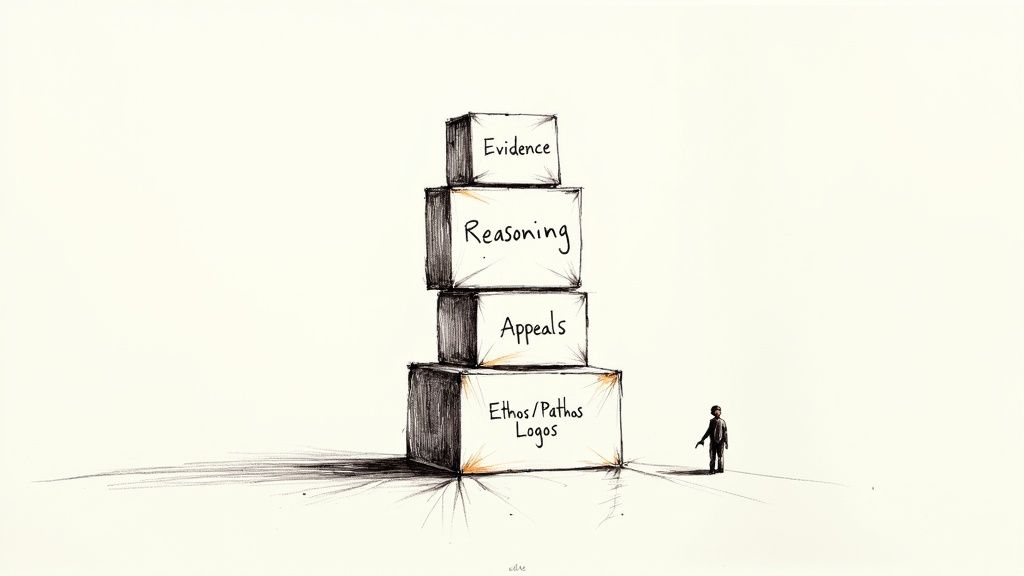
You’ve got your thesis—the North Star of your essay. Now comes the real work: building the body of your argument. Think of each body paragraph as a pillar holding up your position. If one is weak, the whole structure is at risk.
Your job is to make a case so solid and compelling that your reader simply can't brush it aside. This is where you move beyond just stating an opinion and start proving it with hard evidence and sharp thinking.
The Anatomy of a Powerful Paragraph
Every single body paragraph needs a clear, logical structure. This is about guiding your reader's thinking so your ideas are easy to follow and accept. A great paragraph works like a courtroom argument: you make a claim, and you immediately back it up with proof.
Here’s a simple, effective way to structure your paragraphs:
- The Claim: Kick things off with a topic sentence that makes a single, clear point supporting your main thesis.
- The Evidence: Now, prove it. Drop in your proof—a killer statistic, a quote from a respected expert, a real-world example, or a solid data point.
- The Reasoning: This is the most important part. Explain why the evidence matters and explicitly connect it back to your claim. This is where you show your reader how the pieces fit together.
When a paragraph follows this structure, it’s tight, focused, and incredibly effective. You're walking your reader through your logic, one step at a time, leaving no room for doubt.
The Three Pillars of Persuasion: Ethos, Pathos, and Logos
To make your argument truly land, you need to appeal to your reader on a few different levels. The ancient Greeks nailed this thousands of years ago, and their techniques are just as relevant for today's content creators.
- Ethos (Credibility): This is about building trust. You establish ethos by citing credible sources, using a fair and knowledgeable tone, and showing you’ve done your research.
- Pathos (Emotion): This is your connection to the reader’s heart. A vivid personal story or a relatable case study can make your topic feel more human and urgent.
- Logos (Logic): Here’s the bedrock of your argument. Logos is where you bring in the cold, hard facts, statistics, and logical reasoning to prove your point.
The very best persuasive essays weave all three together. An argument built only on logic can feel cold, while one leaning too heavily on emotion can seem manipulative. Balance is key.
A truly persuasive argument isn’t just a list of facts. It’s a carefully woven tapestry of credible sources (ethos), logical reasoning (logos), and relatable human connection (pathos) that makes your position feel both smart and right.
The Power of Diverse Evidence
Seasoned writers know that relying on just one type of proof is a mistake. To build a truly robust case, you need to mix and match your evidence. Effective arguments often draw from a variety of sources. Research into persuasive writing strategies suggests a strong essay might be built on a blend of facts (40%), expert opinions (25%), statistics (20%), and illustrative examples (10%).
After you've gathered evidence, tools like PureWrite can help polish its presentation. To make your arguments even more sophisticated, check out our guide on using compound and complex sentences.
Acknowledging the Other Side
Here’s a move that separates good writers from great ones: addressing the counterargument. It might feel strange to bring up the opposing view, but it’s one of the most powerful things you can do.
When you acknowledge the other side respectfully and then explain why your position is stronger, you show your reader that you’ve thought through the issue from all angles. In fact, studies show that writers who address opposing views can increase their persuasive effectiveness by 35-40%. It’s a sign of confidence and builds your credibility (ethos).
Writing That Resonates and Inspires Action

You've built a solid structure and gathered strong arguments. Now it’s time for the real craft—turning that logical outline into writing that actually moves people. This is where you breathe life into your essay, making your reader not just understand your point, but truly believe it.
The goal is to guide your reader through your argument so smoothly that they don't even notice the journey. You want your ideas to flow like a natural conversation, making complex points feel intuitive.
Crafting a Confident and Engaging Tone
Think of your tone as the personality of your essay. For persuasive writing, you want to sound confident but not arrogant. Your goal is to write with approachable authority.
Ditch uncertain language. Instead of, "It could be argued that..." take a stand with, "The evidence clearly shows that..." This direct approach builds trust. For a deeper dive, check out our guide on how to write engaging content.
Key Takeaway: A confident tone is built on active voice and decisive language. It tells the reader you are an expert on this topic, making your arguments more credible and, therefore, more persuasive.
If you read your draft and it feels a bit flat or overly academic, that’s a perfect time to use a tool like PureWrite. We can help you adjust your sentences to sound more assertive and natural, letting your real confidence shine through.
Connecting Ideas with Seamless Transitions
Transitions are the road signs in your essay. They're the words and phrases that show your reader how one idea connects to the next, guiding them from paragraph to paragraph without any jarring stops.
Without them, even brilliant arguments can feel like a random collection of thoughts. Good transitions are the glue that holds your essay together, creating a logical reading experience.
Think about how different words signal different relationships between ideas:
- To add another point: Additionally, furthermore, not only that, but...
- To show a contrast: However, on the other hand, conversely, despite this...
- To give an example: For instance, specifically, to illustrate...
- To show a result: Therefore, consequently, as a result, for this reason...
Placing these at the start of new paragraphs or sentences builds a clear path for your reader. It shows you're building your case one logical step at a time.
The Revision Process: Sharpening Your Final Draft
Once you have a full draft, the real work begins. Revision isn’t just about fixing typos; it’s about sharpening your arguments, cutting the clutter, and making sure every single word earns its spot.
A great first step is to read your essay out loud. This simple trick helps you catch awkward phrasing and clunky sentences your eyes might miss. Does it sound convincing?
Next, it’s time to be a ruthless editor. Look for any sentence or paragraph that doesn't directly support your main thesis. Be brave and hit delete. Powerful writing is almost always concise writing.
Final Polish and Professional Presentation
Finally, never underestimate the power of a clean presentation. The way your essay looks subtly influences how your reader perceives your credibility. The standard persuasive essay usually falls between 500-2,000 words, and a professional format shows you take your argument seriously.
In fact, some studies have shown that professionally presented papers—using standard formatting like a 12-point Times New Roman font and double-spacing—can receive 10-15% higher evaluation scores than the exact same content with sloppy formatting.
Before you consider your work finished, run through this final checklist:
- Clarity: Is every sentence crystal clear?
- Conciseness: Have you trimmed all unnecessary words?
- Impact: Does your conclusion leave a lasting impression?
- Proofreading: Have you checked for any sneaky grammar, spelling, or punctuation errors?
This final polishing stage turns a good draft into a persuasive masterpiece. We built PureWrite to be that final quality check. Our tool polishes your writing to make sure it’s clear, impactful, and ready to win over any audience.
Using AI as Your Ethical Writing Partner
AI writing tools can be an incredible asset for content creators, but the secret to using them well is about maintaining your own professional integrity. Here at PureWrite, we see AI as a co-pilot, not the pilot. It’s there to help you navigate the writing process, not to take the controls out of your hands.
This means using technology to sharpen your own ideas—not to generate them from scratch. There's a fine line between a helpful suggestion and plagiarism, and learning to walk that line is key. When used responsibly, AI empowers you to create stronger, more polished work that is still authentically yours.
https://www.youtube.com/embed/no0Tt-Ip9AI
Smart Ways to Partner with AI
Think of an AI tool as a tireless brainstorming partner or an exceptionally meticulous proofreader. It can offer a fresh perspective on your persuasive essay or help you polish the final draft, but the core argument must come from you.
Here are a few smart, ethical ways to bring AI into your workflow:
- Finding Counterarguments: Feeling stuck on what the opposing side might argue? Prompt an AI to generate potential counterclaims to your thesis. This is a brilliant way to anticipate objections and strengthen your own position.
- Smoothing Out Your Sentences: Got a paragraph that feels clunky? You can ask an AI to suggest a few different ways to phrase it. This helps improve the clarity and flow of your writing.
- Checking Grammar and Tone: Use AI as a supercharged grammar checker. Beyond just catching typos, it can pick up on subtle tonal issues and suggest ways to sound more confident, academic, or persuasive.
If you're looking for the right tech to help, exploring the best AI apps for Mac can offer great options for drafting and refining your essays.
Our Philosophy: Real persuasion stems from your unique voice and genuine conviction. AI is simply a tool to amplify that voice—not replace it. The aim should always be to enhance your original thoughts, making sure they land with clarity and impact.
Maintaining Authenticity and Avoiding the Pitfalls
The single biggest risk of leaning too heavily on AI is ending up with content that sounds generic and robotic. This is where AI detection tools enter the picture. Many universities and publications now use software to flag AI-generated text, and the penalties for submitting work that isn't your own can be serious. It's more important than ever to understand if AI detectors are accurate.
Recent studies have shown that over 60% of educators are worried about how AI might affect academic integrity. That's precisely why it's so vital to use these tools as a final check, not as a shortcut for the first draft.
Even if you’ve only used an AI assistant for brainstorming, your draft might still have that faint robotic echo. A humanizer is the perfect tool for that final polish. We built PureWrite to bridge this exact gap. You bring your core argument, and our tool helps you refine the language until it sounds completely natural and authentically human.
When writing a persuasive essay, the goal is to connect with your reader. That connection is instantly broken if your writing feels inauthentic. Try PureWrite today to ensure your final essay sounds like you, preserving your unique voice and making your arguments truly your own.
Common Persuasive Writing Mistakes to Avoid
Even a well-researched argument can fall apart if it's riddled with common writing mistakes. Getting good at spotting these traps in your own writing is a game-changer, turning a good essay into a great one. These errors can undermine your credibility, leaving your reader more confused than convinced.
One of the biggest culprits? Sweeping generalizations. Phrases like "everyone knows" or "it's obvious that" state opinions as universal truths without a shred of proof. A truly persuasive argument is built on a foundation of specific, verifiable evidence.
For instance, writing "Technology is ruining society" is a massive overstatement. A far more powerful claim would be: "A recent study revealed that the rise of social media platforms has been linked to a 15% increase in reported feelings of social isolation among teenagers." One is an opinion; the other is a fact-based argument.
Weak Foundations and Muddled Arguments
Another common pitfall is building your essay on a weak or vague thesis statement. Your thesis is the backbone of your entire paper. If it's flimsy or unclear, the rest of your essay will wander aimlessly.
Just as damaging is a messy paragraph structure. When your paragraphs lack a clear focus or bounce between different ideas, you’re making your reader work way too hard. Each paragraph should function as a self-contained mini-argument supporting your main thesis.
Your conclusion is your final chance to persuade. A common mistake is simply repeating your introduction. Instead, you should synthesize your key points and leave the reader with a powerful final thought or a compelling call to action.
Overlooking the Details
Let's be honest: nothing tanks your credibility (your ethos) faster than sloppy writing. Typos, grammatical goofs, and clumsy sentences signal to your reader that you didn't care enough to polish your work.
A few other classic mistakes to watch out for:
- Relying purely on emotion: Pathos is powerful, but it feels manipulative without the support of logos (logic and evidence).
- Ignoring counterarguments: When you don't acknowledge the other side, your argument can come across as biased or uninformed.
- A dull conclusion: Don't just rehash your thesis. Your conclusion should be the mic drop—that final thought that sticks with your reader.
Making sure your writing is clean and professional is non-negotiable. For a quick tune-up, review some basic grammar rules to help you spot and fix those pesky errors. And if you've worked with an AI assistant and the draft feels robotic, give PureWrite a try. We can help you smooth out your sentences and make sure your persuasive essay sounds clear, confident, and completely human.
Got Questions About Persuasive Essays? Let's Clear Things Up.
As you get deeper into writing your persuasive essay, you're bound to hit a few snags. It happens to everyone. Let's tackle some of the most common questions that pop up, so you can move past those roadblocks and get your essay polished and ready.
Navigating Common Hurdles
What if my topic is just... boring? You've been assigned something you have zero passion for. The trick is to find an angle that sparks a little curiosity. Think of it like a detective's case file; your job isn't to love the topic, but to build an airtight case for your position.
Another classic question: how many sources do I actually need? There isn’t a single magic number, but a solid benchmark is to have at least one credible source backing up each of your main arguments. For a typical five-paragraph essay, shooting for three to five high-quality sources shows you’ve done your homework.
Refining Your Strategy
"Wait, isn't this just an argumentative essay?" It’s a subtle but crucial distinction. Argumentative essays are like courtroom arguments—they lean heavily on formal logic (logos). Persuasive essays have more flexibility to bring in emotional appeals (pathos) and personal conviction to connect with the reader.
The most powerful persuasive writing does both. It builds a logical foundation but also makes the reader feel why the issue matters. You want to be both the smart analyst and the passionate advocate.
And finally, what about the intro and conclusion? A good guideline is to have each take up about 10% of your total word count. This gives you enough space to hook the reader and summarize your points without stealing the spotlight from your core arguments.
Crafting an essay that truly connects is tough work. If your draft is sounding a little stiff or your arguments aren't landing with the punch you want, you’re not alone. The PureWrite tool is designed specifically for this—it helps polish your writing so it sounds clear, confident, and genuinely human. Give it a try and turn your solid draft into a truly persuasive piece.