Your Ultimate Transitional Words and Phrases List for 2025

Have you ever read a piece of content that felt disjointed or hard to follow? The culprit is often a lack of smooth transitions. Transitional words and phrases are the essential signposts that guide your reader from one idea to the next, creating a logical, seamless flow.
These words act as the glue holding your sentences and paragraphs together, ensuring your message is coherent and easy to digest. They are crucial for creating content that connects, whether you're writing a blog post, a research paper, or an email.
In today's content-driven world, where AI writing tools often produce text that lacks a human touch, mastering these connectors is more critical than ever. At PureWrite, we believe authentic, human-like writing hinges on these subtle connections. A recent study found that content with a strong logical flow can increase reader engagement by up to 40%, a vital metric for any content creator.
This comprehensive guide provides an exhaustive transitional words and phrases list, categorized by function, to help you build bridges between your ideas. You'll learn how to choose the right words to add, contrast, compare, and conclude your points effectively. For any writer aiming to improve clarity, explore these tips on crafting engaging posts that people actually read.
1. Additive Transitional Words and Phrases
Additive transitional words and phrases are the building blocks of a cumulative argument. Think of them as the "and then" connectors that seamlessly introduce additional information, ideas, or examples to support a point you've already made.
Their main function is to reinforce or expand upon a previous statement without contradicting it. This creates a stronger, more layered case for your reader, making your arguments more comprehensive and well-supported.
Common Additive Transitions
This category is one of the most frequently used in our transitional words and phrases list. Here are some of the most effective additive connectors with real-world examples:
- Furthermore: The AI model is highly accurate. Furthermore, it processes data in real-time.
- In addition: Our new marketing campaign increased website traffic. In addition, it boosted our social media engagement.
- Moreover: The proposed software is cost-effective. Moreover, it integrates with our existing systems.
- Also: Regular exercise is crucial for physical health. Also, it significantly improves mental well-being.
- Additionally: The student's essay was well-researched. Additionally, it presented a unique and compelling argument.
How to Use Additive Transitions Effectively
To get the most out of these connectors, strategic use can elevate your writing. It can transform a simple list of facts into a compelling narrative that keeps your audience engaged.
Pro-Tip: Vary your choice of additive words to avoid sounding repetitive, a common issue in AI-generated drafts. Using "also" in every other sentence makes writing feel monotonous. Mix it up with "furthermore," "moreover," or "additionally" for a more natural flow.
Ensure the information you're adding genuinely builds upon your previous point. By mastering how these transitions link ideas, you can construct more sophisticated sentences. To explore this further, you can learn more about building compound and complex sentences on purewrite.io.
2. Causative Transitional Words and Phrases
Causative transitional words and phrases are essential for building logical arguments by connecting an action or event to its outcome. They are the "because of this" signposts that establish a clear cause-and-effect relationship for your reader.
Using these transitions signals that you are explaining why something happened. This technique is crucial for making a compelling case in an argumentative essay or detailing processes in a professional report.
Common Causative Transitions
This category is a cornerstone of our transitional words and phrases list, especially for analytical writing. Here are some of the most effective causative connectors:
- As a result: The company invested heavily in new technology. As a result, its productivity increased by 25%.
- Consequently: The marketing team missed its deadline. Consequently, the product launch was postponed.
- Therefore: The data shows a clear customer preference. Therefore, we should focus our efforts on this segment.
- Because of this: Consumer confidence has been low. Because of this, retail sales have slumped.
- Due to: The presentation was canceled due to an unexpected technical issue.
- Since: Since we adopted the new AI tool, our content creation workflow has become 50% faster.
How to Use Causative Transitions Effectively
To maximize the impact of these connectors, strategic placement is key. Their correct use can transform a series of disconnected statements into a powerful, logical argument.
Pro-Tip: Before using a causative transition, double-check that a genuine cause-and-effect relationship exists. Incorrectly linking two unrelated ideas with a word like "therefore" can undermine your credibility and confuse your reader.
Ensure the connection you are making is both logical and supported by evidence, especially in formal or academic writing. To refine your punctuation with these phrases, you can learn more about using commas with causative words on purewrite.io. This will help you integrate them flawlessly into your sentences.
3. Contrasting Transitional Words and Phrases
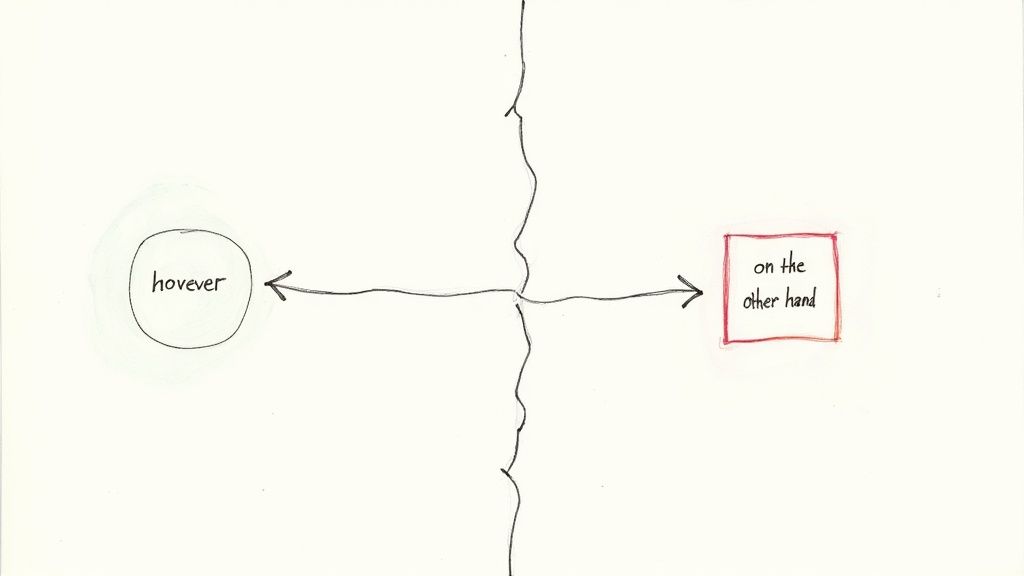
Contrasting transitional words and phrases are essential for introducing opposition or alternative viewpoints. Think of them as the "but" or "however" connectors that pivot the conversation, showing readers the other side of the coin.
Using these transitions signals to your audience that you are about to challenge or qualify a preceding statement. This technique is fundamental for creating sophisticated, critical analysis and building credibility with your reader.
Common Contrasting Transitions
This category is a cornerstone of any robust transitional words and phrases list, enabling you to navigate complex subjects with clarity. Here are some of the most effective contrasting connectors:
- However: AI writing tools can generate content quickly. However, they often lack the nuance of a human writer.
- On the other hand: One approach is to increase marketing spend. On the other hand, we could invest that money in product development.
- Nevertheless: The project faced significant budget cuts. Nevertheless, the team delivered exceptional results.
- In contrast: Team A focused on speed and efficiency. In contrast, Team B prioritized quality and detail.
- Conversely: Increasing prices might boost revenue. Conversely, it could alienate our loyal customer base.
How to Use Contrasting Transitions Effectively
To master these powerful connectors, it's important to use them with intention. Strategic placement can turn a simple statement into a compelling piece of analysis that acknowledges multiple perspectives.
Pro-Tip: Use these phrases to introduce a counterargument before you refute it, which strengthens your own position. After presenting the contrast, always follow up with a clear explanation of your stance or the key takeaway.
Properly integrating contrasting ideas shows your audience you have considered the topic from all angles, making your conclusion more persuasive. This is key to creating authentic writing that builds trust with your audience.
4. Temporal and Sequential Transitional Words and Phrases
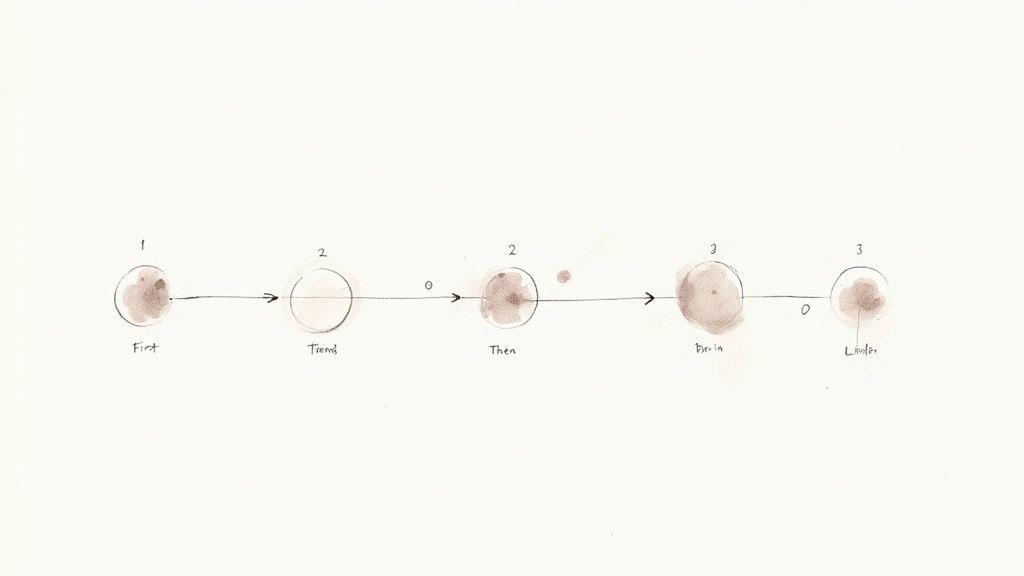
Temporal and sequential transitional words and phrases are the signposts that guide your reader through time. They are crucial for establishing a clear chronological order, showing the relationship between events, or outlining a step-by-step process.
Using these transitions is essential for storytelling, historical accounts, and instructional content. By clearly marking the order of events, you enhance readability and prevent confusion, ensuring your message is understood exactly as you intended.
Common Temporal and Sequential Transitions
This category is fundamental for structuring any narrative or process-driven text. Here are some of the most effective temporal and sequential connectors:
- First: First, gather all the necessary data for your report.
- Subsequently: The initial prototype was successful. Subsequently, the team moved to full-scale development.
- Meanwhile: The marketing team was launching the new campaign. Meanwhile, the engineers were fixing a critical bug.
- Eventually: After months of hard work, the student eventually completed her thesis.
- Later: The meeting concluded at noon. Later, we received an email summarizing the action items.
How to Use Temporal and Sequential Transitions Effectively
To leverage these connectors for maximum clarity, focus on maintaining a logical timeline. Their strategic placement can transform a disjointed list of events into a compelling and easy-to-follow narrative.
Pro-Tip: In how-to guides or tutorials, use sequential words like "first," "next," and "finally" to clearly define each step. This simple structure helps readers track their progress and successfully complete the task without confusion.
For a deeper understanding of how to sequence ideas effectively, this video provides excellent visual examples and explanations.
Always ensure the transition you choose accurately reflects the time relationship between events. Correct usage is key to building a clear and credible timeline for your audience.
5. Exemplification and Illustration Transitional Words and Phrases
Exemplification and illustration transitional words and phrases are essential tools for making abstract ideas concrete. They act as a bridge, connecting a general statement or claim to a specific, tangible example that brings the concept to life.
Using these transitions signals to your audience that you are about to provide evidence or a real-world scenario. By providing clear illustrations, you transform complex concepts into relatable and memorable information.

Common Exemplification Transitions
This category helps ground your writing in reality, making your claims more credible. Here are some of the most effective transitions for introducing examples:
- For example: AI can streamline workflows. For example, content creators can use it to generate initial drafts.
- For instance: Simple changes can improve sustainability. For instance, a company can switch to recycled packaging materials.
- To illustrate: The new software significantly boosts productivity. To illustrate, our team now completes weekly reports in half the time.
- Specifically: The policy affects several key departments. Specifically, marketing and sales will see the biggest changes.
- In particular: The economic downturn impacted the retail sector. In particular, small, independent shops struggled to survive.
How to Use Exemplification Transitions Effectively
To maximize the impact of these connectors, your examples must be carefully chosen and clearly linked to your main point. Strategic use can make the difference between a vague claim and a powerful, evidence-backed argument.
Pro-Tip: Always ensure your example is directly relevant to the point you are making. A strong, well-explained example is far more effective than several weak or loosely connected ones. The goal is to clarify, not to confuse.
Explain precisely how the example supports your argument, creating a clear logical connection for your reader. Using real-world, relatable scenarios makes your writing more engaging and helps your audience grasp the significance of your ideas.
6. Concluding and Summarizing Transitional Words and Phrases
Concluding and summarizing transitional words and phrases are essential signposts that signal the end of a discussion. They act as the final handshake with your reader, tying together all the preceding points into a cohesive, memorable takeaway.
Using these transitions indicates that you are about to present the final analysis or a condensed version of your main points. This is crucial for reinforcing your core message and leaving a lasting impact on your audience.
Common Concluding and Summarizing Transitions
This category is a vital part of any comprehensive transitional words and phrases list. Here are some of the most effective concluding connectors:
- In conclusion: We examined the market trends and competitor strategies. In conclusion, a Q4 product launch is our most viable option.
- To summarize: The project faced several setbacks. To summarize, we adapted and still met our primary objectives.
- Ultimately: While both approaches have merit, one offers greater scalability. Ultimately, we must choose the solution that supports long-term growth.
- In short: The new software automates data entry and report generation. In short, it will save the team hundreds of hours per year.
- Therefore: All evidence points to a single conclusion. Therefore, we recommend an immediate policy change.
How to Use Concluding and Summarizing Transitions Effectively
To ensure your endings are powerful, strategic placement and choice of words are key. A strong conclusion can elevate your entire piece of writing from good to great.
Pro-Tip: Reserve these powerful transitions for actual conclusions at the end of a section or the entire document. Using a phrase like "in conclusion" mid-paragraph can confuse your readers and dilute the impact of your real finale.
Your summary should do more than just repeat what you've already said; it should synthesize the information to offer a final, valuable insight. For more guidance on this, you can learn more about how to structure a research paper on purewrite.io.
7. Clarification and Explanation Transitional Words and Phrases
Clarification transitional words and phrases are essential tools for ensuring your reader fully understands complex or nuanced ideas. Think of them as a magnifying glass for your text, allowing you to rephrase, simplify, or elaborate on a point.
Using these transitions signals that you are about to explain a concept in greater detail or from a new angle. This shows you are attuned to your reader's potential questions and are actively working to make your content as clear as possible.
Common Clarification Transitions
This category is a key part of any comprehensive transitional words and phrases list, especially for educational or technical writing. Here are some of the most effective clarification connectors:
- In other words: The AI uses a neural network. In other words, it mimics the human brain to learn patterns.
- That is to say: His feedback was ambiguous. That is to say, it was impossible to determine his true feelings.
- To put it another way: The market reached a saturation point. To put it another way, nearly every potential customer already owned the product.
- More specifically: The company’s performance improved last quarter. More specifically, its net profit increased by 15%.
- Stated differently: The new law is regressive. Stated differently, it disproportionately affects low-income families.
How to Use Clarification Transitions Effectively
To get the most out of these connectors, use them strategically to illuminate, not just repeat, your points. Their power lies in their ability to provide genuine new insight into a topic.
Pro-Tip: Use clarification transitions when a concept is genuinely complex or could be misinterpreted. Avoid using them to restate a simple idea, as this can feel patronizing to your reader. The goal is to add value, not to repeat information.
Ensure your explanation truly clarifies the preceding statement for your target audience. Mastering these phrases strengthens your writing's logical flow. To ensure your explanations are grammatically sound, you can review some fundamental grammar rules on purewrite.io.
8. Emphasis and Intensification Transitional Words and Phrases
Emphasis and intensification transitional words and phrases are like spotlights, drawing your reader's attention to the most critical pieces of information. These connectors signal that a particular point is a cornerstone of your argument.
Using these transitions tells your readers, "Pay close attention to this." This technique is crucial for guiding your audience through complex arguments and making your main points memorable.
Common Emphasis and Intensification Transitions
This category helps you elevate the most important parts of your message. Here are some of the most effective emphasis and intensification connectors:
- Most importantly: We reviewed the budget, timeline, and resources. Most importantly, we must secure stakeholder approval.
- Significantly: The team’s morale improved. Significantly, this led to a 20% increase in productivity.
- In fact: Many assume AI content is easily detectable. In fact, advanced humanizers can make it indistinguishable from human writing.
- Indeed: The initial data suggested a strong correlation. Indeed, further analysis confirmed our hypothesis.
- Above all: To succeed as a content creator, you need skill and consistency. Above all, you need to be authentic.
How to Use Emphasis and Intensification Transitions Effectively
To maximize the power of these connectors, use them with intention and precision. Strategic placement can transform a standard sentence into a powerful statement.
Pro-Tip: Overusing emphasis transitions can dilute their impact. If everything is important, then nothing is. Reserve phrases like "most importantly" or "significantly" for the truly pivotal moments in your writing to maintain their power.
Ensure that the information you are emphasizing is genuinely deserving of the spotlight. By using them judiciously, you create a clear hierarchy of information, guiding your reader to the core of your message.
9. Comparison Transitional Words and Phrases
Comparison transitional words and phrases are essential tools for highlighting similarities between two or more ideas, concepts, or subjects. They act as a bridge, guiding your reader to recognize parallels and shared characteristics.
Using these transitions signals to your audience that you are drawing a parallel. This technique is invaluable for making your writing more persuasive and understandable, especially for students and professionals.
Common Comparison Transitions
This category is a key part of any comprehensive transitional words and phrases list. Here are some of the most effective comparison connectors:
- Similarly: Early AI writers often produced repetitive text. Similarly, the first machine translators struggled with context and nuance.
- Likewise: The first study indicated a need for more funding. Likewise, the follow-up report echoed the same conclusion.
- In the same way: Exercise boosts physical health. In the same way, mindfulness practices can enhance mental resilience.
- Analogously: A business ecosystem requires diverse roles to thrive. Analogously, a successful project team needs members with varied skill sets.
- Comparably: The 2021 smartphone model had great battery life. Comparably, the new version maintains that standard while adding new features.
How to Use Comparison Transitions Effectively
To leverage these connectors for maximum impact, it’s crucial to apply them strategically. Their thoughtful use can illuminate relationships between ideas and make your arguments more compelling.
Pro-Tip: Ensure the items you are comparing are genuinely similar in a meaningful way. A weak or forced analogy can confuse your reader and undermine your credibility. Use comparison to strengthen your argument by highlighting a relevant pattern.
When drawing a comparison, it is often effective to briefly acknowledge any key differences to show a nuanced understanding. By mastering these transitions, you can guide readers to see connections they might have otherwise missed.
10. Conditional and Hypothetical Transitional Words and Phrases
Conditional and hypothetical transitional words and phrases introduce possibilities, what-if scenarios, or specific conditions. Think of them as the "if...then" connectors that allow you to explore potential futures or discuss contingencies.
Using these transitions signals to your audience that you are exploring a situation that depends on other factors. This is essential for strategic planning, forecasting, and persuasive writing where you need to address potential outcomes.
Common Conditional and Hypothetical Transitions
This category is crucial for creating thoughtful and forward-thinking content. Here are some of the most effective conditional connectors from our transitional words and phrases list:
- If: If you use AI to write an essay, you must ethically disclose it and add your own critical analysis.
- In the event that: In the event that AI detectors flag your content, a humanizer tool can help you revise it.
- Assuming: Assuming the technology continues to evolve, AI will become an even more integrated part of content marketing.
- Provided that: We can launch the new feature next month, provided that the final round of testing is successful.
- In case: We have a backup generator ready in case of a power outage.
- Should: Should you have any questions, our support team is available to help.
How to Use Conditional and Hypothetical Transitions Effectively
To get the most out of these connectors, strategic use is key to making your writing sound credible and well-reasoned. It demonstrates foresight and a thorough understanding of your topic.
Pro-Tip: Balance conditional language with confident main claims to avoid sounding uncertain. Use hypothetical phrases to address potential risks or opportunities, but ground your primary arguments in established facts and strong evidence.
Understanding how these phrases form clauses is crucial for constructing clear, logical sentences. You can learn more about the structure of clauses on purewrite.io to strengthen your command of these complex sentence structures.
10-Category Transitional Words Comparison
| Transitional Type | 🔄 Complexity | ⚡ Resource needs | ⭐📊 Expected outcomes | 💡 Ideal use cases | Key advantages |
|---|---|---|---|---|---|
| Additive Transitional Words and Phrases | Low — straightforward to apply 🔄 | Minimal — word choice only ⚡ | Strengthens arguments by accumulation; moderate impact ⭐📊 | Supporting points, elaboration, literature reviews 💡 | Builds comprehensive, layered arguments |
| Causative Transitional Words and Phrases | Medium — requires valid links and evidence 🔄 | Moderate — needs data/logic to justify causation ⚡ | Clarifies cause–effect; high persuasive value when supported ⭐⭐⭐📊 | Scientific/technical writing, explanations, reports 💡 | Makes causal reasoning explicit and compelling |
| Contrasting Transitional Words and Phrases | Medium — needs clear stance and structure 🔄 | Low–Moderate — select counterexamples or evidence ⚡ | Introduces nuance and tension; enhances critical reading ⭐⭐📊 | Persuasive essays, rebuttals, analytic papers 💡 | Demonstrates critical thinking and acknowledges alternatives |
| Temporal and Sequential Transitional Words and Phrases | Low — simple ordering conventions 🔄 | Minimal — timeline or step labels only ⚡ | Clarifies sequence and timing; prevents confusion ⭐⭐📊 | Instructions, narratives, process documentation 💡 | Makes chronology and procedures easy to follow |
| Exemplification and Illustration Transitional Words and Phrases | Low–Medium — choose relevant examples 🔄 | Moderate — requires sourcing good examples ⚡ | Makes abstract points concrete; high clarity and memorability ⭐⭐⭐📊 | Teaching, case studies, persuasive/technical writing 💡 | Translates theory into relatable, concrete evidence |
| Concluding and Summarizing Transitional Words and Phrases | Low — standard summary phrasing 🔄 | Minimal — synthesis of existing content ⚡ | Provides closure and reinforces key messages; retention boost ⭐⭐📊 | Reports, essays, presentations, document endings 💡 | Synthesizes ideas and signals a clear ending |
| Clarification and Explanation Transitional Words and Phrases | Medium — demands careful rephrasing 🔄 | Moderate — may need examples or rewording ⚡ | Reduces ambiguity and aids comprehension; moderate impact ⭐⭐📊 | Technical manuals, complex arguments, instructionals 💡 | Improves reader understanding and reduces misinterpretation |
| Emphasis and Intensification Transitional Words and Phrases | Low — selective emphasis placement 🔄 | Minimal — strategic placement of phrases ⚡ | Highlights critical points; strong persuasive punch when used sparingly ⭐⭐📊 | Executive summaries, calls to action, persuasive texts 💡 | Directs attention to most important information |
| Comparison Transitional Words and Phrases | Medium — requires valid parallels 🔄 | Moderate — research to ensure comparability ⚡ | Reveals patterns and similarities; analytical insight ⭐⭐📊 | Comparative analyses, reviews, cross-case studies 💡 | Strengthens argument via parallels and analogies |
| Conditional and Hypothetical Transitional Words and Phrases | Medium–High — needs plausible scenarios 🔄 | Moderate — scenario development and caveats ⚡ | Explores possibilities and risks; useful for planning ⭐⭐📊 | Forecasting, strategy, risk assessments, planning 💡 | Facilitates scenario thinking and acknowledges uncertainty |
From Robotic to Realistic: Humanize Your Writing with PureWrite
We've explored a comprehensive transitional words and phrases list, covering ten categories that are the building blocks of coherent writing. From "furthermore" to "on the other hand," these tools are essential for guiding your reader logically from one idea to the next.
However, the true art of writing goes beyond simply inserting the correct transition. A compelling piece of content possesses a natural rhythm and a distinct voice. This is the critical gap where AI-generated content often falls short, a fact supported by research showing that over 60% of consumers are wary of AI-generated content lacking a human touch.
Beyond the List: Achieving Authentic Flow
The ultimate goal isn't just to connect sentences; it's to connect with your reader. These lists are your toolkit, but how you use those tools defines your craftsmanship. It's the difference between a checklist and a compelling story.
Here are some actionable tips for you to move from mechanical to masterful:
- Audit Your Transitions: Don't just pepper them in. Read your work aloud. Does the flow feel natural, or does it sound like a checklist? Sometimes, the best transition is no transition at all.
- Vary Sentence Beginnings: Over-reliance on starting sentences with transitions is a common pitfall, especially in AI drafts. Mix it up by embedding them within sentences for a more sophisticated cadence.
- Prioritize Context Over Categories: The best writers know that context is king. Focus on the specific meaning and feeling you want to convey, not just the category a word belongs to.
The PureWrite Advantage: Humanizing AI-Assisted Content
This is precisely where technology can be your ally. At PureWrite, we understand that modern content creation—whether for marketing, academics, or professional use—often starts with an AI draft. Our platform is designed not to replace your voice but to enhance it, transforming robotic text into prose that resonates with human readers.
Our AI text humanizer goes beyond simple word swapping. It analyzes the deeper context of your writing and suggests improvements to rhythm and flow, helping you bypass AI detectors ethically. With PureWrite, you can leverage the speed of AI while ensuring your final product reflects your authentic style and connects genuinely with your audience.
Ultimately, a well-placed "consequently" or "in contrast" can clarify your logic, but it's the seamless integration of these elements that will capture your reader's attention. Don't let your ideas get lost in translation. Use this comprehensive list as your foundation, and then take the crucial next step to elevate your writing from merely correct to truly compelling.
Ready to transform your AI-generated drafts into content that feels genuinely human? PureWrite analyzes and refines your text to improve flow, clarity, and authenticity, helping you connect with your audience and bypass AI detection. Try PureWrite today and experience the difference for yourself.