First, let's clear up the biggest myth about Turnitin. That percentage you see is a similarity score, not a plagiarism score.
It's a common point of panic for students and writers, but a high score doesn't automatically mean you've done something wrong. It simply flags how much of your text matches sources in Turnitin's massive database—a collection of websites, academic journals, and billions of student papers.
Think of it as a tool that starts a conversation, not one that delivers a final verdict. At PureWrite, we see it as an opportunity to refine your work and ensure your unique voice shines through.
What Your Turnitin Percentage Really Means
Your Turnitin percentage isn't a grade or a judgment. It’s more like an early warning system that helps you and your instructor take a closer look at your work, checking for proper citations, effective paraphrasing, and original thought.
It's simply a measure of textual overlap. For content creators using AI tools, this score is a critical indicator of whether your draft is truly unique or just a remix of existing online content.
This score is just one piece of the puzzle, fitting into the broader framework of assessment for education where the goal is to support your learning, not just police it. The number is a starting point for a deeper review.
Understanding the Score Ranges
So, what’s a "good" or "bad" score? The truth is, it depends on the context of your work. Every university or even department sets its own standards, but some general guidelines can help you make sense of your report.
For a more detailed breakdown of what the software is actually scanning for, our guide on what does Turnitin check for is a great resource.
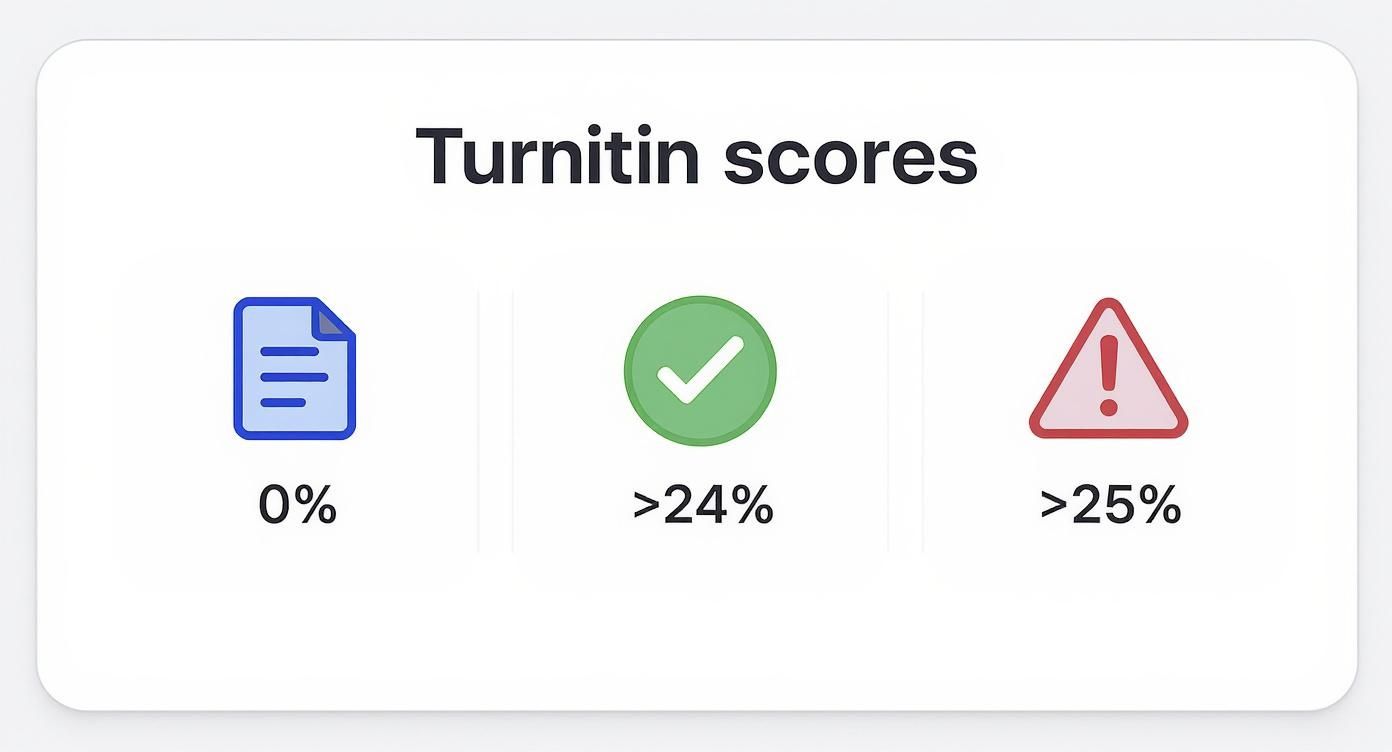
As you can see, a score below 24% is often considered perfectly fine (green), while anything 25% or higher (red) usually signals that you should review the matched text carefully. Context matters more than anything. For example, a marketer's research-heavy white paper will naturally have a higher score than a creative blog post.
Below is a handy table to help you quickly interpret your score.
A Quick Guide to Your Turnitin Score
Use this reference to understand what different Turnitin percentage ranges typically signify for your submission.
| Percentage Range | What It Usually Means | Your Next Steps |
|---|---|---|
| 0% | Completely original text with no matches found. | Great job! This is rare but indicates fully original wording. |
| 1-24% | Generally acceptable. Matches are likely common phrases or properly cited sources. | Review the matches to confirm they are correctly quoted and referenced. |
| 25-49% | A moderate level of similarity. This may be fine for citation-heavy papers. | This is a crucial review zone. Check every highlighted section for unintentional plagiarism, poor paraphrasing, or missing citations. |
| 50-100% | High level of similarity. This is a red flag for significant unoriginal content. | This score requires immediate and thorough attention. You likely need to rework large sections of your paper to ensure academic integrity. |
Remember, these are just guidelines. Always check your institution's or client's specific requirements.
How Turnitin Calculates Your Score
Ever wondered what happens behind the curtain after you hit 'submit'? To understand your Turnitin percentage, you need to know how the system works. It's not just a simple copy-paste checker; it’s a two-stage process combining massive text comparison with a layer of AI detection.
First, the software runs your document against an absolutely gigantic database. We’re talking billions of web pages, a vast library of academic journals, and every student paper ever submitted. It breaks your work into small chunks of text—phrases and sentences—and looks for overlaps.
This huge comparison generates your main similarity score. It’s designed to flag any text that matches its database, from a direct quote to a sentence you paraphrased a bit too closely.
The Text-Matching Process
The heart of Turnitin's calculation is its text-matching algorithm. It highlights parts of your writing that are identical or very similar to content it finds elsewhere, but this often flags things that are perfectly acceptable.
Here’s what commonly gets flagged:
- Direct Quotes: Even if you’ve cited them perfectly with quotation marks, the text itself will be flagged as a match. This is completely normal.
- Bibliographies and Reference Lists: Since citation formats are standardized, your reference list is almost guaranteed to match other papers.
- Common Phrases: Think about standard definitions or technical terms in your field. These are used all the time and will naturally trigger a match.
It’s so important to remember that these matches aren't accusations. They are simply highlighted overlaps that require human review—either by you or your instructor—to check for proper context and citation.
The Rise of AI Detection
Turnitin has also adapted to the new reality of AI writing tools. A key part of its analysis is a separate feature designed to spot the fingerprints of AI-generated content. As these tools become more popular, distinguishing human from machine writing is crucial for academic and professional integrity.
Turnitin’s AI writing detector goes beyond just checking for copied text. It analyzes subtle clues like linguistic patterns, consistency in sentence structure, and word choice to identify writing that sounds too uniform or lacks that distinctly human voice.
This AI score is reported separately from the main similarity percentage, giving instructors another layer of information. For a deeper look into this, check our guide on whether Turnitin can detect AI. This dual-check system provides a more complete picture of how a document was created.
For professionals and students using AI to assist their writing, this means originality is about more than avoiding plagiarism. It's about ethically using tools to enhance your work while ensuring the final product truly reflects your own thinking and voice.
How to Read Your Similarity Report
https://www.youtube.com/embed/6bjnVRVIdJA
Opening your Turnitin report can feel intimidating, but you should think of it as a roadmap for improving your writing, not a judgment. Learning to read it correctly is key to ensuring your work's integrity.
The first thing you'll see is a color-coded system that gives you a quick snapshot of the similarity percentage. Each color corresponds to a different range, giving you an immediate feel for how much of your text matches other sources.
- Blue: No matching text found (0%).
- Green: Between one word and 24% similarity.
- Yellow: 25% to 49% similarity.
- Orange: 50% to 74% similarity.
- Red: 75% to 100% similarity.
This spectrum is your first clue. A green score usually means you're in a good spot, but yellow, orange, or red are clear signals that you need to take a closer look at the specific matches.
Navigating the Match Overview
The real story isn't in the overall percentage—it's in the details. The Match Overview panel breaks down the score, showing you every single source your text has been matched against and the individual percentage for each one.
You’ll see a numbered list of websites, journal articles, and other papers containing similar phrasing. Clicking on a source highlights the corresponding text in your document, helping you see the exact phrases that were flagged. This allows you to determine if it's a properly cited quote or a passage that needs better paraphrasing.
The landscape of academic and professional integrity is shifting with AI. Turnitin’s AI detector, rolled out in April 2023, scanned over 200 million papers by March 2024. The data revealed that over 22 million of those papers had at least 20% AI-written content, underscoring the importance of authentic writing.
Using Filters for a More Accurate Score
Here’s a pro tip: your initial score is often inflated by acceptable matches. The filter tool is your best friend for getting a more accurate picture of your work's originality.
You or your instructor can usually adjust the settings to refine the report:
- Exclude Quoted Material: This tells the system to ignore anything correctly placed within quotation marks.
- Exclude Bibliography: This filter removes your entire reference list from the similarity analysis.
- Exclude Small Matches: You can also set a threshold to ignore short, common phrases by excluding matches below a certain word count (like fewer than 10 words).
Applying these filters can make a huge difference, often dropping your score significantly. It helps you zero in on what really matters: the parts of your paper that are supposed to be your own unique analysis and voice. For more strategies, check our guide on using a plagiarism checker for students.
What's Behind a High Similarity Score?
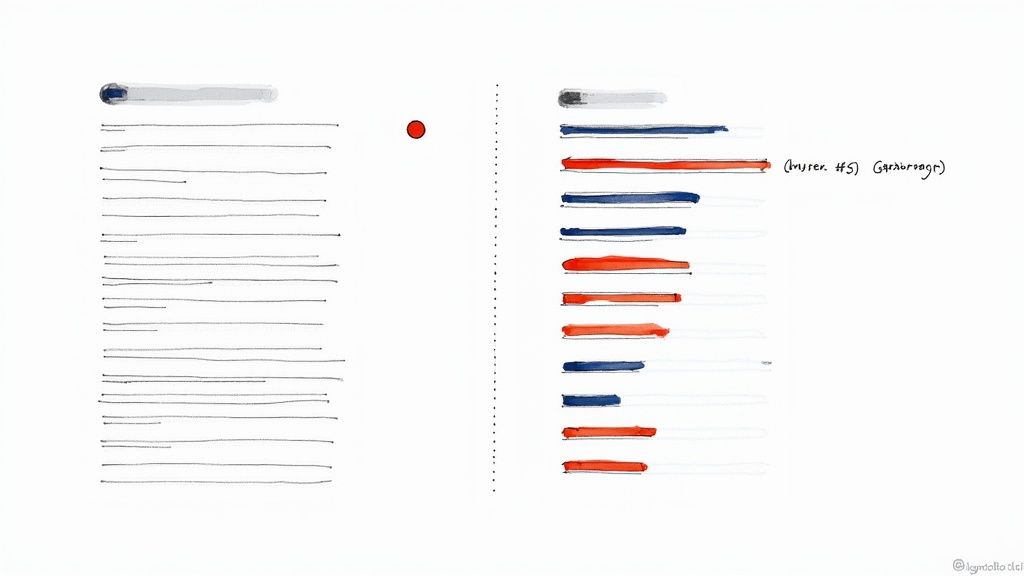
It’s easy to panic when you see a high Turnitin score, but don't. A high percentage is rarely a sign of intentional plagiarism; it's often flagging common, fixable writing habits. Figuring out why the score is high is the first step toward making your work stronger.
A huge chunk of the matches in your report often come from perfectly acceptable parts of your paper. The trick is to learn the difference between a simple technical match and a genuine issue. Once you can spot these common culprits, you'll be able to review your work like a pro.
Leaning Too Heavily on Direct Quotes
One of the biggest reasons for a high score is using too many direct quotations. Quotes are great for backing up your points with evidence, but overdoing it will inflate your similarity percentage because Turnitin flags every word of a quoted passage, even if cited perfectly.
A report filled with quote matches isn't about dishonesty—it's about writing style. It suggests you might be letting your sources do the talking for you, instead of weaving their ideas into your own unique argument.
The goal is to integrate evidence, not just drop it in. For example, a content creator might quote a statistic, but the surrounding analysis should be entirely their own. Effective writing strikes a balance between quoting, paraphrasing, and original analysis.
Shaky Formatting and Citation Issues
You'd be surprised how often simple formatting mistakes push a score up. Forgetting to put quotation marks around a direct quote is a classic example. When that happens, Turnitin flags the text as a potential problem instead of seeing it as a properly attributed source.
Your bibliography is another common source of matches. Since citation styles follow a rigid format, your reference list will naturally look like thousands of others. Instructors can usually filter this out, but the initial report will almost always count it. For those tackling bigger projects, getting the format right is crucial, which is why it helps to learn how to structure a research paper from the start.
Standard Phrasing and Assignment Templates
Finally, some matches are just unavoidable. If you’re writing in a technical field like medicine or law, you have to use standard terminology. These universal phrases are part of the professional language and will naturally get flagged.
This also happens when instructors provide assignment templates or specific headings. If everyone in your class uses the exact same section titles, those phrases will be flagged as matches. These are harmless, and your instructor will recognize them for what they are.
Practical Ways to Lower Your Turnitin Score
Seeing a high Turnitin percentage can be alarming, but think of it as a signpost pointing toward opportunities to strengthen your writing. The goal isn't to trick the system—it's to produce authentic work that showcases your own understanding and voice.
This isn't about swapping out a few words. Real originality comes from truly digesting the source material and then explaining it in your own voice and structure.
Master the Art of Paraphrasing
Effective paraphrasing is the best way to reduce similarity. It’s much more than finding synonyms; it's about completely rebuilding an idea using your own vocabulary and sentence patterns. Imagine you just read a complex report and now have to explain its key findings in a simple email to your team—that’s the essence of good paraphrasing.
Here’s a practical technique: read a passage from a source, close the tab, and write out the core concept from memory. This forces your brain to process the information instead of just shuffling words. Then, compare your version to the original to ensure you captured the meaning accurately without borrowing the exact phrasing.
The secret to great paraphrasing is genuine comprehension. When you truly get a concept, you can explain it in a dozen different ways. A high similarity score is often just a nudge to go back and deepen your understanding of the material.
Use Quotes Strategically and Sparingly
Direct quotes have their place, but they should be used like a powerful spice—a little goes a long way. Leaning too heavily on quotes will inflate your similarity score and can drown out your own voice by letting others do the talking for you.
Before you copy and paste a quote, ask yourself: is this absolutely essential?
- Is the author's original phrasing so unique or powerful that paraphrasing would lose its impact? If so, quote it.
- Could I explain this information just as clearly in my own words? If yes, paraphrasing is almost always the better choice.
Being intentional with your quotes ensures each one adds weight to your argument instead of just taking up space. For more tips on building a stronger voice, check out our guide on how to improve academic writing.
Synthesize Ideas from Multiple Sources
Try to avoid dedicating an entire paragraph to a single source. A much stronger approach is to synthesize, which means weaving together ideas from several different sources to create a new, more robust point. This technique naturally produces more original writing because you’re not just summarizing—you’re actively making connections.
For instance, instead of just explaining what one study found, discuss how its perspective challenges or complements the findings of another. This method doesn't just lower your similarity score; it demonstrates a much higher level of critical thinking and adds more value for your reader.
What Is an Acceptable Turnitin Percentage
This is the million-dollar question for every writer and student. But the truth is, there isn't one "magic number" for a good Turnitin score. The meaning of your percentage is all about context.
Generally speaking, most universities are perfectly happy with a similarity score under 15%. A score in this range usually means your work is original, and any matches are likely just properly cited quotes or common phrases.
Interpreting the Gray Area
Once you see numbers between 15% and 40%, you’ve entered a gray area. This doesn’t automatically mean you’ve done something wrong, but it’s a signal that your instructor or editor will likely take a closer look.
Often, a score in this range suggests you might be leaning too heavily on your sources. Perhaps you've used too many direct quotes, or your paraphrasing sticks a little too closely to the original text. It’s a good cue to go back and express those ideas more in your own words.
Think about it this way: a high percentage in a literature review is totally normal and expected. But that same score on a personal reflection essay? That’s a major red flag. Always consider the type of assignment you're writing.
When a Score Becomes a Concern
A similarity score that creeps over 40% is usually where real concerns begin. This is often an indicator of a much bigger problem, like large chunks of text copied without citation or a fundamental misunderstanding of how to use source material.
This topic is more relevant than ever as schools and businesses adopt new technologies. For example, universities are exploring how AI is enhancing education at the University of Florida while still focusing on academic integrity.
For writers using AI tools, a high score is a clear sign that the draft needs a serious overhaul. If your AI-generated text flags for high similarity, it’s time to humanize it. At PureWrite, we specialize in transforming that content into something that sounds genuinely you, ensuring it's unique and reflects your authentic voice. Give PureWrite a try to refine your work and make it truly original.
Got Questions? We've Got Answers
Let's clear up a few of the most common questions that pop up when dealing with Turnitin. Getting a handle on these will make interpreting your reports much less stressful.
So, Can Turnitin Actually "Detect" Paraphrasing?
This is a great question with a nuanced answer. Turnitin doesn't have a "paraphrase detector," but it does have a powerful text-matching algorithm.
If your paraphrasing sticks too closely to the original sentence structure or just swaps out a few words with synonyms, Turnitin will almost certainly flag it. It's not detecting the act of paraphrasing but rather the "ghost" of the original text.
Good paraphrasing is a complete re-engineering of the idea. It requires you to absorb the concept and explain it entirely in your own words, showing you understand the material, not just that you can rearrange it.
Why Does My Reference List Jack Up My Score?
Yes, it almost always does. Your bibliography is often a major contributor to a high similarity score for a simple reason: references follow a strict, standardized format (like APA or MLA).
The title of a famous book or journal article will be identical across thousands of papers in Turnitin's database. This creates tons of unavoidable matches.
The good news? Your instructor knows this. Most will configure Turnitin to completely ignore the bibliography and any quoted material when calculating the final score. If you see a high percentage at first glance, the reference list is the most likely suspect.
How Does the Turnitin AI Detector Work?
The AI detector is a completely separate tool from the similarity checker. Instead of looking for matched text from a database, it analyzes the style of the writing itself.
The detector has been trained to look for tell-tale signs often found in AI-generated content. It's on the lookout for things like:
- Unusually consistent sentence lengths and structures.
- Word choices that are predictable or lack natural human variation.
- A "flow" that feels a little too perfect or sterile.
Based on these patterns, it gives a separate score indicating the probability that the text was written by an AI. This is why it's crucial to use AI tools ethically—as a starting point for brainstorming or research, not as a ghostwriter for your final draft.
If you've used an AI tool to get started and want to make sure your final paper sounds genuinely like you, PureWrite can bridge that gap. Our platform helps refine AI text, turning it into natural, human-quality writing that maintains your authentic voice. Give it a try at https://purewrite.io.