Academic integrity isn't just about following rules—it's the moral compass for your entire educational and professional journey. Think of it as a "code of honor" that ensures the work you submit is truly your own. At PureWrite, we believe that acting with honesty, trust, and responsibility is what gives your hard-earned degree its real-world value.
What Does Academic Integrity Really Mean Today?
At its core, academic integrity is the bedrock of all credible learning, research, and content creation. It's a promise you make to yourself, your instructors, and your institution that the work you produce reflects your genuine effort and understanding.
This commitment is what keeps education and professional work fair and meaningful. Without it, the value of a degree crumbles, and the trust that holds academic and professional communities together disappears. It's a simple, powerful agreement: your achievements are earned through honest work.
The Five Pillars of Academic Integrity
To really get a handle on academic integrity, it helps to break it down into five core principles. These aren’t just abstract ideas; they’re practical standards that should guide every assignment or project you tackle.
This diagram helps visualize how some of these interconnected values—like honesty, trust, and responsibility—form a protective shield around your work.
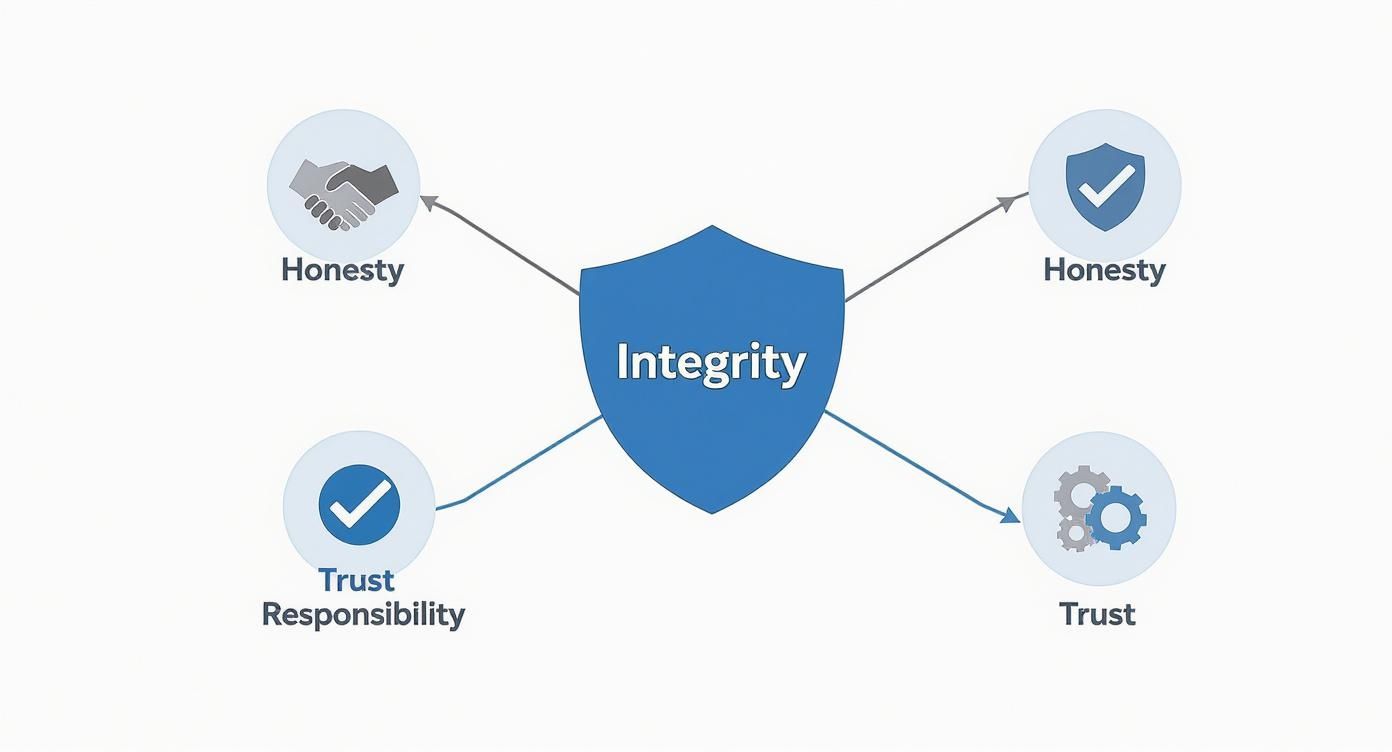
When you see how they all support one another, you get a much clearer picture of what a strong ethical framework looks like in practice.
Let's look at the five internationally recognized values that define academic integrity.
The Five Pillars of Academic Integrity
A summary of the core values that form the foundation of academic integrity.
| Pillar | What It Means in Practice |
|---|---|
| Honesty | Being truthful about your work, properly citing sources, and presenting data accurately. |
| Trust | Creating a reliable environment where everyone can depend on the authenticity of each other's work. |
| Fairness | Treating everyone equally, following the same rules, and ensuring no one has an unfair advantage. |
| Respect | Valuing diverse opinions and ideas, giving credit where it's due, and engaging in respectful debate. |
| Responsibility | Taking ownership of your learning, upholding standards, and holding yourself and others accountable. |
Living by these pillars not only protects your own reputation but also contributes to a culture of integrity that benefits everyone.
The New Challenge: AI Writing Tools
The explosion of artificial intelligence has thrown a wrench into the traditional understanding of this ethical code. For many students and creators, the line between using a helpful tool and committing academic or professional dishonesty has become incredibly blurry.
The numbers don't lie. Recent data shows that a staggering 89% of students admit to using ChatGPT for homework. This massive shift is forcing everyone to re-examine what "original work" even means in 2024. To truly appreciate this new landscape, it's worth exploring the key technological trends in education.
Academic integrity is the courage to be honest, responsible, and fair in the face of pressure to cut corners. It's about valuing the learning and creation process more than the final grade or deliverable.
This new reality makes it more critical than ever to understand how tools like plagiarism checkers operate. For a deeper dive, our guide on what does Turnitin check for breaks down exactly how these systems work.
At PureWrite, we believe technology should be used ethically. AI can be a fantastic assistant for polishing your own authentic ideas, but it should never be a substitute for them. Our goal is to provide tools that help you humanize your writing, ensuring your unique voice always leads the way.
Navigating Common Academic Integrity Mistakes
Knowing the principles of integrity is one thing, but actually putting them into practice is another. The reality is, most violations aren't born from a desire to cheat; they happen when you misunderstand the rules, get overwhelmed by deadlines, or simply don't recognize the common traps.
Learning to spot these potential pitfalls is the key to producing work you can be truly proud of, whether you're a student, a marketer, or a professional.
This isn't about scaring you. It's about building awareness. By walking through the most frequent missteps, you can build the confidence to create original, ethical work every single time.
Beyond Copy and Paste Plagiarism
When you hear "plagiarism," the first thing that probably comes to mind is copying text from the internet. While that’s a major offense, sneakier forms can get well-intentioned creators into trouble. These gray areas are where most unintentional violations happen.
A classic example is improper paraphrasing. Many people think swapping out a few words with synonyms is enough. This is a common misconception that leads to a type of plagiarism called patchwriting. Real paraphrasing means you’ve fully absorbed the source material and can explain the idea completely in your own words and sentence structure—and then, of course, you still give credit with a proper citation.
Another slip-up is leaning too heavily on a single source, even if you cite it correctly. A strong piece of content weaves together ideas from multiple sources to build your unique argument. A great final step before submitting is to use a reliable plagiarism checker for students to ensure your work is truly yours.
Self-Plagiarism and Unauthorized Collaboration
This one often catches people by surprise: you can actually plagiarize yourself. It's called self-plagiarism, and it happens when you submit work, or parts of it, that you already turned in for a different purpose without permission. For example, reusing a college essay for a new class or repurposing a significant portion of a blog post for a client without disclosure.
If you have a great idea from a past project you want to expand on, don't just reuse it. Talk to your current instructor or client first. They can give you the green light and explain how to do it ethically, which usually involves citing your previous work just like any other source.
Unauthorized collaboration is another easy trap to fall into. Study groups and brainstorming sessions are fantastic, but many assignments and projects are designed to be completed alone. Working too closely with a friend on an individual task or sharing answers are both violations.
The core principle is simple: if the work is supposed to assess your individual understanding, it must be completed by you alone. When in doubt about collaboration rules, always ask for clarification.
Data Fabrication and Other Misconduct
Academic and professional integrity isn't just about writing. In research projects, fabrication (making up data) and falsification (changing existing data) are among the most serious breaches of honesty. This could mean anything from inventing survey responses to tweaking experimental results to better fit a hypothesis.
These actions completely undermine the foundation of research, which depends on a truthful and transparent presentation of findings. The pressure to get the "right" results can feel immense, but the commitment to honest reporting is non-negotiable.
Unfortunately, the landscape of academic dishonesty shows some troubling trends. While cheating appears to be on the rise, research from Meazure Learning about academic integrity statistics reveals that less than 2% of students report ever being caught. This suggests a major gap between what's happening and what's being addressed.
At PureWrite, we’re here to support your journey by helping you refine and polish your own ideas. Our tool is designed to humanize your authentic writing, making it clear and impactful without compromising originality.
Understanding Your Institution's Honor Code
Think of your university's honor code as the official rulebook for your academic career. It’s not just a dusty document; it’s the foundation that protects the value of your degree and ensures everyone is on a level playing field. Getting to know this code isn't just a good idea—it's your responsibility.
This policy is your school's promise to uphold fairness and high standards. When you understand it, you're not only protecting yourself from accidental slip-ups but also actively contributing to a campus culture built on trust. It’s the shared agreement that makes your hard work mean something.
Why Every Student Needs to Know the Rules
Ignoring your school's honor code is like driving without knowing the rules of the road—you might be fine for a while, but eventually, you'll get into trouble. These policies create an environment where genuine effort is rewarded and original ideas are respected. They make sure the grade you earn is a true reflection of what you've learned.
Beyond that, these rules give your future degree credibility in the real world. Employers trust degrees from institutions that take honesty seriously. When you and your classmates stick to the honor code, you're all working together to boost the reputation of your school's credentials.
Decoding Your School's Policy
Finding your institution’s academic integrity policy is usually pretty simple. A quick search of the student handbook or your university's main portal should do the trick. If you hit a dead end, your academic advisor can point you in the right direction.
When you sit down to read it, pay close attention to the specific definitions and examples. You’re looking for clear guidance on a few key areas:
- Plagiarism: How, exactly, does your school define it? Do they get specific about things like self-plagiarism or patchwriting?
- Collaboration: What are the ground rules for working with classmates? When is it okay to team up, and when does it cross the line into cheating?
- AI Usage: This is a big one. Most universities now have explicit policies on what is and isn't allowed with AI writing tools. Make sure you understand this section.
- Consequences: The policy will lay out the penalties for violations, giving you a very clear picture of what's at stake.
An honor code isn't a trap to catch you. Its real purpose is to foster an environment where integrity is the default, ensuring that learning is authentic and every student’s hard work is valued.
The Real-World Consequences of Violations
It’s so important to understand that the fallout from academic dishonesty is serious and can follow you long after you leave campus. A first-time mistake might just get you a failing grade on that specific assignment.
But more significant or repeated offenses lead to much tougher outcomes. We’re talking about failing the entire course, suspension, or even permanent expulsion. A mark for academic misconduct on your official transcript can also seriously damage your applications for grad school or future jobs.
At PureWrite, we believe in using AI ethically to help you express your own ideas more clearly. Our tool is built to humanize your original writing, making sure your work is compelling and undeniably yours. Ready to write with confidence? Try PureWrite today! and see how we help you meet the highest standards of integrity.
Practical Strategies for Writing with Integrity
Knowing the rules of integrity is one thing; putting them into practice is where the real learning kicks in. Think of it less as a list of "don'ts" and more as a set of habits that will make your work stronger and your life easier. This is about building a proactive approach to your writing.
These strategies aren't just about avoiding trouble. They're about developing a process that lets your own voice shine through, backed by solid research and honest work. When you get these fundamentals right, you build confidence and create work that’s authentic and academically sound.
Master the Art of Citation
Let's be honest—citation styles like APA and MLA can look intimidating at first. But their purpose is simple: they leave a trail for your reader to follow your research, and they give a respectful nod to the people whose ideas you built upon.
You don't need to memorize every single rule. Instead, get comfortable using a reliable citation manager. The most important thing is consistency. Pick the style your instructor or publication requires and stick with it for everything.
A citation is more than a requirement; it is your way of saying, "This idea was important to my thinking, and here is the original author who deserves the credit." It strengthens your argument by showing it is built on a foundation of credible research.
Go Beyond Basic Paraphrasing
This is a big one. Good paraphrasing is a superpower in academic writing and content creation, but it's also where many people stumble. It isn’t just about swapping out a few words for synonyms—that’s a shortcut to "patchwriting," which is still considered plagiarism.
True paraphrasing is about chewing on an idea and explaining it in your own voice. The best way to do this? Read a passage, close the book or tab, and then write out the main point as if you were explaining it to a friend. Once you have your version, compare it to the original to make sure you didn't accidentally copy the sentence structure or unique phrasing. And, of course, even a perfect paraphrase still needs a citation.
For a deeper dive, check out our guide on how to improve academic writing, which is packed with actionable advice for developing a stronger voice.
To see what this looks like in practice, here’s a quick comparison.
Effective Paraphrasing vs Patchwriting
| Original Text | Poor Example (Patchwriting) | Good Example (Proper Paraphrasing) |
|---|---|---|
| "The rapid proliferation of digital technologies has fundamentally reshaped communication patterns, creating a global village where information transcends geographical boundaries instantaneously." | The fast spread of digital tools has basically reshaped how we communicate, making a worldwide village where data crosses geographic borders in an instant. | Modern digital technology has revolutionized communication by allowing information to be shared globally and immediately, effectively erasing the delays caused by physical distance. |
The "poor" example just shuffles words around. The "good" example captures the core idea but uses a completely different sentence structure and vocabulary, showing true comprehension.
Develop Smart Habits for Research and Writing
Honest work doesn't just happen at the last minute; it starts the moment you begin your research. Good habits are your best defense against accidental missteps.
Here are two of the most important habits for you to build:
- Systematic Note-Taking: Every time you find a great quote or a key statistic, connect it directly to its source. Whether you use a fancy app or a simple notebook, copy the citation info immediately. This small step saves you from the frantic, last-minute hunt for a source you can't remember.
- Strategic Time Management: Procrastination is the enemy of integrity. When you're rushing against a deadline, the temptation to cut corners grows. Break down big projects into smaller chunks—research, outlining, drafting, and revising—and put them on your calendar.
At PureWrite, we believe in supporting these good habits. Our platform is built to help you in the final stages, after you’ve done the hard work of research and drafting. We can help you refine your authentic text, making it clearer and more human-sounding so your original ideas make the biggest impact.
Ready to polish your writing the right way? Try PureWrite today!
How to Use AI Writing Tools Ethically and Effectively
AI has completely changed the game for how we write, but using these tools the right way is essential for keeping your integrity intact. For students, writers, and marketers, the big question is simple: How do you use AI without crossing the line into dishonesty? It boils down to knowing the difference between a helpful assistant and a tool that does your thinking for you.
That distinction is everything. AI can be a fantastic writing partner, but it must always be the assistant, never the author. Your own critical thoughts, unique insights, and voice are what make your work yours.
Drawing the Line Between Assistance and Dishonesty
Here’s a good way to think about it: using an AI tool ethically is like using a calculator for a tough math problem. The calculator handles the tedious number-crunching, which frees up your brain to focus on the actual logic. It doesn't solve the problem for you; it just makes one part of the process faster.
AI writing tools should work the same way. They’re at their best—and most ethical—when you use them for specific tasks that support your own thinking, not replace it.
Let's break down what's generally okay versus what's a clear violation:
Acceptable AI Assistance:
- Brainstorming ideas: Using AI to kickstart your thought process by generating potential topics or subheadings. For example, a marketer could ask for "10 blog post ideas about sustainable fashion."
- Checking grammar and style: Running your own writing through an AI to catch typos, fix grammar, or get suggestions for making sentences flow better.
- Summarizing your research: Asking an AI to condense a long article you've already read to help you quickly review the main points.
- Building an outline: Getting help from an AI to structure your thoughts into a logical flow before you start writing.
Unacceptable AI Usage (Violations):
- Generating the core of your work: Submitting an essay, report, or article that was mostly written by an AI.
- Paraphrasing without understanding: Using AI to rephrase text from a source when you haven't taken the time to actually understand and synthesize the information yourself.
- Making up citations: Relying on AI to create references, which often results in inaccurate or completely fabricated sources.
- Passing off AI output as your own: This is the most blatant violation—presenting machine-generated text as your own original, human-authored work.
The bottom line is all about transparency and ownership. If you couldn't stand up and defend the arguments in your work or explain its core ideas without the AI's help, you've probably crossed an ethical boundary.
How PureWrite Supports Ethical Writing
This is exactly where we designed PureWrite to fit into your writing process. Our tool is meant to be the final, ethical step—something you use after you’ve already done the heavy lifting of researching, thinking, and drafting. We don't write content for you; we help you perfect what you've already created.
You bring us your original ideas and authentic text, and our platform helps you make it better. We focus on humanizing your writing to improve its clarity and impact, all while making sure your unique voice shines through. As AI detectors become more common, our guide on whether Turnitin can detect AI offers a good look into this technology.
Best Practices for Responsible AI Use
To make sure you always stay on the right side of academic and professional integrity, build these habits when you're working with any AI tool. For deeper dives into this fast-changing world, you can explore discussions on AI tools.
- Always Start with Your Own Brain. Use AI as a sounding board to bounce ideas off of, not as the engine that gets you started.
- Fact-Check Everything. Seriously, everything. AI models are known to "hallucinate" facts. Always verify every statistic and claim with a reliable source.
- Disclose Your Use When Required. In many academic and professional settings, you need to be transparent. Always check your institution's or company's policy on disclosing AI assistance.
- Edit, Edit, and Personalize. Never just copy and paste from an AI. Rework the text to infuse it with your own tone, personal examples, and unique perspective.
By treating AI as a partner for polishing your work rather than a machine to do it for you, you can produce high-quality writing that holds up to any standard of integrity.
Building a Lifelong Commitment to Integrity
https://www.youtube.com/embed/no0Tt-Ip9AI
The principles of academic integrity aren’t just about getting through a class—they're the bedrock of a successful and ethical career. The habits you build in school have a funny way of following you. Think of it as investing in your future professional reputation right now.
This commitment to doing the right thing doesn’t stop at graduation. In the workplace, honesty, accountability, and giving credit where it's due are the currencies that build trust. Employers want people they know will produce authentic work and communicate with transparency.
From Campus to Career
The line between academic conduct and professional life is surprisingly direct. A student who learns to meticulously cite sources becomes a professional who respects intellectual property. An individual who takes full responsibility for their own learning grows into an employee known for their reliability.
By embracing these principles now, you're doing much more than just avoiding a failing grade. You are actively forging the kind of character and credibility that future employers and colleagues will value. This is your chance to build a reputation for trustworthiness before your career even officially starts.
Integrity is doing the right thing, even when no one is watching. It’s the personal code that guides your actions when you’re up against a tough deadline or a complex project, whether that’s in a lecture hall or a boardroom.
Upholding Your Standards with the Right Tools
Sticking to your principles can be tough, especially when shortcuts seem to be everywhere. It takes discipline and, sometimes, a little help. After you’ve poured hours into creating original work, the final step is making sure it’s polished, clear, and genuinely reflects your effort. That’s where a tool like Pure Write can be an ethical partner.
Our platform is designed to support your writing process, not replace it. You handle the critical thinking, the research, and the writing; we help you refine that text to make sure it sounds human and has the impact you intended. It's not about changing your voice—it's about amplifying it responsibly.
Ready to make sure your writing always reflects your hard work and high standards? Try PureWrite today! and see how our tool can help you polish your authentic work with complete confidence.
Your Top Questions About Academic Integrity, Answered
Let's be honest, figuring out the rules of academic integrity can feel like walking a tightrope, especially with new AI tools popping up all the time. Here are some straightforward answers to the questions we hear most often from students and creators.
Think of this as your practical guide, but always remember to check your school's or organization's official honor code. That’s your ultimate source of truth.
Can I Use AI Tools to Check Grammar and Spelling?
Absolutely. For the most part, using an AI tool to check your grammar, fix spelling errors, or improve sentence clarity is perfectly fine. It’s no different than using a high-powered spellchecker or a tool like Grammarly. The problem arises when the AI stops being your editor and starts being your author.
You cross the ethical line when an AI generates the core ideas or writes entire paragraphs from scratch. If you're just polishing your own original thoughts, you're almost certainly in the clear. Still, it's always smart to double-check your institution's specific AI policy just to be safe.
What is Self-Plagiarism, Really?
It sounds a bit strange, doesn't it? How can you plagiarize yourself? Self-plagiarism is when you submit work you’ve already turned in for another class or published elsewhere without getting permission first. The core issue is that every new assignment is expected to be a new, original piece of work.
The best way to avoid this is to start every assignment from a blank page. If you have a fantastic idea from a previous paper that you'd like to build on, don't just copy and paste. Have a conversation with your instructor or editor first. They can guide you on how to ethically expand on your earlier research, which will almost always involve citing your own previous work.
How Do I Paraphrase Without Accidentally Plagiarizing?
This is a big one. Good paraphrasing is a skill, and it's about so much more than just swapping out a few words. It's about showing that you truly understand an idea well enough to explain it in your own voice.
Here’s a method that works every time: Read the source material, then put it away completely. Write down the idea in your own words. Once you're done, compare your version to the original to make sure it's genuinely different—and always, always include a citation for where the idea came from.
Is Working with a Friend Considered Cheating?
That depends entirely on the assignment's ground rules. Some projects are designed to be collaborative, but many others are meant to gauge your individual understanding. Unauthorized collaboration is one of the most common ways students and professionals get into trouble.
If the instructions aren't crystal clear about working together, your safest bet is to assume it's an individual assignment. When in doubt, just ask for clarification before you start. While knowing the rules is critical, it can also be helpful to know the technology; we explore this in our guide on if AI detectors are accurate.
At PureWrite, we believe technology should support your authentic work, not replace it. Once you’ve done the hard part—the thinking and the writing—our tool can help you refine your text and make it sound more natural, ensuring your unique voice shines through.
Ready to polish your writing the right way? Try PureWrite today!