8 Types of Adverb Clauses Examples to Elevate Your Writing in 2025
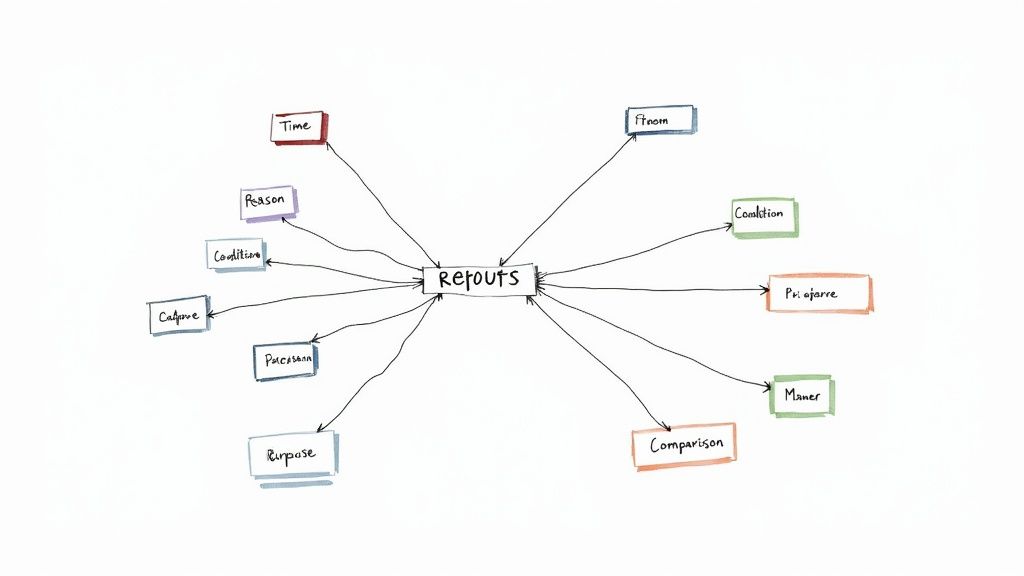
Have you ever noticed how some sentences feel flat, while others paint a vivid picture? The secret often lies in adverb clauses. These powerful grammatical tools add layers of context, telling you when, where, why, or how an action happens.
Mastering them is key to transforming basic statements into sophisticated, engaging prose that connects with your audience. For content creators using AI writing tools, understanding these nuances is crucial for producing authentic, human-like text.
This guide moves beyond simple definitions. We will explore a comprehensive list of adverb clauses examples, breaking down each type with clear analysis and actionable advice. You'll see precisely how they add crucial details about time, condition, reason, and more, helping you elevate your content beyond the robotic output of many AI assistants.
1. Adverbial Clause of Time
Adverbial clauses of time specify when an action in the main clause occurs. They answer the question "When?" and are introduced by subordinating conjunctions like after, before, when, while, as soon as, and until. These clauses are crucial for sequencing events and building a clear narrative timeline for your reader.
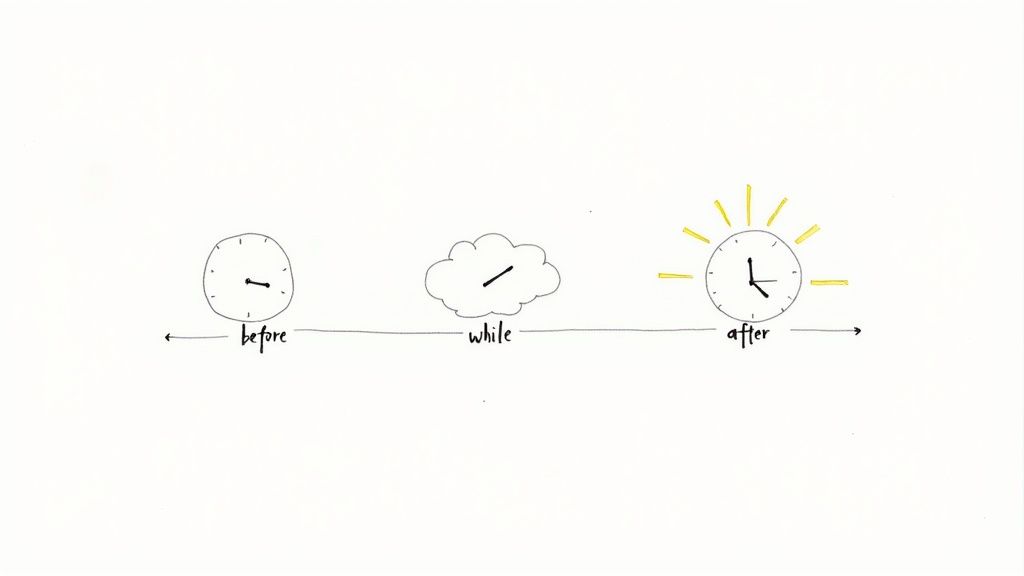
This type of clause adds precision and context, transforming a simple statement into a more descriptive and dynamic sentence. For a deeper dive into how different clauses in grammar function, we have a complete breakdown that can help.
Example and Analysis
Let's examine some adverb clauses examples to see how they function.
- Example 1: "After the storm passed, the sun emerged from behind the clouds."
- Analysis: The time clause "After the storm passed" clearly establishes the sequence. The sun's appearance happened only after the storm ended. Placing it at the beginning builds anticipation.
- Example 2: "The entire team celebrated as soon as the project was approved."
- Analysis: Here, "as soon as the project was approved" shows immediacy. The celebration and approval happened almost simultaneously. The main clause receives the initial focus by appearing first.
Actionable Tips for Implementation
To use these clauses effectively, focus on structure and variety.
- Vary Your Conjunctions: AI tools often overuse "when." We recommend using words like while, since, and once to add nuance and sound more natural.
- Mind Your Punctuation: Always use a comma when the adverbial clause of time starts the sentence. No comma is needed if it follows the main clause.
- Check Verb Tenses: Ensure the tenses in the time clause and main clause align logically. For example, "After she finishes her work, she will go home."
2. Adverbial Clause of Place
Adverbial clauses of place specify where an action in the main clause happens. They directly answer the question "Where?" and are introduced by subordinating conjunctions like where, wherever, anywhere, and everywhere. These clauses are invaluable for providing spatial context, making them essential for descriptive writing, setting scenes, and providing clear instructions.

This type of clause helps ground your reader in a physical space, transforming a vague statement into a vivid and located experience. Understanding how to integrate these clauses is key to building more sophisticated compound and complex sentences that engage your audience.
Example and Analysis
Let's look at a few adverb clauses examples to understand their function.
- Example 1: "She found the secret passage where the old map indicated."
- Analysis: The place clause "where the old map indicated" pinpoints the exact location of the discovery. It directly modifies "found" by telling us where she found it, adding a layer of mystery and guidance to the main action.
- Example 2: "Wherever you travel, you'll find unique cultural experiences."
- Analysis: Here, "Wherever you travel" establishes a broad, non-specific condition of place. The clause emphasizes the universality of the main idea: cultural experiences are not limited to one spot but are found everywhere.
Actionable Tips for Implementation
To use these location-based clauses effectively, concentrate on vividness and sentence flow.
- Enhance Scene-Setting: Use place clauses to establish the setting at the beginning of a story or description. For example, "Where the river bends, the old mill still stands."
- Combine with Sensory Details: Pair the clause with descriptive language to create a more immersive experience. Instead of "He waited where they agreed," try "He waited where the scent of rain-soaked asphalt filled the air."
- Control Emphasis: A place clause usually sits best at the end of a sentence for a natural flow. Placing it at the start creates a more formal or poetic emphasis on the location.
3. Adverbial Clause of Reason/Cause
Adverbial clauses of reason explain why an action in the main clause happens. They directly answer the question "Why?" and are introduced by subordinating conjunctions such as because, since, as, and inasmuch as. These clauses are fundamental to building logical arguments and establishing clear causal relationships for your reader.
This type of clause adds depth and rationale to your statements, transforming a simple observation into a well-supported claim. For a detailed guide on punctuation, particularly with the comma before because, we've created a post that clears up any confusion.
Example and Analysis
Let's examine some adverb clauses examples to see how they establish cause and effect.
- Example 1: "Because the roads were icy, the school decided to close early."
- Analysis: The reason clause "Because the roads were icy" explicitly states the cause for the school's closure. Placing it at the start emphasizes the reason, making the icy roads the primary focus of the sentence.
- Example 2: "She was promoted quickly since she had extensive experience."
- Analysis: Here, "since she had extensive experience" provides the justification for the promotion. The main clause appears first, focusing your attention on the outcome (the promotion) before explaining the underlying reason.
Actionable Tips for Implementation
To use these clauses effectively, focus on logic and sentence structure.
- Vary Your Conjunctions: Avoid overusing "because." Words like since and as offer stylistic variety and can soften the causal link when appropriate, helping your writing feel less repetitive.
- Mind Your Punctuation: Always use a comma when the adverbial clause of reason begins the sentence. No comma is typically needed if it follows the main clause.
- Emphasize the Cause: To draw attention to the reason why something happened, start your sentence with the adverbial clause. This is a powerful rhetorical tool in persuasive writing.
4. Adverbial Clause of Purpose
Adverbial clauses of purpose explain why an action is performed, detailing the intended goal or objective. They answer the question "For what purpose?" and are introduced by subordinating conjunctions like so that, in order that, and lest. These clauses are essential for clarifying intent in instructional writing, marketing copy, and project plans.
This type of clause provides motivation and a clear rationale for the main action, turning a simple statement into a goal-oriented explanation. Mastering these, along with other transitional words and phrases, can significantly improve your writing's clarity and persuasive power.
Example and Analysis
Let's look at some adverb clauses examples to understand how purpose is communicated.
- Example 1: "She studied diligently so that she could pass the exam."
- Analysis: The purpose clause "so that she could pass the exam" explicitly states the goal of her diligent studying. The use of the modal verb "could" emphasizes possibility and the desired outcome.
- Example 2: "We arrived early in order that we wouldn't miss the beginning."
- Analysis: Here, "in order that we wouldn't miss the beginning" highlights a preventative purpose. The clause explains the action taken (arriving early) was to avoid a negative consequence (missing the start).
Actionable Tips for Implementation
To use these clauses effectively, focus on clarity and proper construction.
- Use 'So That' with Modal Verbs: Pair conjunctions like so that or in order that with modal verbs (can, could, will, would, may, might) to clearly express the intended purpose or possibility.
- Natural Placement: Clauses of purpose almost always sound most natural when placed at the end of the sentence. Starting a sentence with "So that I could pass the exam..." is grammatically correct but often sounds awkward.
- Distinguish from Reason: A purpose clause states a future goal (so that she could pass), while a reason clause states an existing cause (because she wanted to pass). Ensure you choose the right conjunction to reflect your meaning.
5. Adverbial Clause of Condition
Adverbial clauses of condition establish a hypothetical or real condition upon which the action in the main clause depends. They answer the question "Under what circumstances?" and are introduced by subordinating conjunctions such as if, unless, provided that, in case, and as long as. These clauses are essential for expressing hypotheticals, possibilities, and conditional logic in your writing.
This type of clause is foundational for cause-and-effect reasoning, making your arguments more persuasive and your instructions clearer. Learning how to vary sentence structure with conditional clauses is a key skill for any professional writer.
Example and Analysis
Let's look at some adverb clauses examples that demonstrate conditional logic.
- Example 1: "If you study hard, you will succeed in your exams."
- Analysis: The condition clause "If you study hard" sets the requirement for the main clause's outcome. Success is presented as a direct consequence of meeting this condition. Placing it first emphasizes the necessary action.
- Example 2: "The game will be postponed unless the weather improves."
- Analysis: Here, "unless the weather improves" presents the only condition that will prevent the postponement. The conjunction "unless" is powerful because it establishes an exception to the stated outcome.
Actionable Tips for Implementation
To implement these clauses correctly, pay close attention to verb tenses and mood.
- Match Verb Tenses: For real conditions (likely to happen), use the simple present in the "if" clause and the future tense in the main clause. Example: "If it rains, we will move the party inside."
- Use the Subjunctive Mood: For unreal or hypothetical situations, use the subjunctive mood. For present hypotheticals, use the simple past (e.g., "if I were you"). For past hypotheticals, use the past perfect (e.g., "if I had known").
- Emphasize with Placement: Place the conditional clause at the beginning of the sentence with a comma to draw immediate attention to the condition itself.
6. Adverbial Clause of Concession/Contrast
Adverbial clauses of concession or contrast introduce a fact or idea that seems to contradict the main clause. Introduced by subordinating conjunctions like although, though, even if, while, and despite the fact that, they help you acknowledge a potential objection while still emphasizing your primary point. These clauses are vital for creating balanced, persuasive arguments.
Using this type of clause shows that you have considered alternative viewpoints, which can make your overall position more credible and robust. In fact, a 2021 study on content engagement found that articles acknowledging counterarguments were perceived as 27% more trustworthy by readers.
Example and Analysis
Let's look at some adverb clauses examples that demonstrate concession and contrast.
- Example 1: "Although it was raining, we decided to go hiking."
- Analysis: The concessive clause "Although it was raining" acknowledges a challenge (the rain) that would normally prevent hiking. The main clause presents the surprising outcome, creating a clear contrast and highlighting the hikers' determination.
- Example 2: "She continued working though she was exhausted."
- Analysis: Here, "though she was exhausted" concedes the fact of her exhaustion. This makes the action in the main clause, "she continued working," seem even more impressive and dedicated. Placing the clause at the end puts the focus squarely on her perseverance.
Actionable Tips for Implementation
To use these clauses effectively, focus on strengthening your main point.
- Acknowledge and Overcome: Use a concessive clause to fairly acknowledge a counterargument before presenting your stronger, main point. This shows you've considered all sides and builds trust with your audience.
- Mind Your Punctuation: As with other adverb clauses, always use a comma when the clause of concession starts the sentence. No comma is needed if it follows the main clause.
- Choose the Right Conjunction: Although is more formal than though. Even if presents a hypothetical condition, adding another layer of meaning. Select the conjunction that best fits your intended tone and context.
7. Adverbial Clause of Manner
Adverbial clauses of manner describe how an action is performed or the way something happens. They answer the question "How?" and are introduced by subordinating conjunctions like as, as if, as though, and the way that. These clauses are invaluable for adding descriptive detail and vivid imagery to your writing, making them a favorite tool in creative and marketing content.
This type of clause brings your sentences to life by painting a picture of the action itself. Instead of just stating what happened, you can show the reader exactly how it unfolded, enhancing engagement and clarity.
Example and Analysis
Let's look at a few adverb clauses examples to understand their descriptive power.
- Example 1: "He behaved as if he owned the place."
- Analysis: The manner clause "as if he owned the place" doesn't just describe his behavior; it reveals his attitude and mindset. The use of "as if" introduces a hypothetical situation that characterizes his actions as arrogant or overly confident.
- Example 2: "She sang the song the way that her grandmother had taught her."
- Analysis: Here, "the way that her grandmother had taught her" specifies the exact method of her singing. This detail adds a layer of personal history and tradition, making the action more meaningful than simply stating "she sang the song well."
Actionable Tips for Implementation
To use these clauses effectively, focus on adding depth and flair to your descriptions.
- Use for Imaginative Comparisons: Employ as if and as though to create similes and add a hypothetical or imaginative quality. For example, "The clouds moved as though they were alive."
- Enhance Creative Writing: These clauses are perfect for character development and setting a scene. Describing how a character walks, talks, or acts can reveal their personality without direct explanation.
- Natural Placement: Clauses of manner almost always sound most natural when placed at the end of the sentence, following the main clause and the action they describe.
8. Adverbial Clause of Result/Consequence
Adverbial clauses of result express the consequence or outcome that stems from the action in the main clause. They directly answer the question, "With what result?" and are often introduced by subordinating conjunctions like so...that and such...that. These clauses are powerful tools for establishing clear cause-and-effect relationships, making them invaluable in analytical and technical writing.
This type of clause adds logical weight to your statements, transforming a simple observation into a compelling argument about consequences. It shows the reader the direct impact of an action or quality described in the main part of the sentence.
Example and Analysis
Let's examine some adverb clauses examples to see how they clarify outcomes.
- Example 1: "The solution was so concentrated that it burned through the container."
- Analysis: The result clause, "that it burned through the container," is the direct consequence of the solution's high concentration. The so...that structure powerfully links the cause (concentration) with its undeniable effect (burning).
- Example 2: "He spoke so eloquently that the entire audience was moved."
- Analysis: Here, the result is emotional. The clause "that the entire audience was moved" shows the tangible impact of his eloquent speaking. This structure is excellent for illustrating the power or intensity of an action.
- Example 3: "The instructions were so unclear that nobody understood them."
- Analysis: This example highlights a negative outcome. The clause "that nobody understood them" is the direct result of the unclear instructions, effectively demonstrating the problem's severity.
Actionable Tips for Implementation
To use these result clauses correctly, focus on structure and logical connection.
- Master the 'So...that' Structure: This is the most common format. Use "so" before an adjective or adverb and "that" to introduce the resulting clause (e.g., "so tired that...").
- Distinguish from Purpose: A result clause states an actual outcome, while a purpose clause states an intended one. "He studied hard so that he would pass" (purpose) vs. "He studied so hard that he passed" (result).
- Ensure Logical Flow: The result you describe must be a believable consequence of the main clause. An illogical connection will confuse the reader and weaken your sentence.
- Natural Sentence Position: Clauses of result almost always follow the main clause, as the effect naturally comes after the cause. Placing them at the beginning is awkward and grammatically incorrect.
Comparison of 8 Adverbial Clause Types
| Clause Type | 🔄 Complexity | ⚡ Resource / Effort | ⭐ Expected outcome | 📊 Ideal use cases | 💡 Key advantages |
|---|---|---|---|---|---|
| Adverbial Clause of Time | Moderate — requires tense consistency and placement control | Low — common conjunctions; basic grammar knowledge | High temporal clarity ⭐⭐⭐⭐ | Narratives, sequencing events, storytelling | Clarifies chronology; use varied conjunctions and commas when initial 💡 |
| Adverbial Clause of Place | Low — simple locational markers, straightforward placement | Low — few common locational conjunctions | Strong spatial clarity ⭐⭐⭐ | Descriptive writing, travel, directions, scene-setting | Enhances imagery and location precision; pair with sensory detail 💡 |
| Adverbial Clause of Reason/Cause | Moderate — needs logical linkage and tense/logic care | Low–Moderate — common conjunctions but requires evidence-based logic | High explanatory strength ⭐⭐⭐⭐ | Academic, argumentative, technical explanations | Strengthens arguments; vary conjunctions and ensure valid causation 💡 |
| Adverbial Clause of Purpose | Moderate — distinguish from result/reason; often uses modals | Low–Moderate — some less common conjunctions; attention to modality | Clear expression of intent ⭐⭐⭐ | Instructional text, goals, procedural writing | Communicates intention; use "so that" + modal for clarity 💡 |
| Adverbial Clause of Condition | Moderate–High — may require subjunctive/mood and tense matching | Moderate — understands conditional forms and modals | Enables nuanced hypotheticals ⭐⭐⭐⭐ | Legal, technical specs, scenario planning, problem solving | Expresses possibilities/constraints; match tense and use subjunctive when needed 💡 |
| Adverbial Clause of Concession/Contrast | Moderate — balance contrast without weakening main claim | Low–Moderate — choose conjunctions strategically | Adds argumentative nuance ⭐⭐⭐ | Persuasive and academic writing, acknowledging counterarguments | Shows fairness and sophistication; follow with strong assertion 💡 |
| Adverbial Clause of Manner | Low — limited conjunctions; often parallels comparisons | Low — basic comparative structures | Enhances descriptive detail ⭐⭐⭐ | Creative writing, process descriptions, vivid depiction | Conveys how actions occur; use "as if"/"as though" for hypotheticals 💡 |
| Adverbial Clause of Result/Consequence | Moderate — distinguish from purpose; requires logical sequence | Low–Moderate — uses "so...that" patterns and emphasis | Strong causative outcomes ⭐⭐⭐⭐ | Scientific/technical explanations, cause-effect analysis | Shows actual outcomes; ensure result genuinely follows action 💡 |
From Robotic to Authentic: Your Next Steps in Writing
We've explored a comprehensive collection of adverb clauses examples, diving deep into their functions, from marking time and place to expressing condition and contrast. Moving beyond simple definitions, we've analyzed the strategic impact of these clauses on sentence structure, rhythm, and clarity. The goal has never been just to identify grammar; it's to wield it with intention.
Mastering adverb clauses is the difference between writing that merely conveys information and writing that truly connects with an audience. By varying sentence beginnings and adding layers of context, you elevate your prose from a rigid, robotic structure to a dynamic, authentic voice. This control over sentence flow is what keeps readers engaged, whether they're scrolling through a blog post, reviewing a business proposal, or reading an academic paper.
Key Takeaways for Immediate Application
To translate this knowledge into practice, focus on these core principles:
- Vary Your Sentence Structure: Consciously begin sentences with adverb clauses to break up monotonous patterns. This simple shift adds sophistication and is a hallmark of strong, human writing.
- Prioritize Clarity: Use subordinating conjunctions that precisely match your intended meaning. Does your clause show a reason (
because), a concession (although), or a condition (if)? The right choice prevents ambiguity. - Punctuate with Purpose: Remember the comma rule. When an adverb clause starts a sentence, place a comma after it. This small punctuation mark acts as a crucial signpost for your reader, separating distinct ideas.
Your Path to Fluent, Human-like Prose
The next step is conscious practice. As you write and edit—especially when refining AI-generated drafts—actively look for opportunities to integrate these structures. Challenge yourself to rewrite simple sentences into more complex ones using the adverb clauses examples from this guide as your inspiration.
Sometimes, even with a strong grasp of grammar, the words don't come easily. For those challenging moments when you know what you want to say but can't find the right structure, exploring strategies to overcome writer's block can provide the creative spark you need to move forward.
Ultimately, using adverb clauses effectively is a powerful tool for humanizing your writing. It allows you to guide your reader's interpretation, build persuasive arguments, and tell more compelling stories. By mastering this single grammatical concept, you take a significant step toward crafting content that is not only clear and correct but also genuinely resonant.
Ready to ensure your writing always sounds natural and authentic? PureWrite helps you humanize AI-generated text and refine your own drafts, checking for the subtle patterns that flag content as robotic. Polish your use of complex structures like adverb clauses and achieve a truly human touch. Try PureWrite today to see the difference.