In APA Style, the golden rule is that you should use footnotes sparingly. Think of them as a special-purpose tool for providing supplemental content or copyright attribution, not your everyday method for citing sources.
Crucially, APA footnotes are not a replacement for the standard author-date in-text citations—like (Miller, 2023)—that you use throughout the body of your paper. Understanding this distinction is the first step to mastering professional academic writing.
Understanding When to Use Footnotes in APA Style
When you're crafting content, whether it's an academic paper or a professional report, clarity and flow are key. The APA's parenthetical author-date system is designed to keep your reader engaged with your argument without constant interruption.
But what if you have a piece of information that’s helpful but would feel like a clunky detour in the middle of a sentence? This is the perfect moment to use a footnote.
Think of it as a quiet aside to your reader—a brief note that adds context without derailing the main conversation. Mastering this subtle art is especially important when you need to craft a strong literary analysis essay, where maintaining narrative flow is vital for your argument's impact.
This decision tree breaks it down beautifully: if you're citing a source to back up a claim, you should stick with an in-text citation. If you're just adding a bit of bonus info, a footnote is your go-to tool.
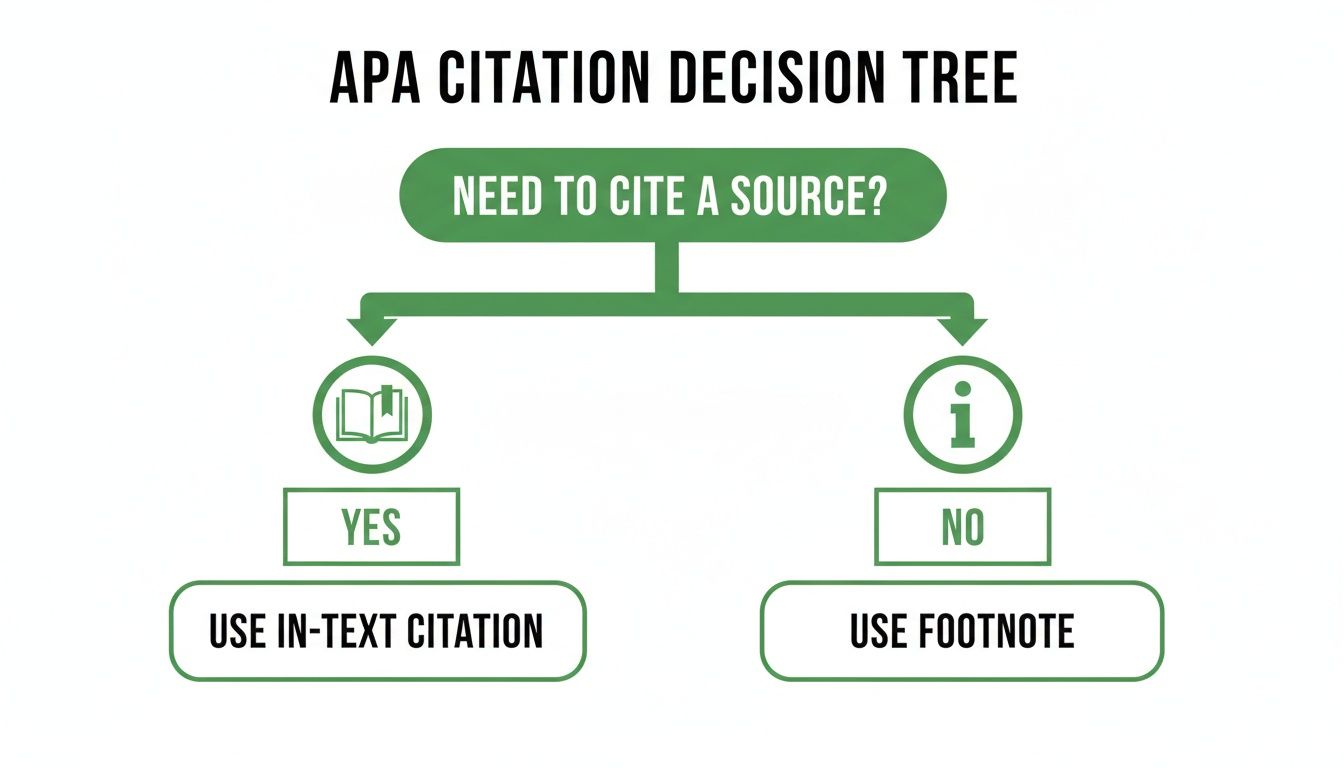
As the flowchart shows, these two tools have distinct jobs and shouldn't be interchanged.
The Two Types of APA Footnotes
You'll only ever need to use two kinds of footnotes in APA Style. Once you get the hang of them, you’ll know exactly how to keep your writing looking professional and well-structured.
- Content Footnotes: You can use these to offer supplemental information. For example, you might want to briefly define a technical term without interrupting your sentence or add an interesting, but tangential, fact.
- Copyright Permission Footnotes: These are non-negotiable. You must use them when you reprint long quotations, tables, or figures from another published source to formally credit the original publisher.
To understand the difference more clearly, let's compare footnotes with their much more common cousin, the in-text citation.
Footnotes vs In-Text Citations in APA
| Feature | Footnotes | In-Text Citations |
|---|---|---|
| Primary Purpose | Provide supplemental information or copyright credit. | Directly credit sources for ideas, quotes, and data. |
| Typical Use Case | Adding a brief, tangential thought or a definition. | Citing a study to support a claim (e.g., Smith, 2023). |
| Frequency | Used sparingly, only when absolutely necessary. | Used frequently, every time a source is referenced. |
As you can see, they operate in completely different lanes. In-text citations show where your information came from, while footnotes are for adding extra information.
This strong preference for in-text citations isn't new; it dates back to 1929 when academics first created the APA guidelines for clearer scientific writing. Today, this system is trusted by over 70% of behavioral science journals worldwide, proving its effectiveness.
Knowing how to structure a research paper is the first step, and getting details like footnote usage right is what sets great writing apart.
How to Format Your APA Footnotes Perfectly
Getting your footnotes formatted correctly is a small detail that makes a huge difference in how professional your work appears. It’s a two-part process: placing a superscript number in your text and writing the note at the bottom of the page. Let’s walk through how to nail both steps.
First, you'll place the footnote number in your main text. This should be a superscript number, floating slightly above the line like this¹.
A key rule to remember is that this number always comes after any punctuation. If you're adding a note at the end of a sentence, the period or comma comes first, followed by the number.
For example: This is how you would add a supplemental thought to a sentence.¹
Notice how the number comes right after the period? It’s a simple but non-negotiable rule in APA formatting.
Formatting the Footnote at the Page Bottom
Now for the second part: writing the actual note at the bottom of the page. This is where you’ll put your extra information or copyright details. APA has specific guidelines to keep everything looking clean and consistent.
Here’s a quick rundown of the formatting rules for the note itself:
- Numbering: Start with the same number you used in the text (e.g., 1, 2, 3), but use a regular number, not superscript. Place a period right after it.
- Indentation: You need to indent the first line of the footnote. A standard 0.5-inch indent, just like for a new paragraph, is perfect.
- Font and Spacing: The font should match your main text (e.g., Times New Roman), but it's often a bit smaller—say, 10-point if your body text is 12-point. The note should also be double-spaced.
A well-formatted footnote is a sign of a meticulous writer. It shows your reader that you care about clarity and professionalism, building trust in your work from the ground up.
Putting It All Together: A Visual Example
Let's see what this looks like in practice. After placing a footnote number in your paper, you’ll see a short horizontal line at the bottom of that page, separating your main text from the footnote below it.
Here's an example:
¹ This is an example of a properly formatted content footnote. The first line is indented, the note is double-spaced, and the font is consistent with APA guidelines, though slightly smaller than the main body text.
Mastering these formatting details is just as important as the content itself. This attention to detail should extend to your entire paper, including section headers. For a deeper dive, check out our guide on APA format for headings and subheadings to structure your whole document perfectly.
At PureWrite, we believe great writing should feel authentic and look polished. While AI writing tools can generate text, they often miss these critical formatting nuances. You can use PureWrite to humanize your content and ensure it meets the strict standards that lead to academic and professional success.
Using Content Footnotes to Add Value
Think of content footnotes as the academic equivalent of a helpful aside. They are your secret weapon for adding interesting, supplemental information without derailing your main argument.
A well-placed footnote shows you respect your reader's focus while still offering them a chance to dive deeper if they choose. This keeps your core argument sharp, clean, and persuasive, resulting in a more professional and reader-friendly paper.

When Should You Use a Content Footnote?
Knowing when to use a content footnote can truly elevate your writing. They aren't meant for every little detail, but in specific situations, they provide the perfect way to add nuance and context without creating clutter.
Here are a few ideal scenarios for using a content footnote:
- Defining Technical Terms: If you're using a specialized term that only experts in your field would know, a footnote is the perfect place for a quick, concise definition.
- Offering a Brief Tangent: Have a fascinating but non-essential fact that adds color to your topic? A footnote lets you share it without breaking your train of thought.
- Providing Additional Resources: You can point readers toward other relevant studies or articles for further reading. Remember, if you cite it here, it must also appear in your reference list.
Making these strategic choices is a hallmark of great academic writing. If you’re looking to sharpen your skills, we’ve put together practical advice on how to improve academic writing that will help you communicate your ideas with more impact.
Real-World Examples of Content Footnotes
Let's see this in action. A quick before-and-after comparison makes the power of a good content footnote immediately obvious.
Example 1: Defining a Term
- Before (in-text): The study's methodology relied on psychometrics, which is the science of measuring mental capacities and processes, to ensure valid results.
- After (in-text): The study's methodology relied on psychometrics¹ to ensure valid results.
- Footnote: ¹ Psychometrics is the science of measuring mental capacities and processes.
Example 2: Adding a Tangent
- Before (in-text): The initial findings were published in 2021, though it is worth noting that the preliminary data was first presented at an obscure conference two years prior, which generated very little discussion at the time.
- After (in-text): The initial findings were published in 2021.²
- Footnote: ² Preliminary data was first presented at a conference two years prior, though it generated little discussion at the time.
By moving these extra details into a footnote, you let your main sentences breathe. The core message lands with more punch, making your writing more direct and effective.
Handling Copyright Permission Footnotes
Sometimes, a standard citation isn't enough. When you’re using a significant portion of someone else's work—like a long quote, a data table, or an image—you need a copyright permission footnote. This is your formal way of stating, "I have permission to use this."
Think of it this way: a normal in-text citation gives credit for an idea, while a copyright footnote credits the actual material. This is a crucial practice for maintaining what is academic integrity and showing you've secured the rights to use protected content.
When Is a Copyright Footnote Required?
So, where do you draw the line? While "fair use" guidelines can feel a bit murky, APA Style provides some clear rules of thumb for academic and professional writers.
You will definitely need a copyright footnote for:
- Long Quotations: Any direct quote of 40 words or more that is set as a block quote.
- Tables and Figures: If you've reproduced or adapted a table, chart, graph, or image from another source.
- Tests and Scales: When you reprint a psychological test or another standardized measurement tool in your work.
Skipping this step is a significant ethical oversight. It's about respecting the intellectual property of others and upholding the standards of your field.
The Standard Format for Copyright Footnotes
APA has a specific formula for these footnotes, designed to provide all essential information clearly and consistently. Once you know the template, you can apply it to almost any source.
Here’s the basic structure:
From [or Adapted from] Title of Work, by A. A. Author, Year, Publisher (DOI or URL). Copyright Year by Copyright Holder. Reprinted [or Adapted] with permission.
Let's break that down:
- Opening Phrase: Start with "From" if you copied it exactly, or "Adapted from" if you made changes.
- Source Information: This part looks like a reference list entry—title, author, year, and publisher.
- Copyright Statement: Add the copyright year and the name of the entity holding the copyright.
- Permission Statement: Finish with "Reprinted with permission" or "Adapted with permission."
This level of detail isn't just about following rules. It’s a professional courtesy that shows you respect the original creator's work, building your credibility as a careful and ethical writer.
Practical Examples in Action
Seeing these formats in practice makes them easier to remember. Here are a couple of common scenarios you’ll likely encounter as a content creator or student.
Example 1: Citing a Long Quotation from a Book
Imagine you've used a block quote from a book. You'll add a superscript number at the end of the quote, and the footnote at the bottom of the page will look like this:
¹ From The Art of Clear Writing, p. 87, by J. Carter, 2021, Academic Press. Copyright 2021 by Academic Press. Reprinted with permission.
Example 2: Citing a Figure from a Journal Article
If you've included a chart from a journal article, the copyright information goes in a note directly below the figure itself. It follows the same basic format.
Note. From "Data Visualization Trends in Modern Science," by L. M. Rodriguez, 2022, Journal of Information Science, 45(2), p. 112 (https://doi.org/xxxx). Copyright 2022 by the Society for Information Science. Reprinted with permission.
How to Add Footnotes in Word and Google Docs
We've covered the "why" and "when" of APA footnotes. Now for the easy part: the "how."
Thankfully, you don't have to manage footnote numbers manually. Modern word processors do all the heavy lifting, which is great for maintaining your focus and workflow.
For Microsoft Word Users:
- Place your cursor where you want the footnote number to appear.
- Go to the References tab on the ribbon.
- Click Insert Footnote. Word will instantly add the superscript number in your text and create a corresponding note at the bottom of the page for you to fill in.
For Google Docs Users:
- Position your cursor in the desired spot.
- Click on the Insert menu at the top.
- Select Footnote (or use the shortcut
Ctrl+Alt+F). Like Word, Google Docs will automatically handle the numbering and placement for you.
Automating these technical steps frees you up to focus on what matters: your ideas. For more ways to streamline your workflow, our guide to the best academic writing software is a great place to start.
Common Mistakes to Avoid With APA Footnotes
Even experienced writers can get tangled up in the finer points of APA footnotes. A few common slip-ups can easily make a polished paper look amateurish. Think of this section as a final quality check to catch small errors before you submit your work.
One of the most frequent mistakes is using a footnote where a standard in-text citation belongs. Remember, your go-to should always be a citation like (Smith, 2023). Footnotes are reserved for supplemental information or copyright permissions, never for routine source attribution.
Forgetting the Reference List Connection
Another common blunder is mentioning a source in a content footnote but failing to include it in the reference list at the end of your paper. This leaves your reader at a dead end, unable to track down the material you've pointed them to.
Every source cited in a footnote—whether for further reading or a side-note—must also have a full entry in your reference list. This ensures your paper is a complete, self-contained resource for anyone following your research trail.
It’s a simple but critical cross-check. Taking a moment to verify this connection maintains your work's integrity and shows your commitment to academic traceability.
Formatting and Placement Goofs
Finally, don't let simple formatting mistakes undermine your hard work. A surprisingly common error is placing the footnote number before punctuation (like this¹.) instead of correctly placing it after (like this.¹).
A few other formatting issues pop up all the time:
- Wrong Numbering Style: Using symbols (*, †) or letters (a, b) instead of sequential Arabic numerals (1, 2, 3).
- No Indentation: Forgetting to indent the first line of each footnote at the bottom of the page.
- Inconsistent Spacing: Using single spacing in the footnote text when your main paper is double-spaced.
AI writing assistants often get these subtle formatting rules wrong. While AI can be a powerful tool for brainstorming, it often produces text that looks right at first glance but fails under scrutiny from a discerning reader or professor. Using AI ethically means always verifying its output and adding your authentic voice.
Quick Checklist for APA Footnote Errors
This table summarizes the most common footnote mistakes and gives you a clear path to fix them, ensuring your paper meets professional standards.
| Common Mistake | Why It's Wrong | How to Fix It |
|---|---|---|
| Using footnotes for regular citations | APA requires the author-date system for all primary citations. Footnotes have a different, specific purpose. | Move the source information into a standard in-text citation, like (Author, Year), and ensure it's in the reference list. |
| Source in footnote, but not in references | It creates a "dead link" in your research, preventing readers from finding the source material. | Double-check that every source mentioned in any footnote also has a complete entry in your main reference list. |
| Superscript number before punctuation | The APA manual specifies that the number should always follow the punctuation mark at the end of a clause or sentence. | Move the number so it appears immediately after the period, comma, or quotation mark (e.g., "...as shown here.¹"). |
| Forgetting to indent the footnote | The first line of every footnote should be indented like a standard paragraph to improve readability. | Set a first-line indent of 0.5 inches for each footnote at the bottom of the page. |
Treating this checklist as your final review step can save you from losing easy points and helps present your research in the most professional light possible.
Frequently Asked Questions About APA Footnotes
Footnotes in APA can feel a little counterintuitive, so it's no surprise that a few common questions pop up all the time. Let's tackle some of the biggest points of confusion so you can use them with confidence.
Do I Need to Include a Source from a Footnote in My Reference List?
Yes, you absolutely do. Your reference list is the master list of every source you've consulted. If you mention a source in a content footnote—even just for further reading—it must also have a full entry in your reference list.
This makes it easy for your reader to track down your sources. Even though a copyright footnote contains full source details, it's still best practice to include it in the reference list for consistency.
Can I Use Footnotes Instead of Parenthetical Citations?
This is a big one: no. APA Style is very clear that you cannot use footnotes as a substitute for standard in-text citations. The author-date system, like (Smith, 2023), is the only approved way to cite sources within your main text.
Footnotes are reserved for supplemental information or for copyright attributions. Using them for your primary citations is a common mistake and a surefire way to lose marks.
Here’s a good way to remember it: parenthetical citations are for proving a point with evidence. Footnotes are for expanding on a point with extra context.
What Is the Difference Between Footnotes and Endnotes?
Functionally, they're identical—the only difference is where they appear in your paper.
Footnotes appear at the bottom of the page where you place the superscript number, giving the reader immediate context.
Endnotes, on the other hand, are collected on a separate page at the end of your document, right before the reference list.
The official APA Publication Manual allows you to use either one. The most important thing is to check if your instructor or publisher has a preference and then stick with that method consistently.
Getting the hang of apa footnote citations can be tricky, and it's one of those details that AI-generated drafts often get wrong. At PureWrite, we specialize in refining robotic text into clear, human-written work that meets the highest academic standards. Make sure your paper sounds like it was written by you, not a machine. Try PureWrite today and feel the difference.