Mastering APA Footnote Format: A Practical Guide
Welcome to your guide on getting APA footnotes just right. While the APA 7th edition leans on author-date in-text citations, footnotes still play a specific—and important—role. Think of them as a way for you to provide extra information or handle copyright permissions without breaking the flow of your main argument.
Understanding the Role of Footnotes in APA Style
Have you ever had a thought that needed to be shared but didn't quite fit into the sentence you were writing? That's a perfect use case for footnotes. The official APA Publication Manual suggests using them sparingly, but when you do, they add a layer of depth and show you've been thorough.
Let's be clear: the main job of an APA footnote isn't to cite your sources. That's what your parenthetical citations are for. Instead, footnotes are like a quiet aside to your reader, offering a brief, relevant detail that enriches what you've already written.
Here at PureWrite, we know that nailing these small details can feel overwhelming, especially when you're also focused on making sure your AI-generated draft sounds authentic. Applying the apa footnote format correctly is a big step toward a polished, professional paper that showcases your expertise and ethical approach.
What Footnotes Accomplish
In APA style, footnotes are reserved for two main jobs, and we'll break down both in this practical guide:
- Content Footnotes: These offer supplemental information. It's the kind of detail that's interesting or helpful but would otherwise interrupt the flow if you stuck it in the middle of a paragraph. A great use case is defining jargon for a broader audience.
- Copyright Permission Footnotes: You absolutely need these when you're reprinting a long quotation or using a table or figure from another copyrighted work. This is a critical part of ethical writing.
For more general advice on academic writing, you might find our comprehensive research paper writing tips helpful. Knowing when and how to drop in a footnote will ultimately make your writing clearer and more effective for your reader.
When Should You Use a Footnote in APA Style?
Knowing when to add a footnote is key to keeping your content focused and easy for your audience to follow. APA style, which has been evolving since its inception in 1929, is all about clarity. While your in-text citations handle the heavy lifting for sources, footnotes serve two very specific and distinct purposes.
The golden rule is to use them sparingly. An APA footnote should be a quick, targeted note that adds a little extra value without derailing the main text. If a piece of information is essential to your argument, it belongs right in the paragraph.
Content Footnotes: Adding Supplemental Details
The first and most common reason to use a footnote is for content. These are perfect when you need to add a short, supplemental piece of information that would otherwise make your sentence clunky.
Think of it as a helpful aside to your reader. For example, if you're a marketer writing a blog post about a technical SEO concept, you could use a footnote to define a term like "canonicalization" for beginners without interrupting your main point. This makes your content accessible to a wider audience.
A good content footnote is concise and sticks to a single idea. If you find yourself writing a whole paragraph, that material is better suited for an appendix.
Copyright Permission Footnotes: Giving Credit Where It's Due
The second type of footnote is more specific and legally crucial: the copyright permission footnote. As a content creator, you must use one whenever you reproduce a lengthy quotation or reprint a table, figure, or test from a copyrighted source.
This footnote serves as a formal acknowledgment that you've received permission from the copyright holder to use their work. It's a non-negotiable part of ethical and professional integrity. When working with extensive quotes, it's also a great idea to master how to paraphrase without plagiarizing to avoid relying too heavily on borrowed text.
2. APA Footnote Formatting: The Core Rules
Getting your APA footnotes formatted correctly is all about the details. Consistent, precise formatting makes your paper look professional and, more importantly, keeps it easy for your reader to follow along. These core rules cover the essentials—numbering, placement, font, and spacing.
First things first: the number. You’ll insert a superscript number right after the word or sentence that needs the footnote. It goes immediately after the punctuation, like a period or comma.¹ Just make sure you number them consecutively throughout your paper, starting with 1.
Placement and Spacing
You have two choices for where the actual footnotes go. You can either place them at the bottom of the page where the reference appears, or you can compile them all on a dedicated "Footnotes" page that comes after your reference list. Most word processors, like Microsoft Word or Google Docs, can automate the bottom-of-the-page option for you, which is handy.
The formatting for the note itself is just as specific, no matter where you put it:
- Start each footnote with its matching superscript number, then add a single space.
- The body of the footnote should be single-spaced.
- If you end up with more than one footnote on a single page, leave a double space between them to keep things clean and readable.
Deciding whether you need a content note or a copyright note is the first step. This flowchart breaks down that decision process.
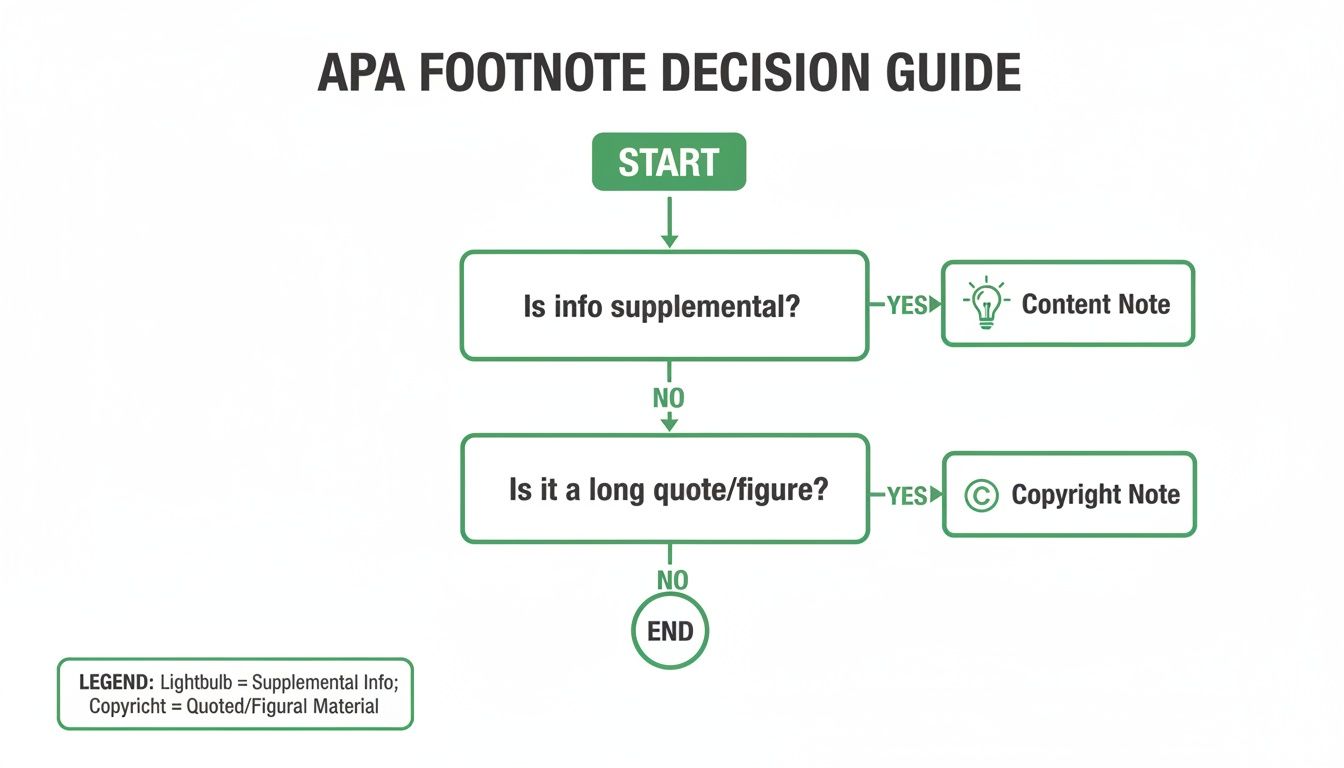
As you can see, if you're just adding a bit of extra information, you'll use a content note. But if you're reproducing a long quotation or an entire figure, you'll need to handle copyright permission.
Quick Comparison of APA Footnote Types
To help you quickly distinguish between the two, this table provides a side-by-side look at their core features and when to use them.
| Feature | Content Footnotes | Copyright Permission Footnotes |
|---|---|---|
| Purpose | To provide supplemental information without disrupting the main text's flow. | To grant legal attribution for using copyrighted material (e.g., long quotes, tables, figures). |
| Typical Content | Brief explanations, definitions, asides, or tangential thoughts. | A formal statement like "From [or Adapted from] Title of Work, by Author, Year, Source. Copyright [Year] by Copyright Holder. Reprinted [or Adapted] with permission." |
| When to Use | When you have extra details that are useful but not essential to your argument. | Required when reprinting a quote over 400 words, or a table/figure from another published source. |
Think of content footnotes as helpful asides for your reader, while copyright footnotes are a legal and ethical necessity.
Font and Indentation
Consistency is the name of the game in APA Style. Your footnotes should always use the same font and font size as the rest of your paper—no exceptions. Each footnote also needs to be indented 0.5 inches from the left margin, just like a standard paragraph indent.
Getting these small formatting details right is just as crucial as structuring your main text. For a deeper dive into overall document structure, our guide on APA format for headings and subheadings is a great resource.
The 7th edition, in particular, has adapted to modern digital practices. For instance, the shift to a single space after a period reflects how 95% of today's word processors handle digital typesetting. Paying attention to these standards makes a real impact; some studies suggest that papers with proper APA adherence see citation rates that are 15% higher.
Practical Examples of Content and Copyright Footnotes
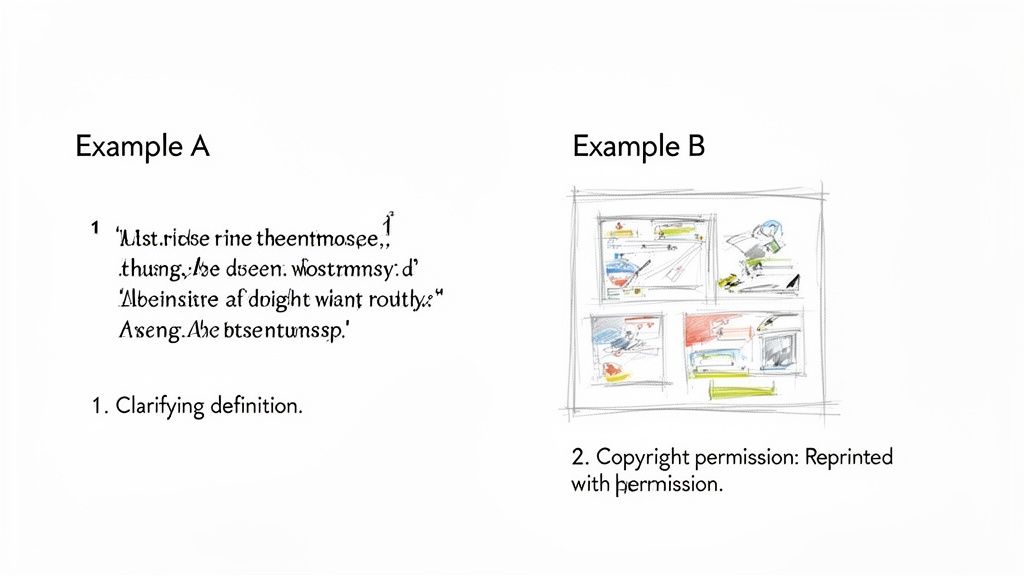
Seeing the rules of the APA footnote format in action is often the "aha!" moment. Theory is one thing, but practical, real-world examples make all the difference.
Let's walk through a few clear examples that you can use as a reference for your own writing. We'll look at both content footnotes and copyright permission footnotes, showing you the in-text sentence and the corresponding note.
Content Footnote Example
Content footnotes are perfect for adding a quick, clarifying thought that would otherwise interrupt the flow of your main argument. Think of them as a way to provide helpful context without derailing your paragraph.
For instance, a content creator writing about social media metrics might use a term unfamiliar to some readers.
In-Text Sentence: The campaign's success was measured by its high engagement rate, particularly its viral coefficient.¹
Corresponding Footnote:
¹ The viral coefficient is a metric that quantifies the number of new users an existing user generates, essentially measuring word-of-mouth growth.
See how that works? The footnote gives a concise definition, adding valuable depth for the curious reader. All this happens without cluttering the original sentence.
Copyright Permission Footnote Example
Copyright footnotes are less about adding extra info and more about meeting your ethical and legal obligations as a writer. You must use them when you reproduce significant copyrighted material, like a long block quote, an image, or a full assessment instrument.
These notes follow a very specific formula.
In-Text Sentence: The following infographic detailing consumer behavior trends is used with permission.²
Corresponding Footnote:
² From "The State of Modern Marketing," by J. Doe, 2023, Marketing Insights Weekly. Copyright 2023 by The Insight Group. Reprinted with permission.
This format is direct and professional. It clearly identifies the source, the copyright holder, and confirms that you have permission to use the material. This is a non-negotiable part of ethical content creation.
While these examples give you a solid starting point, remember that footnotes are just one detail in a much larger structure. For a broader view, our guide on how to structure a research paper can help you put all the pieces together.
Common APA Footnote Mistakes to Avoid
Even seasoned writers can get tripped up by the finer points of footnotes. Knowing where people typically go wrong is the best way to get them right in your own work.
One of the biggest blunders is using footnotes for regular citations. APA Style is built on the author-date parenthetical citation system. Footnotes are meant for a very specific purpose: to add extra, non-essential information or handle copyright permissions, never to replace your standard in-text citations.
Another frequent error is messing up the numbering. Footnotes must be numbered consecutively, starting with ¹ and continuing in order throughout the entire paper. Don't restart the numbering on each new page, and avoid using symbols like asterisks (*).
Formatting and Content Errors
Simple formatting slip-ups can also make your work look less professional. Every footnote needs a 0.5-inch first-line indent, just like a regular paragraph, but the note itself should be single-spaced. Forgetting that indent or double-spacing the note are common mistakes.
Finally, there's the issue of what actually goes in the footnote.
A content footnote should be a brief, targeted aside. If your explanation requires a full paragraph, that information is better suited for an appendix where it won’t disrupt the reader’s focus.
When it comes to copyright, leaving out key details is a critical mistake. A copyright permission footnote isn't complete without the explicit phrase "Reprinted [or Adapted] with permission." These small details are just as important as getting other citation elements right, like the nuances of et al. punctuation.
AI writing tools often miss these subtle rules, producing text that looks right but contains critical errors. This is why human oversight and ethical AI use are so important.
Quick Reference Templates for APA Footnotes
Sometimes, you just need a quick template to get the job done right. This section is designed for exactly that—giving you ready-to-use templates for both content and copyright footnotes in APA 7th edition.
Think of these as your go-to cheat sheet. Just grab the template, swap in your information, and you're good to go. It saves you from having to hunt down specific rules when you're on a deadline.
Content Footnote Template
Use this template when you want to add a quick clarification, offer a brief definition, or point the reader to more information without cluttering your main paragraph.
- In-Text Example: The team implemented an agile workflow¹ for the project.
- Template: ¹ [Add your brief, one-sentence explanation here. You can also direct readers elsewhere, e.g., "See Author (Year) for a comprehensive overview."]
- Finished Example: ¹ Agile workflow is an iterative approach to project management that helps teams deliver value to their customers faster and with fewer headaches.
This is a clean, professional way to provide extra value to your reader without breaking the flow of your argument.
Copyright Permission Footnote Template
If you're reprinting a long quotation, a figure, a table, or any other copyrighted material, you need a copyright permission footnote. This isn't optional—it's an ethical requirement.
- Template: From [or Adapted from] Title of Work, by A. A. Author, Year, Source (e.g., Publisher, Journal Name). Copyright [Year] by Copyright Holder. Reprinted [or Adapted] with permission.
- Finished Example: From Visualizing Data, by E. Tufte, 2001, Graphics Press. Copyright 2001 by Graphics Press. Reprinted with permission.
Getting these details right is a core part of academic and professional writing. It's no surprise that nearly 90% of social science dissertations in the U.S. follow APA style, a standard that has evolved significantly over the years. You can learn more about the evolution of APA guidelines to see how it has adapted over time.
While AI writing tools can be a great starting point, they frequently stumble on small but critical formatting rules like these. We built PureWrite to bridge that gap, helping you catch those nuances and refine your text until it sounds genuinely human. Give PureWrite a try to polish your next paper with confidence.
Frequently Asked Questions About APA Footnotes
It's completely normal to have a few lingering questions when you're trying to get all the details of an APA paper just right. We've put together some straightforward answers to the most common questions we get about using APA footnote format.
Does APA 7th Edition Use Footnotes for Citations?
No, and this is probably the biggest point of confusion. The APA 7th edition relies on the author-date parenthetical style for in-text citations (for example, Smith, 2023).
Footnotes in APA have a very specific job: they're used only for adding extra, supplemental information or for giving copyright attribution. They are not used for standard source citations the way you would in a style like Chicago.
Should I Put Footnotes at the Bottom of the Page or on a Separate Page?
You actually get to choose. APA gives you two options for placing your footnotes. You can either put them at the bottom of the page where the superscript number appears, or you can gather them all on a separate page titled "Footnotes" right after your reference list.
In our experience, placing them at the bottom of the page is far more common for student papers and is generally easier for your reader to follow.
A quick pro-tip: Always double-check with your instructor or the publication you're submitting to. They often have a preference. The golden rule is consistency—pick one method and stick with it.
Can I Use Footnotes in a Student Paper?
Yes, but you should use them sparingly. The official APA guidelines are clear that footnotes should only be used when absolutely necessary. Think of them as a tool for adding a brief, important thought that would otherwise interrupt the flow of your writing.
For most undergraduate essays or blog posts, you probably won't need them at all. You'll see them more often in complex projects like dissertations or professional journal articles.
How Do I Cite a Source Within a Footnote?
Great question. If you happen to mention a source within your footnote, you need to cite it right there using a standard APA in-text citation. You also have to include the full citation for that source in your main reference list.
Here’s a practical example of what that looks like:
- Footnote Example: ¹ For a different perspective on this theory, see the work of Johnson (2022), which offers a compelling counter-argument.
- Reference List Entry: You would then add the full reference for Johnson (2022) to your reference list at the end of the paper.
Nailing these specific rules is what makes your writing look professional and ethically sound. It’s also where many AI-generated drafts fall short, often missing these subtle formatting points. At PureWrite, we built our tool specifically to catch these kinds of nuanced mistakes.
You can use PureWrite to scan your text and get instant feedback that not only corrects your formatting but also helps humanize your writing. It ensures your final paper meets the highest standards of authentic, ethical writing. Give it a try at https://purewrite.io.