Can Turnitin Detect ChatGPT? A Practical Guide for Writers

Yes, Turnitin can detect content from ChatGPT, but the story doesn't end there. While its AI detection feature is designed to flag text from large language models, its real-world performance is a complex and often debated topic.
If you submit a raw, unedited paper straight from an AI, it's almost certain to be flagged. However, the system is far from perfect, which creates a gray area for anyone using AI as a writing partner. This guide offers practical advice for ethically navigating this new landscape.
What Turnitin Claims About Its AI Detector
For content creators, students, and professionals using AI writing tools, understanding what detectors like Turnitin can and can't do is crucial. It's not just about avoiding a flag; it's about understanding the technology's accuracy, its limitations, and how to use AI tools ethically and effectively.
Turnitin launched its AI detection feature in April 2023 with a bold claim: 98% overall accuracy and a false positive rate of less than 1%. Initial tests seemed promising, showing the tool could identify fully AI-generated essays while correctly clearing human-written ones.
However, real-world data tells a more nuanced story. An analysis of the first 200 million papers scanned by the detector revealed that 11%—a staggering 22 million papers—contained at least 20% AI-generated text. You can explore these findings on Turnitin's performance for a deeper look.
The Real Score
So, what does Turnitin's AI detection score actually mean for you? It's not a simple guilty-or-not-guilty verdict. Think of it as a probability score that estimates how likely it is that the text was generated by a machine.
A high score indicates the writing follows predictable, uniform patterns characteristic of current AI models. This is precisely why a copy-pasted response from ChatGPT often gets flagged; it lacks the natural rhythm, variation, and unique voice of human writing.
To give you a better idea, here’s a quick summary of how the detector typically handles different types of content.
Turnitin AI Detection at a Glance
The table below breaks down how likely different types of text are to be flagged by Turnitin's AI detector.
| Content Type | Detection Likelihood | Actionable Advice |
|---|---|---|
| Raw ChatGPT Output | Very High | Avoid submitting raw AI output. Always treat it as a first draft. |
| Lightly Edited AI Text | High | Simple synonym swaps aren't enough. The core AI patterns remain. |
| Heavily Humanized AI Text | Low | Rework the text to add your unique voice, examples, and analysis. |
As you can see, the more you refine and personalize the text, the less it resembles a machine's output.
The challenge isn't about "beating the detector"; it's about producing genuinely authentic work. The smartest approach is to use AI as a collaborator—a starting point—before you add your own critical thinking, unique voice, and personal style.
That’s exactly what we at PureWrite are focused on. We designed our tool to help you transform a basic AI draft into polished, human-quality content that authentically reflects your own knowledge and perspective.
Ready to see how it works? Try PureWrite and humanize your content today.
How Turnitin Detects AI-Generated Content
So, how does Turnitin spot text written by AI? It's not magic; it's a sophisticated process of pattern recognition. The system has been trained on vast amounts of data to identify the subtle "digital fingerprints" that large language models like ChatGPT leave behind.
Think of AI writing as a perfectly straight, machine-paved road—incredibly efficient and predictable. Human writing, in contrast, is more like a winding country path with its own unique rhythm, unexpected turns, and varied terrain. Turnitin's detector is trained to spot that machine-like uniformity.
This diagram helps visualize the core concepts behind Turnitin’s AI detection.
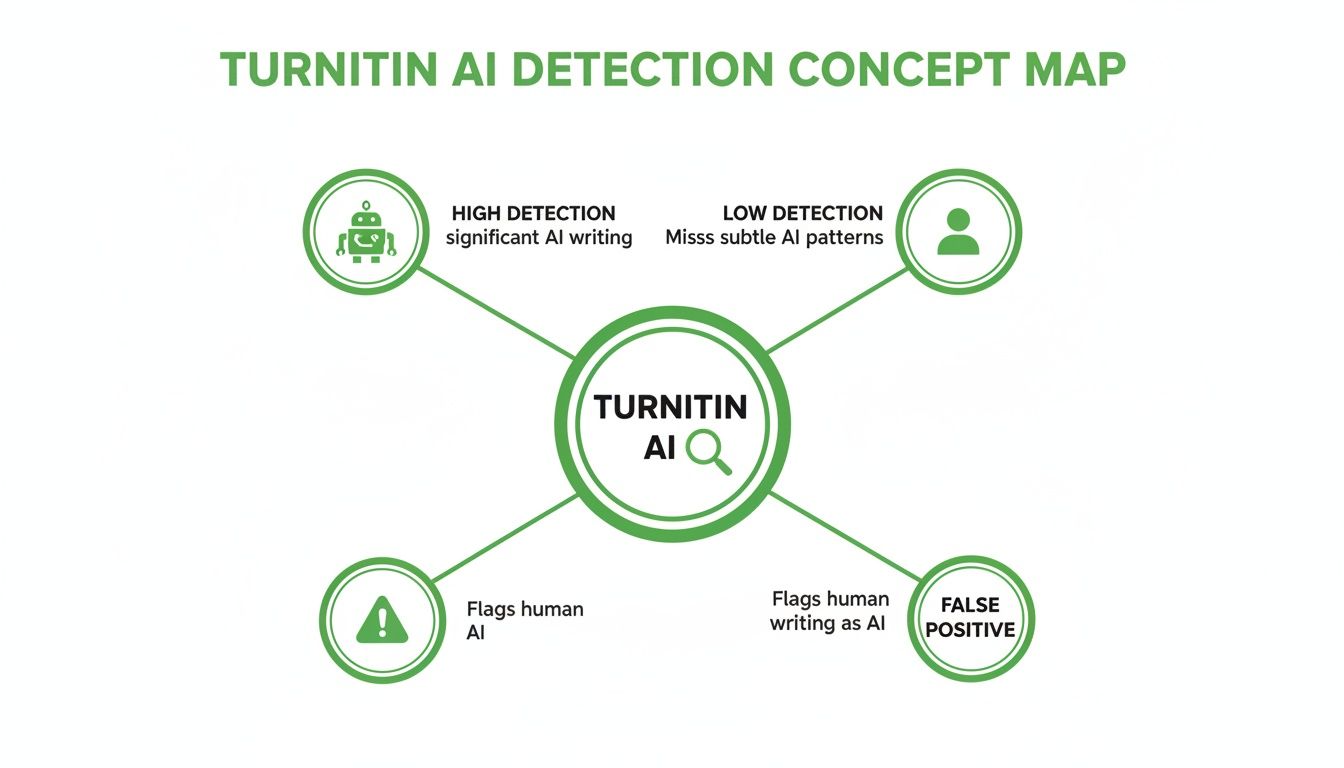
As you can see, the system constantly balances correctly identifying AI-generated text with the risk of flagging human work (a false positive). This highlights the complexity behind that simple percentage score.
The Tell-Tale Signs: Perplexity and Burstiness
To understand how Turnitin spots these patterns, you need to know two key concepts it analyzes: perplexity and burstiness. Don't worry about the technical jargon; the ideas are quite simple.
Perplexity measures how predictable a piece of text is. AI models are built to choose the most statistically probable next word, often resulting in safe, conventional sentences. As a human writer, you are far less predictable, often choosing a more creative or unusual word over the obvious one.
A low perplexity score means the text is unsurprising and follows common patterns—a classic sign of AI generation. A high perplexity score suggests more complex and varied language, which is a hallmark of human writing.
A paragraph filled with common phrases and overly simple sentence structures is a major red flag for the detector.
Finding the Natural Rhythm of Writing
The second signal is burstiness, which refers to the variation in sentence length and structure. When you write, you naturally create a rhythm by mixing short, punchy sentences with longer, more complex ones. This is part of what makes writing engaging.
AI models often struggle with this, tending to produce sentences of similar length and complexity, creating a monotonous, robotic flow. This lack of natural variation is a dead giveaway for an AI detector. It's looking for the natural ebb and flow that you, as a human writer, create instinctively.
Understanding these signals is a huge step. For a broader look at the tool, check out our guide on what Turnitin checks for.
At PureWrite, our goal is to help you break free from these robotic patterns. Our tool is designed to introduce the natural variation, unique vocabulary, and sophisticated sentence structures needed to make your text sound genuinely human. Ready to move beyond predictable writing? Try PureWrite and find your authentic voice.
The Real-World Impact of AI Detection in Education
The rise of AI writing tools has significantly impacted the academic world, creating new challenges for both students and educators. This isn't just about technology; it's about academic integrity, fairness, and the very meaning of learning. The stakes are incredibly high for everyone involved.
The statistics are telling. A recent study found that 86% of students worldwide now use AI to help with their studies, while 30% admitted to using tools like ChatGPT to write their assignments directly. In response, the number of educators using AI detectors has jumped from 38% to 68% in just one year, creating a high-pressure environment for students. You can see more stats and trends on AI detection tools to get the full scope.
The Problem with False Positives
One of the most significant issues is the ethical problem of false positives. Imagine dedicating hours to a paper, only to have an algorithm flag it as AI-generated. A single, incorrect flag can lead to serious consequences, from a failing grade to academic probation.
This risk is so tangible that some universities, like Vanderbilt, temporarily disabled Turnitin's AI detection feature in 2023 due to concerns about its accuracy and potential for unfairness.
Certain writing styles are also more likely to be flagged by mistake, creating an unfair bias.
- Non-native English speakers often use simpler, more structured sentences—a pattern that can mimic AI-generated text.
- Neurodivergent individuals may have unique writing patterns that an algorithm, trained on "average" text, could misinterpret.
- Writers in technical fields who rely on formal, precise language are also at a higher risk of a false accusation.
A New Educational Landscape
This new reality is forcing a necessary conversation about AI's role in education. For a deeper look at how these tools are being adopted, a practical guide to AI for teachers offers valuable insights. The goal must shift from simply "catching" students to fostering a more thoughtful, human-first approach to writing and learning.
The core issue is that AI detection provides a probability, not a certainty. Relying solely on a percentage score ignores the nuance of human expression and the serious consequences of being wrong.
This is why we champion ethical AI usage and authentic writing at PureWrite. It's one thing to use AI as a brainstorming partner; it’s another to let it do the thinking for you. The final work must be grounded in your own voice and ideas. The challenge for students today is navigating the line between assistance and dishonesty. Our guide on the modern plagiarism checker for students explores this further.
So, How Accurate Is It, Really? Let's Talk False Positives
When Turnitin first launched its AI detector, it made bold claims about accuracy. In practice, however, the reality is more complicated. The system isn't a simple "yes" or "no" button; it's an algorithm making an educated guess, which can cause problems for writers who are doing everything right.
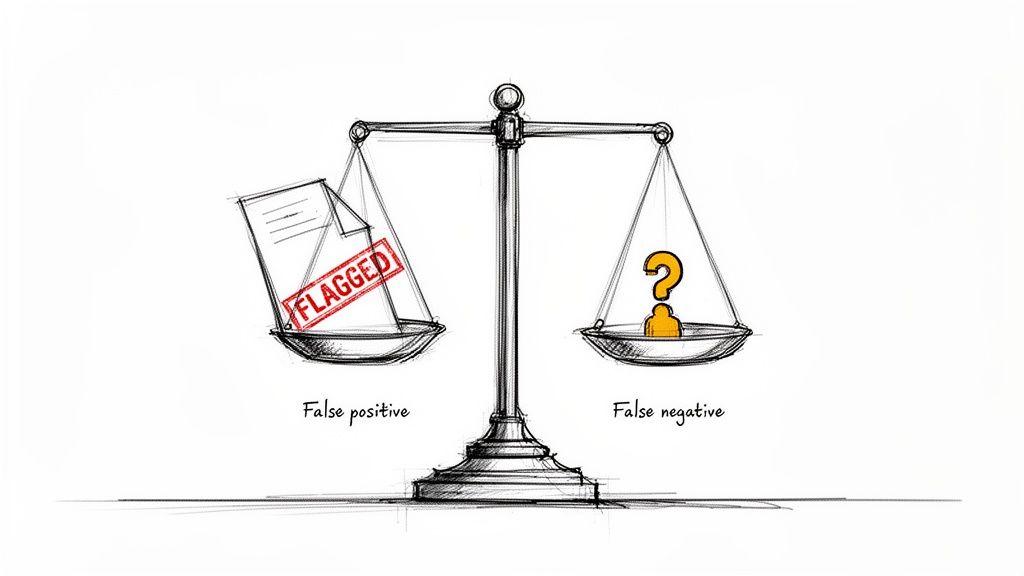
The biggest issue is the false positive—when a human's original writing is incorrectly flagged as AI-generated. This isn't just a minor glitch; a false accusation can have severe consequences for a student or professional. The problem is that some human writing styles happen to resemble the predictable patterns AI detectors are trained to find.
Who Is More Likely to Get Flagged?
Certain individuals are more likely to be flagged simply because of how they naturally write. Understanding this bias is crucial for interpreting any detection score.
- Non-native English speakers often use simpler sentence structures and standard vocabulary, which can appear formulaic to an algorithm.
- Neurodivergent writers may have a unique or logical style that doesn't fit the "typical" human mold the detector expects.
- Technical writers are also at risk, as their need for precise, formal language can lack the creative flourishes that AI detectors associate with human writing.
This is a central issue in the debate over Turnitin’s effectiveness. The company initially advertised a false positive rate of less than 1%. However, independent tests and real-world anecdotes suggest the error rate can be much higher for these specific groups.
To its credit, Turnitin has acknowledged this dilemma and now accepts a 15% false negative rate, meaning it intentionally allows some AI-generated content to pass in order to reduce the odds of flagging an innocent person.
The key takeaway is that a detection score is not a verdict. It is one data point that requires human judgment and common sense to interpret correctly.
This uncertainty is why our focus at PureWrite is on helping you create genuinely human-sounding text. Instead of playing a cat-and-mouse game with a flawed system, the best strategy is to elevate your writing so it truly reflects your own unique voice. If you want to go deeper, check out our article on whether AI detectors are accurate.
A Smarter Way to Use AI in Your Writing
Given the reality of AI detection, the conversation must shift. Instead of asking, "How do I beat Turnitin?" you should be asking, "How can I use AI responsibly?" The goal should never be to sneak content past a checker; it should be to produce authentic, high-quality work you are proud of.
Think of an AI tool like ChatGPT as a brilliant but inexperienced research assistant, not a ghostwriter. It's fantastic for brainstorming ideas, structuring an outline, or generating a messy first draft to overcome writer's block. But that's where its job ends and yours begins. The critical thinking, personal voice, and final polish must come from you.
The core principle here is ownership. Once the AI provides a starting point, it's your responsibility to take complete control. This means more than just changing a few words; it requires deep revision, rigorous fact-checking, and weaving your unique perspective into the writing.
From AI-Assisted to Human-Authored
Taking true ownership means you're transforming the text, not just editing it. You're making it fundamentally yours.
Here are a few actionable steps to make that happen:
- Rewrite, Don't Tweak: Instead of editing single words, rewrite entire paragraphs from scratch using your own sentence structures and vocabulary.
- Inject Your Own Experience: Share a personal story, an opinion, or a unique example from your life. For instance, if you're writing a marketing article about social media, include a real-world case study from a campaign you ran.
- Verify Everything: AI models are known to "hallucinate" facts and sources. You are the final editor and are responsible for the accuracy of every claim.
When you work this way, you're using a powerful tool to be more efficient, but the final product is undeniably your own. For those in education seeking structured guidance, programs like the Presidential AI Challenge Support Program provide excellent frameworks for ethical AI use.
Protecting Your Academic and Professional Integrity
Using AI ethically is a direct reflection of your personal integrity. Submitting raw, unedited AI content as your own bypasses the learning process and often violates academic or professional codes of conduct. To understand the principles at stake, it's worth reading our guide on what is academic integrity.
The best defense is a good offense. Always be prepared to stand behind your work. Could you explain your research process from memory? Can you walk someone through your arguments and show them your draft history? If the answer is yes, you are on solid ground.
Ultimately, the surest way to avoid issues with AI checkers is to create content that is so thoroughly humanized that it leaves no doubt. This is exactly what we built PureWrite to help you do. Our platform helps you infuse AI drafts with the natural cadence, stylistic variation, and authentic voice that detectors miss and human readers connect with.
Ready to turn your AI drafts into polished, original work? Try PureWrite today.
How to Create Authentic, Human-Quality Content
Knowing the limitations of AI detection is a good start, but what you really need is a practical method to ensure your work is truly your own. After brainstorming and drafting with AI, the final submission must reflect your critical thinking and sound like you. This is where you can bridge the gap between a rough AI draft and a polished, genuinely human final piece.
We built PureWrite to do more than just swap a few synonyms. Our tool is designed to intelligently rephrase your text, eliminating the robotic and predictable sentence patterns that systems like Turnitin are trained to detect. It's all about restoring the natural rhythm and flow that AI-generated text often lacks.
From Robotic to Realistic
Our 'Humanize' feature is specifically built to introduce natural sentence variety and sophisticated word choices, giving your writing an authentic cadence. This process elevates your text into something more engaging and compelling.
The goal isn't to "trick" a system; it's to produce work that is fundamentally better. Authentic writing is engaging, nuanced, and far more persuasive than anything a machine can generate on its own.
To see this in action, here’s a quick comparison. It highlights the difference between a standard AI output and text that has been thoughtfully humanized.
Raw AI Draft vs. PureWrite Enhanced Text
| Characteristic | Raw ChatGPT Output | PureWrite Humanized Output |
|---|---|---|
| Sentence Structure | Often uniform and predictable. | Varied, with a mix of short and long sentences. |
| Word Choice | Can be repetitive or overly formal. | Nuanced, context-appropriate, and avoids clichés. |
| Flow and Rhythm | Monotonous and robotic. | Natural and engaging, reflecting human speech patterns. |
| AI Detection Risk | High. | Significantly Lowered. |
| Authenticity | Lacks a unique voice. | Preserves and enhances your personal writing style. |
By focusing on these core elements, you are not just avoiding a flag; you are crafting content that stands up to scrutiny because it’s genuinely well-written. For a deeper dive, check out our guide on how to humanize AI text.
The best way to see the shift is to experience it yourself. Pasting your draft into PureWrite allows you to witness the transformation firsthand, creating high-quality work that stays true to your original ideas. Try PureWrite for free and see the difference.
Your Top Questions About AI Detection, Answered
Let's wrap up with clear, straightforward answers to some of the most common questions people have about Turnitin and its AI detection capabilities.
Can Turnitin Detect Other AI Models Besides ChatGPT?
Yes, it can. Turnitin's software isn't built to detect only ChatGPT. It is designed to be "model-agnostic," meaning it doesn't matter which AI wrote the text.
Instead, it looks for the tell-tale fingerprints that most large language models (LLMs) leave behind, such as predictable word choices and unnaturally consistent sentence structures.
So, whether you're using Google's Gemini, Anthropic's Claude, or another AI writer, the detection principles are the same. The system is hunting for the style of AI writing, not the signature of a specific tool. Switching models is not an effective strategy to avoid detection.
What About Paraphrasing? Will That Get Detected?
This is a common question, and the answer depends entirely on how you paraphrase.
If you only perform a light edit—swapping a few words for synonyms or rearranging a sentence—then yes, it is still likely to be detected. These superficial changes do not alter the underlying robotic structure of the text.
However, a deep and thoughtful paraphrase is a different story. This involves fully absorbing the ideas from the AI draft and then rewriting them from scratch in your own voice, using your unique phrasing and sentence rhythms. When you do this, you are not just editing; you are truly authoring the content.
True paraphrasing isn't about hiding the origin of an idea. It's about genuinely making that idea your own by explaining it in your authentic voice.
What Should I Do If My Work Is Falsely Flagged?
First, don't panic. A false positive for AI use is stressful, but it can happen. AI detectors are not perfect, and many instructors understand their limitations.
If you find yourself in this situation, be prepared to discuss your writing process. Here are some practical steps you can take:
- Show Your Work: Gather any evidence of your writing process, such as outlines, rough notes, or the version history in Google Docs or Microsoft Word. This can serve as powerful proof of your work.
- Explain Your Process: Be ready to explain your natural writing style. If you are a non-native English speaker or write in a very formal manner, this can sometimes trigger a false positive.
Ultimately, your strongest defense is an authentic writing process from the start.
The best way to write with confidence is to create work that is truly yours. At PureWrite, we built our platform to help you do just that—to take a functional AI draft and transform it into a polished, authentic piece of writing that sounds like you. We provide the tools to refine your work, ensuring it meets high standards while keeping your unique voice front and center.
Ready to stop worrying about AI detection and start elevating your writing? Try PureWrite for free today!