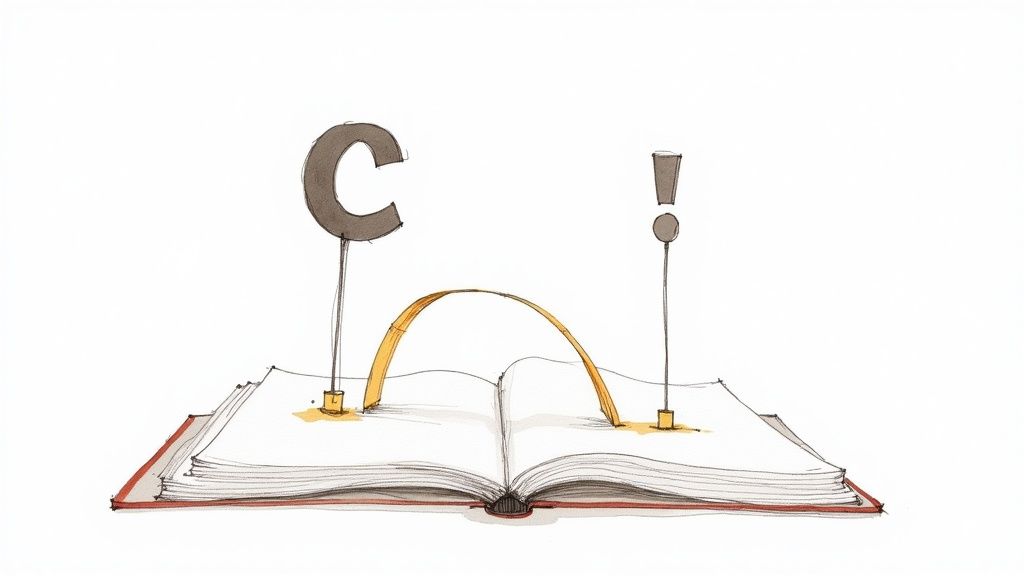
Let's be honest: colons and semicolons can feel intimidating. But the core difference is actually simple. A colon is like a pointing finger, saying "here's what I mean," while a semicolon is like a handshake, connecting two closely related, complete thoughts.
Nailing this distinction instantly makes your writing feel more polished and authoritative. As a content creator or professional, this small detail signals to your audience that you value clarity and precision.
Why Bother With Punctuation in 2024?
In an age of tweets and DMs, it’s tempting to let the finer points of punctuation slide. But for anyone writing professionally—from content creators to students—these little marks are more important than ever. They guide your reader’s pace and ensure your message is crystal clear.
Good punctuation isn't just about following rules; it’s about showing you care. It signals a level of professionalism that builds immediate trust with your audience. With AI writing tools becoming common, knowing these rules is key to maintaining your authentic voice.
Getting to the Heart of Colons and Semicolons
When you're editing a draft, trying to decide which mark to use, ask yourself this: what is the relationship between these two parts of my sentence? Are you introducing something, or are you linking two equal ideas?
That single question is your guide. Use the colon as a signpost pointing ahead or the semicolon as a bridge to join two related paths. This deliberate choice is what separates human-led writing from generic AI output.
As you can see, the colon is your go-to for introductions, lists, quotes, or an explanation. A semicolon, on the other hand, connects two independent clauses that are too closely related to be separated by a period.
Colon vs Semicolon At a Glance
To make it even clearer, here’s a quick side-by-side comparison. Using the wrong one can trip up your reader, but the right choice makes your writing flow effortlessly.
| Punctuation Mark | Primary Function | Common Use Case Example |
|---|---|---|
| Colon ( : ) | To introduce or point to what comes next. | She had three goals for the summer**:** to read more, travel, and relax. |
| Semicolon ( ; ) | To connect two closely related, complete sentences. | The meeting ran an hour over**;** everyone was eager to leave. |
This table strips it down to the essentials. Both marks perform jobs that a simple comma or period can't quite handle on their own, adding a layer of sophistication to your work.
For a more comprehensive look at the building blocks of strong writing, our guide on basic grammar rules is a fantastic place to start.
At PureWrite, we see great writing as a blend of solid grammatical foundations and a unique, authentic voice. Mastering how punctuation shapes meaning is the first step in creating content that doesn't just pass for human—it truly connects with humans.
How to Use Colons for Clarity and Emphasis
Think of the colon as the drumroll in your writing. It’s a punctuation mark that says, “Pay attention, something important is coming next.” Learning to use it well is about strategically directing your reader's focus.
At its heart, a colon builds anticipation. The golden rule is that it must follow a complete sentence (what we call an independent clause). The first part of your sentence sets the stage, and the colon is the curtain rising on the main event.
Introducing Lists and Items
One of the most frequent jobs for a colon is to introduce a list. This is a fantastic trick for content creators who need to lay out information in a clear, digestible way. Just remember: the words before the colon must form a complete thought.
Let’s look at a real-world example:
- Correct: The marketing campaign has three core components: social media outreach, email newsletters, and influencer collaborations.
- Incorrect: The campaign's components are: social media, email, and influencers.
See the difference? The first example works because "The marketing campaign has three core components" is a full sentence. Nailing this one simple rule instantly makes your writing look more professional.
Providing Elaboration or Explanation
Colons are also brilliant for connecting two related ideas. You can use one when the second part of a sentence directly explains, illustrates, or expands on the first. It creates a more dramatic and focused connection.
For instance, a project manager might write:
The AI detection score was surprisingly low: our writer had successfully blended the initial draft with authentic human insights.
Here, the second part of the sentence tells you why the score was low, giving an immediate and satisfying explanation. This technique adds a touch of class to your writing. For a deeper dive, our guide to compound and complex sentences is a great next step.
While its core function has remained steady, studies of written English show that a colon appears about once for every 100 to 150 words, far more often than the semicolon. This shows how useful it is for structuring information. You can explore the history of colon usage) to see how it has evolved.
Capitalization Rules After a Colon
This is a subtle point, but it matters for a polished final draft. The guideline is simple:
- Lowercase: If the colon introduces a list or a phrase, the first word after it stays lowercase (unless it’s a proper noun).
- Uppercase: If the colon introduces a complete sentence, a direct quote, or a formal question, you can capitalize the first word.
Choosing to capitalize a full sentence after a colon can add extra punch, drawing your reader's eye to a key point. The most important thing is to be consistent throughout your document.
The screenshot below, from Wikipedia's page on the colon, shows just how versatile this little punctuation mark is, especially in our digital world.
As the image shows, the colon isn't just for essays; it's a key player in technical contexts like URLs and computer programming.
In the end, using punctuation like the colon is about making deliberate choices. AI writing tools can generate technically correct sentences, but they often miss the nuance needed to use a colon for maximum effect. That’s where you, the writer, come in.
Using Semicolons to Connect Related Ideas
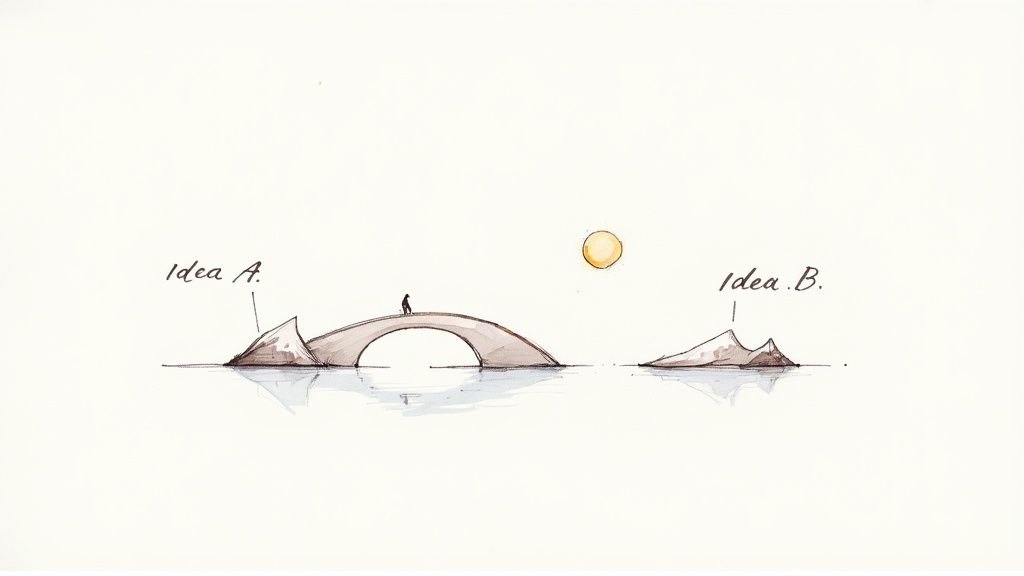
The semicolon is one of the most underappreciated tools in a writer's arsenal. Think of it as a "super comma"—stronger than a comma but not as final as a period. Its main job is to link two complete sentences that are so closely related, a full stop would feel too abrupt.
Using a semicolon signals a deliberate connection, adding rhythm and sophistication to your writing. It tells the reader that one idea flows directly into the next, creating a nuance that a simple "and" just can't match.
Joining Two Independent Clauses
By far, the most powerful way to use a semicolon is to join two independent clauses. Don't let the grammar term scare you; an independent clause is just a complete sentence. When you have two full sentences sharing a deep, logical connection, the semicolon is the perfect bridge.
Take a look at this business update:
The design team worked tirelessly on the new interface; their efforts paid off with a 25% increase in user engagement.
See how that works? The semicolon elegantly fuses them, showing a direct cause-and-effect relationship that two separate sentences would weaken. You can dive deeper with more examples of compound sentences to see this in practice.
Pairing with Conjunctive Adverbs
Semicolons are also the perfect partner for conjunctive adverbs. These are transitional words like however, therefore, moreover, and consequently that show a specific relationship between two ideas. When you use one to connect two full sentences, a semicolon should come right before it.
Here’s what that looks like in a professional context:
- The team expected the project to be simple; however, unexpected challenges arose.
- The data was conclusive; therefore, we decided to move forward with the launch.
Placing the semicolon here provides structure and guides your reader through your logic. Skip it, and you've got a run-on sentence—a common mistake that can derail your message.
Organizing Complex Lists
This last use is more niche, but it's a lifesaver for detailed content. Semicolons are brilliant for bringing order to complex lists where the individual items already contain commas. Trying to separate these items with more commas just creates a mess.
Imagine listing team members for a report:
- Confusing: The event's key speakers are Sarah Chen, a data scientist from Austin, Mark Lee, a marketing director from Chicago, and Maria Garcia, a product manager from Miami.
- Clear: The event's key speakers are Sarah Chen, a data scientist from Austin; Mark Lee, a marketing director from Chicago; and Maria Garcia, a product manager from Miami.
The semicolons make it instantly obvious where one entry ends and the next begins. It’s a small tweak that makes a huge difference in readability and professionalism.
While semicolons might be rare in a quick text, mastering them is the mark of a skilled writer. AI can generate correct sentences, but it rarely has the stylistic finesse to use a semicolon for maximum impact. At PureWrite, we help you elevate that AI content, making every punctuation choice purposeful. Try PureWrite today!
Common Punctuation Mistakes to Avoid
Working with colons and semicolons can sometimes feel like walking a grammatical tightrope. Even experienced writers can take a tumble. Let's highlight the most common pitfalls so you can sidestep them with confidence.
One of the biggest blunders is misplacing the colon. Its job is to act as a formal introduction. But to do that, it must follow a complete sentence. Writers often make the mistake of dropping it in too early, interrupting the sentence's natural flow.
The Colon Catastrophe: An Incomplete Thought
A classic colon mistake is forcing it in right after a verb or preposition. Just remember this golden rule: the part of the sentence before the colon must be able to stand on its own.
Let's look at a common "before and after" example:
- Incorrect: For our project, we need: a designer, a developer, and a project manager.
- Correct: For our project, we need three key roles: a designer, a developer, and a project manager.
- Also Correct: For our project, we need a designer, a developer, and a project manager.
In the first example, "For our project, we need" is left hanging—it’s not a complete thought. Sometimes, the easiest fix is admitting the colon isn't needed at all.
Semicolon Slip-Ups: The Comma Splice and Its Fix
The semicolon is easily one of the most misunderstood punctuation marks. This confusion leads writers to avoid it or use it incorrectly. The biggest problem? The dreaded comma splice, where two independent sentences are squished together with just a comma.
The semicolon is the perfect hero for this very situation.
- Incorrect (Comma Splice): The presentation is finished, we just need to rehearse it.
- Correct: The presentation is finished; we just need to rehearse it.
By swapping the comma for a semicolon, you create a strong, sophisticated link between two related ideas. If you're struggling to spot these errors, modern tools like an AI-powered writing assistant like Grammarly can be a huge help.
And this uncertainty isn't just a feeling. Surveys have shown that 67% of students rarely or never use semicolons, mostly because they aren't confident about how to do it right. It’s a clear sign that a little guidance goes a long way.
At PureWrite, we believe mastering punctuation is a key part of humanizing AI content. An AI might generate a comma splice, but a thoughtful writer knows a semicolon is the elegant solution. It's these small, intentional choices that elevate your writing from robotic to authentic. Ready to refine your AI drafts? Try PureWrite today!
Overcorrecting with Semicolons
On the flip side, it's easy to get too excited about semicolons and start using them everywhere. A common slip-up is using a semicolon when a simple comma would do the job, especially when a coordinating conjunction (like and, but, or so) is already present.
- Incorrect: The algorithm is efficient; but it requires a lot of data.
- Correct: The algorithm is efficient, but it requires a lot of data.
Getting these details right makes a massive difference in your writing's clarity and professionalism. If you want to dig deeper, check out our guide on capitalization and punctuation rules.
The Shifting Sands of Punctuation in a Digital World
Language is a living thing. The explosion of digital communication—from emails and blogs to social media—has completely rewired how we write. This has had a huge impact on how we use colons and, even more so, semicolons.
This isn't just a hunch; you can see the shift in data. Online communication values speed and clarity, which means we naturally lean toward shorter, punchier sentences. As a result, the more formal connections that semicolons create are often swapped for simpler punctuation.
The Great Semicolon Decline
The semicolon's popularity has seen a dramatic rise and fall. It used to be a cornerstone of formal writing, but it's become much less common in our daily reading and writing. This reflects a massive stylistic shift toward more direct, conversational language.
A recent analysis of English-language books highlights this trend. Between 2000 and 2022, the use of the semicolon plummeted by nearly 47%. In 2000, you’d find a semicolon roughly once every 205 words; by 2022, that number stretched to one every 390 words. You can dig into more of the data on this punctuation shift to see what this means for modern language.
But this decline doesn’t mean the semicolon is dead. Far from it. It just means its role has become more specialized. A carefully placed semicolon can now make your writing feel more deliberate, thoughtful, and authoritative.
Punctuation in the Age of AI
The arrival of AI writing tools adds another interesting wrinkle. These models learn from massive text datasets, including older books where semicolons were common. This can cause AI-generated content to sound a bit stiff or old-fashioned.
This presents a new challenge for content creators and marketers. It’s no longer enough to just know grammar rules; you must also understand modern style to connect with your audience. An AI-written draft often needs a human editor to tweak the punctuation so it sounds like it was written in this century.
Understanding this evolution is what separates good writers from great ones. It’s not about throwing out old rules but knowing when to use them for formal effect and when to adapt for modern, clear communication.
And that’s exactly where we come in. While an AI might spit out text that feels robotic, PureWrite helps you humanize that content. Our platform helps you refine punctuation and sentence flow until it feels natural, authentic, and right for your audience.
Ready to make sure your content speaks today's language? Try PureWrite and see the difference.
Practical Exercises to Improve Your Punctuation Skills
https://www.youtube.com/embed/ruOYTZfxiqk
Knowing the rules is half the battle; putting them into practice is where you build confidence. Think of this section as your personal grammar gym—a place to flex your punctuation muscles and get a real feel for how colons and semicolons work in the wild.
I'll provide sentences with common punctuation puzzles. Your job is to decide where a colon or semicolon should go. This hands-on approach is the best way to move from simply knowing the rules to truly mastering them.
Exercise 1: Joining Related Thoughts
Let’s start by connecting two complete sentences. A semicolon is the perfect tool for linking two independent clauses that are closely related. Give it a shot with these examples.
- The project deadline is tomorrow we still have a lot of work to do.
- She spent all day coding the new feature it launched without any bugs.
- The algorithm was complex however, the results were incredibly accurate.
Answer Key:
- The project deadline is tomorrow**;** we still have a lot of work to do. (The semicolon acts as a bridge, connecting two complete but related thoughts.)
- She spent all day coding the new feature**;** it launched without any bugs. (Again, the semicolon smoothly links two independent clauses.)
- The algorithm was complex**;** however, the results were incredibly accurate. (A semicolon is the right choice before a conjunctive adverb like "however".)
If you need a quick refresher on how sentences are put together, check out our guide on clauses in grammar. It's a great starting point.
Exercise 2: Introducing Lists and Explanations
Now for the colon. A colon's primary role is to act as a presenter, introducing a list, a quote, or an explanation. The golden rule? It must always come after a complete sentence. See if you can place the colon correctly here.
- The marketing report highlighted three key metrics engagement, reach, and conversion rate.
- The team had one clear objective to increase user retention by 15%.
- He gave his final verdict the campaign was a resounding success.
At PureWrite, we know that deliberate practice is what separates AI-generated text from truly authentic writing. Working through exercises like these builds the instinct you need to catch and fix clunky punctuation, making your final draft shine.
Answer Key:
- The marketing report highlighted three key metrics**:** engagement, reach, and conversion rate. (The colon is perfect here to introduce the list that follows a complete sentence.)
- The team had one clear objective**:** to increase user retention by 15%. (Here, the colon introduces a phrase that explains the objective.)
- He gave his final verdict**:** the campaign was a resounding success. (The colon sets up the direct explanation of the verdict.)
Working through these examples helps you develop an intuitive feel for these powerful punctuation marks. To see how solid punctuation fits into the bigger picture of effective writing, take a look at this guide on how to write essays fast.
Still Have Questions? Let's Clear Things Up
To wrap things up, let's tackle a few of the most common questions that pop up when you start using colons and semicolons more thoughtfully. Think of this as a quick-reference guide for those tricky situations.
Can a Semicolon and a Conjunction Hang Out Together?
In a word: no. You shouldn't use a semicolon right next to a conjunction like and, but, or so when connecting two full sentences. The semicolon is strong enough to do that job all by itself.
Using both is like wearing a belt and suspenders—it's redundant. You have to choose one.
- Incorrect: The data looked promising; but we needed more research.
- Correct: The data looked promising, but we needed more research.
- Also Correct: The data looked promising; we needed more research.
Think of the semicolon as the more sophisticated connector. It creates a pause that’s a bit stronger than a comma but not quite as final as a period.
To Capitalize or Not to Capitalize After a Colon?
This is a great question, and the answer depends on what comes after the colon. The rule of thumb is simple: you only capitalize the first word if it kicks off a complete sentence, a formal question, or a direct quote.
If what follows the colon is just a list or a fragment, keep it lowercase (unless, of course, the first word is a proper noun like a name). Getting this right is a small detail that adds a ton of polish to your writing.
Let's look at it in action:
- Lowercase (a list): The strategy required three elements: market research, competitor analysis, and customer feedback.
- Uppercase (a full sentence): The team reached a clear conclusion: The project was ready for launch.
When Do I Bring in Semicolons for a List?
Semicolons are your best friend when you’re building a complex list—specifically, a list where the individual items already have their own commas. Using semicolons here acts like a "super-comma," separating the main items so your reader doesn't get lost.
Without them, your sentence can quickly turn into a confusing jumble.
- Confusing: The team included Maria, the project lead, David, the lead developer, and Sarah, the designer.
- Clear: The team included Maria, the project lead; David, the lead developer; and Sarah, the designer.
The semicolons make it crystal clear where one person's description ends and the next begins.
Mastering the subtle rules of colon and semicolon use is one of the fastest ways to elevate your writing from good to great. AI can string words together, but it often fumbles the nuance that makes prose feel genuinely human. At PureWrite, we specialize in transforming that AI-generated content, making sure your punctuation isn't just correct but powerful. Let us help you turn your drafts into clear, authentic, and engaging writing by visiting https://purewrite.io.