8 Crucial Compound Sentences Examples for Writers in 2025

In a world increasingly filled with AI-generated content, the ability to write with nuance and clarity is more valuable than ever. While AI tools can produce simple sentences, mastering compound sentences is key to creating a more sophisticated, engaging, and human-like writing style.
This skill allows you to connect related ideas smoothly, create a natural rhythm, and guide your reader's thoughts with precision. Moving your prose beyond robotic simplicity is essential for connecting with your audience and standing out. Whether you're a content creator, a student, or a professional polishing a report, understanding how to construct effective compound sentences examples is a non-negotiable skill.
At PureWrite, we believe that powerful writing starts with strong fundamentals. This guide provides practical examples and strategic insights to help you move beyond basic structures and write with authentic confidence. We will break down eight essential methods for forming compound sentences, showing you not just what they are, but why and when to use them for maximum impact.
1. Coordinating Conjunctions (FANBOYS Method)
The most common way to build compound sentences is by using a coordinating conjunction. These are seven short words that connect two complete, independent ideas. The easiest way to remember them is with the acronym FANBOYS: For, And, Nor, *B***ut, Or, Yet, So.
Each conjunction signals a specific logical relationship between the two clauses it joins. This method provides a clear and direct way to combine related thoughts, improving the flow and rhythm of your writing.
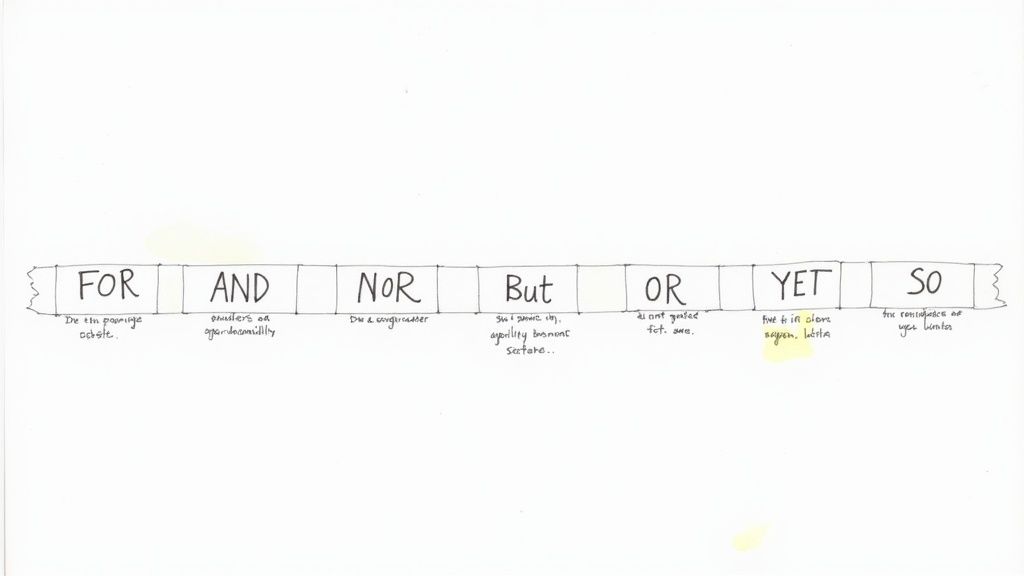
Mastering FANBOYS is the first step toward crafting more engaging and dynamic prose, a crucial skill for any writer aiming for authenticity.
Example Breakdown
Let's examine some common compound sentences examples using this method:
Example 1: The marketing team developed a new campaign, and the sales team prepared their outreach.
- Analysis: 'And' simply adds one related idea to another. This sentence connects two distinct but related actions happening within a business.
Example 2: The AI tool generated the first draft, but it lacked a personal touch.
- Analysis: 'But' introduces a contrast. The first clause states a fact, while the second presents a common problem with automated content.
Example 3: You could publish the blog post as-is, or you could refine it for a more human feel.
- Analysis: 'Or' presents two alternative choices. This structure helps you weigh the options between speed and quality in content creation.
Actionable Takeaways
To effectively use coordinating conjunctions, always place a comma before the FANBOYS word when it joins two independent clauses. This punctuation is crucial for clarity. Choose the conjunction that most accurately reflects the logical bridge between your two ideas. For more detail on creating powerful sentence structures, explore our guide on compound and complex sentences.
2. Semicolon Linking
Another sophisticated way to form compound sentences is by linking two closely related independent clauses with a semicolon (;). This punctuation mark signals a stronger connection between ideas than a period would, without using a FANBOYS conjunction.
Using a semicolon suggests the two clauses are equal and that the second clause directly explains, elaborates on, or contrasts with the first. This method is highly effective in professional and academic writing, where it adds stylistic variety and a formal tone.
Mastering the semicolon is a key step toward more nuanced writing, helping your content feel less like a checklist and more like a cohesive argument.
Example Breakdown
Let's look at some compound sentences examples built with a semicolon:
Example 1: The conference lasted three days; attendance exceeded all expectations.
- Analysis: The second clause provides a direct result related to the first. The semicolon implies a cause-and-effect relationship without stating it.
Example 2: AI can generate content quickly; human writers provide creativity and empathy.
- Analysis: Here, the semicolon joins two clauses that present a direct contrast. This comparison highlights the distinct roles of AI and humans in content creation.
Example 3: The weather forecast predicted rain; the outdoor event was moved indoors.
- Analysis: This example clearly shows one event leading to another. The semicolon powerfully links the reason (the forecast) to the outcome (the relocation).
Actionable Takeaways
To use a semicolon correctly, ensure that the statements on both sides of it are complete sentences. The key is that the ideas must be very closely related. Avoid overusing semicolons in casual content where a period or conjunction would be more appropriate. For a deeper dive into the building blocks of sentences, explore our guide on clauses in grammar.
3. Conjunctive Adverbs: Contrast (However, Nevertheless, Still)
Beyond FANBOYS, conjunctive adverbs offer a more formal and emphatic way to connect independent clauses. When you need to show a strong contrast or unexpected outcome, adverbs like however, nevertheless, and still are powerful tools.
They signal that the second clause presents information that contradicts the first, adding a layer of nuance. This method elevates sentence structure by creating a more deliberate pause and a stronger logical pivot between two ideas.
Mastering this form is essential for academic, professional, and formal writing where precise relationships between ideas are critical for building a credible argument.
Example Breakdown
Let’s explore some compound sentences examples that use contrasting conjunctive adverbs:
Example 1: The AI writing assistant generated 1,000 words in minutes; however, the content required significant human editing.
- Analysis: 'However' introduces a direct but neutral contrast. The first clause highlights AI's efficiency, which the second clause tempers with the reality of its limitations.
Example 2: The article was algorithmically optimized for SEO; nevertheless, it failed to engage human readers.
- Analysis: 'Nevertheless' implies a stronger, more surprising contradiction. It emphasizes that despite technical perfection, the content lacked the essential human connection.
Example 3: The software promised flawless grammar; still, the writer found several awkward phrases.
- Analysis: 'Still' highlights persistence in the face of the information in the first clause. It suggests the writer's critical eye was necessary despite the tool's claims.
Actionable Takeaways
Remember the semicolon-adverb-comma rule: Independent Clause; however, Independent Clause. This punctuation is non-negotiable for grammatical accuracy. While 'however' is a versatile choice, use 'nevertheless' or 'still' to inject a stronger sense of surprise or persistent opposition into your compound sentences examples. This precision helps guide your reader through complex arguments.
4. Conjunctive Adverbs: Cause and Effect (Therefore, Consequently, As a result)
Another powerful way to form compound sentences is by using conjunctive adverbs that signal a cause-and-effect relationship. Words like therefore, consequently, and as a result show that the second independent clause is a direct logical outcome of the first.
This method adds analytical depth, clearly connecting an action to its consequence. Using these adverbs elevates your writing by establishing clear, logical connections, making your arguments more persuasive and your narratives more coherent.
This is especially useful in professional and analytical writing where demonstrating causality is key to building trust with your audience.
Example Breakdown
Let’s explore some compound sentences examples that use this causal structure:
Example 1: The company invested in content quality; therefore, its organic traffic increased by 50%.
- Analysis: 'Therefore' presents a direct, logical conclusion. The traffic increase is the immediate and expected result of the investment.
Example 2: The writer focused on authentic storytelling; consequently, the article resonated with the target audience.
- Analysis: 'Consequently' works well for results that unfold from a strategic choice. The audience connection is a consequence of the writer's authentic approach.
Example 3: Many creators rely solely on AI; as a result, their content lacks a unique voice.
- Analysis: 'As a result' strongly emphasizes the outcome. This phrase places focus squarely on the loss of authenticity, a tangible impact of over-reliance on automation.
Actionable Takeaways
To correctly use these adverbs, place a semicolon (;) before the adverb and a comma (,) after it. Ensure a genuine cause-and-effect relationship exists; otherwise, the connection will feel forced. If you're struggling to make your AI-generated text sound more natural, PureWrite can help you refine these logical connections. Try Pure Write to humanize your content.
5. Conjunctive Adverbs: Addition and Emphasis (Moreover, Furthermore, Indeed)
Another powerful way to form compound sentences is by using conjunctive adverbs for addition and emphasis. Words like moreover, furthermore, and indeed build upon the first clause, adding weight or reinforcing a point.
This method is ideal for creating more formal and persuasive compound sentences examples, as it guides the reader's thought process more explicitly than a simple 'and'. Using these adverbs adds a layer of sophistication, helping you construct compelling arguments by logically stacking related ideas.
This technique is a great way to make your writing more authoritative and convincing, especially in professional or academic contexts.
Example Breakdown
Let's explore how these conjunctive adverbs function to connect and amplify ideas:
Example 1: Ethical AI use requires transparency; moreover, it demands a commitment to originality.
- Analysis: 'Moreover' adds a new, equally important piece of information. The sentence shows that ethical AI has two core requirements.
Example 2: The report was well-researched; furthermore, its recommendations were practical and actionable.
- Analysis: 'Furthermore' introduces an even stronger, more compelling point. It builds on the report's quality by highlighting its practical value.
Example 3: AI detectors can be unreliable; indeed, a 2023 study found they often misidentify human writing as AI-generated.
- Analysis: 'Indeed' is used for powerful emphasis, confirming the statement in the first clause with a specific piece of evidence.
Actionable Takeaways
To correctly use conjunctive adverbs like 'moreover', place a semicolon (;) before the adverb and a comma (,) after it. Choose your adverb carefully: use 'moreover' for adding similar ideas, 'furthermore' to add a stronger point, and 'indeed' for emphatic confirmation. This precision will make your writing more impactful.
6. Semicolon with Conjunctive Adverbs
For a more sophisticated and formal connection between ideas, you can use a semicolon paired with a conjunctive adverb. This hybrid method creates a strong, logical bridge between two independent clauses, signaling a specific relationship like cause-and-effect, contrast, or emphasis.
This structure elevates your writing by creating more nuanced transitions than a simple coordinating conjunction. It's particularly effective in academic and professional writing where precise logical connections are crucial.
Using this method demonstrates a higher command of sentence structure and adds stylistic variety, helping you avoid the repetitive patterns often found in AI-generated text.
Example Breakdown
Let's break down some compound sentences examples that use this advanced technique:
Example 1: The initial prototype failed testing; nevertheless, the engineers persisted in their development efforts.
- Analysis: 'Nevertheless' shows concession despite a setback. The semicolon provides a firm separation, while the adverb signals the team's determination.
Example 2: The market showed strong growth last quarter; therefore, investors remained confident in the company's future.
- Analysis: 'Therefore' establishes a clear cause-and-effect relationship. The market's growth is the direct cause of investor confidence.
Example 3: The candidate had impressive credentials; however, the interview panel had concerns about her experience.
- Analysis: 'However' introduces a direct contrast. It pivots from a positive point (credentials) to a conflicting negative one (concerns).
Actionable Takeaways
The key to this structure is precise punctuation: use a semicolon before the conjunctive adverb and a comma after it. This format correctly separates the two clauses while guiding the reader. Choose the adverb that most accurately reflects the relationship between your clauses. For a deeper look, check our guide on capitalization and punctuation.
7. Parallel Structure with Multiple Coordinating Conjunctions
Beyond joining just two clauses, you can create powerful, rhythmic sentences by linking three or more independent clauses using repeated coordinating conjunctions. This technique, known as polysyndeton, uses parallel structure to build momentum and emphasize the equality of each idea.
This method intentionally uses a series of conjunctions (like 'and' or 'or') to create a continuous stream of thought. It’s an advanced stylistic choice that can add a distinct, human voice to your prose, transforming a simple list into a more dramatic statement.
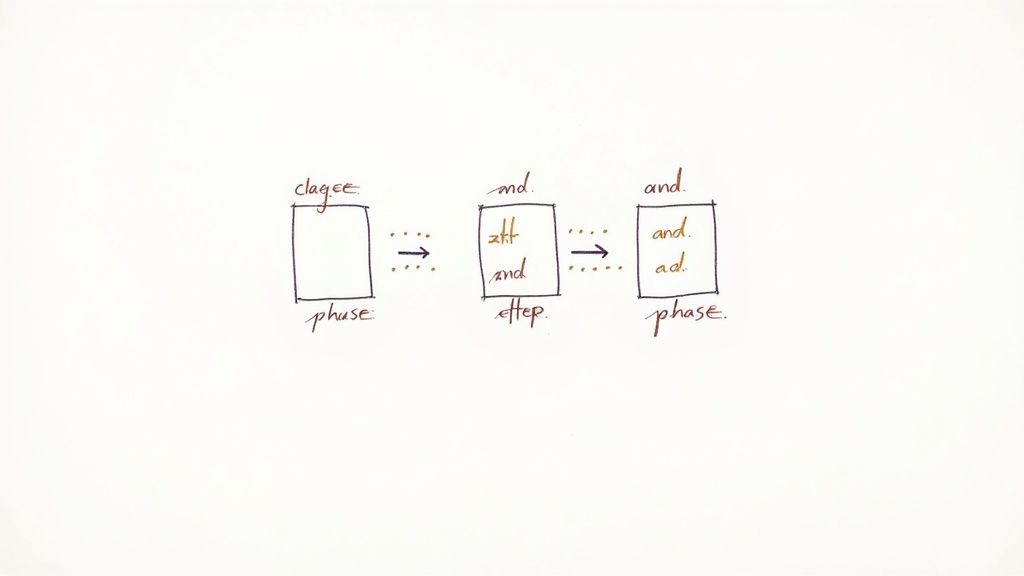
It's a great way to make your writing more memorable and impactful, especially in storytelling or persuasive content.
Example Breakdown
Let's look at some compound sentences examples that utilize this parallel, multi-clause structure:
Example 1: The team played aggressively, and they communicated effectively, and they executed their strategy flawlessly.
- Analysis: The repetition of 'and' links three distinct, equally important actions, emphasizing the team's comprehensive effort.
Example 2: We could hire a freelancer, or we could use an AI writer, or we could train our in-house team.
- Analysis: Here, the repeated 'or' presents a series of options with equal weight, creating a sense of abundant choice and possibility.
Example 3: She worked hard, and she studied diligently, and she ultimately succeeded beyond her expectations.
- Analysis: This sentence builds a narrative of cause and effect. The repetition of 'and' creates a powerful, cumulative rhythm that builds toward the successful outcome.
Actionable Takeaways
To use this technique effectively, ensure each clause is grammatically parallel. While powerful, limit this structure to three or four clauses to avoid overwhelming the reader. For a refresher on the basics, explore these examples of a simple sentence.
8. Colon for Compound Sentence Expansion
A more advanced way to connect two related ideas is by using a colon. This method links two independent clauses where the second clause directly explains, exemplifies, or elaborates on the first. It creates a strong, decisive connection, signaling to the reader that a clarification is coming.
This technique is especially powerful in formal and technical writing. Using a colon adds a level of sophistication and authority, creating anticipation before revealing the crucial explanatory detail.
It’s a deliberate choice that guides the reader’s focus, making it an excellent tool for emphasizing key points or conclusions in your content.
Example Breakdown
Let's look at some compound sentences examples where a colon provides a powerful link between ideas:
Example 1: The experiment yielded a surprising result: the test subjects showed unprecedented cognitive improvements.
- Analysis: The colon introduces a direct explanation. The first clause makes a general statement, and the second specifies what that result was.
Example 2: Our content strategy has one primary goal: to build genuine trust with our audience.
- Analysis: Here, the colon creates anticipation. The first clause identifies the "one primary goal," and the second clause reveals it, providing a clear and impactful mission statement.
Example 3: AI writing tools share a common weakness: they struggle to replicate authentic human emotion.
- Analysis: This example uses the colon to introduce a specific elaboration. The first clause presents a "common weakness," and the second defines it, adding clarity and focus.
Actionable Takeaways
To use colons effectively, ensure the clause before the colon is a complete sentence. The information that follows must directly explain or illustrate that first clause. Mastering this punctuation mark is a key part of advanced writing. For a deeper dive, explore our guide on basic grammar rules.
8 Compound Sentence Structures Compared
| Method | Complexity 🔄 | Skill / Effort ⚡ | Expected Outcome 📊 | Ideal Use Cases 💡 | Key Advantages ⭐ |
|---|---|---|---|---|---|
| Coordinating Conjunctions (FANBOYS Method) | Low — comma + conjunction | Low — very learnable (mnemonic) | Clear, balanced clauses; accessible prose | Elementary instruction, everyday writing, simple joins | ⭐ Easy to apply; widely accepted; shows logical relations |
| Semicolon Linking | Moderate — punctuation precision | Medium — must identify independent clauses | Elegant, formal linkage; emphasizes relation | Academic and professional sentences, concise contrasts | ⭐ Sophisticated tone; links ideas without conjunction |
| Conjunctive Adverbs: Contrast (However, Nevertheless, Still) | Moderate — semicolon + adverb + comma | Medium — punctuation + adverb choice | Strong, nuanced contrast; highlights exceptions | Formal arguments, editorial writing, emphasis on contradiction | ⭐ Clear contrast emphasis; more nuanced than "but" |
| Conjunctive Adverbs: Cause and Effect (Therefore, Consequently, As a result) | Moderate — same punctuation pattern | Medium — ensure genuine causal link | Explicit cause→effect clarity; logical progression | Expository/argumentative writing, reports, analysis | ⭐ Clarifies causality while keeping clause equality |
| Conjunctive Adverbs: Addition and Emphasis (Moreover, Furthermore, Indeed) | Moderate — semicolon + adverb + comma | Medium — judicious selection to avoid repetition | Builds cumulative support; strengthens arguments | Persuasive essays, academic support, formal reports | ⭐ Adds emphasis and cohesion to supporting points |
| Semicolon with Conjunctive Adverbs | High — combines punctuation + lexical precision | High — steep learning curve; meticulous punctuation | Most sophisticated and precise clause relationships | Graduate-level writing, professional communications | ⭐ Maximum flexibility and precision; polished prose |
| Parallel Structure with Multiple Coordinating Conjunctions | Moderate — repeated conjunctions, strict parallelism | Medium — requires parallel phrasing and rhythm | Rhythmic, cumulative effect; equal emphasis on items | Persuasive/poetic writing, rhetoric, cumulative lists | ⭐ Memorable rhythm; emphasizes equality of ideas |
| Colon for Compound Sentence Expansion | Moderate — colon introduces elaboration | Medium — style-guide awareness; clear relation needed | Dramatic emphasis; signals explanation or list | Technical writing, manuals, formal explanations | ⭐ Creates anticipation and clear elaboration |
From Robotic to Realistic: Humanize Your Sentences with PureWrite
Throughout this guide, we've explored the tactical power of compound sentences. You’ve seen how they work, from simple connections with FANBOYS to the sophisticated relationships established with semicolons. The goal isn't just to memorize rules; it's to develop an intuitive feel for how these structures create authentic rhythm and flow.
Mastering these compound sentences examples is the key to elevating your prose from a series of robotic statements to a cohesive, compelling narrative. By strategically choosing how to connect your ideas, you gain precise control over your reader's experience. This control is what separates functional writing from truly engaging content.
Your Path to Fluent Sentence Construction
So, what are the next steps? True mastery comes from application. As you write and edit, consciously look for opportunities to combine related ideas. Ask yourself:
- Could these two simple sentences be linked to show their relationship?
- Am I overusing "and" or "but"? Could a word like "however" or "moreover" add more precision?
- Would a semicolon create a stronger, more immediate link between these two clauses?
This deliberate practice will gradually transform your sentence-building habits. Instead of defaulting to simple structures, you will begin to see opportunities for more elegant connections, making your writing more dynamic and persuasive.
Connecting Clarity with Discoverability
Ultimately, clear and varied sentence structure is about effective communication. When your ideas flow logically and your writing is a pleasure to read, your message resonates more deeply with your audience. This clarity not only improves reader engagement but also plays a vital role in digital content performance.
Well-structured, readable content is favored by both humans and algorithms. As you work to refine your sentence structure, remember that the ultimate goal is effective communication. You can further enhance your writing's reach by optimizing content for search engines.
Your journey with compound sentences examples is a significant step toward becoming a more versatile and impactful writer. Continue to experiment, practice, and refine, and you will unlock a new level of clarity and style in all your work.
Ready to transform your correct sentences into compelling ones? Let Pure Write help you bridge the gap between grammatical accuracy and human-like flow. Our tool analyzes your text to suggest sophisticated structural improvements and ensure your compound sentences sound natural, not robotic. Try Pure Write today to refine your writing and connect with your audience on a deeper level.