The Power of Less: A Guide to Conciseness in Writing

Conciseness in writing is about delivering your message with maximum impact using the fewest words possible. It’s not about being blunt or skipping important details; it’s about making every word count so your message is powerful and direct, not lost in a sea of fluff. This guide offers practical advice for content creators, students, and professionals aiming to sharpen their writing, especially when using AI tools.
Why Conciseness in Writing Is Your Secret Weapon
In a world drowning in information, your reader's attention is a precious resource. Concise writing helps you capture and hold it by showing respect for your audience's time and demonstrating a commitment to clarity.
Think of a wordy sentence as a winding road with unnecessary detours. A concise one is a direct highway to the destination. Which route would you rather your reader take?
The Core Benefits of Clear Communication
When you adopt a concise style, your writing immediately becomes stronger. Arguments land with more force, instructions are easier to follow, and your stories become far more engaging.
The benefits are real and measurable. Studies show that concise writing can boost reader comprehension by as much as 40%. For professionals who spend nearly 28% of their work week on email, trimming the fat from their writing is a massive productivity gain.
Why Every Writer Needs This Skill
Whether you're crafting a business proposal, a blog post, or a simple email, conciseness is your ally. When you can explain a topic without hiding behind jargon or filler words, you project confidence and expertise.
Understanding where to be brief is a strategic skill. In professional documents, for instance, length is a critical factor. For a great example, check out this advice on how long a CV should be. By cutting the clutter, you create a better, more memorable experience for your reader.
Concise vs Wordy Writing At a Glance
Let's look at the real-world impact of these two styles. This table gives you a quick snapshot of how readers perceive your writing based on whether it’s tight and focused or long-winded.
| Attribute | Wordy Writing | Concise Writing |
|---|---|---|
| First Impression | Confusing, unprofessional | Clear, confident |
| Reader Engagement | Low, high bounce rates | High, keeps attention |
| Message Clarity | Obscured by fluff | Direct and impactful |
| Readability | Difficult to scan | Easy to read and understand |
| Audience Respect | Disrespects reader's time | Values reader's time |
The choice is clear. Concise writing doesn't just make your message easier to understand—it builds trust and authority with your audience from the very first sentence.
How to Spot the Hidden Traps in Your Writing
Before you can write with impact, you have to learn to spot the bad habits that make your sentences weak. Many writers—and many AI tools—fall into these traps without noticing, cluttering sentences with words that get in the way.
Think of these filler words as weeds in a garden. Words like “really,” “basically,” “actually,” and “just” might feel natural when we talk, but in writing, they add fluff and make you sound hesitant.
Trimming Down Redundancy and Fluff
Another common trap is redundancy—using two or more words that mean the same thing. Have you ever written “final outcome,” “added bonus,” or “past history”? In each case, one word is just repeating the other.
Here’s a practical example:
- Wordy: The final outcome of the project was a complete success.
- Concise: The project’s outcome was a success.
AI-generated content is especially prone to this. Models are often trained to be extra descriptive, leading to repetitive phrases a human writer would instinctively cut. You can find more examples in our guide on frequently misused words.
The Problem with Passive Voice
One of the biggest energy drains in writing is the passive voice. It occurs when the subject of the sentence is acted upon instead of performing the action, often making your writing feel indirect and clunky.
Wordy (Passive): The report was written by our team, and the data was analyzed by the research department. (15 words) Concise (Active): Our team wrote the report, and the research department analyzed the data. (11 words)
The passive voice isn't always wrong, but overusing it drains your writing of its punch. Switching to an active voice brings back clarity and energy, a cornerstone of concise writing.
At PureWrite, we’ve designed our tool to ethically catch these hidden traps. Our AI text humanizer spots wordiness, redundancy, and passive voice, helping you turn clunky AI drafts into prose that sounds authentically human. Humanize Your AI Content with PureWrite and see how easy it is to make every word count.
Your Toolbox for Achieving Powerful Conciseness
Now that you can spot wordiness, it's time to stock your editing toolbox. Making your writing concise is about applying specific, hands-on techniques to turn a clunky draft into sharp, compelling prose.
Think of your first draft as a rough block of marble. As an editor, your job is to chip away everything that isn't the final sculpture. Every word you cut should make the piece stronger, revealing the powerful message locked inside.
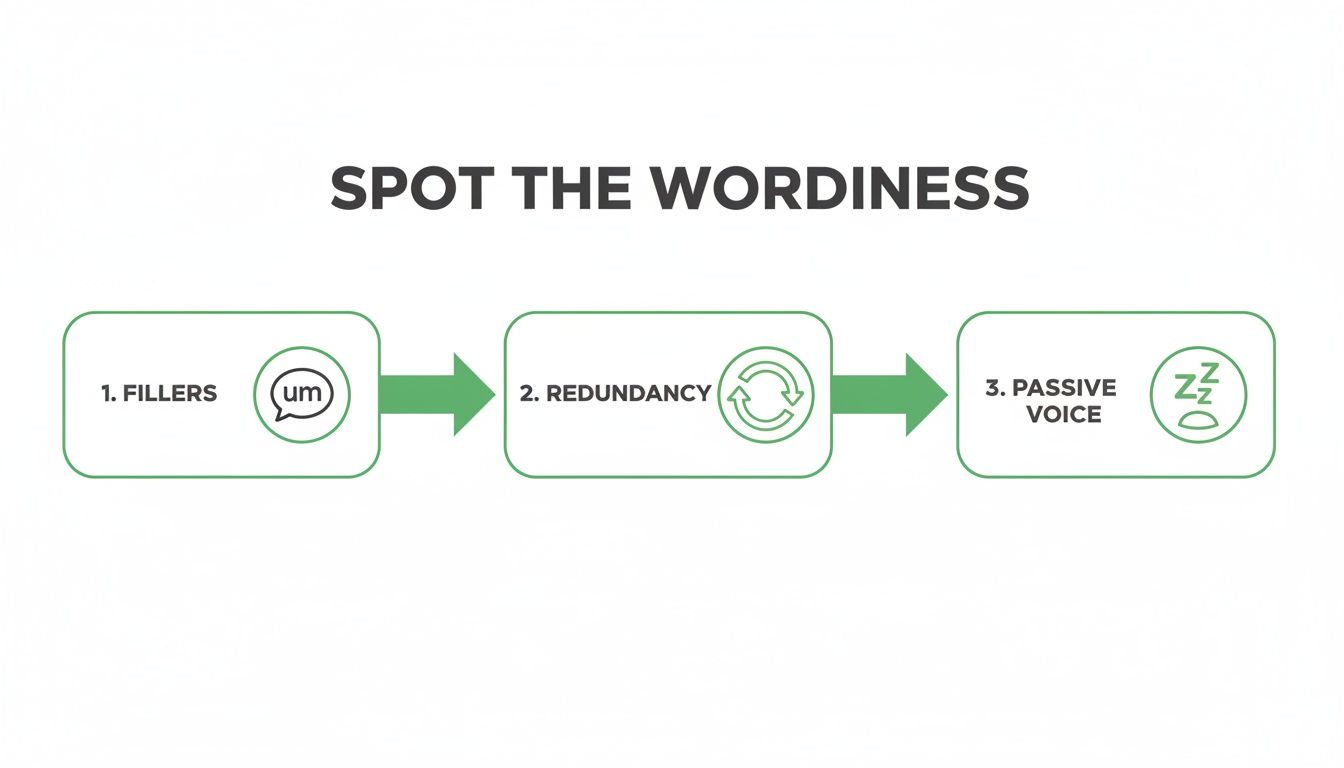
This visual guide helps you hunt down the three most common culprits that bog down your writing and make readers tune out.
Start with a Filler Word Hunt
The fastest win in tightening your writing is to slash filler words. These are the verbal tics that sneak into our drafts but add zero value, like really, just, basically, actually, and very.
Do a quick scan of your document for these suspects and delete them. You’ll be amazed at how much more confident your sentences sound. For example, "I'm really sure it's basically correct" instantly becomes the much stronger, "I'm sure it's correct."
Swap Lengthy Phrases for Powerful Words
Next, target clunky, multi-word phrases that can be replaced by a single, more potent word. Mastering this is a game-changer for concise writing. Why say something in four words when one will do?
Here are a few common offenders to watch out for:
- Instead of: "Due to the fact that"
- Use: "Because"
- Instead of: "In order to"
- Use: "To"
- Instead of: "At this point in time"
- Use: "Now"
Making these simple swaps immediately cuts your word count and cranks up clarity. This isn't just about style; research shows clear, concise writing can improve reader understanding by as much as 50%. For a closer look, you can explore the impact of effective communication on LucilleOssai.com.
Flip Passive Voice to Active Voice
One of the most effective ways to inject energy into your writing is by switching from passive to active voice. In the active voice, the subject is the one doing the action, making your sentences more direct.
It’s a simple fix that delivers a huge payoff.
- Passive: The new feature was announced by the marketing team.
- Active: The marketing team announced the new feature.
The active version is shorter, more direct, and has forward momentum. For a deeper dive into this and other crucial editing techniques, check out our complete guide to editing and revising your writing.
At PureWrite, we built our platform to help automate this process. Our AI text humanizer ethically refines AI-generated content, correcting wordiness and passive voice while preserving your authentic voice. Humanize Your AI Content with PureWrite and see how quickly you can make your content connect with your audience.
Conciseness In Action: Before And After Examples
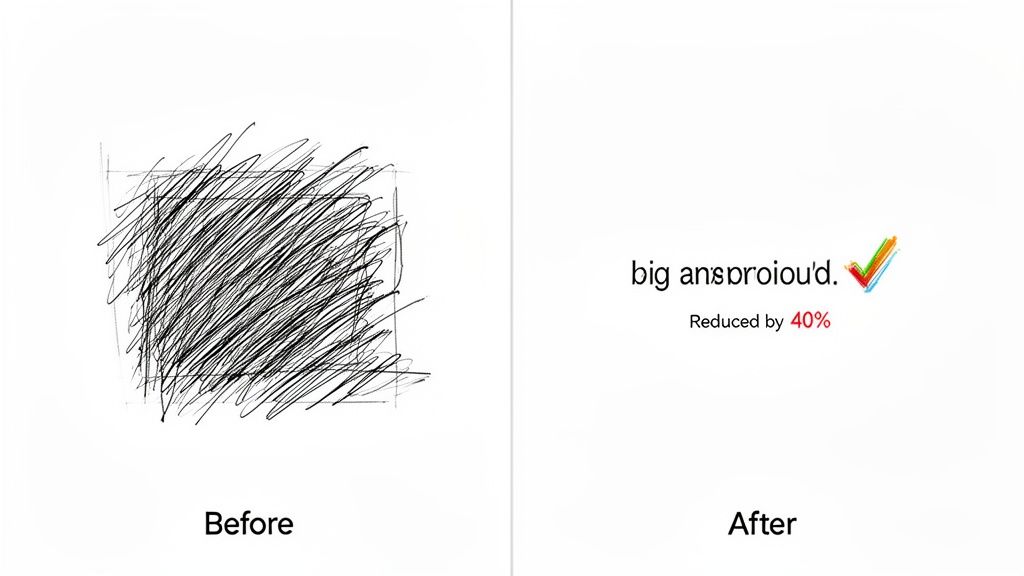
Theory is one thing, but seeing conciseness in practice is where the lightbulb really goes on. Let’s look at how a few quick edits can transform writing from clunky to clear. We’ll break down the why behind each change so you can start spotting these opportunities in your own work.
Transforming A Wordy Email
Emails are a classic breeding ground for fluff. We often pad them to sound formal or unsure, but this just buries the point and wastes everyone's time.
Before (61 words):
I am writing this email because I wanted to follow up on the proposal that was sent over to you last week for your review. It would be greatly appreciated if you could find some time in your busy schedule to take a look at it and provide us with any feedback you might happen to have at your earliest possible convenience.
After (21 words):
Following up on the proposal I sent last week. Please let me know if you have any feedback when you have a moment.
The Breakdown:
- Word Count Reduction: A huge 66% drop.
- Key Edits: We cut the obvious opening, "I am writing this email because," and swapped long-winded phrases like "at your earliest possible convenience" for the more natural "when you have a moment."
- Result: The new version is direct and respectful of the reader's time, yet still polite.
Sharpening A Blog Post Introduction
The first few lines of a blog post have one vital job: hook the reader. If your intro is bloated with filler, you'll lose them before they get to the good stuff.
Before (73 words):
In today’s world, it is absolutely essential for businesses of all shapes and sizes to have a very strong online presence. For this reason, content marketing has become an incredibly important strategy that you should definitely consider implementing. The purpose of this article is to explore some of the various different ways that you can go about using content marketing in order to grow your business and find more new customers.
After (25 words):
A strong online presence is essential for business growth. This article explores how to use content marketing to attract new customers and expand your reach.
The Breakdown:
- Word Count Reduction: A 65% reduction.
- Key Edits: We cut empty intensifiers ("absolutely essential") and redundant phrases ("various different ways"). The clunky "The purpose of this article is to explore" became a direct statement.
- Result: This intro gets right to the point. It tells you exactly what the article is about and what value you'll get from it. This is crucial if you're starting with an AI draft; learning how to rewrite AI-generated text is a core skill for producing clean, human-sounding content.
This is exactly what we focus on at PureWrite. Our tool is built to ethically find and trim the fat from your writing, helping you turn verbose drafts into crisp, engaging content. Humanize Your AI Content with PureWrite and see how easy it is to make every word count.
How PureWrite Helps You Master Concise Writing
Let's be honest: turning a clunky, AI-generated draft into concise prose can be a tedious chore. We built PureWrite to be your partner—one that helps you create clear, human-sounding content that genuinely connects with readers.
Our AI text humanizer gets to the root of what makes writing wordy, spotting and fixing awkward phrasing, redundant sentences, and weak verbs. PureWrite helps you put the principles of concise writing into practice instantly, turning verbose AI drafts into polished prose that still sounds like you.
From Verbose Drafts to Polished Prose
Instead of just pointing out mistakes, PureWrite actively refines your writing. Our tools automatically shorten tangled sentences, swap in stronger verbs, and cut filler words that dilute your message. It’s an ethical way to use AI that helps you produce better content, faster.
Writers using tools like ours can transform a wordy AI draft into a precise, human-like piece that keeps their unique voice, often cutting word count by 20-30% on average. This boosts readability and can increase acceptance rates for professional and academic work, ensuring your ideas have the impact they deserve.
An Ethical Partner in Your Writing Process
Our goal is to empower writers, not replace them. Think of PureWrite as an intelligent editor that catches the subtle mistakes and clumsy sentences you might miss, helping you preserve your authentic style. If you want to explore other tools that trim down sentences, it’s worth seeing what an effective AI paragraph rewriter can do.
PureWrite is a bridge between the efficiency of AI and the authenticity of human writing. We help you create content that is not only concise but also engaging and trustworthy, ensuring it passes AI detection and connects with your audience.
If you’re tired of wrestling with bloated drafts, we’re here to help. To see how our technology refines AI-generated text, take a look at our guide on using an AI text enhancer.
Ready to see the difference for yourself? Humanize Your AI Content with PureWrite and discover how simple it can be to tighten your writing and achieve real conciseness.
Wrapping Up: Your Concise Writing Questions, Answered
Let's tie everything together by tackling some common questions about conciseness. Think of these as practical speed bumps you might hit along the way. Getting them sorted out will help you edit with more confidence.
Does Concise Writing Make Your Work Boring?
Absolutely not. Conciseness is about impact, not simplicity. Fluffy, wordy writing is what bores readers by forcing them to dig for your point.
When you're concise, you choose more powerful verbs and precise nouns. Your sentences have energy and directness. That clarity is what grabs and holds a reader's attention, all while respecting their time.
Is It Possible to Be Too Concise?
Yes, you can take it too far. If you slash so many words that your message becomes blunt, choppy, or misses critical context, you've gone from editing to butchering. Concise writing is about being clear and complete in as few words as possible.
The goal isn't to remove everything you can, but to remove everything that isn't essential. Always ask yourself: "Does this word add real value?" If not, it's out.
Getting this balance right just takes practice. A great tip is to read your work out loud after editing. Your ear will catch any awkward, clipped phrasing that signals you may have trimmed too much.
How Does Conciseness Play into SEO?
From an SEO perspective, conciseness is a massive advantage. Search engines like Google are obsessed with user experience, and content that's easy to read and understand delivers a great experience.
Here’s how it helps you rank:
- Boosts Readability: Content that's easy to scan keeps people on your page longer, signaling to Google that your content is high-quality.
- Drives Engagement: When people "get" your message right away, they're more likely to stick around, click your links, or share your article.
- Sharpens Your Message: Clear writing makes it easy for search engine crawlers to understand what your page is about, which helps you rank for the right keywords.
What’s a Good Way to Practice Becoming More Concise?
Like any craft, it takes deliberate practice. A fantastic exercise is to set a timer for 10-15 minutes and just write without stopping or self-editing. This separates the creative part of your brain from the critical editor.
When the timer dings, then go back and revise with one mission: make it concise. Hunt down every filler word, passive verb, and redundant phrase. This two-step process—write freely, then edit ruthlessly—is how you train yourself to produce cleaner, tighter first drafts over time.
At PureWrite, we believe the best writing is clear, direct, and genuinely human. Our tool is designed to help you achieve conciseness without the struggle, turning clunky AI drafts into polished content that truly connects. Ready to make every word count?