Master Your Message: 10 Frequently Misused Words to Fix in 2025
In an age of AI-powered writing, it's easy to assume that small grammatical errors are a thing of the past. But for content creators, students, and professionals like you, precision is more important than ever. A single misplaced word can undermine credibility, confuse your message, and even signal to sophisticated algorithms that your content lacks a human touch.
At PureWrite, we believe in using AI ethically to enhance, not replace, genuine human communication. Even the most advanced models can stumble over the nuances of the English language, which is why a final human touch is essential. According to a recent survey, over 60% of consumers lose trust in a brand due to grammar or spelling errors in their content.
This guide dives into the most frequently misused words that often slip past both human editors and automated tools. We’ll provide clear examples and actionable tips to help you refine your drafts, ensuring your final piece is professional and authentically yours. Getting these details right not only boosts your authority but also improves how search engines interpret your content, a key aspect of Natural Language Processing (NLP) SEO.
1. Affect vs. Effect
Kicking off our list of frequently misused words is the classic pair: affect and effect. These two are often swapped, creating confusion in both professional and academic writing. Mastering the difference ensures your message is precise and impactful.
Affect is almost always a verb meaning "to influence" or "to produce a change in something." Think of it as the action. In contrast, effect is typically a noun meaning "a result" or "a consequence." It’s the outcome of an action.
The Core Distinction
The easiest way to remember the difference is with a simple mnemonic device: RAVEN.
- Remember
- Affect is a
- Verb
- Effect is a
- Noun
This simple acronym can help you make the right choice in seconds.
Examples in Action
Let’s see how this plays out for a content creator writing a marketing report:
Incorrect: The new policy will have a negative affect on productivity.
Correct: The new policy will have a negative effect on productivity. (Here, you're discussing the result).
Incorrect: How will the software update effect our workflow?
Correct: How will the software update affect our workflow? (Here, you're asking how it will influence the workflow).
Pro Tip for Writers: Try substituting affect with "influence" and effect with "result." If the sentence still makes sense, you've likely chosen the correct word. For example, "The new policy will have a negative result" works, confirming effect is correct.
While there are rare exceptions, sticking to the A=Action, E=End Result rule will keep your writing clear 99% of the time. Nailing basic grammar is fundamental to strong communication. For a deeper dive, explore the distinction between affect and effect and other grammar essentials.
2. Their vs. There vs. They're
Next on our list of frequently misused words are the classic homophones: their, there, and they're. These three sound identical but have completely different meanings, making them a common source of error that can make your writing seem rushed. Getting them right is a non-negotiable step toward professional communication.
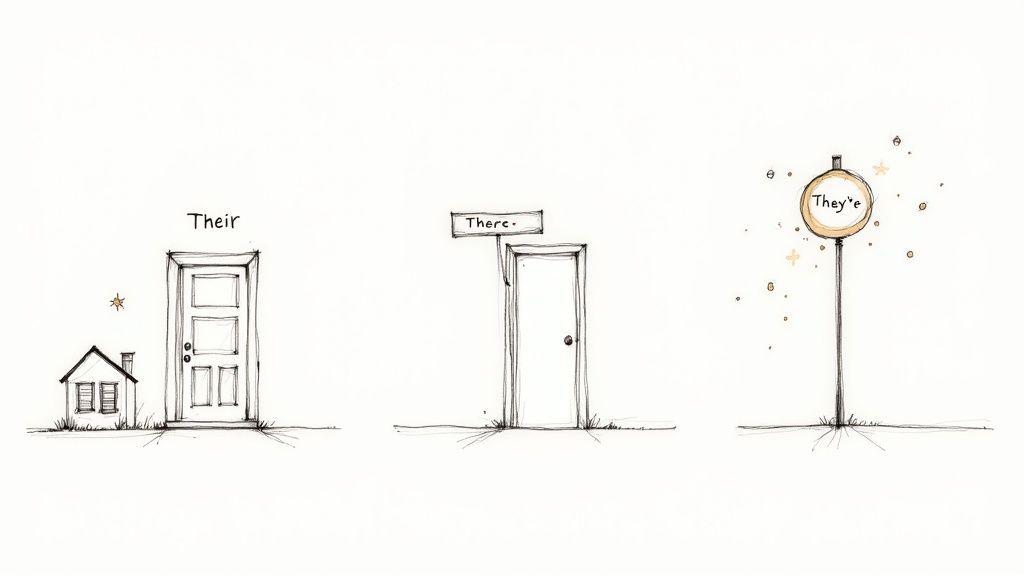
Their is a possessive pronoun; it shows ownership. There is an adverb indicating a place or can be used to introduce a sentence. Finally, they're is a contraction of "they are."
The Core Distinction
Understanding the function of each word is key. Here’s a simple breakdown to help you keep them straight:
- Their: Use this to show something belongs to people. Think of the "i" in their as a person, and this word always involves people's possessions.
- There: This word contains "here," which helps you remember it's about location (here or there). It can also point to the existence of something, as in "There is a problem."
- They're: The apostrophe is your clue. It signifies a missing letter ("a"), reminding you that this is a shortened form of "they are."
Examples in Action
Imagine you're a marketer drafting an email to your team:
Incorrect: The students left they're books over their.
Correct: The students left their books over there. (The books belong to them, so we need the possessive their. The location is "over there.")
Incorrect: There going to there house to get their keys.
Correct: They're going to their house to get their keys. (The first is an action, "they are going," so we use the contraction they're. The other two show possession.)
Pro Tip for Creators: When you see they're, mentally expand it to "they are." If the sentence reads correctly ("They are going to their house"), you've used it properly. This quick check is perfect for polishing blog posts and social media captions.
Mistakes with these words are easy to fix once you know what to look for. For more guidance on polishing your prose, explore our resources on effective writing techniques.
3. Your vs. You’re
Next on our list of frequently misused words are your and you’re. This common mistake often appears in digital communication and can unfortunately detract from an otherwise professional message, whether it's in an email to a client or a social media update. Understanding the difference is crucial for maintaining credibility.
Your is a possessive pronoun used to show that something belongs to "you." In contrast, you’re is a contraction of the words "you are." The apostrophe in you’re signals that the letter "a" has been removed.
The Core Distinction
The simplest way to get this right every time is to test the sentence. If you can substitute "you are" and the sentence still makes grammatical sense, then you’re is the correct choice. If it doesn't make sense, you need the possessive your.
- Your shows possession (e.g., your report, your strategy).
- You’re is a substitute for "you are" (e.g., you’re the best person for the job).
This simple check is a powerful tool to prevent one of the most common writing errors.
Examples in Action
Here’s a practical use case for a student emailing a professor:
Incorrect: I really appreciate you’re help on this project.
Correct: I really appreciate your help on this project. (The help belongs to you, so the possessive is needed. "You are help" is incorrect).
Incorrect: Let me know when your ready to leave.
Correct: Let me know when you’re ready to leave. (The sentence works perfectly if you say, "Let me know when you are ready to leave").
Pro Tip for Professionals: Read your sentence aloud. Saying "you are" in place of the word in question is often the quickest way to catch the mistake. Your ear can catch what your eyes might miss during a quick proofread of an important email.
Catching these small but significant errors is a hallmark of a careful writer. To refine your editing process further, consider exploring tools that improve writing clarity.
4. Its vs. It's
Next on our list of frequently misused words is a pair whose simplicity is deceptive: its and it’s. The confusion here stems from the apostrophe, which usually signals possession but, in this case, signals a contraction. Getting this right is a small detail that makes a big impact on your credibility.
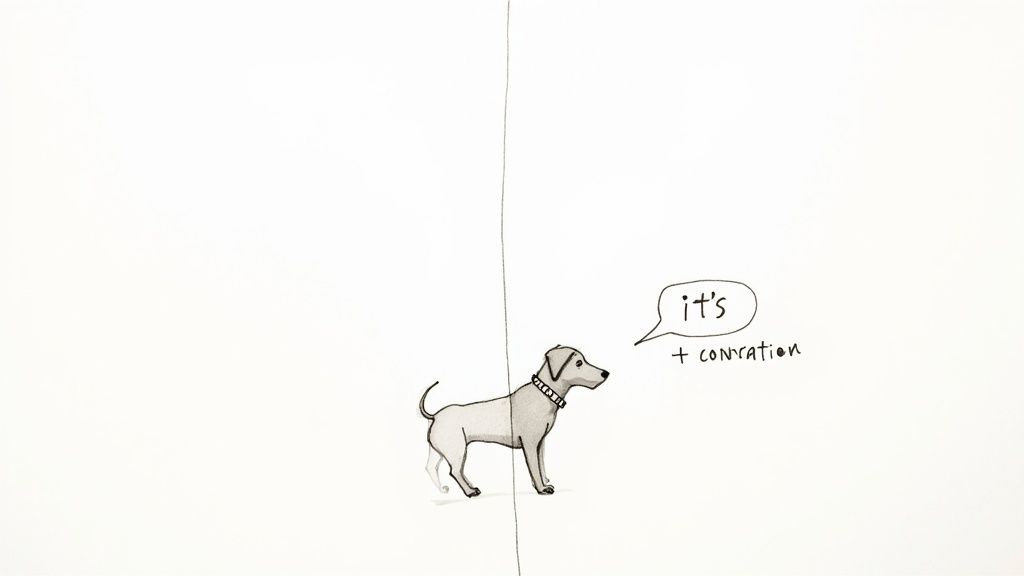
It's is a contraction of "it is" or "it has." The apostrophe takes the place of the missing letters. In contrast, its is a possessive pronoun, just like his or her, showing ownership. This is the exception to the rule that apostrophes show possession.
The Core Distinction
The most reliable way to choose correctly is to use the replacement test. Can you substitute "it is" or "it has" into your sentence?
- If "it is" or "it has" fits, use it's.
- If it does not fit, use its.
This quick check will solve the issue nearly every time you encounter it.
Examples in Action
A content creator describing a new software feature might write:
Incorrect: The dog wagged it's tail because its time for a walk.
Correct: The dog wagged its tail because it's time for a walk. (You can't say "the dog wagged it is tail," but you can say "it is time for a walk.")
Incorrect: Its important that the project meets its deadline because it's success matters.
Correct: It's important that the project meets its deadline because its success matters. (It is important, the project's deadline, the project's success).
Pro Tip for AI Users: AI writing tools sometimes incorrectly use possessives. Remember that possessive pronouns like his, hers, yours, and theirs never use an apostrophe. Think of its as belonging to this group to avoid this common AI error.
Mastering punctuation is a key step toward polished writing. For a deeper look, you can explore the details of proper capitalization and punctuation rules.
5. Accept vs. Except
Next on our list of frequently misused words are accept and except, two words whose similar sounds mask their completely different meanings. Confusing these terms can drastically alter the meaning of your sentence, making it essential for clear and professional communication to get them right.
Accept is a verb that means "to receive," "to agree to," or "to take on." Think of it as an action of welcoming something. In contrast, except is usually a preposition meaning "to exclude" or "apart from." It singles something out from a group.
The Core Distinction
The difference comes down to inclusion versus exclusion. Accept brings something in, while except leaves something out. A helpful way to remember this is to focus on the first letters:
- Accept = Agree or Add
- Except = Exclude
This simple association can guide you to the correct choice when you’re unsure.
Examples in Action
Here’s a use case for a project manager sending a team update:
Incorrect: All employees accept Tom should attend the mandatory meeting.
Correct: All employees except Tom should attend the mandatory meeting. (Here, Tom is being excluded from the group).
Incorrect: We are happy to except your generous offer.
Correct: We are happy to accept your generous offer. (Here, the offer is being received or agreed to).
Pro Tip for Professionals: Try replacing except with "with the exclusion of" or "but not." If the sentence makes sense, you've used it correctly. For example, "All employees, but not Tom, should attend" works, confirming except is the right word.
Mastering pairs like accept and except is a key step toward more precise writing. Tools like PureWrite can help you spot these subtle but critical errors, ensuring your message is always clear.
6. Compliment vs. Complement
A single vowel swap is all that separates compliment and complement, making this pair one of the trickiest on our list of frequently misused words. While they sound identical, their meanings are entirely different. Confusing them can change the entire meaning of your sentence, so getting this one right is crucial for clarity.
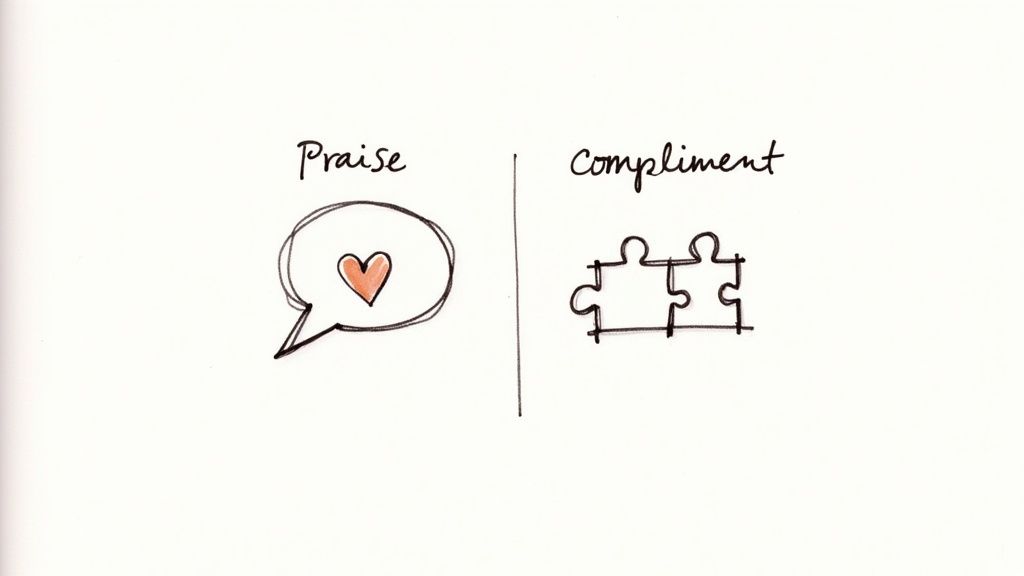
Compliment, with an "i," is a term of praise or admiration. Think of it as saying something nice. In contrast, complement, with an "e," means to complete, enhance, or go well with something. It's about two things fitting together perfectly.
The Core Distinction
An easy way to remember the difference is to focus on the middle letters:
- Compliment involves "I" and "me"—it's often about giving praise to a person.
- Complement helps to complete something else.
This simple association can help you quickly distinguish between the two and choose the right word every time.
Examples in Action
For a marketer writing ad copy, this distinction is key:
Incorrect: Your detailed analysis is a nice compliment to the visual data.
Correct: Your detailed analysis is a nice complement to the visual data. (Here, the analysis completes the data).
Incorrect: She paid me a lovely complement on my public speaking skills.
Correct: She paid me a lovely compliment on my public speaking skills. (Here, she offered praise).
Pro Tip for Content Creators: Think about the "i" in compliment as standing for an "individual" receiving praise. If you are praising someone, use the word with the "i." If you are talking about two things that go well together (like a product and a service), you need the "e" for complement.
For more guidance on similar word pairs, you can learn about the distinction between assure and ensure and other vocabulary nuances.
7. Lose vs. Loose
A simple typo that can instantly trip up a reader, the confusion between lose and loose is a common pitfall. Though they look and sound similar, their meanings are distinct. Getting this pair right is a small detail that significantly boosts your credibility and clarity.
Lose is a verb meaning "to fail to win," "to misplace," or "to be deprived of something." In contrast, loose is almost always an adjective meaning "not firmly fixed," "not tight," or "unrestrained." It describes the state of something.
The Core Distinction
The easiest way to remember the difference is to focus on the pronunciation and the number of "o"s.
- Lose (one 'o') sounds like it ends with a "z" sound. If you misplace something, it is lost (which also has one 'o').
- Loose (two 'o's) sounds like it ends with an "s" sound, like a goose. The extra "o" gives it room to be "loose."
This sound and spelling association is a quick mental check you can perform while writing.
Examples in Action
Here’s a practical example for anyone writing instructions or a guide:
Incorrect: Be careful not to loose your keys on the trail.
Correct: Be careful not to lose your keys on the trail. (Here, we need the verb for the action of misplacing something).
Incorrect: My shoelaces came lose during the race.
Correct: My shoelaces came loose during the race. (Here, we need the adjective to describe the state of the shoelaces).
Pro Tip for Writers: To check your usage, try this sentence: "Don't lose the loose screw." This phrase uses both words correctly and can help solidify their distinct meanings in your mind. If you remember this one example, you’ll master one of the most frequently misused words in English.
Sticking to the L-O-S-E = misplace and L-O-O-S-E = not tight rule will ensure your writing is correct virtually every time.
8. Then vs. Than
It's a common typo that can slip past even the most careful writers. The words then and than sound nearly identical, but swapping them can completely alter the meaning of a sentence. Because they serve entirely different grammatical functions, mastering this pair is crucial for clear and logical writing.
Then is an adverb that deals with time or sequence. It answers the question "when?" or "what's next?". In contrast, than is a conjunction used exclusively for comparison. It introduces the second part of a comparative statement.
The Core Distinction
The easiest way to keep these straight is to associate each word with its function. Think about the letters they contain:
- Then has an "e," like the word "time." It tells you when something happened.
- Than has an "a," like the word "compare." It is used for making a comparison.
This simple association can help you pause and choose the correct word, ensuring your comparisons and timelines are communicated accurately.
Examples in Action
For a professional writing a comparative analysis, this is critical:
Incorrect: I would rather eat pizza then salad.
Correct: I would rather eat pizza than salad. (Here, we are comparing two food options).
Incorrect: First, we will go to the store, and than we will go to the park.
Correct: First, we will go to the store, and then we will go to the park. (Here, we are describing a sequence of events).
Pro Tip for Students: If you're unsure, try substituting then with "at that time" or "next." Try substituting than with "compared to." If the sentence still makes sense, you've got the right one. This is a great final check for academic essays.
For more guidance on refining your prose and avoiding other frequently misused words, explore our full collection of writing resources.
9. Who vs. Whom
Navigating the difference between who and whom can feel like an outdated grammar puzzle, but it still holds weight in formal and professional contexts. Because modern English is shifting away from its use, whom is one of the most frequently misused words today, often making writers pause in uncertainty.
Who is a subject pronoun, meaning it performs the action in a sentence. In contrast, whom is an object pronoun, meaning it receives the action. Think of it this way: who does the action, while whom has the action done to it.
The Core Distinction
The most reliable way to get this right is to use a simple substitution test with other pronouns. This trick can instantly clarify which word you need.
- Who = He/She/They (subject pronouns)
- Whom = Him/Her/Them (object pronouns)
If you can rephrase the question and answer it with "he," "she," or "they," use who. If the answer is "him," "her," or "them," the correct choice is whom.
Examples in Action
Here’s a real-world example for professional correspondence:
Incorrect: Whom is coming to the party?
Correct: Who is coming to the party? (Test: He is coming to the party. He matches who.)
Incorrect: The award was given to the person who we admire most.
Correct: The award was given to the person whom we admire most. (Test: We admire him. Him matches whom.)
Pro Tip for Professionals: In a sentence like "To whom should I address the letter?", rearranging it helps. "I should address the letter to him." Since "him" is the correct pronoun, you know whom is the right choice. This simple rephrasing is a powerful editing tool.
While casual conversation often defaults to who, mastering whom for formal writing demonstrates precision. To explore this further, you can learn more about how pronouns function within different grammatical clauses.
10. Could of vs. Could Have
Next on our list of frequently misused words is a common error that stems from how we speak versus how we write: could of versus could have. This mistake is prevalent in informal communication and social media, but it can significantly undermine your credibility in professional or academic contexts.
Could have is a modal auxiliary verb phrase used to talk about past possibilities. Could of is a grammatically incorrect transcription of the spoken contraction "could've." The word of is a preposition and cannot function as a verb in this context.
The Core Distinction
This error happens because the contraction could've (which means could have) sounds very similar to "could of" when spoken aloud. The rule is simple: the word of should never follow a modal verb like could, should, or would. The correct word is always have.
To remember this, just say the contraction could've aloud. Recognize that the "'ve" is a shortened form of have, not of.
Examples in Action
This is a mistake AI writing tools often make, so human oversight is key:
Incorrect: I could of gone to the concert if I had saved more money.
Correct: I could have gone to the concert if I had saved more money. (Or, "I could've gone...")
Incorrect: We should of left earlier to avoid the traffic.
Correct: We should have left earlier to avoid the traffic. (Or, "We should've left...")
Pro Tip for AI Users: AI models learn from vast text data, including informal language where this error is common. Always proofread for "could of," "should of," or "would of" in AI-generated drafts and replace "of" with "have." This is a non-negotiable rule in standard English.
Eliminating this error is a quick way to make your writing appear more polished and professional. If you’re looking for more ways to polish your prose, you can learn how to improve English writing skills with other fundamental tips.
Quick Comparison: 10 Commonly Misused Word Pairs
| Item | 🔄 Complexity | ⚡ Resources / Effort | ⭐ Expected outcome | 📊 Ideal use cases | 💡 Key advantages / Tips |
|---|---|---|---|---|---|
| Affect vs. Effect | Beginner → Intermediate (verb vs. noun) | Low — brief practice & examples | Fewer noun/verb errors; clearer meaning | Academic, business, journalism | 'A' = Action; substitute "influence" for affect, "result" for effect |
| Their vs. There vs. They're | Beginner (three distinct functions) | Low — mnemonic drills & reading aloud | Eliminate common spelling/usage mistakes | Student essays, social posts, emails | Their = possession; There = place/existence; They're = they are (expand to check) |
| Your vs. You're | Beginner (possessive vs. contraction) | Low — quick substitution test | Stronger professional tone; reduced casual errors | Emails, social media, presentations | Replace you're with "you are" to test; use checklist when editing |
| Its vs. It's | Intermediate (possessive vs. contraction exception) | Moderate — deliberate proofreading practice | Correct apostrophe use; clearer technical writing | Technical docs, marketing copy, academic papers | Its = possessive (no apostrophe); it's = it is/has — try replacing to verify |
| Accept vs. Except | Intermediate (different meanings) | Moderate — contextual exercises | Accurate agreement/exclusion distinctions | Formal correspondence, reports | Except = exclusion (think "exception"); Accept = receive/agree |
| Compliment vs. Complement | Intermediate (minimal spelling difference) | Moderate — paired examples & mnics | Improved clarity in tone and meaning | Marketing, customer service, emails | Compliment = praise (i); Complement = completes (e) — use context (praise vs. complete) |
| Lose vs. Loose | Beginner → Intermediate (pronunciation + meaning) | Low — pronunciation mnemonics | Avoid oppositely different meanings; clearer writing | Sports writing, casual communication | One 'o' (lose) = verb; two 'o's (loose) = not tight; test by sounding out |
| Then vs. Than | Beginner (time/sequence vs. comparison) | Low — substitution tests | Correct sequencing and comparative statements | Narrative writing, comparisons in analysis | Then = when/next; Than = comparison — try replacing with "next/after" or "compared to" |
| Who vs. Whom | Advanced (subject vs. object; formal usage) | Higher — grammatical substitution practice | Proper formal tone in academic/professional writing | Formal letters, academic papers, legal writing | Replace with he/him: he→who, him→whom; in doubt, use who in casual contexts |
| Could of vs. Could Have | Beginner → Intermediate (contraction confusion) | Low — contraction awareness training | Remove high-impact informal errors; professional correctness | All professional and academic writing | "Could of" is always incorrect; use "could have" or "could've" — write out when unsure |
Elevate Your Writing with Human-Centric AI
Mastering these ten frequently misused words is more than just an academic exercise; it's a fundamental step toward becoming a more precise, credible, and impactful communicator. Each error, no matter how small, can distract your reader and erode the authority you’ve worked so hard to build. In content marketing, academic writing, and professional correspondence, that clarity is non-negotiable.
Why does this level of detail matter so much? Because precise language shows respect for your audience. When you take the time to choose the correct word, you're telling your reader that their understanding is your top priority. This commitment to quality builds trust and engagement, ensuring your ideas are not just read but truly absorbed.
Bridging the Gap Between AI Drafts and Polished Prose
This is where the ethical application of technology becomes a game-changer. Modern AI writing tools are incredibly powerful, but they are not infallible. They can still stumble over the nuanced, context-dependent rules that govern human language. This is why a human-centric approach is critical for creating authentic and trustworthy content.
At PureWrite, we believe AI should serve the writer, not replace them. Our platform is designed to be your intelligent editor, catching the very slip-ups we've discussed. But we go a step further by focusing on the human elements of writing: flow, tone, and authenticity, helping you transform a functional AI draft into a final piece that connects with your audience.
The technology behind these advancements is fascinating. The field of Natural Language Processing is what allows tools like ours to interpret and analyze human-like text, identifying subtle errors a basic spell-checker would miss. This is how we help you humanize AI-generated drafts so they resonate on a deeper level.
By integrating a tool like PureWrite into your workflow, you create a powerful system of checks and balances. You can leverage AI for speed while relying on our specialized platform to ensure the final output is polished, accurate, and authentically yours. You're not just fixing frequently misused words; you're elevating your entire communication strategy.
Ready to eliminate common errors and ensure your AI-assisted writing is clear, professional, and authentic? Pure Write is designed to catch these nuanced mistakes and help you humanize your message with precision. Try Pure Write today to experience the confidence that comes from flawless, human-centric content.