Does Turnitin Check for AI? A Practical Guide for Creators and Students
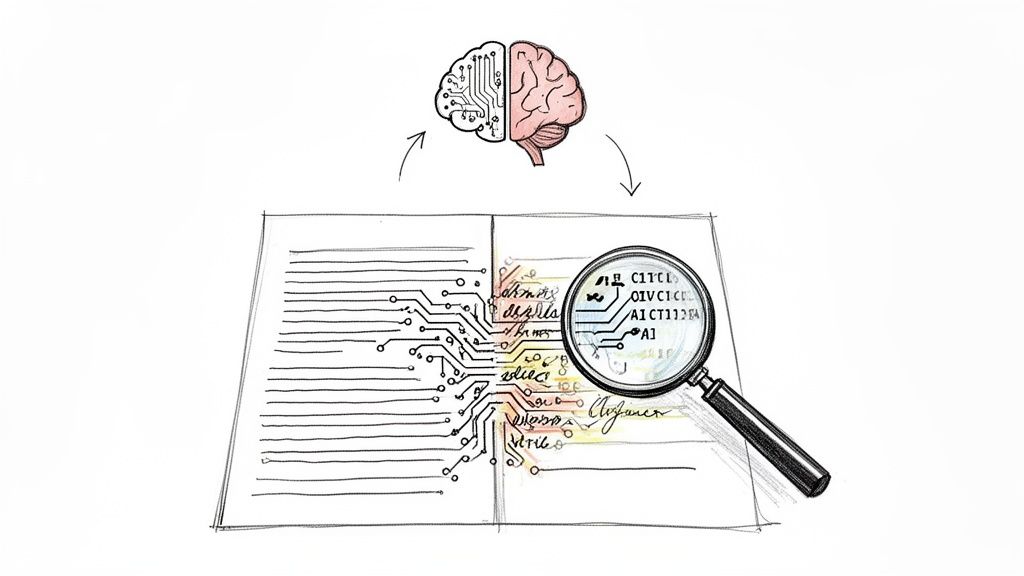
Yes, Turnitin actively checks for AI. Its software includes a built-in detector that scans submissions for the unique patterns of AI-generated text. It then provides instructors with a report highlighting the probability that a tool like ChatGPT was used, making it a standard part of academic integrity checks.
For content creators, students, and professionals, this isn't a roadblock—it's a new reality. Understanding how this technology works is the first step toward using AI tools ethically and effectively.
Understanding Turnitin's Role in AI Detection
If you're using AI assistants in your workflow, you need to understand what Turnitin can and cannot do. The focus has shifted from simple copy-paste plagiarism to demonstrating that your work is genuinely yours, even if you used AI for brainstorming or drafting.
Turnitin officially launched its AI detection feature in April 2023. It's now used by over 16,000 institutions to review more than 65 million papers annually. These staggering numbers, discussed in detail in Turnitin's widespread adoption and impact on RealTouchAI, show how critical this tool has become in modern writing and education.
Why This Matters for Your Writing
The presence of AI detection means you must approach your writing process with more intention. The goal isn't to "beat the system" but to use AI tools as ethical partners that enhance your authentic voice and ideas.
Here’s our practical advice for any creator or student:
- Treat AI as an Assistant: AI is brilliant for generating ideas, structuring an outline, or producing a rough first draft. However, you should never submit unedited AI output as your own final work.
- The Human Touch is Everything: Your most important job is to weave in your unique insights, add personal examples, and rewrite the text in a style that is recognizably yours. This step is non-negotiable for authentic writing.
- Originality is Still King: Your final submission must be a product of your own intellect. AI should be a launchpad, not the entire rocket.
This table breaks down the core functions of Turnitin's AI detector and what they mean for you.
Turnitin AI Detection at a Glance
| Feature | What It Means for You |
|---|---|
| Probability Score | You receive a percentage, not a simple "yes" or "no." This score requires context, as even human writing can sometimes trigger a low score. |
| Sentence-Level Analysis | The tool highlights specific passages it suspects are AI-generated, showing you precisely where to focus your editing and humanization efforts. |
| No "Foolproof" Guarantee | Turnitin acknowledges that false positives can occur. Instructors are advised to use the score as a conversation starter, not a final verdict. |
| Focus on Writing Patterns | It flags predictable sentence structures and common word choices typical of AI. You can address this by infusing your unique voice and style. |
Focusing on these principles will help you navigate this landscape with confidence. A tool like PureWrite can be your ally here. By pasting your AI-assisted drafts into our platform, you can transform your text into something polished, original, and authentically human. Try PureWrite today to ensure your content reflects your true voice.
How Turnitin's AI Detection Actually Works
To understand how Turnitin checks for AI, you have to look beyond traditional plagiarism detection. It no longer just scans for copied text; it now analyzes the very DNA of the writing itself to identify machine-like patterns.
The algorithm is trained on a massive dataset of both human and AI-generated text. This training enables it to recognize the subtle, almost invisible hallmarks that distinguish one from the other.
Think of it like an art expert authenticating a painting. A human writer leaves unique "brushstrokes"—varied sentence lengths, nuanced phrasing, and a distinct voice. AI, in contrast, often produces text that is a bit too perfect and uniform, and that clean consistency is a major giveaway.
Looking for AI's Digital Footprint
Turnitin's system is trained to focus on key traits common in AI-generated content. Knowing what these are is your first step to creating work that won't be flagged.
Here are the main signals the detector looks for:
- Predictability: AI models are designed to choose the most statistically probable next word. This often leads to text that feels safe and predictable, lacking the creative leaps a human writer makes.
- Uniformity: You'll often notice sentences of similar length and structure in AI drafts. This unnatural consistency is a red flag, as human writing has a natural rhythm that varies.
- Lack of Personal Voice: This is a critical one. AI cannot fake a genuine human voice, weave in authentic personal stories, or offer the unique insights that make your writing sound like you.
At its core, AI writing often lacks what experts call "perplexity" and "burstiness." These are just technical terms for the beautiful, unpredictable nature of human expression. We naturally mix simple and complex sentences, and our word choices can be wonderfully surprising.
It's a Game of Probabilities
A crucial point to remember is that Turnitin provides a probability score, not a definitive "yes" or "no" verdict. It reports the likelihood that parts of the text were written by AI.
This distinction is important because it acknowledges the technology isn't perfect. For a deeper analysis of the data behind these tools, our guide on whether AI detectors are accurate offers valuable insights.
This probabilistic approach means an instructor receives a report highlighting sentences that appear AI-like, not a definitive accusation. Your job as a writer is to infuse your work with so much of your own style and analysis that the probability of it being flagged becomes negligible. That’s exactly what we help you do at PureWrite—we refine AI-assisted drafts into polished, human-centric writing that passes muster.
The Truth About Turnitin's AI Detection Accuracy
So, we've established that Turnitin checks for AI. The next critical question is, "How accurate is it?" The honest answer is that it's complicated. While the detector is adept at spotting raw, unedited AI text, its reliability decreases with heavily edited or nuanced writing.
The system's biggest challenge is the issue of false positives—when human-written text is wrongly flagged as AI-generated. This is a significant problem, as it can cause unnecessary stress for students and creators. A 2023 Stanford University study found that AI detectors often incorrectly flag text written by non-native English speakers.
The Problem of False Positives
Why do false positives happen? A writer's natural style, especially if it's very formal or follows a rigid structure, can sometimes mimic the patterns AI detectors are trained to find.
This flowchart illustrates what Turnitin's AI detector analyzes when scanning a document.
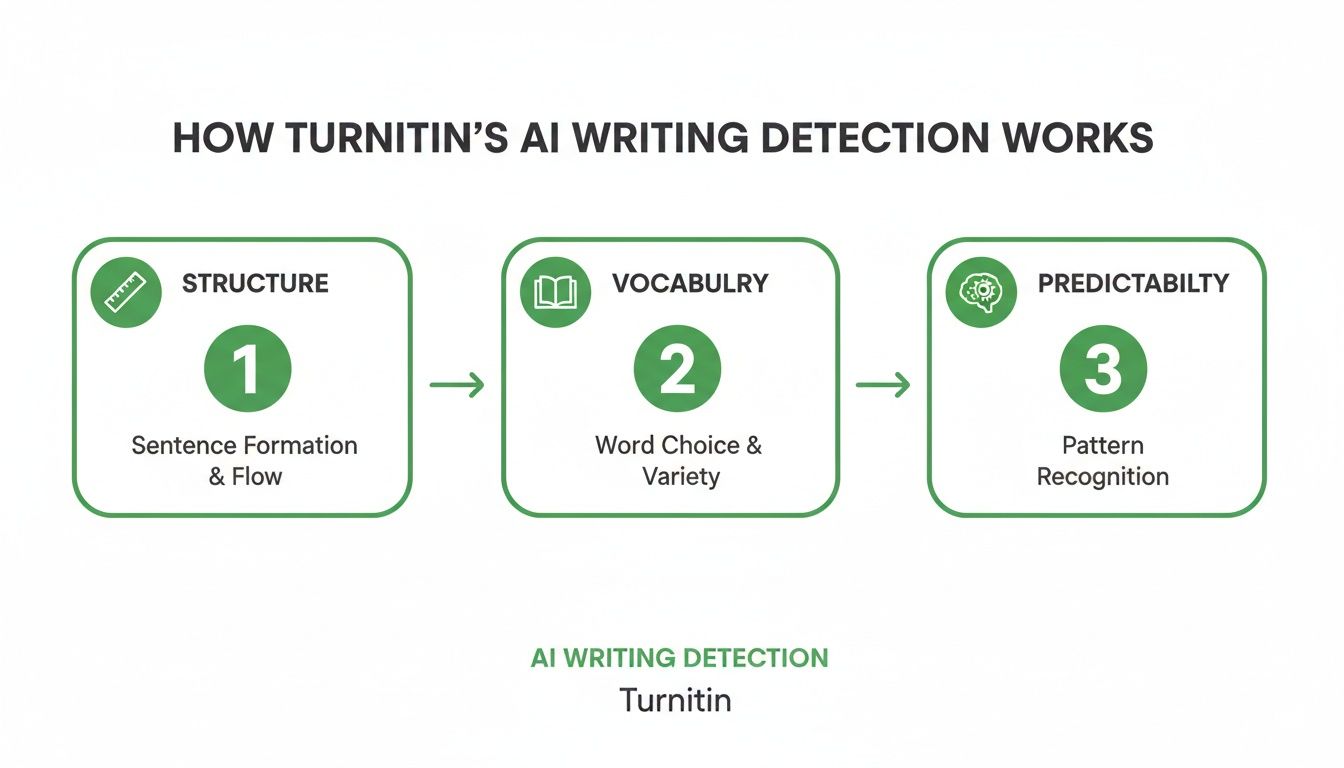
As you can see, it focuses on structure, vocabulary, and predictability. These are the exact areas where human and AI writing can overlap, leading to potential errors.
Turnitin has acknowledged these limitations, which is why it updated its system in July 2024 to hide any score below 20% from instructors. This change aims to reduce the number of baseless accusations based on low-confidence flags.
The key takeaway for you is this: a high AI score is not a verdict. It is a data point that requires human interpretation and should be used to start a conversation, not end one.
Navigating the Nuances
Understanding these limitations is half the battle. Your goal should not be to "trick" the system, but to produce work that is so authentically you that its origin is never in question. When you focus on developing a strong voice and weaving in unique insights, you naturally create something a machine cannot replicate.
This is exactly where we at PureWrite can help. Our platform is designed to help you take an AI-assisted draft and refine it into polished, human-sounding content.
- Humanize Your Text: We help you adjust the tone and word choice to remove the stiff, robotic feel of AI writing.
- Improve Readability: Our tools guide you in varying your sentence structures to create a more natural and engaging flow.
- Ensure Originality: By making the draft truly your own, you significantly lower the chances of it being flagged while upholding ethical standards.
By understanding what a Turnitin percentage score really means, you can prepare your work for submission with confidence. Give it a try—paste your next draft into PureWrite and see how we can help you bridge the gap between AI efficiency and authentic human expression.
Ethical Ways to Use AI Writing Tools
Let's be clear: your goal should never be to "beat" or "trick" a tool like Turnitin. Instead, the real victory comes from shifting your mindset. You should think of AI as a powerful assistant, not a ghostwriter who does the work for you.
Your unique voice, critical thinking, and personal experiences are what give your writing value. No AI can replicate that. When you learn to use AI as a collaborative tool, you build the best possible defense against any misconduct allegations.
Adopt an AI-Assisted Workflow
The smartest, most ethical way to use AI is to integrate it into a human-driven process. For example, a marketing team could use AI to generate 10 blog post ideas and outlines. A writer then takes the best one and uses their expertise to write an original, insightful article based on that structure.
Here’s a practical workflow you can follow:
- Brainstorm and Outline with AI: Use a tool like ChatGPT to explore topic ideas, find different angles, or create a basic outline. This helps you conquer the blank page.
- Generate a Rough Draft: Let the AI produce the first pass. Treat this output as raw clay—a starting point, and nothing more.
- Humanize and Make It Yours: This is where you take full ownership. You need to heavily rewrite, edit, and inject your own voice, analysis, and style. This is about fundamentally reshaping the text, not just changing a few words.
Inject Your Human Signature
To make content undeniably yours, you must add the elements an AI cannot. For instance, a professional sharing a case study can add specific, real-world data and a personal reflection on the project's outcome—details an AI could never invent.
Here are a few powerful ways to do this:
- Share a Personal Story: Weaving in a relevant personal anecdote or professional experience immediately adds a layer of authenticity.
- Add Your Own Analysis: Go beyond the information the AI provided. What are your unique insights? Can you connect ideas in a new way or challenge a common assumption?
- Vary Your Sentence Rhythm: AI text often has a monotonous rhythm. Consciously mix short, punchy sentences with longer, more descriptive ones to create a natural and engaging flow.
- Let Your Voice Shine Through: Ensure the final piece sounds like you. Whether your tone is witty, formal, or conversational, it should be consistent throughout your final edit.
This approach is more than just a good idea; it's an effective strategy. While basic paraphrasing might slightly lower AI detection scores, one study showed that adding personal anecdotes can drop the average AI score to just 16.8%. For students seeking to use these tools responsibly, exploring strategies for effective AI homework help is a great next step.
By adopting this workflow, you move from being a passive user to an active creator. This is the philosophy we champion at PureWrite. Our tool is built for that crucial final stage—helping you transform a generic AI draft into something polished, original, and authentically yours. To learn more, check out our guide on how to avoid AI detection.
How PureWrite Humanizes Your AI Content
You've used AI to get a first draft on the page. Now comes the most important part: transforming that robotic text into content that sounds genuinely human. This is precisely where we designed PureWrite to help, bridging the gap between AI's speed and the nuance of your voice.
Our goal is not to help you "trick" a detector. It's to help you create better, more original work that authentically reflects your ideas. We focus on improving the very things AI often struggles with—tone, clarity, and unique voice. When you get these right, your writing won't raise red flags.
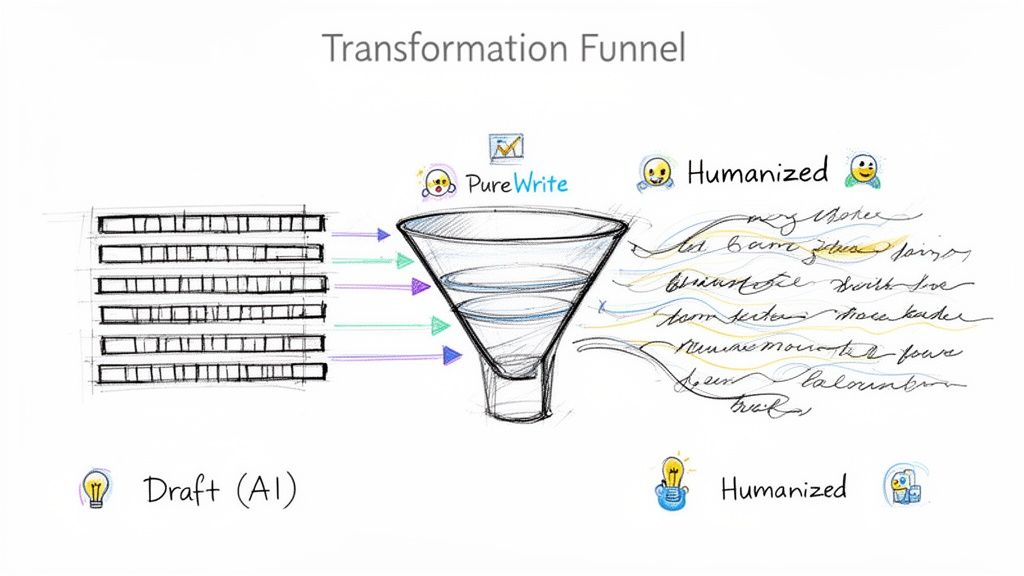
The process is simple. You paste your AI-generated text on the left, and our 'Humanize' feature instantly refines it into natural, flowing prose on the right, complete with clear readability scores to guide your edits.
Getting Rid of That Robotic Feel
Let's be honest: raw AI text often feels stiff and predictable. It's built on common sentence patterns and statistically likely word choices—the exact digital fingerprints that AI detectors look for. PureWrite is designed to tackle this directly.
Our platform helps you:
- Mix Up Your Sentences: We intelligently rework your sentence structures to create a more natural rhythm, blending short statements with more complex ones.
- Find Better Words: Our system suggests more precise and engaging vocabulary, moving beyond the generic words that AI models often overuse.
- Make it Easy to Read: We help you clarify your writing so your message connects powerfully with your readers.
By using PureWrite, you can instantly refine your text to improve its tone and flow while preserving your core message. This is a game-changer for content marketers, students, and any professional who needs to produce high-quality writing efficiently.
Your Co-Editor for Authentic Writing
Think of PureWrite as your personal writing co-editor. We're here to empower you, helping you take full ownership of your AI-assisted drafts and elevate them to a higher standard. When you prioritize quality and originality, your final work becomes a genuine reflection of your effort.
Our philosophy is simple: AI should assist, not replace. The final piece must be driven by your unique perspective. We provide the tools to make that humanization process faster and more effective.
Ready to see the difference? Paste your AI draft into PureWrite and watch it transform into polished, natural writing that connects with readers and stands up to scrutiny. For more strategies, check out our guide on using an AI text enhancer.
FAQ: Your Questions About Turnitin and AI, Answered
Let's cut through the noise. When it comes to Turnitin and AI detection, you probably have some specific questions. We've designed this FAQ to give you straightforward, practical answers to the most common concerns we hear from creators and students.
Think of this as your quick-reference guide for navigating AI writing tools responsibly.
Can Turnitin Detect Specific AI Models Like ChatGPT?
Yes, but it doesn't single out specific models. Turnitin's detector is trained to identify the hallmarks of machine-generated text, regardless of whether it comes from ChatGPT, Gemini, or another AI. It's not looking for a "ChatGPT signature."
Instead, it analyzes linguistic patterns like predictable sentence structures and a lack of human-like variation. This is why switching AI models won't fool the system. The key isn't finding an "undetectable" AI; it's learning to genuinely make the text your own.
What Is a "Good" AI Score on Turnitin?
There is no universal "safe" score, as each institution sets its own policies. However, it's significant that Turnitin now hides scores under 20% from an instructor's primary view, suggesting this range is generally considered low-risk.
Remember, the score is just one data point. The most important thing is to understand your institution's specific policy on upholding academic integrity and use AI as a tool for assistance, not replacement.
Does Simply Paraphrasing AI Content Work?
Not effectively. Simply swapping words or rephrasing sentences is a surface-level fix that modern detectors can often see through. They analyze deeper patterns in rhythm and style that basic paraphrasing doesn't address.
True humanization is a complete overhaul. It means rewriting sentences, injecting your unique analysis, and restructuring the text so it flows with your voice, not the AI's.
This is where a dedicated tool can make a significant difference in your workflow.
Can a High AI Score Get Me in Trouble?
A high AI score is not an automatic guilty verdict. It's a red flag that should prompt a conversation. Most educators are trained to use the score as a starting point to discuss your writing process, not as definitive proof of misconduct.
The best way to handle this situation is to be prepared to discuss how you used AI as a tool and show your work, such as research notes and early drafts. This reinforces the importance of using AI as an assistant, not a ghostwriter.
FAQ
Need a quick answer? Here’s a summary of the most common questions we get about Turnitin’s AI detection.
| Question | Answer |
|---|---|
| Does Turnitin detect specific AIs like ChatGPT? | It detects the patterns of AI writing common to all models, not a specific AI's signature. |
| What's a safe AI score? | There's no universal number, but scores under 20% are often considered low-risk by Turnitin itself. Always check your school's policy. |
| Can I just paraphrase AI text? | No. Simple paraphrasing doesn't remove the underlying AI patterns that detectors look for. |
| Is a high AI score proof of cheating? | Not on its own. It’s an indicator that prompts a discussion with your instructor. Human judgment is the final step. |
Hopefully, these answers give you the clarity and confidence to use AI writing tools smartly, ethically, and effectively.