How to Write an Essay Rough Draft: A Practical Guide for Creators
An essay rough draft isn't just a messy first attempt; it's your creative sandbox. This is the crucial first step where you can freely explore ideas, map out arguments, and discover what you really want to say—without the pressure of perfection.
For content creators, students, and professionals alike, mastering the draft is the key to producing authentic, high-impact writing.
Why Your Essay Rough Draft Is a Strategic Advantage
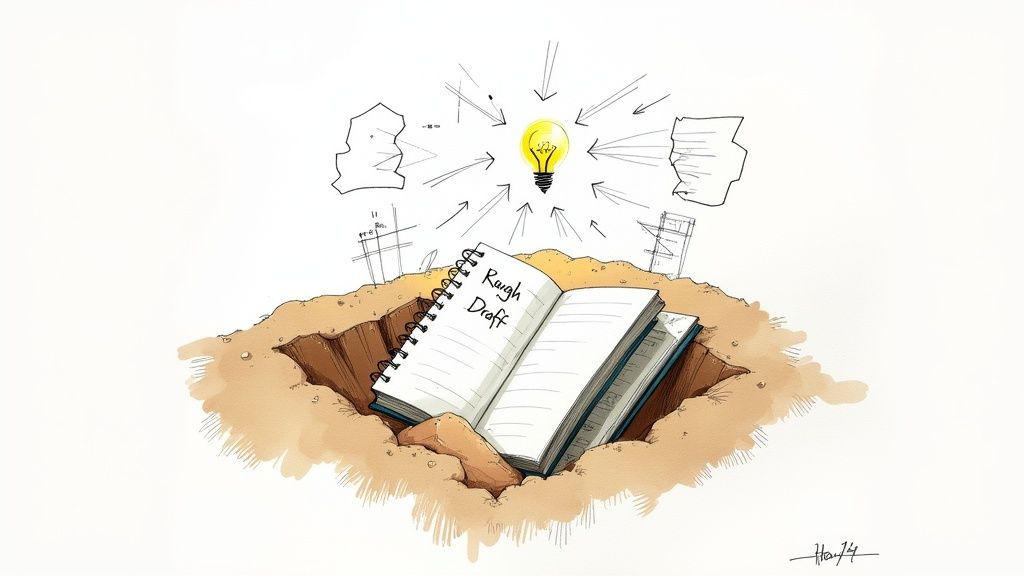
Let's be honest: the term "rough draft" often sounds like a disorganized, painful chore. But viewing it this way misses its strategic purpose. This is your private workspace to make mistakes, test theories, and connect ideas to see what works.
Embracing this "roughness" is your biggest advantage because it's where the real thinking happens. The goal isn't a polished masterpiece; it's simply getting your thoughts out of your head and onto the page.
Shifting Your Mindset From 'Messy Chore' to 'Strategic Tool'
To truly leverage the drafting stage, you must reframe how you think about it. It’s not an obstacle to overcome; it's the launchpad for your best work.
| Common Misconception | Strategic Purpose |
|---|---|
| It’s just a formality before the real writing. | It is the real writing—the exploration part. |
| It needs to be coherent and well-structured. | Its purpose is to find the structure. |
| Mistakes and bad ideas are signs of failure. | Mistakes are how you discover the good ideas. |
| You should try to make it as good as possible. | The only goal is to get words on the page. |
Once you see the draft as a tool for discovery, the entire process becomes less intimidating and far more productive.
What a First Draft Is Really For
The pressure to write a perfect essay from the start is a leading cause of writer's block. The truth is, that's not how great writing happens. According to one former admissions counselor, a staggering 90% of application essays are unremarkable, often because they feel like unrevised first drafts.
That’s a powerful reminder: the draft is for you, not for your reader. It's there to help you:
- Discover Your Argument: You often don't know exactly what you think until you try to write it down.
- Organize Your Thoughts: It's your chance to see how your points fit together and identify gaps in your logic.
- Build Momentum: Getting something on the page, no matter how imperfect, creates forward motion.
The struggle to get started is a major reason the academic writing service market is projected to hit $10.5 billion by 2035. Writers are looking for a way past that initial hurdle.
Your first draft is a beginning, a necessary first step in a long process that culminates in bringing your unique vision to life. It’s the lump of clay before it becomes a pot—essential and full of potential.
Cultivating an Ethical and Authentic Voice
While using AI writers to generate a first draft is tempting, it often leads to generic text that lacks your unique spark. Ethical AI usage means leveraging technology as a partner, not a replacement for your own critical thinking.
At PureWrite, we believe in using AI to refine your work. Once you have your ideas down, you can use our tool to humanize your draft, improve its clarity, and ensure it truly sounds like you. For more on this, check out our guide on what is academic integrity.
Building Your Blueprint Before You Start Writing
The best essays are rarely written by just diving in. The real magic happens in the planning stage. Trying to write without a clear direction is a classic recipe for writer's block and wasted time.
Think of this prewriting phase as creating a blueprint for your essay. It’s not about stifling creativity; it’s about giving that creativity a solid structure to build upon.
Uncovering Your Ideas with Prewriting Techniques
Before you can build an argument, you need raw materials. Prewriting is about freely exploring your topic to see what ideas you can uncover.
Two of the most effective methods for this are freewriting and mind mapping. They help you get past that initial "blank page" fear.
- Freewriting: Set a timer for 10-15 minutes and just write. Don't stop to edit or second-guess yourself. The goal is a continuous flow of thought to uncover unexpected connections.
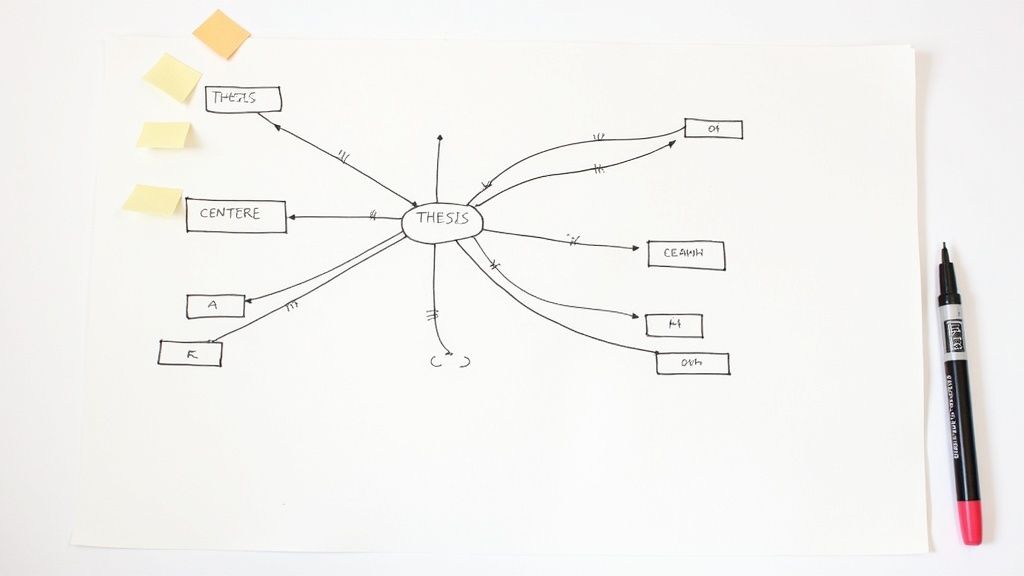
- Mind Mapping: For a more visual approach, put your main topic in a circle in the middle of a page. Draw lines out to related ideas, keywords, and evidence to see how concepts connect organically.
You don't have to choose just one. A content creator might start with freewriting to brainstorm blog post ideas, then use a mind map to structure the chosen topic into sections.
Think of prewriting as gathering your raw materials. You wouldn't start building a house without lumber, bricks, and a plan. Similarly, you shouldn't start drafting an essay without your core ideas, evidence, and a clear direction.
From Brainstorm to Outline
Once you have a collection of ideas, it's time to give them structure with an outline. An outline is a flexible roadmap that guides your writing and ensures your points flow logically.
At a minimum, your outline should contain three key elements:
- Your Thesis Statement: The core argument of your essay in one or two clear sentences.
- Main Supporting Points: The three to five key ideas that will become your body paragraphs.
- Key Evidence: Specific facts, examples, or data you'll use to back up each point.
Spending time on a detailed outline pays off hugely during drafting. For larger projects, a good research project planning template can help you map everything out from concept to final draft.
With this blueprint in hand, writing your essay rough draft becomes about articulating ideas you've already organized. This preparation frees you to write with confidence.
How to Write Your Draft Without Hitting a Wall
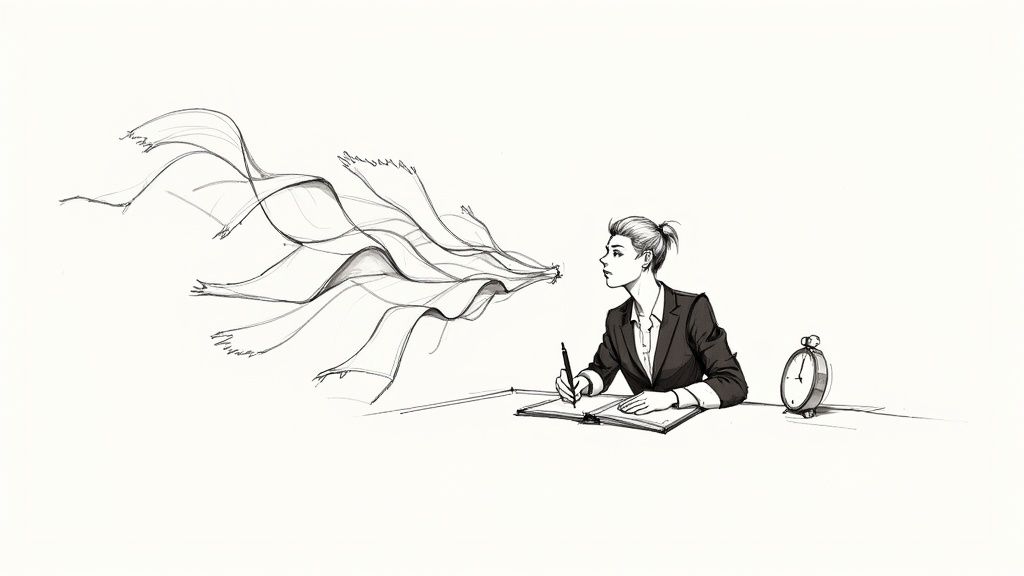
You have your blueprint; now it's time to start building. Your number one goal during this stage is momentum, not perfection. Your inner editor should take the day off.
The trick is to get all your ideas onto the page as quickly and freely as possible. This "fast drafting" approach means ignoring the urge to find the perfect word or sentence structure.
Start with the Body Paragraphs
This may sound counterintuitive, but one of the best ways to find your writing rhythm is to skip the introduction for now. Trying to craft the perfect opening hook right away can be paralyzing.
Instead, dive into the meat of your essay—the body paragraphs. Since you already know your main points from your outline, you can focus on building a solid foundation for your argument.
Embrace Imperfection with Placeholders
Nothing kills your flow like stopping to look up a date, find a statistic, or track down a quote. To maintain momentum, use simple placeholder notes directly in your text.
For example, a marketer drafting a report might write:
[Insert Q4 sales growth statistic here][Add a better transition to the competitor analysis section][Flesh out this customer testimonial with more detail][Check exact wording of the CEO's quote from the press release]
These markers let you flag a gap without derailing your writing session. You can easily search for these brackets later during the revision stage.
Think of your first draft as a discovery process. You're not just transcribing a finished essay from your mind; you're actively figuring out what you want to say as you write. Give yourself the freedom to explore without judgment.
Use Technology as a Smart Assistant
Writing platforms have become incredibly helpful tools. It's no surprise that the market for them, valued at $1.8 billion in 2023, is expected to reach $4.5 billion by 2032. Features like AI suggestions and templates can genuinely speed up the drafting process.
Here at PureWrite, we see AI as a partner to refine your work, not replace your voice. Once you have your rough ideas on the page, our tool can help you humanize the text, boost clarity, and ensure your writing connects with your reader.
And if you do find yourself stuck, learning a few strategies for overcoming writer's block can provide the push you need. Combining these techniques with a smart drafting plan will help you produce a solid first pass.
Common Rough Draft Mistakes and How to Avoid Them
Every writer falls into the same traps when drafting. Spotting these pitfalls early is the key to a smoother process and a much stronger final piece of content.
One of the biggest momentum killers is editing as you write. Constantly stopping to fix a typo or rephrase a sentence forces your brain to switch between creative and analytical modes, which is exhausting and grinds your flow to a halt.
Stopping the Cycle of Self-Editing
The purpose of a rough draft is to get your ideas on the page, not to write a masterpiece. You must give yourself permission to be messy. Resisting the urge to self-censor allows you to freely explore connections and build arguments.
A practical trick is to change your text color to white or dim your screen for a few minutes. When you can't see the words, you stop obsessing over them and simply write.
Another huge time-waster is falling down the research rabbit hole. Stick to your plan and use placeholders like [find statistic here] to mark spots where you need more info. Keep the drafting session focused on drafting.
Fortifying Your Essay's Foundation
A weak or vague thesis statement is like building a house on a shaky foundation. If your core argument isn't clear and debatable, your paragraphs will wander aimlessly.
- Weak Thesis: "AI writing tools are important for content creators." (This is a fact, not a debatable argument.)
- Strong Thesis: "For content creators, the true value of AI writing tools lies not in generating first drafts, but in accelerating the research and revision process." (This is specific, debatable, and provides clear direction.)
This foundational weakness is a common struggle. In fact, a report on the growth of academic writing services shows that a massive 35% of student demand comes from needing help to turn rough drafts into coherent arguments.
Your draft is a tool for thinking. Trying to make it perfect from the start is like trying to sculpt a statue from marble that's still inside the mountain. First, you have to get the raw material out.
Finally, a modern pitfall is over-relying on generative AI for your first draft. This often results in generic, soulless writing that lacks authenticity. AI detection algorithms are also becoming more sophisticated, with studies showing they can identify AI-generated text with over 95% accuracy in some cases.
At PureWrite, we always recommend using AI ethically to refine and humanize your text after you've laid down your own core ideas. This ensures your final piece is polished and professional yet fundamentally yours. Our guide on how to paraphrase without plagiarizing is a great resource for maintaining your original voice.
From Raw Draft to Polished Essay
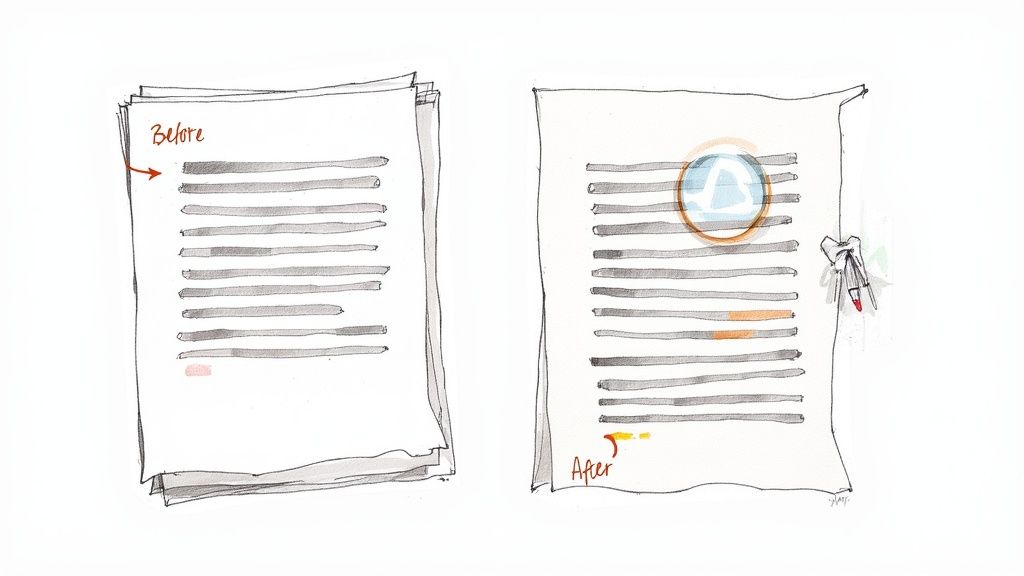
You've completed your essay rough draft. That's a huge step. Now, the revision stage begins, where you sculpt that raw material into a coherent, persuasive, and polished argument.
This isn’t just about fixing typos. True revision starts with the big picture. Before you worry about commas, you must examine the essay's core structure.
Start with Big Picture Edits
First, step away from your writing for a while. Returning with fresh eyes helps you assess the core structure and argument, not just sentence-level details.
Your initial read-through should focus on these key areas:
- Thesis Strength: Is your main argument clear, specific, and debatable?
- Logical Flow: Do your paragraphs follow a natural sequence, with each one building on the last?
- Paragraph Cohesion: Does every paragraph focus on a single main idea introduced by a clear topic sentence?
A great practical tip is to read your essay aloud. Your ears will catch awkward transitions, logical jumps, and clunky phrasing that your eyes might miss.
Zooming In on Sentence-Level Clarity
Once the overall structure is solid, it's time to put your sentences under the microscope. Your goals here are clarity and impact. Every word should earn its place.
This is the perfect moment to use a smart writing partner. When you paste your draft into PureWrite, you get instant feedback on repetitive, unclear, or robotic phrasing. We built our tool to help you refine clunky sentences while preserving your authentic voice.
Let's look at a real-world example from a business professional's draft:
- Before: "The data which was collected by the researchers was then used for the purpose of analyzing the trends over the period of the last ten years."
PureWrite helps you transform that into something much punchier:
- After: "Researchers used the collected data to analyze trends over the past decade."
The revision cuts the fluff, making the sentence more direct and powerful. For more on this, check out our guide on what is concise writing.
By tackling revisions in these two distinct layers—structure first, then sentences—you can transform an overwhelming task into a manageable process. Give your draft the attention it deserves and try PureWrite to help you take it from good to great.
Answering Your Top Essay Draft Questions
We get a lot of questions about the drafting process. Let's tackle some of the most common concerns, from the acceptable level of messiness to knowing when to switch to editing.
How Messy Can a Rough Draft Actually Be?
Honestly, there’s no such thing as "too messy." A first draft's job is to be a low-stakes sandbox for your ideas. Typos, awkward sentences, and half-formed thoughts are not just okay; they are expected.
Think of it as a painter’s preliminary sketch. It’s not ready for a gallery, but it’s the crucial first step. As long as you can follow your own train of thought, you’re on the right track.
Your first draft is simply a beginning, a necessary first step in a long process that culminates in bringing your unique vision to life. It’s the lump of clay before it becomes a pot—essential and full of potential.
Do I Need to Bother with Citations in My Rough Draft?
Yes, but don't get bogged down in perfect formatting. It's essential to track where your information comes from to avoid accidental plagiarism. However, you don't need to stop your flow to wrestle with APA or MLA style guides.
A simple note like (Smith, 2021, p. 45) is perfect. It’s enough to remind you of the source. You can handle the detailed formatting during the revision stage.
When Is It Time to Stop Writing and Start Editing?
The best time to switch from writer to editor is after taking a break. Step away from your draft for at least a few hours, or a full day if possible. Coming back with fresh eyes is the single best way to spot weaknesses.
You'll know it's time to revise when you have a complete draft that addresses all the key points from your outline. Even if the intro is clunky and the conclusion fizzles out, you're ready for the next phase.
Once you've got that raw draft ready to be polished, PureWrite is here to help. Our tool is designed to humanize your writing, sharpen your clarity, and ensure your unique voice shines through. Give it a try and see how easy it can be to elevate your essay to the next level.