Grammar is or are: Master Subject-Verb Agreement with Confidence
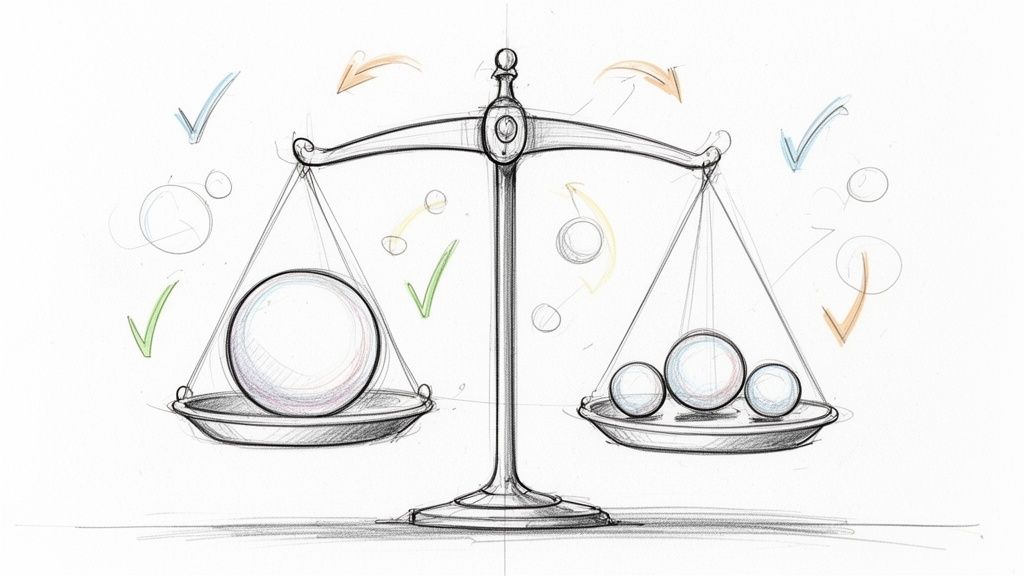
Choosing between "is" and "are" all comes down to a core grammar rule: subject-verb agreement. While it sounds technical, the idea is simple. The subject of your sentence (the "who" or "what") must match its verb.
For content creators, mastering this isn't just a grammar exercise; it's about building credibility and ensuring your message is crystal clear. Let's dive into how you can get it right every time.
The Simple Answer to Is vs. Are
At its heart, getting "is" and "are" right ensures your sentences are clear and professional. This is a foundational skill that builds trust with your audience, whether you're a student, a marketer, or a professional using AI writing tools.
The golden rule is beautifully simple: use is for a singular subject and are for a plural one. If one report is on your desk, you'd say, "The report is ready." If there are several, it becomes, "The reports are ready." This basic pairing makes your writing smooth and correct, as seen in these examples of a simple sentence.
Of course, English loves to throw a few curveballs. What about nouns you can't count, like "information" or "advice"? These uncountable nouns always take the singular verb is. For instance, you'd say, "The information is helpful," not "are helpful."
Locking in the Basics
Before we jump into the trickier scenarios, let's solidify this fundamental concept. Strong grammar skills are built on a solid foundation, and we're here to help you build it.
Here's a quick reference table to help you lock in the basic rules.
Quick Guide to Subject-Verb Agreement
| Verb | When to Use It | Example Sentence |
|---|---|---|
| Is | With a singular subject (one thing or person). | The marketing plan is brilliant. |
| Are | With a plural subject (more than one thing or person). | The marketing plans are brilliant. |
| Is | With uncountable nouns (like feedback, water, advice). | The feedback is constructive. |
| Are | With nouns that are always plural (like scissors, pants, glasses). | The scissors are in the drawer. |
This table covers the most common situations you'll face. As a content creator, you know that sometimes the subject of a sentence isn't immediately obvious, especially when editing quickly. Even AI writing tools can produce sentences that are technically correct but feel unnatural. This is where your human touch and ethical AI usage become essential.
Solving Tricky Subject-Verb Agreement Puzzles
Alright, let's move past the basics. What do you do when your subject isn’t a straightforward "blog post" or "the reports"? This is where the real art of grammar comes in, and understanding the context is your best tool for deciding whether grammar is or are the right choice.
One of the most common curveballs is the collective noun. Think of words like team, committee, family, or audience. These words describe a group, but the grammar can get a little fuzzy. The answer depends entirely on how that group is behaving in your sentence.
When a Group Is One... or Many
If the group acts as a single, unified whole, you should treat it as singular and use is. For example, "The marketing team is launching the new campaign on Tuesday." In this sentence, the team is a single unit with one goal.
But what if the members of that group are acting as individuals? Then, the noun becomes plural, and you need to use are. Picture this: "The marketing team are debating the best tagline for the campaign." Now, we're focused on the individual members and their separate opinions.
This simple flowchart can help you visualize that basic choice.

It really boils down to this: if the subject is one thing, use 'is'. If it’s more than one, use 'are'.
The Sneaky Case of Indefinite Pronouns
Another area that trips up even seasoned writers is indefinite pronouns. These are words that point to non-specific people or things, and they can be a real headache for content creators and students alike.
Here’s the golden rule for most indefinite pronouns: treat them as singular. Nail this, and you'll sidestep a ton of common mistakes.
Words like everyone, everybody, anyone, anybody, someone, somebody, each, and nobody always take a singular verb. It can feel a little weird because they often refer to groups of people, but grammatically, they’re treated as one individual at a time.
- Correct: Each of the writers is responsible for proofreading their own work.
- Incorrect: Each of the writers are responsible for proofreading their own work.
Getting these details right is crucial, especially as your sentences get longer and more involved. If you want to dive deeper into sentence structure, we have a whole guide on building effective compound and complex sentences. For non-native English speakers, these rules can be particularly tricky; check out these helpful English lessons for Spanish speakers for extra support.
Even sophisticated AI writing tools can get tangled in these rules and produce awkward sentences. That's why we always recommend giving any AI-generated text a quick human review. It’s about making sure your writing sounds authentic, not robotic.
The Great Debate: Data Is or Data Are?
Few words get grammar enthusiasts, writers, and data scientists as fired up as "data." Is it a single thing or a collection of many things? How you answer that question says a lot about who you're writing for.
Your choice between "data is" and "data are" isn't just about being "correct"—it's about meeting your audience's expectations.
Where the Confusion Comes From
Let's get the history out of the way. "Data" is technically the plural of the Latin word "datum," meaning a single piece of information. For a long time, especially in academic circles, you would only ever see "data are."
But language evolves based on how we use it. Over the last few decades, "data" has morphed into a mass noun for most people, much like "water" or "information." You wouldn't say "the informations are helpful"; you'd say "the information is helpful."
That’s exactly what’s happened with data. In most modern contexts, it refers to a whole body of information treated as a single concept.
What to Use in Your Content Today
For anyone writing content for business, marketing, or technology, the verdict is in: "data is" is the modern standard. It's what your audience expects to read, and it sounds natural and current.
Using "data are" can, in many professional contexts, make your writing feel stiff or overly academic. This can create a subtle disconnect with readers who are used to the modern, singular form.
Even major style guides like the AP Stylebook and The Chicago Manual of Style now recommend treating "data" as a singular noun in most situations.
For content creators and marketers, the takeaway is clear: "The data is compelling" is the modern, audience-friendly choice that aligns with professional communication norms.
The numbers back this up. A 2018 analysis found that "data is" appeared in 78% of cases in the Corpus of Contemporary American English, while "data are" appeared just 22% of the time. You can dig deeper into this linguistic shift and discover how the use of 'data' has evolved.
This is a classic example of where human editing is essential, especially when working with AI writing tools. An AI, trained on vast and sometimes dated text, might output "data are." It's not technically wrong, but it might be the wrong choice for your blog post or marketing email.
At PureWrite, we help you refine these nuances. Our tool is designed to humanize AI-generated text so it sounds authentic and connects with a modern audience.
Writing with Numbers, Fractions, and Percentages
Numbers can throw a wrench into subject-verb agreement, but there’s a simple trick: ignore the number and look at the noun it’s describing. The noun is what really decides whether you use is or are.
This becomes crystal clear with fractions and percentages. If you say, "Half of the cake is gone," you're talking about one cake—so you use is. But if you say, "Half of the cookies are gone," you're talking about multiple cookies, which calls for are.
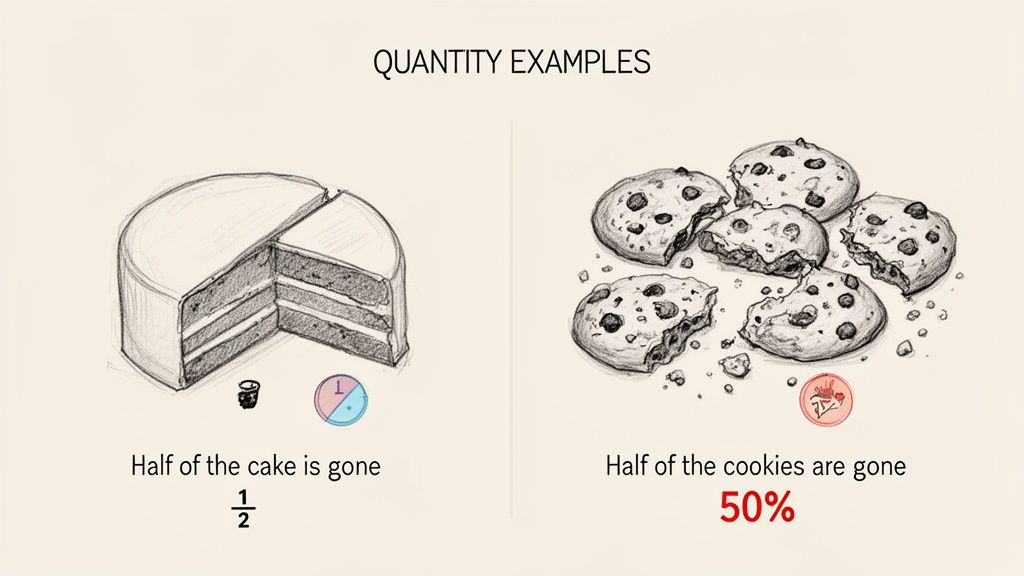
Once you get this, you’ll find it applies to all sorts of measurements, helping your data-driven content sound that much more professional.
Applying the Rule to Time and Money
This same logic works for time, money, and distance when you're talking about them as a single, collective amount. Even if the number is plural, if the idea is singular, you stick with "is."
When a plural number describes a single quantity or concept, treat it as singular. The focus is on the total amount, not the individual parts.
Let's look at a few real-world examples you might use in your content:
- Money: "Ten dollars is the price of the ticket." (Here, you're talking about a single price).
- Time: "Three hours is a long time to wait." (That’s one block of time).
- Distance: "Five miles is too far to walk from here." (We’re treating this as one complete distance).
The Number Of vs. A Number Of
Here's a classic grammar tripwire: "a number of" versus "the number of." They look almost identical but signal opposite verb choices. Nailing this is key in professional documents, as you might find when learning how to write business reports.
The distinction is actually quite simple:
- A number of just means "several" or "many," so it takes a plural verb. For example, "A number of clients are attending the webinar."
- The number of refers to a specific, single figure, so it takes a singular verb. For instance, "The number of clients attending the webinar is fifty-seven."
Mastering nuances like this is what makes your writing precise and clear. When you're humanizing AI-generated text, these are exactly the kinds of phrases to watch out for. At PureWrite, we specialize in refining these grammatical details, ensuring your content is both correct and authoritative.
Finding the Subject in Complex Sentences
Sometimes, the true subject of a sentence plays hide-and-seek. It might be buried under a long phrase, turning the choice between is or are into a bit of a guessing game. This is a common tripwire when you're crafting longer, more complex sentences.
Think of yourself as a director trying to find the lead actor in a crowded scene. Your job is to ignore all the extras—the distracting phrases and clauses—and put the spotlight on the real star. This skill is vital when polishing AI-generated text, which can often produce sentences that are technically correct but feel clunky.

Cutting Through the Clutter
One of the sneakiest distractions is the prepositional phrase—little groups of words starting with a preposition (like of, in, with, from). These phrases often get wedged right between the subject and the verb. The trick is to mentally cross them out to reveal the real subject.
Remember: The subject of your sentence is never hiding inside a prepositional phrase. If you ignore these phrases, you’ll find the real subject your verb needs to agree with.
Let's look at an example: "A box of old documents is sitting on the shelf." The verb is singular because the subject is box, not documents. If you just cross out "of old documents," the correct choice becomes crystal clear.
Getting a handle on how different parts of a sentence work together is key. For a deeper dive into this, you can check out our detailed guide on the role of clauses in grammar.
Sentences Starting with There Is or There Are
Sentences that kick off with "There is" or "There are" flip the typical sentence structure. In these cases, the subject comes after the verb. This is called an inverted sentence, and it's a classic spot for agreement errors.
The secret is simple: look at the noun that comes right after the verb. That’s your true subject, and it dictates your choice.
- "There is a problem with the latest report." (The subject is the singular noun problem.)
- "There are several problems with the latest report." (The subject is the plural noun problems.)
This rule is a big deal in professional writing, where clear communication builds credibility. A recent Grammarly Business report analyzing 50 million corporate documents found that in emails and reports, the singular phrasing "data is" now appears 92% of the time. This is a perfect example of how modern usage reshapes old rules. You can read more about these fascinating findings.
When wrestling with a tricky sentence, especially one from an AI tool, pasting it into PureWrite can make all the difference. We'll help you spot the true subject and ensure your verb aligns perfectly, so your writing always sounds natural and polished.
A Practical Checklist for Spotting "Is vs. Are" Errors
So, you’ve put in the hard work and your draft is complete. This final stretch—the editing phase—is what separates good content from great content. Polishing your work, especially checking for subject-verb agreement, is a critical step for every writer.
Here's a simple, actionable checklist to help you hunt down every last "is" or "are" mistake.
One of the best proofreading hacks we know is to read your work aloud. It sounds simple, but your ears are fantastic at catching clunky phrasing and mismatched verbs that your eyes might miss. This forces you to slow down and truly hear how your sentences flow.
Quick and Dirty Self-Editing Tips
Another great trick, especially for long sentences, is to mentally strip them down to the essentials. Find the core subject and verb, and cross out all the extra phrases. This instantly reveals whether you need a singular or plural verb.
Before you hit publish, run through these quick checks:
- Find the Subject: Pinpoint the main noun. Is it one thing, or are there more?
- Ignore the Noise: Don't let phrases wedged between the subject and verb throw you off.
- Listen to Yourself: Read the sentence out loud. If it sounds off, it probably is.
- Mind the Tricky Stuff: Give extra attention to collective nouns, indefinite pronouns, and measurements.
For a deeper dive into common writing pitfalls, this guide on the Top 10 Common Grammar Mistakes in English is a fantastic resource.
Your Secret Weapon: Going Beyond Basic Spell Check
Let's be honest, standard spell checkers are helpful, but they're far from perfect. One analysis found that these tools correctly identify issues only about 60-80% of the time. They can't grasp the context and nuance that make writing feel human. This is especially true for AI-generated text, which might be technically correct but often feels stiff and robotic.
This is where a tool like PureWrite makes all the difference. We go beyond basic checks, analyzing your writing to ensure it's not just correct but also clear, engaging, and authentic. Let us help you find and fix those sneaky ‘is’ or ‘are’ errors so your final draft is truly flawless.
If you want to brush up on the fundamentals, our guide on basic grammar rules is a great place to start.
Is and Are FAQs: Your Toughest Questions Answered
Even with a good handle on the basics, a few tricky situations can make you second-guess yourself. Let's tackle some of the most common grammar puzzles that trip up content creators, students, and professionals.
What About 'None'? Is It 'None Is' or 'None Are'?
This is a classic grammar sticking point, but the answer has become much more flexible. Traditionally, "none" meant "not one," so it was always treated as singular. That is still technically correct, but it's not the whole story anymore.
Today, it depends on what you're talking about. If "none" refers to an uncountable noun (like information), stick with is: "None of the research is conclusive." But if you're referring to countable items (like reports or people), using are is now perfectly acceptable and often sounds more natural: "None of the reports are finished."
Takeaway: Trust your instincts here. If the noun "none" is standing in for feels plural, go ahead and use "are." Modern usage has made this a common and accepted choice.
How Do 'Either/Or' and 'Neither/Nor' Work?
When you connect two subjects with phrases like "either/or" or "neither/nor," there's a straightforward guideline: the proximity rule. This means the verb agrees with whatever subject is closer to it.
Take this sentence: "Neither the project manager nor the developers are on board with the new timeline." We use are because the plural noun "developers" is right next to the verb.
Now, let's flip it: "Neither the developers nor the project manager is on board with the new timeline." Because the singular "project manager" is now closer, the verb switches to is.
Why Do Some People Say 'The Team Are'?
If you've ever seen a collective noun like "team" paired with "are," you've likely stumbled upon a key difference between American and British English. It's a fascinating quirk that says a lot about where the writer is from.
In American English, we almost always treat collective nouns—team, committee, company—as a single entity. So, you would say, "The team is playing well this season."
But in British English, it's common to treat these groups as a collection of individuals. This means they often use a plural verb to emphasize the people within the group. A British writer might say, "The team are debating their next move." Neither is wrong; they just belong to different dialects. For a global or American audience, sticking with the singular "is" is the safest bet.
Getting these details right is what separates good writing from great writing. For anyone creating content with AI, that final human touch is essential. PureWrite can help you spot those slightly off-kilter phrases and awkward grammar moments, making sure your subject-verb agreement is always on point. Try PureWrite today and see how it can help you turn AI drafts into polished, perfectly natural content.