Grammar Is vs Are: A Practical Guide to Subject-Verb Agreement

At its core, the difference between "is" and "are" is simple. You use is for a single subject and are for multiple subjects. Think: "This blog post is helpful" versus "These blog posts are helpful." Nailing this distinction is the bedrock of clear, professional writing that connects with your audience.
As content creators, getting this right builds credibility. Whether you're writing a marketing email, a student essay, or editing AI-generated content, mastering subject-verb agreement is non-negotiable for quality.
The Core Rule of Is vs Are Explained Simply

Getting "is" and "are" right boils down to subject-verb agreement. This sounds technical, but the idea is intuitive: the verb must match the subject. If your subject is singular (one thing), the verb must be singular. If your subject is plural (more than one thing), the verb must be plural.
This harmony is one of the most fundamental basic grammar rules you need to master. When your subjects and verbs agree, sentences flow logically, making your content easy to follow and building trust with your readers.
Interestingly, even sophisticated AI writing tools can stumble here. Research shows that popular grammar checkers only catch subject-verb agreement errors with about 66% accuracy, and sometimes they introduce new mistakes. This is a compelling reason to always give your work a final human review—a step where PureWrite can make all the difference.
Quick Guide to Subject-Verb Agreement
Here’s a quick-reference table to help you double-check your sentences and build confidence in your writing.
| Subject Type | Example Subject | Correct Verb | Full Sentence Example |
|---|---|---|---|
| Singular Noun | The cat | is | The cat is sleeping on the chair. |
| Plural Noun | The cats | are | The cats are sleeping on the chair. |
| Singular Pronoun | It | is | It is important to proofread. |
| Plural Pronoun | They | are | They are working on the project. |
| Collective Noun (as one unit) | The team | is | The team is ready for the game. |
As you can see, the rule itself is straightforward. The real challenge for writers and content creators is correctly identifying the subject, especially when sentences get more complex. The next sections will walk you through those trickier situations.
Navigating Tricky Subjects: Beyond the Basics
Navigating the trickier side of subject-verb agreement is where good writing becomes great. The basic rule—singular subject with 'is', plural with 'are'—is simple enough, but English loves to throw curveballs. These are the situations where the true subject isn't immediately obvious, and they can trip up even experienced writers and AI tools.
Mastering these nuances gives your writing a level of precision and authority that stands out. Let's dig into the most common challenges you'll face as a content creator.
Collective Nouns: A Question of Unity
A collective noun is a word representing a group of individuals—think team, committee, family, or audience. Deciding between 'is' or 'are' comes down to one question: is the group acting as a single unit, or are its members acting individually?
If the group is a unified entity, use 'is'.
- Real-World Example: Our marketing team is launching the new campaign on Tuesday. (The team is a single unit with one goal.)
If the group's members are acting as individuals, often with differing actions, use 'are'.
- Real-World Example: The marketing team are debating which social media platforms to use. (The individuals on the team are doing the debating.)
This is a subtle but crucial distinction that adds a professional touch to your writing. For an AI-generated draft to sound authentic, it needs to get these human-like nuances right.
Indefinite Pronouns: Singular or Plural?
Indefinite pronouns like everyone, anyone, someone, each, and either can be confusing. Though they feel plural, most are grammatically singular and take 'is'. This is a common tripwire for students and professionals alike.
Actionable Tip: A simple trick is to remember that words ending in '-one,' '-body,' or '-thing' are always singular. This instantly clears up a common point of confusion.
Let's look at a few examples:
- Everyone is invited to the webinar.
- Somebody is responsible for this decision.
- Neither of the options is ideal.
A few indefinite pronouns are always plural, including several, few, both, and many, which always pair with 'are'. To make it more interesting, some pronouns—like all, some, most, and any—can be singular or plural depending on what they refer to. This flexibility shows how important it is to understand the full context of your sentences, a skill you can sharpen by learning how different clauses in grammar work together.
Mastering Special Cases Like 'There Is' and 'There Are'
Some sentences seem designed to trip us up, especially when the subject isn't at the beginning. These tricky cases are where most "is vs. are" mistakes happen, but once you know the rules, you'll find they’re simple to navigate. This is particularly relevant for marketers and students who need their writing to be flawless.
Let's tackle the most common culprit: sentences starting with "there is" or "there are." Here’s the secret: "there" is never the subject. The real subject comes after the verb, and that’s what your verb needs to agree with.
- Correct: There is a problem with the latest report. (The subject, "problem," is singular.)
- Correct: There are several problems with the latest report. (The subject, "problems," is plural.)
Finding the Real Subject in Phrases With 'Of'
Prepositional phrases, especially those using "of," can also be misleading. When you see "a list of items," your brain might focus on "items" and want to use "are." However, the verb must match the main subject, not the object inside the prepositional phrase.
For example, in "A list of items is on the desk," the actual subject is "list," which is singular. The phrase "of items" just adds detail.
- Singular Subject: A box of old photos is in the attic. (The subject is "box.")
- Plural Subject: The photos in that box are fading. (The subject is "photos.")
An actionable trick is to mentally cross out the prepositional phrase ("of..."). This instantly reveals the true subject, clarifying whether you need "is" or "are." It’s a foundational skill that works with understanding different verbs. For more on that, check out our guide on action verbs vs. linking verbs.
Percentages and Fractions
The rule for fractions and percentages is logical. The verb agrees with the noun the fraction refers to. If that noun is singular or non-countable (like "information"), use is. If it’s a plural, countable noun, use are.
- Singular: Half of the pie is gone. (You’re talking about a single pie.)
- Plural: Half of the employees are out of the office. (You’re talking about multiple employees.)
- Singular: All of the information is correct. ("Information" is a non-countable noun.)
This decision tree gives you a quick visual path for figuring out some of these trickier subjects.
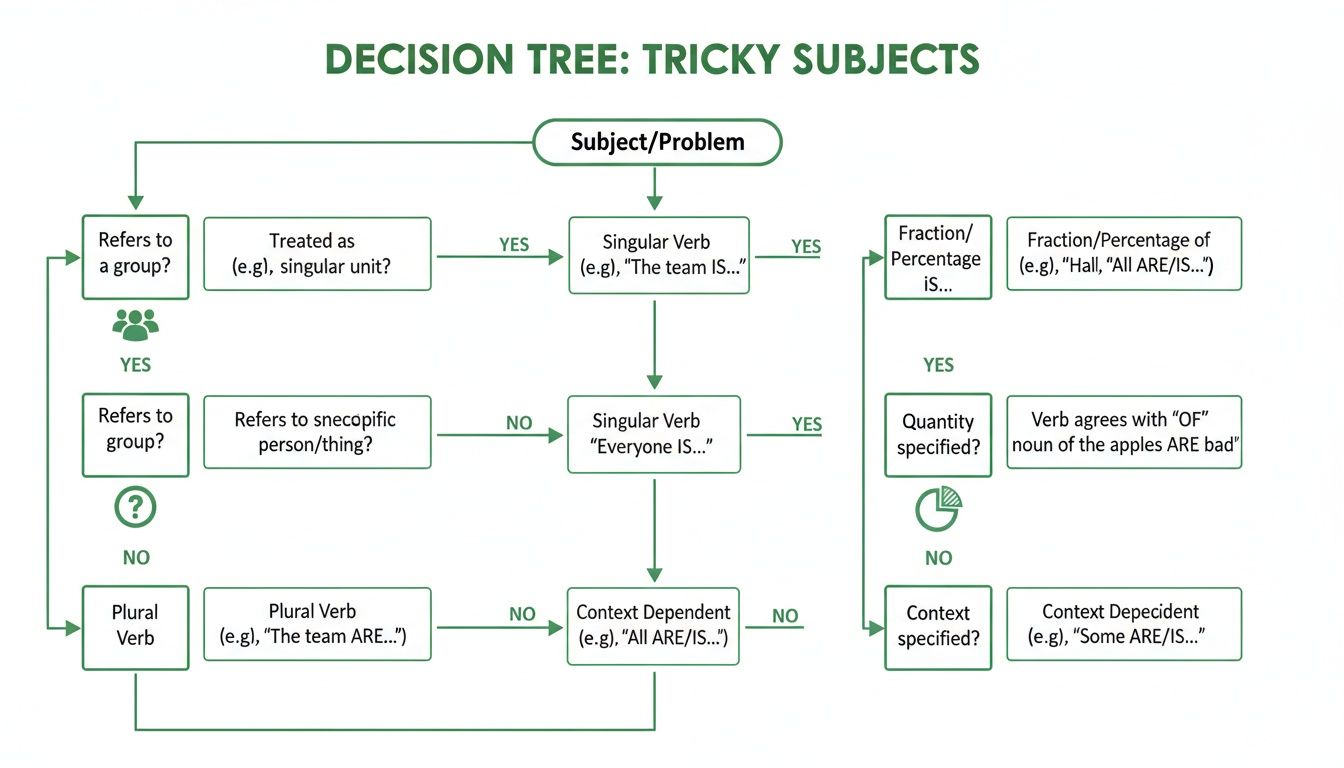
The flowchart reinforces the main idea: context is everything. Your choice of verb depends entirely on the subject and how it’s used in the sentence.
To help you keep these rules straight, here’s a quick reference table.
Decision Guide for Special Grammar Cases
| Grammar Case | The Rule to Follow | Singular Example ('is') | Plural Example ('are') |
|---|---|---|---|
| 'There is/are' | The verb agrees with the noun that comes after it. | There is a single reason for the delay. | There are multiple reasons for the delay. |
| Collective Nouns | Use 'is' when the group acts as one unit. Use 'are' when individuals act separately. | The team is playing well tonight. | The team are arguing over the new strategy. |
| Phrases with 'of' | The verb agrees with the subject before 'of', not the noun inside the phrase. | A list of names is on the table. | The names on the list are hard to read. |
| Fractions/Percentages | The verb agrees with the noun the fraction refers to. | Half of the cake is missing. | Half of the cookies are gone. |
This table can be a lifesaver when you're writing and hit a tricky spot. Finally, remember that titles of books, movies, or company names are always treated as a single entity, even if they sound plural.
- Example: The Avengers is my favorite movie.
- Example: Collins and Sons is hiring a new marketing director.
Even the best AI tools get tripped up by these special cases. A final human review is always essential for ensuring your content is grammatically sound, clear, and authentic.
How Language Evolution Shapes Modern Grammar
Grammar isn't a static rulebook. It's a living system that adapts to how we actually talk and write. Grasping this helps you, as a modern writer or content creator, know when to follow traditional rules and when to bend them to connect with your audience.
The "is vs. are" debate often highlights this evolution. A once-strict rule can soften as common usage shifts. This reflects the difference between prescriptive and descriptive grammar.
Prescriptive vs. Descriptive Rules
Prescriptive grammar dictates how language should be used based on traditional standards—what you learned in school. In contrast, descriptive grammar observes and describes how people actually use language in the real world.
The tension between these views is where things get interesting for writers. Take the word "data." A prescriptivist insists "data" is plural, so you must write "the data are clear." But descriptively, most of us treat "data" as a singular mass noun, like "information."
Evidence backs this up. The NOW Corpus, which tracks over 5 billion words from news sources, reveals that "data is" appears more than seven times as often as "data are." That 7:1 ratio is a powerful signal that the singular form has become the norm in everyday and professional writing. You can discover more about this linguistic trend on Vice.
Making Conscious Grammatical Choices
So, what does this mean for you? It means you can make a conscious choice based on your audience and purpose.
- Use Case (Academic/Scientific): In formal settings, sticking to prescriptive rules (like "data are") signals credibility and adherence to convention.
- Use Case (Marketing/Blog Content): Here, the more common, descriptive form ("data is") will sound more natural and relatable to your readers.
Actionable Tip: Your primary job is to communicate clearly. The "right" grammar is whichever version your audience understands without being distracted by a word that sounds stuffy, outdated, or wrong to them.
This is an area where AI writing tools can struggle. They might default to a rigid, prescriptive model that sounds robotic or produce text that feels inhuman. That’s where we come in. After you get a draft from an AI, PureWrite helps you smooth out the edges so it sounds authentic. To learn more about this ethical approach, check out our guide on how to humanize AI text.
Mastering grammar isn’t just about memorizing rules. It's about understanding your context, audience, and the changing nature of language to make your message land perfectly.
Common "Is" vs. "Are" Mistakes and How to Fix Them

The fastest way to sharpen your writing is to spot common errors. Let’s walk through the "is" vs. "are" mistakes that trip up even seasoned writers, marketers, and students. We'll break down real-world examples and show you exactly how to fix them.
Think of this as a practical tune-up. Recognizing these patterns is the first step toward creating clearer, more professional content every time you write.
The Separated Subject and Verb
This is incredibly common. It happens when a long phrase comes between the subject and verb, making it easy to lose track of what needs to agree. Your brain often defaults to the noun closest to the verb, which is frequently not the real subject.
- Before: The list of new marketing initiatives are ready for review.
- After: The list of new marketing initiatives is ready for review.
Why it's fixed: The real subject is "list" (singular), not "initiatives" (plural). By mentally removing the phrase "of new marketing initiatives," the correct verb—is—becomes obvious. This single fix can help you avoid a whole category of confusing sentences and other frequently misused words.
Confusion with Compound Subjects
When you connect subjects with "or" or "nor," the rule is simple: the verb agrees with the subject closest to it. This is called the proximity rule.
- Before: Neither the project manager nor the team members is available.
- After: Neither the project manager nor the team members are available.
Why it's fixed: The verb "are" correctly matches "team members," the plural subject sitting right next to it. If you flip the sentence, the verb changes: "Neither the team members nor the project manager is available."
Expert Insight: Remember, clarity is your ultimate goal. A sentence can be grammatically correct but still sound clunky. If that happens, don't hesitate to rephrase it. "The project manager is unavailable, and so are the team members" often flows much more smoothly.
Missteps with 'Skunked Terms' Like Data
Some words exist in a grammatical gray area. Take "data"—a classic "skunked term" because people argue over whether it's singular or plural. Using "data are" can sound stiff to many readers, while "data is" may irk traditional grammarians.
Style guides reflect this divide. The APA manual, for example, insists on the plural for scientific writing, but general usage has favored the singular "data is" since the 1940s. While knowing the rules is vital, some people find success with strategies for acquiring grammar naturally through practice. Ultimately, catching these common slip-ups in your own drafts is what builds confident, polished writing.
Is vs. Are: Answering Your Lingering Questions
Let's wrap up by tackling some common questions that still trip up writers. Think of this as a quick-reference guide to solve those nagging doubts that pop up during proofreading. We’ve gathered the trickiest scenarios to help you master subject-verb agreement.
Getting these details right separates good content from great content. It's also where you can add real value when editing AI-generated text, since automated checkers only catch about 66% of these kinds of subject-verb agreement mistakes.
"A Number Of" vs. "The Number Of": What's the Rule?
This is a classic grammar trap with a simple solution. "A number of" is another way of saying "many," so it always takes a plural verb. In contrast, "the number of" refers to a single, specific figure, making it singular.
- A number of employees are attending the workshop. (Meaning many employees are going.)
- The number of employees attending the workshop is twelve. (The subject is the single noun "number.")
How Do I Handle Subjects Joined by "Or" or "Nor"?
When you connect two subjects with "or" or "nor," the verb agrees with the subject that is closer. This is the proximity rule—the verb just has to match the noun or pronoun right next to it.
For instance, in "Neither the manager nor the employees are available," the verb "are" is plural because it's closest to "employees." If you flip them, the verb changes: "Neither the employees nor the manager is available."
Is "None" Singular or Plural?
This one is tricky because its usage has shifted, but the modern approach is straightforward. "None" can be singular or plural, depending on what it refers to. If it means "not one" and refers to something non-countable (like water or information), use a singular verb.
Key Insight: While "none is" is always technically correct, "none are" often sounds more natural to modern readers when you're talking about countable things. For example, "None of the experts are sure" flows better than the more formal "None of the experts is sure."
If "none" means "not any" and refers to a plural, countable noun (like experts), using a plural verb is now widely acceptable and much more common.
- Singular: None of the advice is helpful. (You can't count "advice.")
- Plural (Common): None of the team members are ready. (You can count "team members.")
Why Do News Headlines Use "Is" with Plural Subjects?
You've likely seen headlines like, "Ten Million Dollars Is Winning Lottery Jackpot." This isn't a mistake; it's a style called "headlinese." Its goal is to be short and punchy, even if it means bending a few grammar rules. In this case, a plural subject like "ten million dollars" is treated as a single concept.
While this works for a newspaper, it’s a style choice to avoid in your formal or professional writing. For reports, articles, and emails, always stick to standard subject-verb agreement rules for maximum clarity.
Even when you know the rules, ensuring your writing feels natural can be challenging, especially when refining AI-generated drafts. PureWrite is designed to bridge that gap. Our platform polishes AI text, fixing subtle grammatical quirks and stylistic hiccups to make your content sound authentically human. Try it and see how simple it is to produce clear, polished, and engaging writing. Learn more about PureWrite.