Help with Punctuation for Clear, Confident Writing
You're about to send an email, submit an essay, or publish an AI-assisted blog post. The wording sounds professional, but one sentence still makes you hesitate: does that comma connect the ideas, or leave your reader guessing?
Good help with punctuation starts with that question, not a list of marks to memorize. You need to decide what readers should understand, then choose punctuation that makes your meaning clear.
Why Punctuation Changes How Readers Understand You
Consider this draft email: “Please review the proposal before we send it the client needs the revised version.” You can recognize the words, but you have to work out where the instruction ends and the explanation begins.
A clearer version is: “Please review the proposal before we send it. The client needs the revised version.” The writer hasn't added information. They've made the relationship between existing ideas easier to follow.
Read for meaning before marks
Punctuation gives readers directions. It helps them recognize boundaries, connect ideas, identify quoted words, and distinguish essential information from an aside.
Compare these instructions:
- Addressing someone: “Let's review, Jordan.” You're asking Jordan to participate.
- Naming the subject: “Let's review Jordan.” You're proposing a review of Jordan.
- Separating actions: “Approve the draft. Send the invoice.” You're giving distinct instructions.
These aren't cosmetic differences. Before adding a comma, ask who's doing what and which words belong together.
A practical purpose with a long history
The oldest known punctuation examples include word-separating points on the 9th-century BC Mesha Stele; Greek writers used vertically arranged dots by the 5th century BC, and broader standardization followed European movable-type printing in the 1450s, according to the history of punctuation.
That history reflects a practical need: writers must communicate with readers who can't hear their voice or ask immediate questions. A colleague opening your report needs enough guidance to interpret it independently.
Start with the reader: Ask what someone could misunderstand before asking which punctuation mark looks right.
Treat editing as a sequence of meaning decisions. Establish where thoughts end, clarify their relationships, and check whether quotations and omissions remain honest. Then consider how the same text works aloud, through assistive technology, and after AI-assisted revision.
Master Sentences Commas and Full Stops
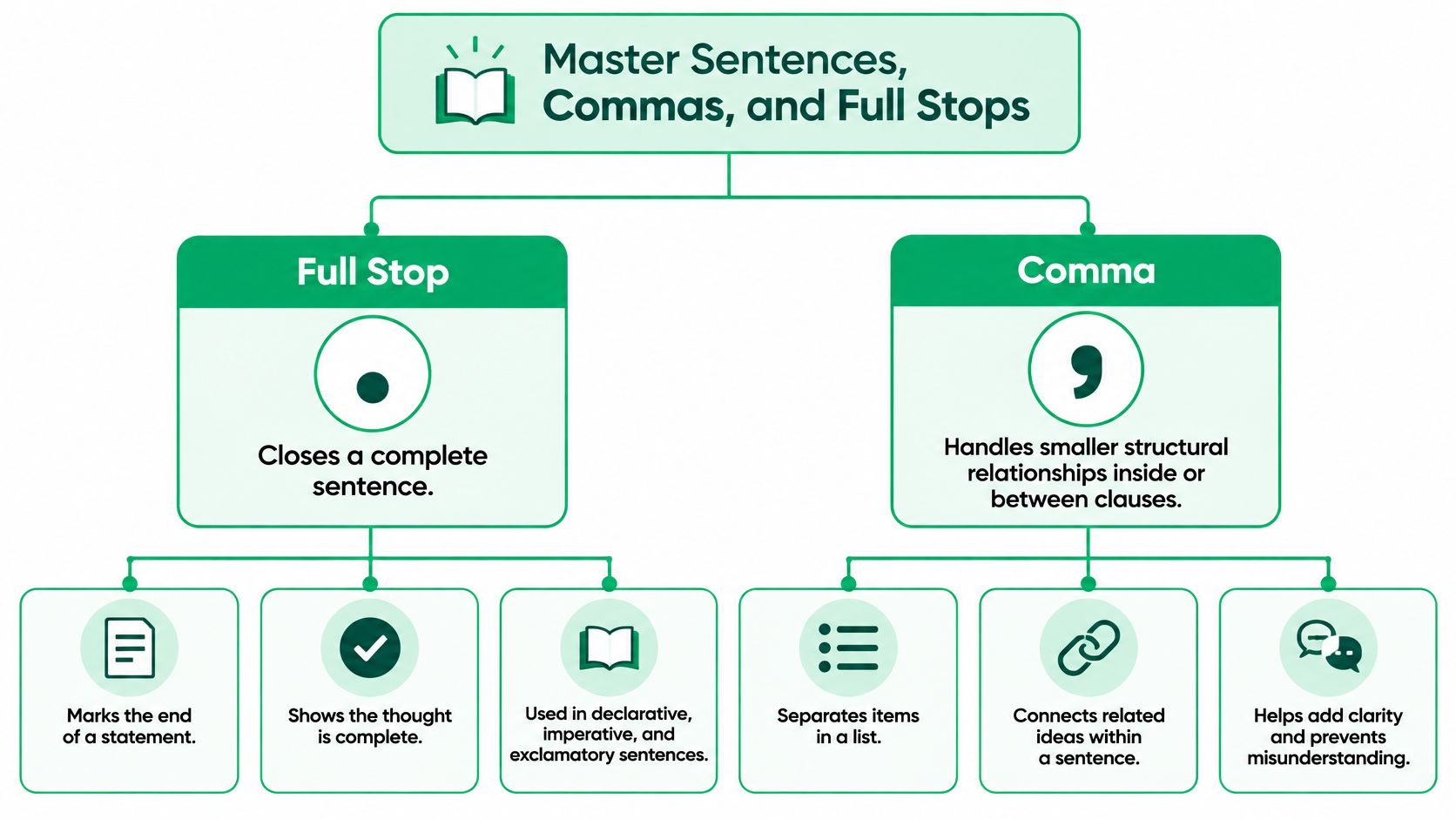
A full stop, also called a period, closes a complete sentence. A comma usually handles a smaller relationship within a sentence, although it can also help connect complete clauses.
Think of a period as a red light, a semicolon as a controlled intermediate stop, and a comma as light guidance. The analogy helps with rhythm, but grammar, not the length of your breath, determines the choice.
Find the complete thoughts
An independent clause can stand alone as a sentence. “The editor approved the draft” works independently; “because the editor approved the draft” leaves readers waiting for more information.
For a closer explanation, use our guide to clauses in grammar. Identifying clauses makes punctuation decisions less dependent on guesswork.
Compare these editing choices:
| Draft | Revision | Reason |
|---|---|---|
| The draft is ready, please review it. | The draft is ready. Please review it. | A period separates complete thoughts. |
| The draft is ready and needs approval. | Keep as written. | The verbs share the subject “draft.” |
| The draft is ready but the references need checking. | The draft is ready, but the references need checking. | Each side contains a complete thought. |
A comma splice occurs when you connect independent clauses with only a comma. You can repair it with a period, a semicolon, or an appropriate conjunction, depending on the relationship you intend.
Give each comma a job
In focused student-writing research, 589 of 688 punctuation errors involved commas, or 85.6%, while full stops accounted for 5.4%; these aren't universal error rates, but they show why sentence-level practice matters in that learner dataset (punctuation-error research).
Use these common patterns when reviewing your own work:
- Introductions: “After reviewing the brief, we revised the headline.” The comma separates the opening phrase from the main statement.
- Lists: “The report includes findings, limitations, and recommendations.” Follow your house style consistently for the final list comma.
- Optional information: “The proposal, which includes the revised budget, is ready.” The inserted detail adds information without identifying which proposal you mean.
Be careful with that last pattern. “Writers who cite their sources build trust” identifies a particular group; enclosing “who cite their sources” in commas would change the meaning.
Punctuation should clarify the relationship between words, not merely fill a stylistic gap.
If you can't explain what a comma separates, don't automatically delete it. First check whether the sentence itself needs restructuring.
Choose the Right Mark for Each Pause
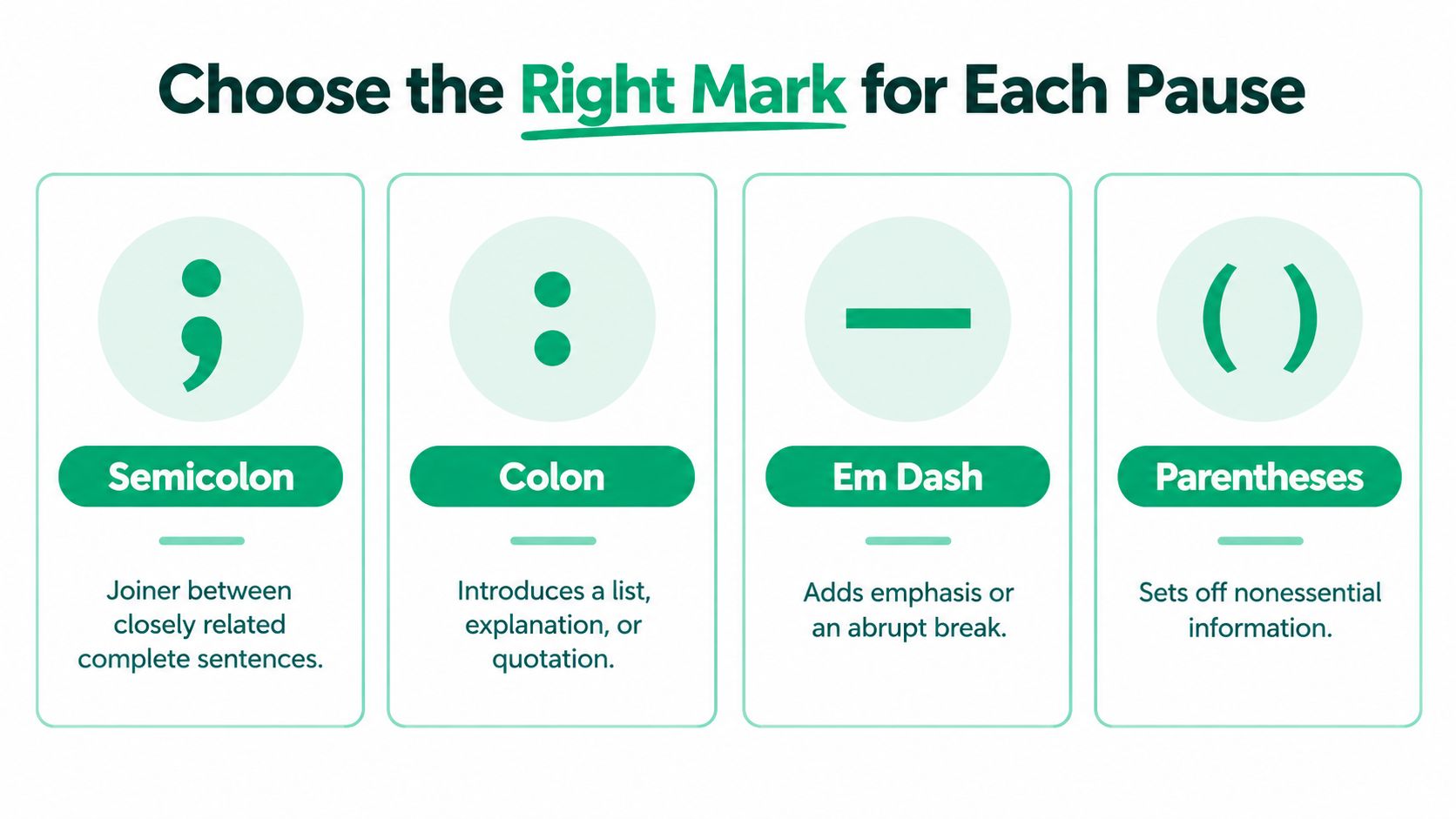
“The findings are preliminary. Further testing is needed.” That version gives each statement its own space. “The findings are preliminary; further testing is needed” presents them as closely connected observations.
Neither version is automatically better. Your choice depends on whether you want readers to pause between ideas or consider them together.
Match the mark to the relationship
| Mark | Intended relationship | Illustrative use |
|---|---|---|
| Period | A distinct statement | “The study has limitations. Interpret the findings cautiously.” |
| Semicolon | Closely related complete statements | “The study has limitations; the findings require caution.” |
| Colon | An explanation, list, or reveal | “The recommendation is clear: revise before publishing.” |
| Em dash | An interruption or emphatic turn | Useful when an abrupt break is intentional. |
| Parentheses | Optional supporting information | “The draft is ready (references included).” |
A semicolon needs a complete statement on each side in this use. It isn't a more formal comma.
A colon directs attention toward what follows. In ordinary explanatory sentences, make sure the words before it form a complete statement: “Bring the following materials: your notes and draft,” rather than “Bring: your notes and draft.”
For more comparisons, consult our guide to colon and semicolon use.
Choose connection without adding clutter
You can also connect independent clauses using a comma plus and, but, for, or, nor, so, or yet. Purdue's guidance illustrates the pattern with “The campaign launched on Monday, and traffic increased by 20%”; that percentage is part of the grammatical example, not a reported campaign result (Purdue's punctuation guidance).
Different contexts call for different emphasis:
- Research papers: Use a semicolon when the relationship between complete statements is close and clear.
- Presentation slides: A colon can introduce the conclusion: “Our priority: clearer onboarding.”
- Product copy: Prefer a direct statement when an interruption would distract from the benefit.
- Emails: Keep an aside in parentheses only if recipients can safely skip it.
An em dash can create emphasis, but repeated interruptions can make your main point difficult to locate. If you insert an aside mid-sentence, make its beginning and ending unmistakable; an incomplete pair leaves readers unsure where the main statement resumes.
Parentheses shouldn't become storage for deadlines, conditions, or essential warnings. If readers need the information to act correctly, put it in the main sentence.
Handle Quotes Apostrophes and Ellipses Correctly
Suppose you're turning interview notes into a blog post. Your first responsibility isn't making the quotation sound polished; it's preserving what the person said.
Direct quotation reproduces exact wording. A paraphrase expresses the meaning in your own words and shouldn't wear quotation marks.
Keep quotation boundaries clear
The examples below are invented for practice, not quotations from real interviewees.
- Direct quotation: The editor said, “The opening needs context.”
- Paraphrase: The editor recommended adding context to the opening.
- Nested quotation: The editor said, “Replace ‘perfect' with a more precise word.”
In common American usage, periods and commas go inside closing quotation marks. For example, write “The draft is ready,” she said, rather than placing the comma outside; regional and publication styles can differ.
Titles of short works may also take quotation marks, depending on your style guide. Don't add quotation marks merely to make social copy sound important: describing a service as “reliable” can introduce unintended doubt.
Separate possession from contraction
| Draft | Correction | Meaning |
|---|---|---|
| The writers notebook is missing. | The writer's notebook is missing. | The notebook belongs to one writer. |
| The writers notebooks are missing. | The writers' notebooks are missing. | The notebooks belong to multiple writers. |
| Dont publish the draft. | Don't publish the draft. | The apostrophe marks missing letters. |
Check it's by expanding it to “it is” or “it has.” If neither fits, you probably need the possessive its.
Academic abbreviations need separate attention rather than the same rules as possessives. Our guide to et al. punctuation addresses that distinct editing question.
An ellipsis can signal omitted material. With the invented original “The draft is clear, carefully sourced, and ready,” an honest shortened quotation could read “The draft is clear ... and ready.” Never remove a qualification that changes the speaker's position.
Accessibility check: Don't rely on decorative symbols to communicate information readers need.
Screen readers may skip or inconsistently interpret special characters, so restrained punctuation and testing important copy aloud through assistive technology are sensible practices (punctuation and accessibility guidance). Check ellipses, repeated symbols, and slash-heavy labels in context rather than assuming their visual meaning will survive text-to-speech.
Diagnose Common Punctuation Mistakes
An error is easier to fix when you identify its cause. A sentence may look overpunctuated because the writer has inserted commas wherever they paused, or underpunctuated because they haven't decided where an idea ends.
Fluent AI-generated wording can make those problems less noticeable. Read the structure independently of how polished the vocabulary sounds.
Trace the symptom to its cause
| Symptom | Likely cause | Quick correction |
|---|---|---|
| “The page is live, share it.” | Complete thoughts joined too weakly | “The page is live. Share it.” |
| “The draft is ready please review it.” | No sentence boundary | “The draft is ready. Please review it.” |
| “The revised headline, sounds clearer.” | Comma separates subject and verb | “The revised headline sounds clearer.” |
| “Please send ‘the draft.” | Mismatched quotation marks | Remove unnecessary marks or match the pair. |
| “The clients feedback arrived.” | Ownership isn't marked | Choose “client's” or “clients’” according to meaning. |
| “Can you approve the draft.” | Ending doesn't match a direct question | “Can you approve the draft?” |
Don't repair only the visible mark. If you keep finding sentence-boundary problems in a paragraph, check whether you've crowded too many actions, conditions, and explanations into the same sentence.
A useful professional distinction is whether you're still improving the writing or checking a settled draft. BarkerBooks' copy editing vs proofreading explained offers context for separating those stages instead of expecting a final punctuation pass to solve structural problems.
Account for language background and voice
If English isn't your first language, ask whether you're applying a familiar convention from another language. That's a diagnostic question, not a judgment about your writing ability.
Check these areas deliberately:
- Sentence boundaries: Does the English version clearly distinguish separate statements?
- Quotation conventions: Have you followed the target publication's marks and spacing?
- Questions and emphasis: Does the ending match the sentence's function?
- Comma choices: Are you following the English sentence structure rather than translating pauses mechanically?
Some decisions depend on intended meaning rather than an absolute prohibition. Our explanation of the comma before because explores why context matters.
Also distinguish mistakes from purposeful variation. A brief fragment in a headline may suit the format; a missing verb in a research explanation may leave readers confused. Preserve intentional voice when readers can understand it, and revise when the departure creates ambiguity.
Proofread With a Repeatable Quick-Fix Routine
Proofreading works better when you give each pass a specific purpose. Trying to evaluate structure, tone, spelling, citations, and punctuation simultaneously makes it harder to explain why you're changing anything.
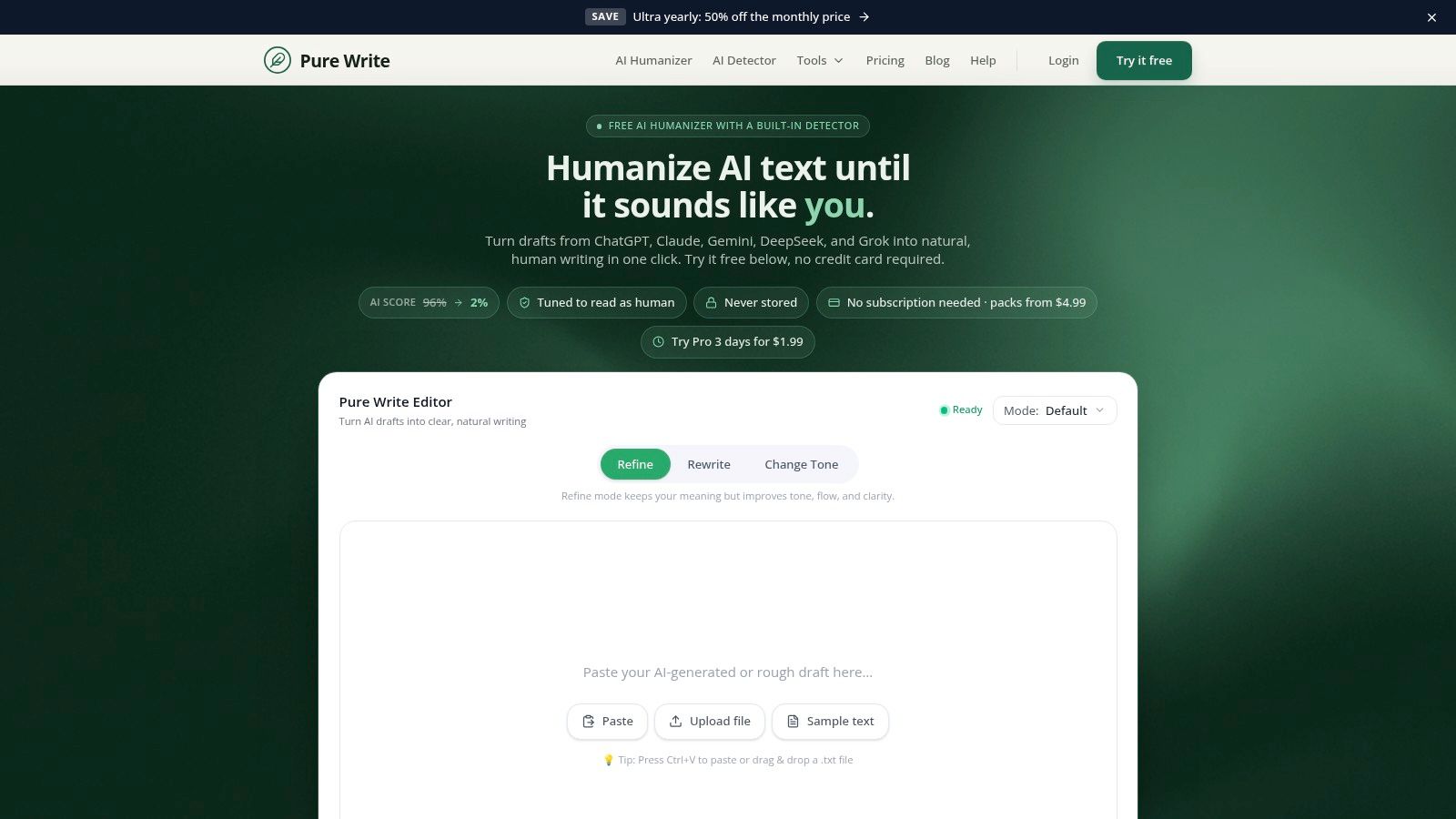
For AI-assisted editing, keep your original draft available for comparison. The editor view below provides context for reviewing a draft rather than replacing your judgment.
Give each pass a purpose
- Find boundaries first. Mark where each complete idea ends. Split overloaded sentences at genuine changes in thought.
- Inspect relationships next. Check clauses and conjunctions before deciding whether a comma belongs.
- Check small marks separately. Search for unmatched quotation marks, misplaced apostrophes, and unexplained omissions.
- Read for the recipient. Confirm that instructions, deadlines, and qualifications remain easy to find.
Mark uncertain passages instead of interrupting every pass to research a rule. Once you've clarified the sentence, return to its punctuation.
At Pure Write, we offer punctuation review and writing enhancement as aids to that process. You can compare recommendations with a manual read-through or other options in our guide to grammar checker software, then keep only changes that fit your meaning.
Keep responsibility with the author
Paste only material you're permitted to share, inspect each recommendation, and compare the revision with your original. A smoother sentence isn't an improvement if it alters a quotation, removes a limitation, or replaces your voice with generic phrasing.
UNESCO's 2023 guidance emphasizes human agency, inclusion, equity, privacy, and meaningful use, alongside teacher training and age-appropriate safeguards (UNESCO's generative AI guidance). For your editing workflow, that means retaining responsibility for claims, citations, and final wording.
Use the accompanying video as another opportunity to consider the editing workflow.
Before submitting, confirm that your use of AI follows your institution's or client's rules. Keep drafts and revision notes so you can explain how you developed the final text.
Practice Common Punctuation Fixes
Knowing a mark's name doesn't prove you can choose it well. Try repairing each example before reading the suggested version, then explain what the reader gains.
Make and explain the correction
Comma splice: “The draft is clear, the conclusion needs work.”
Corrected: “The draft is clear. The conclusion needs work.” Separate the complete judgments.Colon introducing evidence: “The notes support the decision the instructions confused readers.”
Corrected: “The notes support the decision: the instructions confused readers.” The second statement explains the first.Semicolon connecting ideas: “The headline is concise the introduction is repetitive.”
Corrected: “The headline is concise; the introduction is repetitive.” The comparison joins complete statements.Dash emphasis: Revise “The answer was obvious (revise)” without an abrupt interruption.
Suggested: “The answer was obvious: revise.” You can retain emphasis without using a dash.Parenthetical aside: “The draft references included is ready.”
Corrected: “The draft (references included) is ready.” The aside is optional.Quotation placement: In American usage, repair: The editor said, “Revise this”.
Corrected: The editor said, “Revise this.” The period belongs inside.Missing apostrophe: “The writers notes are attached,” referring to one writer.
Corrected: “The writer's notes are attached.” The apostrophe identifies possession.Ellipsis for omission: Shorten the invented sentence “We reviewed the draft, checked its references, and approved it.”
Suggested: “We reviewed the draft ... and approved it.” The omission remains visible.
Edit a message
Try: “Hi Sam the draft is ready, can you check the clients name.”
Suggested revision: “Hi Sam, the draft is ready. Can you check the client's name?” This assumes one client.
Cross-linguistic research identifies comma overuse, run-ons, and question-mark difficulties among Spanish-speaking English learners, alongside comparative work on English and Arabic (research on punctuation transfer). If a correction feels unfamiliar, compare the underlying sentence relationships rather than memorizing the replacement mark.
Build Better Punctuation Into Every Draft
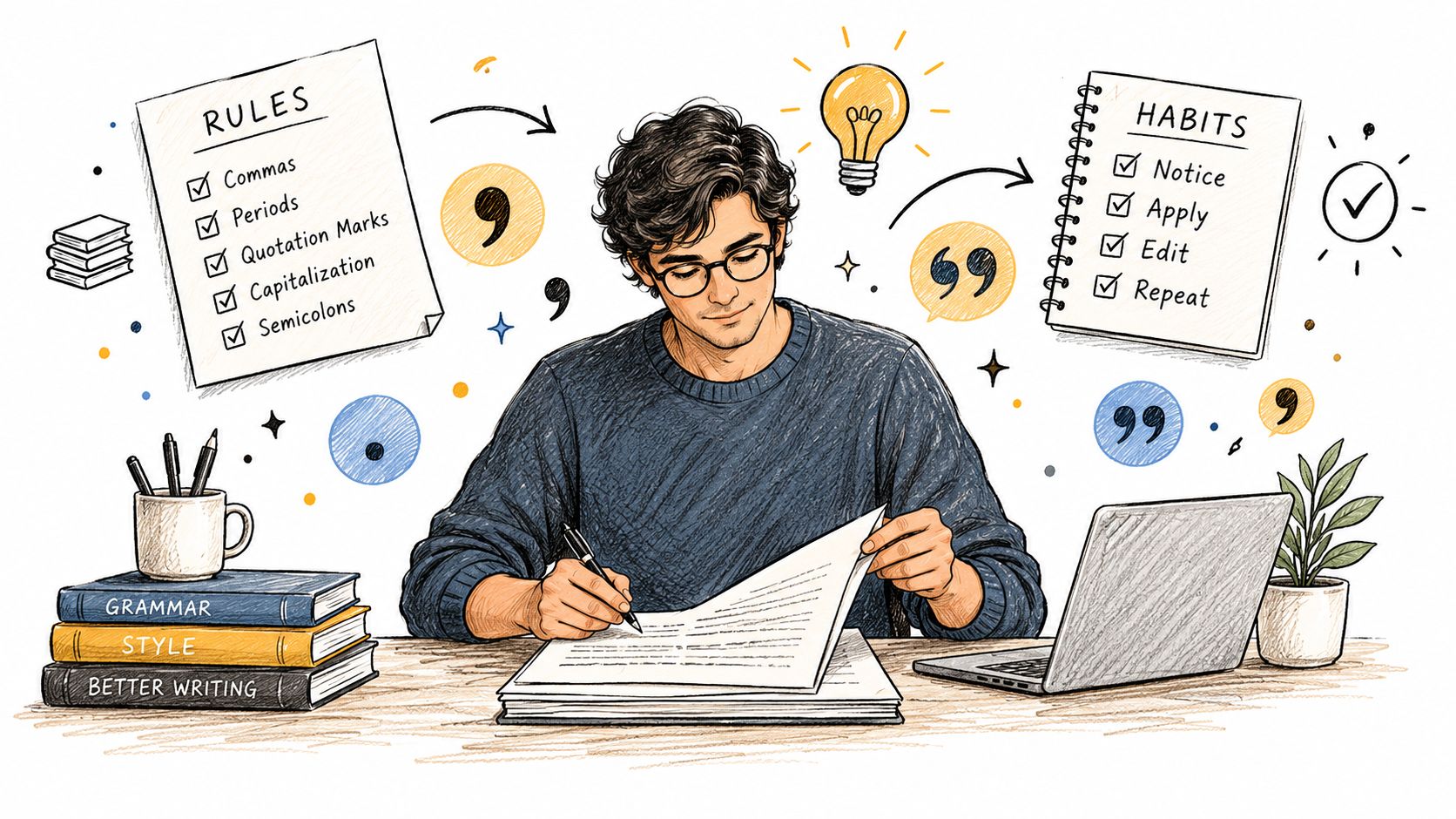
Better punctuation habits begin before your final proofread. While drafting, make the intended relationship clear enough that you can later explain each mark's purpose.
The habit is simple: choose for meaning, then verify for context. Your audience, genre, language background, and publication style all affect what readers will find clear.
Measure clarity rather than apparent humanness
Don't judge a revision by whether it looks less machine-generated. Judge whether it expresses your ideas accurately and helps the intended reader understand them.
In a 2024 study of STEM-student writing, AI detectors incorrectly labeled approximately 1.3% of essays as AI-generated, while human raters produced false-positive judgments for about 5.0% (study of AI-detection judgments). Detection results should prompt review, not establish authorship or justify an accusation.
Authentic writing means taking responsibility for the ideas and wording, not chasing a detection score.
Keep a personal editing record
- Save recurring corrections: Record a sentence you repaired and why the revision works.
- Document style decisions: Note your publication's preferences so you don't reconsider them in every draft.
- Preserve evidence of authorship: Retain notes, sources, and meaningful revision history.
Use assistance to strengthen work you understand, not to disguise authorship or submit unreviewed material. A dependable final draft is one you can explain, defend, and confidently put your name to.
We offer writing enhancement and AI-content humanization to help you revise for natural phrasing, clarity, and punctuation while keeping editorial decisions yours. Visit Pure Write with a paragraph you own, compare each recommendation with your intended meaning, and keep only the changes that make your writing clearer and more authentic.