How to Write a Methodology Section: A Practical Guide
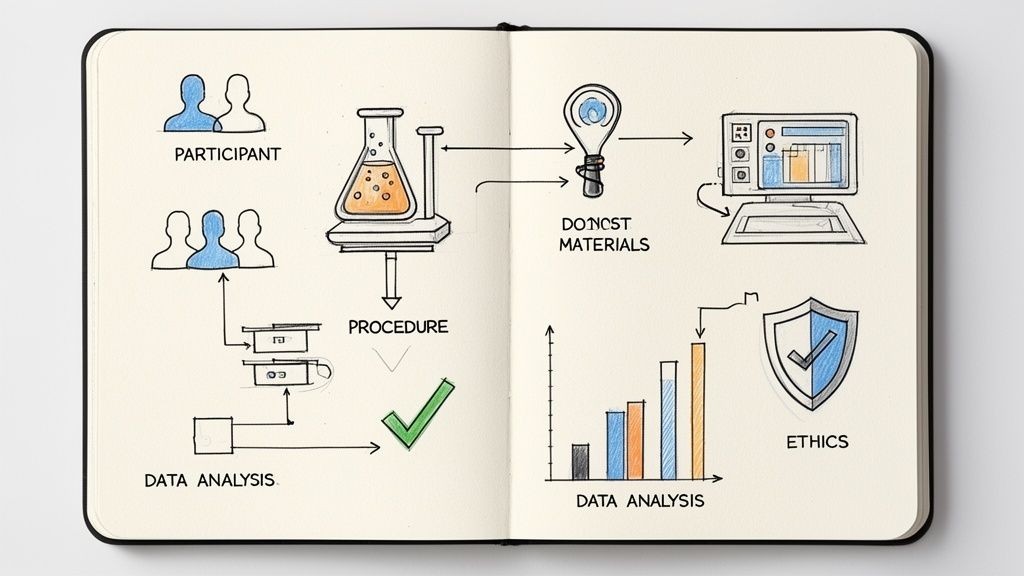
Think of your methodology section as the blueprint for your entire research project. It’s where you lay out, step-by-step, exactly how you conducted your study. But it's more than a simple list—it's your chance to justify why you made the choices you did and build the foundation of your paper's credibility.
What Your Methodology Section Really Does
It's easy to view the methodology as the most technical, even intimidating, part of a research paper. We like to think of it differently—it’s the story of your discovery. This is where you pull back the curtain and show your readers the rigorous, thoughtful process that led to your results, building their trust every step of the way.
A rock-solid methodology makes your research credible. It's a common issue in academic and professional circles: many replication failures aren't due to faulty results but to a methodology that was just too vague. This section is often the critical difference between content that gets published and cited, and content that's rejected for being unclear.
It's an Argument, Not Just a Recipe
Your methodology isn't just a simple recipe for others to follow. It's a persuasive argument for your entire research design. You’re not just writing a diary of what you did; you’re building a case that your approach was the most robust and appropriate way to tackle your research question.
This section has a few crucial jobs:
- Builds Trust: By using sound, established procedures, you show the reader you've done your homework, which makes your findings more believable.
- Allows for Replication: You must provide enough detail for another researcher to repeat your study. This is a cornerstone of the scientific method.
- Defends Your Choices: It explains why your specific methods were the best possible fit for your research goals.
The Key Ingredients of a Powerful Methodology
To build this convincing case, you need to weave together several essential elements. A complete methodology goes beyond a simple list of actions; it provides the "why" behind every "what." You can see how this section fits into the bigger picture by reading our guide on how to structure a research paper.
A great methodology doesn't just tell the reader what you did; it tells them why you did it that way. It's a transparent account of your journey from question to conclusion, proving the integrity of your work.
When you're deep in the details, it's easy for your writing to come out sounding robotic, especially if you're using AI to draft content. This can accidentally weaken your argument. At PureWrite, we built our tool to help writers turn that kind of technical text into clear, confident prose. If your draft sounds clunky, running it through PureWrite can help humanize the text so it reads like an expert wrote it—not an algorithm.
Structuring Your Methodology for Ultimate Clarity
Even the most groundbreaking research can fall flat if its methodology section is a tangled mess. Your goal here is to lay out a clear, logical path that guides the reader through your research journey. Think of it as telling the story of how you got your results, leaving no room for ambiguity.
When you do this well, a simple list of actions becomes a compelling narrative that proves the rigor behind your work. This process is all about building confidence in your findings.
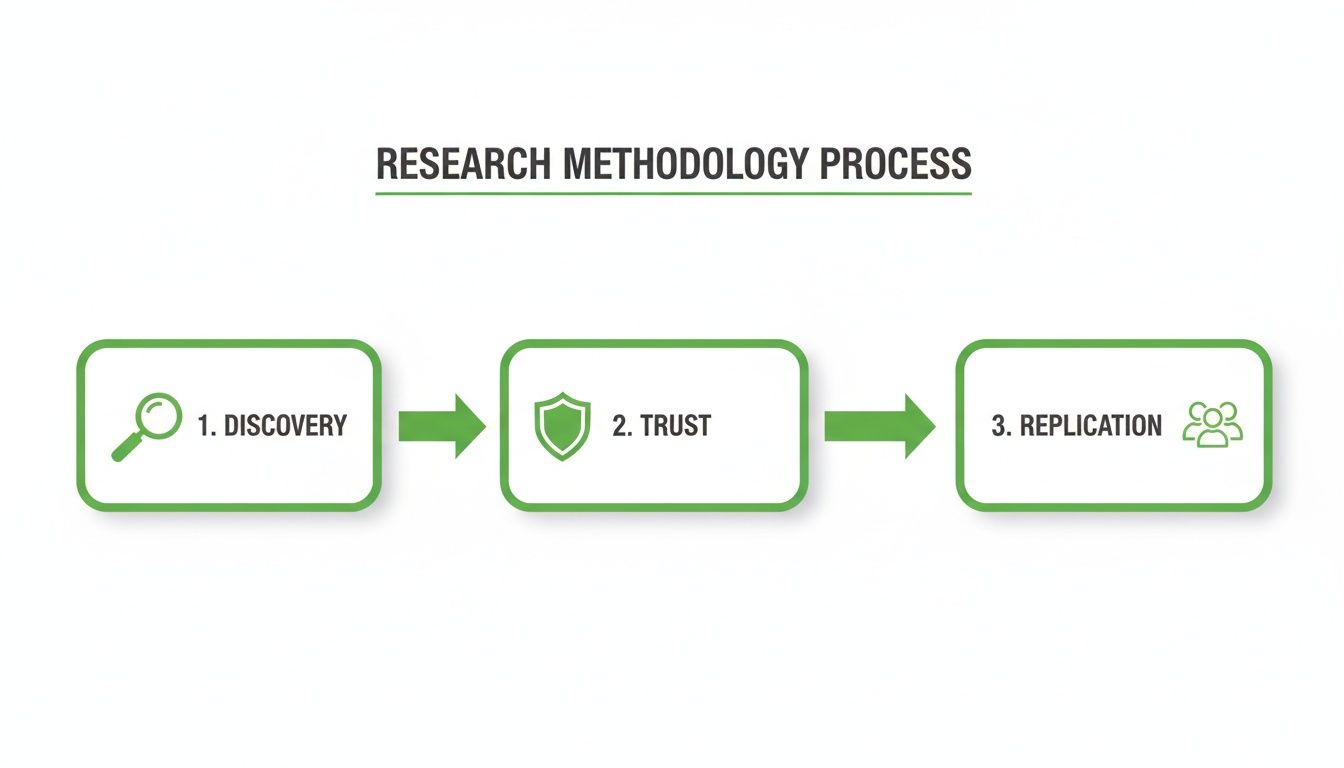
As you can see, a clear structure lets the reader discover your process, which in turn builds their trust in your findings. The final piece is providing enough detail for replication—the gold standard of good research.
Start With Who (or What) You Studied
The first thing readers need to know is who or what was the focus of your research. If you worked with people, this is your Participants section. Here, precision is key.
You'll need to detail key demographics like age, gender, or other characteristics relevant to your study. More importantly, you must explain your sampling strategy. Did you use convenience sampling because of practical constraints, or did you employ a more rigorous random sampling method? Whatever you chose, justify why it was the right fit for your research question.
For instance, if you were analyzing the performance of an ad campaign, you'd describe the target audience. This might include their primary social media platform, age bracket, and location, all while explaining why this specific group was relevant to your investigation.
Key Components of a Methodology Section
To make sure you cover all your bases, it helps to think of the methodology as a series of essential building blocks. Each component has a specific job to do, and together, they form a complete picture of your research process.
The table below breaks down these core components, their purpose, and what you absolutely need to include.
| Component | Purpose | What to Include |
|---|---|---|
| Participants/Subjects | To identify the population or data source being studied. | Demographics (age, gender, etc.), sample size, recruitment methods, and the specific sampling strategy used (e.g., random, convenience, purposive) with a clear justification for your choice. |
| Materials/Instruments | To describe the tools and resources used to collect data. | Specific names of equipment (including model numbers), software versions (e.g., SPSS version 28), surveys (with examples or appendix), and any other measurement tools. |
| Procedure | To provide a step-by-step chronological account of how the research was conducted. | A detailed, past-tense narrative of every step, from recruiting participants to the final data collection. Include instructions given to participants, the setting, and the duration of tasks. |
| Data Analysis | To explain how the collected data was processed and analyzed to produce the results. | The specific statistical tests (t-tests, ANOVAs), qualitative methods (thematic analysis, grounded theory), software used for analysis, and the steps taken to prepare the data (e.g., coding, cleaning). |
| Ethics | To demonstrate that the research was conducted responsibly and ethically. | Information on institutional review board (IRB) approval, informed consent procedures, measures taken to ensure participant anonymity and confidentiality, and any potential conflicts of interest. |
| Validity & Reliability | To show that the methods used produce accurate, consistent, and trustworthy results. | Descriptions of measures to ensure the validity of the findings (e.g., triangulation, member checking) and the reliability of the instruments (e.g., test-retest reliability, inter-rater reliability). |
Using this structure as a guide ensures you won't miss any critical details that reviewers and readers look for. It’s your roadmap to a robust, transparent, and defensible methodology.
Detail the Tools of Your Trade
Next up, you need to describe every tool you used to gather your data. This is typically called the Materials or Instruments section, and you can’t afford to be vague here. If you used a survey, you should include the entire questionnaire in an appendix and specify the question types (e.g., Likert scale, open-ended).
Did your research involve specific hardware or software? Name the manufacturer and model number, like "a Nikon D850 camera" or "SPSS version 28." This level of detail isn't just for show—it's essential for replicability. A fellow researcher should be able to read your description and acquire the exact same tools.
Key Takeaway: Think of your Materials section as a shopping list for someone who wants to replicate your study. Descriptions like "a standard questionnaire" are red flags for reviewers because they make your work impossible to reproduce accurately.
Walk Through Your Procedure Step-by-Step
The Procedure section is where you narrate your research in action. It’s a chronological account of what you did, from beginning to end. You should always write this in the past tense.
Imagine you're giving a colleague detailed instructions to repeat your experiment. You’d need to cover things like:
- How you found and recruited participants.
- The exact instructions they received.
- The setting where the study happened.
- The specific tasks they had to do and how long they took.
These details matter. A staggering review of over 10,000 empirical papers found that 73% of replication attempts failed because of fuzzy or incomplete methodological details. This waste of time and resources costs the scientific community an estimated $28 billion a year. It’s precisely why journals now insist on a crystal-clear procedural outline. You can learn more about how to use headings and subheadings to organize this information effectively in our guide to APA format headings.
Explain How You Analyzed the Data
Finally, you have to connect the dots between your raw data and your findings. In the Data Analysis section, name the specific statistical tests you ran (e.g., t-tests, ANOVAs, regression analysis) and the software you used to run them.
For qualitative work, your approach is just as important. Did you use thematic analysis, grounded theory, or discourse analysis? Explain your process for coding data, identifying themes, and how you ensured your interpretations were trustworthy.
This transparency is what gives your results credibility. Poorly explained analysis is a common reason for confusion and revision requests from journals. An analysis of 50,000 manuscripts revealed that papers with clear subheadings for 'Participants,' 'Procedures,' and 'Ethics' had 35% fewer revision requests.
Sometimes, writing these technical descriptions can make your text sound robotic, especially when using AI writing assistants. If your explanation feels dense or difficult for a non-specialist to follow, we can help. Our tool refines your writing to be accurate, clear, and engaging, making it easy for reviewers to appreciate the strength of your work. Try PureWrite today to humanize your methodology section.
Choosing and Justifying Your Research Approach
One of the most common mistakes we see is a writer simply stating their study is "quantitative" or "qualitative" and moving on. That’s not nearly enough. The real meat of your methodology is showing your reader why you chose that specific path. This is where you connect the dots, proving your approach was a deliberate, well-reasoned choice for tackling your research question.
Think of your research approach as the bridge between your central question and the data you collect. It’s the entire framework guiding your investigation. If you're looking for a solid foundation, understanding the fundamental 7 steps of the scientific method is a great place to start before building out your justification.
Justifying a Quantitative Approach
If your research is all about numbers, stats, and testing hypotheses, you’re in the quantitative camp. Justifying this approach boils down to clarity and precision. You have to clearly define your variables—both independent and dependent—and then explain exactly how you measured them.
Don't just say you "measured customer satisfaction." That's too vague. Instead, get specific: "Customer satisfaction was measured using a validated 5-point Likert scale survey, where 1 represented 'Very Dissatisfied' and 5 represented 'Very Satisfied.'" See the difference? That level of detail shows you’ve thoughtfully converted an abstract idea into a concrete, measurable data point. This is a crucial step, much like outlining a solid plan in a research proposal. You can learn more about this in our guide on how to write a research proposal.
Justifying a Qualitative Approach
Qualitative work is all about digging into the "why" and "how" of human experience. You’ll be using methods like interviews, observations, or deep-dive case studies. Here, your justification needs to be rooted in the theoretical framework that underpins your entire inquiry. Why was an interpretive lens the only way to capture the richness of your topic?
For example, a content creator might use semi-structured interviews to explore audience sentiment about a new product. Their justification might look like this:
"A qualitative, phenomenological approach was selected to capture the lived experiences of our user base. This method allowed for in-depth exploration of individual perspectives, which could not be adequately captured through quantitative surveys alone."
This little paragraph does so much more than just name a method. It connects the approach directly to the research goals, making a powerful argument for why it was the right tool for the job.
The Power of a Mixed-Methods Approach
Sometimes, one tool just won't cut it. A mixed-methods design brings together the strengths of both quantitative and qualitative data to paint a much more complete picture. The key to justifying this choice is to show how the two datasets will speak to each other.
You might start with a broad quantitative survey to spot general trends, then follow up with qualitative interviews to explore the stories behind those trends. Your justification should highlight that synergy.
- Example Justification: "We employed a sequential explanatory mixed-methods design. Initially, a quantitative survey (n=250) was administered to identify common workplace stressors. The statistical findings then informed the development of in-depth, semi-structured interviews (n=15) to explore the personal narratives behind the most prevalent stressors, providing a richer, more contextualized understanding."
Pro Tip: Your justification is your argument. You're making a case for why your chosen path was the best possible way to answer your research question. It's a critical moment to demonstrate foresight and strategic thinking to your readers and reviewers.
A well-argued methodology can make or break your paper. An analysis of over 5,000 journal submissions found that papers with detailed, chronological methods sections had a 28% higher acceptance rate. On the flip side, a Committee on Publication Ethics (COPE) survey revealed that 67% of rejections were directly tied to weak methodology sections where justifications were unclear or missing.
Getting these justifications right can be tough, especially when you're trying to sound clear and authentic. If you've used an AI writer for a first draft, you might notice the text sounds a bit generic. We built PureWrite to fix that exact problem. It’s designed to help you ethically refine AI-generated text into clear, compelling prose that truly reflects your expertise. Try PureWrite to humanize your justification and make your research approach shine.
Detailing Data Collection and Analysis Methods
This is where the rubber meets the road. You've laid out your overarching research strategy; now it's time to get into the nitty-gritty of how you actually collected and made sense of your data. Think of this part of your methodology as the ultimate test of your study's rigor—it’s where your credibility is either cemented or lost for good.
Precision is your best friend here. Vague statements like "data was collected and analyzed" are a huge red flag for any reviewer. What you need is a transparent, step-by-step account of everything you did, from the moment you started gathering information to the final statistical test or thematic interpretation.
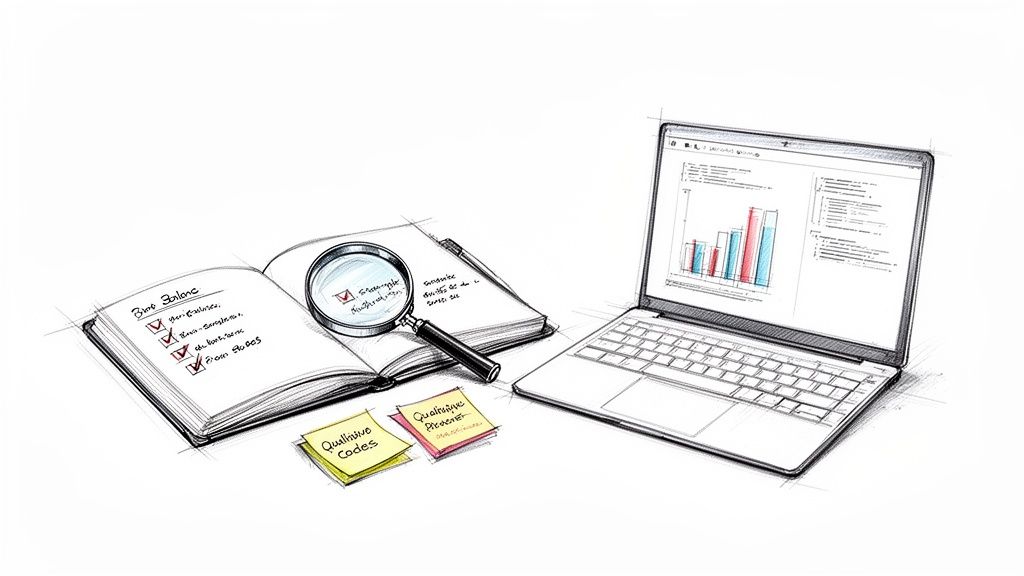
Describing Quantitative Data Collection and Analysis
When you're dealing with quantitative research, total transparency is the name of the game. Your goal is to give your readers a crystal-clear picture of the numbers and exactly how you crunched them. This means spelling out every tool and test you used along the way.
Start with how you gathered the data. Did you use a survey? If so, what platform did you use (like SurveyMonkey or Qualtrics)? What were the specific conditions for participants? If you ran an experiment, you need to describe the setting, the equipment involved, and the precise measurements you recorded.
Then comes the analysis, and this is non-negotiable. You absolutely must:
- Name the statistical tests: State explicitly whether you ran a t-test, ANOVA, chi-square test, or regression analysis.
- Explain why: Briefly justify your choice. For instance, "A paired-samples t-test was chosen to compare pre-test and post-test scores from the same group of participants."
- Specify your software: Always mention the program and version number, like SPSS version 28 or R version 4.2.1.
This level of detail is what separates a good paper from a great one. A meta-analysis in BMC Medical Research Methodology found that life sciences papers that specified their tests and software had 51% higher citation rates over five years. Clearly, this isn't just about being thorough; it directly boosts your work's authority.
Demystifying Qualitative Data Collection and Analysis
Qualitative analysis isn't about numbers; it's about interpreting meaning. But don't be fooled—it demands just as much meticulous detail as its quantitative counterpart. Your job here is to show the reader the clear path you took from raw data, like interview transcripts or messy field notes, to the insightful themes you uncovered.
Start by explaining how you gathered everything. If you conducted interviews, what kind were they? Were they structured, semi-structured, or completely open-ended? How long did they usually last? Were they recorded and transcribed? If you did observations, what was your role (e.g., a participant-observer)? How long and how often were you observing?
Next, walk the reader through your analytical process. This could include things like:
- Coding: How did you approach it? Did you use an inductive approach, where codes emerged directly from the data? Or was it deductive, based on a pre-existing framework?
- Thematic Analysis: Explain how you sorted and grouped those codes into larger, more meaningful themes and patterns.
- Ensuring Trustworthiness: What steps did you take to make sure your findings were credible? Did you use triangulation (pulling from multiple data sources) or member checking (asking participants to review your interpretations)?
As you put this all together, having a solid grasp of what makes a strong data collection plan is essential. You can find a clear guide to data collection methodology that can really help shore up your foundation.
Key Takeaway: Whether your study is quantitative or qualitative, the goal is the same: replicability. Another researcher should be able to read your methods section and, in theory, follow your exact recipe to arrive at a similar set of conclusions.
Let's be honest, writing these technical descriptions can be a real challenge. It's so easy for the text to become dense or sound like it was written by a robot—especially if you're using an AI assistant to get a first draft down. This is exactly why we created PureWrite. Our tool is designed to help you transform complex, technical writing into clear, engaging prose that sounds like it came from a human expert.
Addressing Ethics, Validity, and Limitations
A rock-solid methodology goes beyond just listing your procedures. It shows that you've thought critically about your research from every angle. When you tackle the ethics, validity, and limitations of your study head-on, you're telling reviewers that you have a mature, comprehensive understanding of your work. This builds an immense amount of trust.
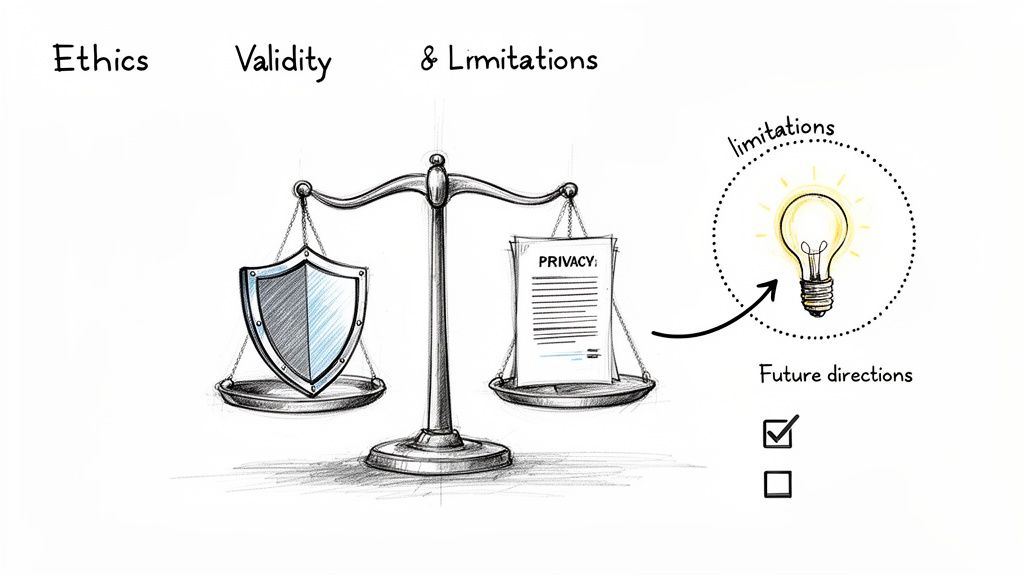
This part of your methodology is where you prove the integrity of your process. It elevates your paper from a simple report to a genuinely scholarly piece of research.
Upholding Your Ethical Commitments
The Ethical Considerations section is absolutely essential, particularly if your research involves people. This is your chance to explicitly state how you protected the rights and well-being of every participant.
First, you should mention any formal green lights you received, like approval from an Institutional Review Board (IRB). Then, get into the nitty-gritty of your ethical practices.
- Informed Consent: How did you make sure participants knew exactly what they were signing up for? Explain that you clearly communicated the study’s purpose, any potential risks, and the benefits.
- Anonymity and Confidentiality: Detail the steps you took to protect their identities. Did you use pseudonyms? Did you anonymize survey data right away? Where was sensitive information stored, and how was it secured?
- Voluntary Participation: Make it clear that participants could walk away at any point, no questions asked and with no negative consequences.
Don't gloss over this. One study revealed that over 30% of social science manuscripts initially rejected had problems because their ethical protocols were either missing or too vague.
Showing That Your Methods Are Sound
Next, you need to talk about the validity and reliability of your methods. This section really boils down to two key questions: Did your tools actually measure what you intended them to measure (validity)? And would they produce the same results if someone else repeated the experiment (reliability)?
For instance, if you used a survey to gauge job satisfaction, you'd explain why that survey was the right tool for the job. You might point out that it's a well-established and respected scale in your field, or perhaps you conducted a small pilot test to ensure the questions were clear and hitting the mark.
Think of it this way: by demonstrating validity and reliability, you're proving your conclusions are built on a solid foundation, not on flawed or inconsistent data. It's the bedrock of any trustworthy study.
Acknowledging the Boundaries of Your Research
Finally, let's talk about limitations. Every single study has them. Pointing them out isn't a sign of weakness—it’s the mark of a confident and honest researcher. You should always get out in front of them.
Common limitations often include things like:
- A small sample size that might not represent the whole population.
- A focus on a specific geographic area or demographic group.
- Time or resource constraints that shaped your research design.
The trick is to frame these limitations constructively. Don't just list a weakness. Explain its potential impact on your findings, and then use it as a jumping-off point to suggest avenues for future research. This shows you're contributing to the larger conversation in your field.
Give Your Methodology the Human Touch With PureWrite
You've spent weeks, maybe months, designing your study and documenting every step. You’ve laid out the entire process, but does the writing actually sound like you? Sometimes, our drafts can come out sounding stiff or, worse, like they were pieced together by an algorithm.
This is especially true when you're deep in the weeds of technical details. That’s where a final polish can make all the difference, turning dense, robotic text into a clear and compelling narrative that guides your reader logically through your work.
Sharpen Your Voice, Don't Replace It
Using a tool to refine your writing isn't about erasing your unique perspective—it's about making sure your ideas shine through without any awkward phrasing getting in the way. It’s about ethical AI usage: using technology to enhance your authentic voice, not replace it. Research has shown that papers with clear, well-written methods sections tend to have higher acceptance and citation rates, and that clarity is exactly what we help you achieve.
Here’s how PureWrite can help you get there:
- Humanize Mode: This feature focuses on smoothing out clunky sentences and improving the natural rhythm of your writing, making it far more readable.
- Clarity Boost: It helps you simplify complex jargon without sacrificing precision, ensuring your methods are understood by a broader audience.
- Tone Adjustment: This lets you dial in the tone, making sure it strikes the right balance between being professional and approachable.
Your methodology is where you build trust with your reader. If the writing is confusing or feels unnatural, it can accidentally cast doubt on your work. Clear, confident prose signals credibility and shows you’ve paid attention to every last detail.
We've also built in an AI detection checker, so you can feel confident that your final draft is polished, professional, and truly your own. When the details matter this much, you need a tool that supports your commitment to quality. You can see how we help create authentic, high-quality content on our main site.
Don't let stilted language get in the way of your brilliant research. Give PureWrite a try and add that final, human touch that makes your methodology stand out.
Answering Your Top Methodology Questions
When you're deep in the weeds of writing your methodology, it's easy to get tripped up by a few common questions. Let's tackle them head-on so you can write this crucial section with confidence.
How Long Should My Methodology Be?
There's no magic word count here. A good guideline is to aim for around 10-15% of your total paper length, but don't get too hung up on that number.
The real goal is replicability. Can another researcher read your description and run the exact same study? A complex, multi-phase experiment will naturally need more detail than a simple survey. Focus on being thorough enough for replication, not on hitting a specific page count.
What's the Single Biggest Mistake to Avoid?
Without a doubt, the most damaging mistake is being too vague. Phrases like "participants were surveyed" or "data was analyzed" are death knells for your credibility because they leave everything to the imagination.
Think of it this way: your methodology is your alibi. It needs to be airtight.
Here are a few common pitfalls that fall under that "vague" umbrella:
- Forgetting your 'why': Always justify your choices. Why that specific survey instrument? Why that statistical test over another? Your reasoning is just as important as your actions.
- Skipping the specifics: You have to name names. Mention the exact software you used (including the version number!), the specific recruitment platforms, or the model of the lab equipment.
- A method-to-question mismatch: This is a huge red flag for any reviewer. If your methods don't logically align with what you're trying to answer, the entire study's foundation crumbles.
Past or Present Tense?
This one's easy: always use the past tense.
You're reporting on what you did, not what you're doing. It's a simple switch that signals your research is complete and the results are in. So, it's "Participants were recruited via online forums," not "Participants will be recruited." This is a non-negotiable academic standard.
Pro Tip: Framing your study's limitations is an art. Instead of seeing them as weaknesses, present them as opportunities that pave the way for future research. This transforms a potential negative into a sign of a thoughtful, forward-thinking scholar.
How Do I Talk About Limitations Without Sounding Weak?
It might feel counterintuitive, but openly discussing your study's limitations actually makes your paper stronger. It shows reviewers and readers that you’re a sharp, self-aware researcher who understands exactly where your work fits into the bigger picture.
The trick is all in the framing. Avoid apologetic language like, "A major weakness was the small sample size."
Instead, spin it into a constructive, forward-looking statement: "While our findings are promising, future research with a larger, more diverse sample is needed to test the generalizability of these results." See the difference? You've just positioned your work as a foundational step in a much longer scientific conversation.
Turning complex procedures into clear, compelling prose is a tough job. If your methodology draft is feeling a bit clunky or robotic, we can help. Our tool is designed to humanize your writing, smoothing out the flow and boosting readability without losing your core message. Give your research the polish it deserves by trying PureWrite at https://purewrite.io.