How to Write a Research Proposal That Gets Approved
Writing a research proposal is a multi-layered process. It's about defining a sharp, clear question, digging deep into the existing literature, and laying out a methodology that’s not just credible but convincing. Think of it as the blueprint, sales pitch, and strategic plan for your entire project, all rolled into one. Your job is to persuade funders that your idea isn't just good—it's essential.
Why Your Proposal Is Your Most Important Document
Let’s get one thing straight: a research proposal is much more than an academic formality. It's the single most critical document that stands between your big idea and the green light—or funding—needed to make it a reality.
This document is your first, and often only, shot to prove your concept is viable, significant, and worth the investment. A well-crafted proposal doesn't just list methods; it weaves a compelling narrative that convinces a review committee your research is absolutely necessary. It's a strategic tool designed to grab attention and build confidence in you as a researcher.
The Blueprint For Success
Your proposal is the architectural blueprint for your entire research journey. A solid, detailed plan demonstrates foresight and a deep command of your subject. It signals to reviewers that you've thought through the potential hurdles and have a clear, practical roadmap for navigating them.
Without this strong foundation, even the most brilliant ideas can come across as half-baked and risky. You need to communicate that you're not just passionate but also organized and fully prepared to execute the project from start to finish.
This is especially critical in today’s competitive academic and scientific landscape where resources are tight. The average proposal win rate sits around 45%, but top performers consistently hit success rates over 75%. Their secret? They invest heavily in the strategic writing process. You can dig into the data behind these proposal writing service market trends and statistics.
Your proposal isn’t just about explaining what you’ll do; it’s about arguing why it must be done. It transforms a private inquiry into a public contribution, making a case for why your work deserves a place in the broader academic conversation.
More Than Just An Outline
Ultimately, a strong research proposal is an exercise in persuasion. It demands that you wear several hats at once. You have to be:
- The Visionary: Articulating a novel idea that captures the imagination.
- The Scholar: Proving you have a comprehensive grasp of your field.
- The Project Manager: Presenting a realistic, grounded timeline and budget.
- The Storyteller: Weaving all these pieces into a coherent and engaging narrative.
To give you a clearer picture, here is a quick overview of the essential sections and their primary function in your proposal.
| Anatomy of a Winning Research Proposal | |
|---|---|
| Section | Primary Goal |
| Introduction | Hook the reader, establish context, and state the core research problem. |
| Literature Review | Demonstrate your expertise and show how your work fills a gap. |
| Methodology | Detail the "how"—your research design, methods, and data analysis plan. |
| Significance/Impact | Argue for the "so what"—why your research matters. |
| Timeline & Budget | Prove the project is feasible, well-planned, and a sound investment. |
Learning how to write a great research proposal is about mastering all these roles. If you're using AI tools to help with initial drafting, remember that the final touch is what counts. It’s crucial to refine the output to reflect your unique voice and deep expertise. At PureWrite, we specialize in helping researchers transform AI-generated text into authentic, human-centric writing that truly represents their vision. The goal is a final proposal that’s polished, persuasive, and ready to win.
Finding Your Focus and Crafting a Powerful Research Question
Every great research proposal is built around an irresistible question. It’s the engine that drives the whole project. Your first, most critical task is to move from a vague area of interest to a sharp, focused inquiry.
Think about the difference between saying, "I want to study social media," and asking, "How does the use of ephemeral content on Instagram Stories affect brand loyalty among Gen Z consumers?" The first is a vast territory; the second is a specific destination. Your job is to define that destination with absolute clarity.
A compelling question doesn't just give your proposal direction—it makes a promise to the reader that you're about to tackle a specific, important problem with a well-defined plan.
From Broad Interest to Focused Inquiry
It's completely normal to start with a wide topic. The trick is to narrow it down methodically until you land on something both manageable and meaningful. You can think of it as a funnel, moving from a general theme down to a specific, researchable problem.
Let's say you're a content creator interested in the rise of remote work. That's a great start, but it's too broad. To find your focus, you can brainstorm more specific angles:
- Productivity: Do remote work policies actually boost or hinder creative team output?
- Mental Health: What are the psychological impacts of long-term remote work on junior marketers?
- Technology: Which collaboration tools are most effective for hybrid creative teams, and why?
- Corporate Culture: How can companies maintain a cohesive culture when their teams are globally distributed?
Each of these is a huge leap toward a solid research question. You’re no longer just exploring "remote work"—you're zeroing in on a particular challenge. This is the kind of focus that gets a research proposal taken seriously.
A great research question is both an anchor and a compass. It grounds your study in a specific context while guiding every decision you make, from your literature review to your methodology. It provides the "why" that justifies your entire project.
Identifying a Genuine Research Gap
Once you have a potential focus, you need to find out if it addresses a genuine research gap. A gap isn't just something no one has written about. It’s a missing piece of the puzzle in the current academic or professional conversation—an unanswered question, an outdated theory, or a new problem that existing studies don't cover.
This is where a preliminary literature search comes in. You’re not writing the full review just yet, but you do need to get a feel for the current state of play. Ask yourself:
- What are the major debates or disagreements in this area?
- What methods have other researchers used to study this?
- Are there specific populations or contexts that have been overlooked?
Answering these questions helps you position your work. For instance, if most studies on remote work focus on massive tech corporations, a study looking at its impact on small marketing agencies could fill a crucial gap.
Ultimately, your research question functions like the central argument of an essay. If you want more tips on building a strong, defensible core argument, we have a helpful guide on how to write a thesis statement that really clarifies the process.
A clear question always leads to a clear proposal. Remember that.
The Literature Review: More Than Just a Book Report
Let's be honest: many people dread the literature review. It often gets treated like a chore—a long, boring summary of every paper you’ve ever read on a topic. But that’s a huge missed opportunity.
Your literature review is actually your secret weapon. It’s not a summary; it's a carefully crafted argument. This is where you prove you’re not just a tourist in your field. You know the landscape, you understand the ongoing conversations, and you’ve spotted a critical piece of missing territory that only your research can map out.
A weak literature review just lists sources. A strong one weaves them into a story that leads, inevitably, to your research question. It convinces the reader that your study isn’t just interesting, but absolutely necessary.
From Summarizing to Synthesizing
Think of yourself less as a librarian and more as a detective building a case. Your job isn't to list clues one by one ("Smith found this, Jones found that"). It's to connect the dots and show the jury—your review committee—what it all means.
For example, a content marketer shouldn't just say: "Study A found that long-form content ranks higher. Study B also found this."
Instead, you can synthesize those findings to build your case: "While foundational studies from SEO experts established that long-form content boosts rankings, their work focused exclusively on B2B tech industries. This leaves a significant gap in understanding how content length impacts search performance for direct-to-consumer lifestyle brands."
See the difference? The second version doesn’t just report facts; it exposes a gap. To find these gaps, you need to be actively looking for a few key things:
- Common Threads: What ideas, concepts, or findings keep popping up across different studies?
- The Big Debates: Where do the heavy hitters in your field disagree? The tension in these arguments is often where the most exciting new research questions live.
- Methodological Cracks: Did past studies rely on small sample sizes? Outdated methods? Did they ignore a variable you think is crucial?
- The Story Over Time: How has the conversation around your topic evolved? Tracing this history can reveal where the field is heading next.
When you weave these elements together, your research stops feeling like "just another project" and starts feeling like the crucial next piece of the puzzle.
Structuring Your Argument
Building this kind of narrative takes a clear strategy. For a deeper dive into the nuts and bolts, this external resource offers a practical, step-by-step guide on how to write a literature review that can give you a solid foundation.
Here at PureWrite, we've also put together our own guide. It's a comprehensive walkthrough showing you exactly how to write a literature review that does more than just summarize—it argues. It’s designed to help you showcase your expertise from the very beginning.
A truly great literature review uses the past to make a powerful, persuasive case for the future of your proposed work. It should leave your reader thinking, "Of course, this is exactly what needs to be studied next."
Your literature review sets the stage. It's where you define the context, establish the stakes, and create the intellectual space that only your research can fill. A great review makes your proposed study feel inevitable.
AI as Your Research Assistant, Not Your Ghostwriter
Let's face it, wading through hundreds of articles is a monumental task. This is where AI writing tools can be an amazing assistant—if you use them ethically. You can use an AI to help summarize dense articles, spot key themes across a dozen papers at once, or even generate a first-pass annotated bibliography. It's a massive time-saver.
But here’s the critical part: the synthesis must be yours. The deep thinking that connects the sources, critiques their methods, and builds the overarching argument—that's a human job. Never let an AI create the core narrative of your literature review. Its job is to help with the heavy lifting, not to do the thinking for you.
After using an AI to help organize your material, your most important step comes next. You have to take that raw output and rewrite it in your own analytical voice. This is where we come in. Paste that AI-assisted draft into PureWrite, and our tools will help you humanize it, making sure it carries the authentic authority and critical insight that a review committee expects to see. Give PureWrite a try to turn your collection of notes into a powerful scholarly argument.
Crafting a Rock-Solid Research Methodology
Think of your research question as the destination. Your methodology, then, is the detailed, turn-by-turn roadmap that proves you know how to get there. This is where you move from the "what" and "why" to the "how." It's your chance to show the review committee that you're not just an ideas person—you're a capable researcher with a concrete, actionable plan.
A vague or poorly justified methodology is one of the fastest ways to get a proposal rejected. What reviewers are looking for is a clear, logical, and rigorous blueprint that convinces them you can actually pull this off.
Choosing Your Research Design
First things first: you need to declare your overarching approach. Will you be conducting qualitative, quantitative, or mixed-methods research? This choice isn't about personal preference; it has to be a direct answer to the demands of your research question.
Let's use a marketing example. If your question is, "What are the lived experiences of first-time online shoppers navigating a complex e-commerce site?" A qualitative approach using user interviews is a natural fit. You need rich, narrative data.
But if your question is, "Is there a statistical relationship between website load time and shopping cart abandonment rates?" then you absolutely need a quantitative design with A/B testing and analytics.
The key is justification. Don't just state your choice. You need to explain why it's the best tool for the job and, often just as importantly, why other approaches wouldn't work as well.
Detailing Data Collection and Analysis
Once you’ve set the stage with the big-picture design, it’s time to zoom in on the specifics. This is the nitty-gritty of your plan, and there's no room for ambiguity. Precision is everything.
You need to clearly lay out:
- Participants or Data Sources: Who are you studying? Be specific. Describe your target population, how you'll recruit them (sampling strategy), and your target sample size, with a clear reason for that number. If you're analyzing texts, name them.
- Instruments and Tools: What will you use to collect data? This could be anything from a validated survey questionnaire or a semi-structured interview protocol to a specific analytics platform like Google Analytics.
- Step-by-Step Procedures: Walk the reader through the entire process. How will you get consent? Where will user testing take place? What is the exact sequence of events from recruitment to data collection?
- The Analysis Plan: This is crucial. How will you make sense of all the information you gather? For quantitative work, name the statistical tests you plan to run. For qualitative data, explain your coding approach (e.g., thematic analysis).
A well-defined methodology shows you've thought through the inevitable hurdles and have a clear, actionable roadmap. This single-handedly boosts a reviewer’s confidence in your ability to actually finish the project.
Addressing Limitations and Ethical Guardrails
No study is perfect, and pretending yours is a major red flag. Being upfront about the potential limitations of your methodology doesn’t weaken your proposal—it makes it stronger.
It shows you're a critical and honest thinker. Briefly mention potential issues like a small sample size, a narrow demographic focus, or the biases of self-reported data. Then, explain the steps you'll take to minimize their impact.
Just as critical are the ethical considerations. You have to spell out exactly how you'll protect your participants. This isn't optional. Be sure to cover:
- Securing informed consent
- Guaranteeing participant anonymity and data confidentiality
- Minimizing any potential risks
- Your plan for getting Institutional Review Board (IRB) approval if applicable
Skipping this section can get your proposal tossed out immediately. Reviewers need absolute certainty that your research will be conducted ethically and responsibly. For more ideas on how to organize this information, our guide on how to structure a research paper offers principles that apply perfectly here.
Here's a tip: funders are increasingly looking for data-driven justifications for every choice. Tying your plan to clear metrics can boost approval odds by as much as 30%. For a closer look at grant statistics, you can discover more insights on Instrumentl.com.
If writing a methodology from scratch feels overwhelming, AI can be a decent starting point for brainstorming. You can ask it to suggest analysis techniques or list common ethical concerns. But the final plan, the justification, has to be yours. That’s where we come in. Use AI for the rough draft, then bring it to PureWrite to refine, clarify, and humanize the text. We’ll help ensure your methodology sounds less like a template and more like the confident, expert plan it needs to be.
Assembling Your Proposal From Title to Timeline
Alright, you’ve wrestled with your research questions and hammered out a solid methodology. Now it's time to bring everything together into a single, cohesive document. This is the part where you build the complete proposal, carefully arranging each section to create a powerful and persuasive argument.
Think of it as constructing a house. Each piece—the title, the abstract, the budget—has a specific job to do. When they all fit together perfectly, the entire structure is strong, logical, and impressive.
This flow is the backbone of any research project: you design the study, collect the data, and then analyze what you've found.
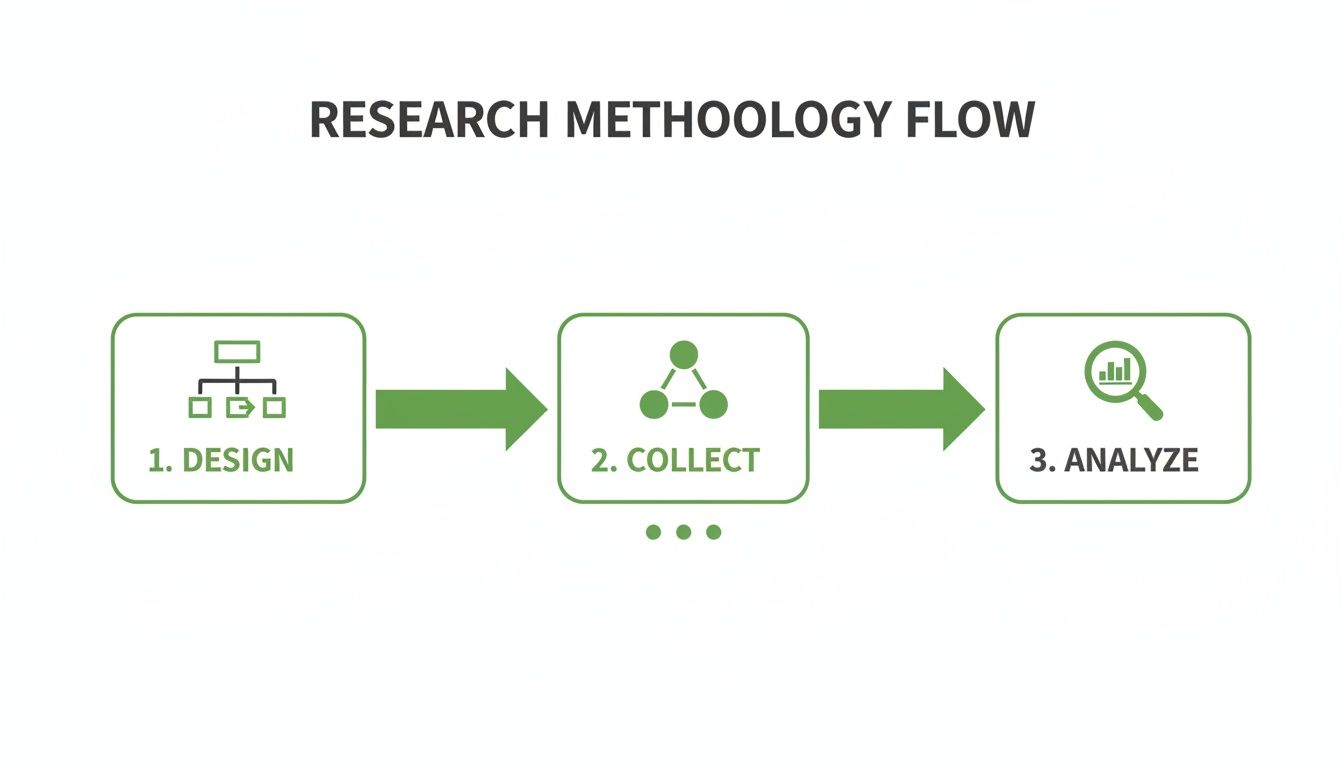
This simple diagram is a great reminder that every section of your proposal must connect. Your research design dictates how you'll gather information, which in turn shapes how you'll make sense of it all.
Crafting a Compelling Title and Abstract
First impressions matter, and your title is the very first thing anyone will read. It needs to be sharp, descriptive, and intriguing. A great title immediately tells the reader what your research is about and why it's unique. Forget clever wordplay; your goal here is crystal clarity.
Right after the title comes the abstract, which is essentially your entire project squeezed into a tiny package. In about 150-250 words, you have to nail down:
- The core problem you're addressing
- Your main research question
- A quick overview of your methods
- The anticipated findings and their importance
A punchy abstract grabs the reader and makes them want to read the rest of your proposal. It’s your elevator pitch on paper, so make every single word count.
The Introduction and Significance Statement
Your introduction is where you set the scene. Start by hooking the reader, establishing the context of the problem, and building a sense of urgency. This is your chance to create a narrative that flows directly into your research question and hypothesis.
Next, you need to answer the all-important "so what?" question in your significance statement. This isn't just about contributing to an academic debate. Explain how your work could actually make a difference. Will it change a policy? Improve a professional practice? Offer a new way of thinking? Be confident but realistic about the potential impact of your project.
One of the biggest mistakes you can make is burying the significance deep inside the proposal. You need to state why your work matters right up front. It frames how the reviewer sees everything that follows.
The Work Plan: Realistic Timelines and Budgets
This is where your abstract ideas become a concrete plan. A detailed timeline shows your committee or funders that you've thought through every stage and can realistically manage the project. Break it down into phases with clear deliverables and deadlines. If you need help structuring this, learning how to create a robust action plan is a great place to start.
Your budget needs to be just as meticulous—and more importantly, justifiable. You can't just throw numbers on a page. Every single cost, from participant gift cards to specialized software, must clearly connect back to your methodology.
- Personnel Costs: If you have a team, list who’s doing what and their compensation.
- Direct Costs: This covers tangible things like equipment, travel, and research supplies.
- Indirect Costs: Often called overhead, these are institutional costs typically calculated as a set percentage of your direct costs.
Making sure these sections are clearly formatted is non-negotiable. For tips on structuring your document so it's easy to follow, our guide on APA format for headings and subheadings is a fantastic resource.
If you used AI to get a first draft of these sections, the next step is what really counts. We can help you take that robotic text and refine it into a persuasive, human-sounding narrative that truly reflects your expertise. Give PureWrite a try to make your final proposal not just complete, but compelling.
Polishing Your Proposal for Maximum Impact
Even the most brilliant research plan can get rejected if it’s poorly presented. This is where the real work of persuasion begins—turning your solid draft into a document that’s as compelling as the ideas within it.
After pouring weeks, or even months, into your research, it’s all too easy to become blind to your own mistakes. A clunky sentence here, a bit of jargon there—these small things add up. They create friction for the reader and can quietly chip away at their confidence in your work. Your final mission is to hunt down and eliminate every single one of those friction points.
From Draft to Polished Document
This last pass is so much more than a quick spell-check. Think of it as a deep-tissue massage for your proposal, working out all the knots and stiff phrasing to improve its flow, tone, and overall impact. A good edit can be the difference between a proposal that’s just competent and one that’s truly convincing.
Here’s what you should focus on during this final stage:
- Clarity and Conciseness: Is every sentence pulling its weight? Look for words you can cut and convoluted phrases you can simplify. If a sentence makes you pause, it gets rewritten.
- Tone and Voice: Does this sound like you? Your writing should convey confidence and a genuine passion for the project. Reviewers can tell when you’re just going through the motions.
- Consistency: Are terms, acronyms, and formatting styles the same from start to finish? Small inconsistencies are distracting and look sloppy.
This process often blends different types of editing together. If you want to get into the weeds on this, our article on copy editing vs. proofreading breaks down the specific roles each one plays.
Polishing isn't about chasing perfection. It's about being persuasive. Your final edit should remove every possible barrier between your great idea and the reader fully grasping its value.
Humanizing Your Content to Connect with Reviewers
Let’s be honest: many of us use AI tools to help structure our thoughts or draft initial sections. There's nothing wrong with that, but this is the moment to make sure your voice is the one the review committee hears. Raw AI text often feels sterile and lacks the personal touch that builds trust.
Used ethically, AI can be a massive time-saver. Some studies show that AI-integrated writing can slash production time by 60%. More importantly, teams that reinvest that saved time into strategy see their proposal win rates jump from an average of 45% to over 75%. You can dig into the data on proposal management software trends to see for yourself.
This is where a tool like PureWrite comes in. When you run your AI-assisted drafts through our 'Humanize' mode, it smooths out the robotic phrasing and improves the natural flow. It makes sure your methodology is clear, your arguments are engaging, and the final document feels like it came from a person, not a program.
Ready to give your proposal the final polish it deserves? Try PureWrite today and see how it transforms your draft into a convincing document that gets noticed.
Common Questions About Writing a Research Proposal
If you're staring down the barrel of writing a research proposal, you're not alone in having a few questions. We've seen countless students and researchers wrestle with the same hurdles, so let's clear up some of the most common ones.
What's the "Right" Length for a Proposal?
This is probably the most frequent question we get. The honest answer is, "it depends," but that's not very helpful. In most cases, you're probably looking at a document that's 10 to 25 pages long, not counting your bibliography or any appendices.
Of course, a massive, multi-year project might need 50 pages to do it justice. The real goal isn't hitting a specific page count; it's being comprehensive without being long-winded. Every single page has to earn its spot and push your core argument forward.
How Much Research Do I Need to Do Before I Even Start Writing?
The short answer is: a lot more than you probably think. You need to dive deep enough into the existing literature to prove there's a real, identifiable gap that your work will fill. You can't just have a hunch; you need evidence.
Your proposal isn't a wish list or a vague idea. It’s the blueprint. It proves to the committee that you've already done the heavy intellectual lifting and have a solid, workable plan ready to go from the moment you get the green light.
You also need to have done enough background work to select a methodology that's not only appropriate but also defensible. Reviewers can spot a flimsy or ill-conceived research design from a mile away.
Can I Use AI Tools to Help Me Write It?
Absolutely, as long as you use them smartly and ethically. AI can be a fantastic assistant for tasks like summarizing a dense article or catching awkward phrasing.
But—and this is a big but—it cannot be the author. Your core argument, your critical insights, and your unique perspective have to be front and center. Raw AI text just doesn't have the sophisticated nuance or authoritative voice that a review committee is looking for. It's a tool, not a replacement for your own expertise.
Once you've used AI to help brainstorm or organize your thoughts, the next step is to make the text truly your own. That’s where a tool like PureWrite comes in. It’s built to help you refine and humanize your draft, ensuring your final proposal is polished, compelling, and sounds like the expert you are.