Master Your Essay: How to Write a Thesis Statement That Drives Your Argument
To nail a strong thesis statement, you need to start with a specific, arguable claim that gives your reader a sneak peek at the main points you're about to make. This single sentence, usually found at the end of your introduction, is the roadmap for your entire essay.
What a Thesis Statement Actually Does
Think of a thesis statement as the engine of your paper. It’s not just a quick summary of your topic; it's the core argument that drives everything forward. Without a solid thesis, your writing risks becoming a jumble of disconnected facts and ideas.
A well-crafted thesis is a promise you make to your reader, setting clear expectations about what you're going to prove. It's what separates a memorable, persuasive argument from a forgettable report that just wanders.
This one sentence is also your best friend for staying on track. As you dig into research and start writing, your thesis becomes your compass, making sure every paragraph and piece of evidence connects directly back to your central claim.
The Blueprint for Your Argument
A strong thesis gives your paper structure and purpose, turning scattered thoughts into a logical argument. At its heart, a good thesis performs four critical jobs, which we'll break down below.
The Four Core Functions of a Thesis Statement
| Function | What It Does for Your Paper |
|---|---|
| Presents a Debatable Claim | It's not a fact; it's a specific, arguable interpretation that you will defend with evidence. |
| Narrows Your Focus | It takes a broad topic and zooms in on a manageable scope, like turning "climate change" into a specific argument about its economic impact. |
| Provides a Roadmap | It hints at the structure of your paper. Each point it raises corresponds to a section or paragraph in the body of your essay. |
| Creates a Unified Whole | It ensures every part of your paper—from evidence to analysis—works together to support one central idea. |
Each of these functions is essential for building a coherent and convincing paper. This highly structured approach is a cornerstone of modern writing.
In fact, studies have shown that teaching students how to write a sharp thesis can improve paper coherence by over 40%, which really underscores its importance. You can learn more about its role in composition from guides at Indiana University.
A thesis statement is your paper's central nervous system. It connects every idea, argument, and piece of evidence back to a single, controlling purpose.
Ultimately, mastering thesis statements is a huge step in your development as a writer. For more tips on sharpening your scholarly voice, check out our guide on how to improve academic writing.
If you've used an AI writing tool to generate a draft that feels stiff or lacks a clear argumentative edge, let PureWrite help. We can help you humanize it ethically, refining your thesis for clarity and punch so your authentic message connects with your audience.
The Anatomy of a Powerful Thesis Statement
A great thesis statement is more than just a topic sentence. It’s a bold claim, a specific argument, and a clear guide for your reader, all packed into one or two sentences. Think of it as having three non-negotiable parts.
If you nail these, you're building your entire paper on a rock-solid foundation.
It All Starts with an Argument
First and foremost, your thesis has to be arguable. This is the absolute heart of it. A thesis can't just be a fact that everyone already agrees on.
For instance, stating "The internet provides access to information" isn't a thesis; it's just true. There's nothing to prove. An arguable thesis, on the other hand, is a claim that someone could reasonably challenge, which forces you to back it up with evidence.
Let's try that again: "While the internet has democratized information, its reliance on algorithms has created echo chambers that are more damaging to public discourse than beneficial." Now that's an argument that needs a vigorous defense.
Specificity is Your Best Friend
Next up, your thesis must be laser-focused and specific. Vague statements like "Social media has changed society" are a dead end. The topic is so massive that your essay will end up being a mile wide and an inch deep.
You have to narrow it down. Which part of social media? How did it change what aspect of society?
A much stronger, more specific version might be: "The rise of ephemeral content on platforms like Instagram and Snapchat has shortened consumer attention spans, forcing brands to adopt more aggressive and fragmented marketing strategies." See how this gives you a clear, manageable lane to write in?
Your Thesis Must Be a Roadmap
Finally, a strong thesis acts as a roadmap, giving your reader a sneak peek of the main points you're about to cover. It sets expectations and shows that you have a clear, organized plan for your argument.
Take this example: "Corporate wellness programs often fail to address burnout because they focus on individual coping mechanisms instead of correcting systemic issues like excessive workload and toxic company culture."
This sentence tells the reader exactly what's coming. They know the essay will first tackle individual coping mechanisms, then move to excessive workloads, and finally discuss toxic culture. Getting this structure right often comes down to smart sentence construction, where understanding things like clauses in grammar can make a world of difference.
Your thesis is the single most important sentence in your essay. It’s your argument, your guide, and your promise to the reader, all rolled into one. Treat it with the attention it deserves.
The proof is in the data. A meta-analysis of over 10,000 student essays found that approximately 78% of the highest-scoring papers had thesis statements that were arguable, specific, and provided a clear roadmap.
Balancing these three elements is a skill that takes practice. Maybe you’ve used an AI tool to get some ideas, but the thesis it generated feels a bit lifeless or generic. At PureWrite, we're here to help you refine that initial draft, sharpen your claim, and ensure your authentic voice shines through with confidence.
Adapting Your Thesis to Different Essay Types
A thesis statement isn't a one-size-fits-all component you can just drop into any paper. The very purpose of your essay—whether you're aiming to persuade, analyze, or simply explain—dictates what your thesis needs to accomplish.
Trying to use a persuasive thesis for an explanatory paper is like bringing a sledgehammer to a job that needs a screwdriver. It’s the wrong tool. To write a thesis that actually works, you have to first understand the specific demands of the essay you're tackling.
Crafting a Thesis for Argumentative Essays
Argumentative essays are about taking a firm stand. Your job is to convince the reader that your position on a debatable topic is the most sensible and well-supported one. This means your thesis statement has to be a bold, clear, and defensible claim.
It's not enough to just state your opinion. You have to frame it as an assertion that you can back up with solid evidence and logical reasoning.
Let's see how we can turn a flimsy observation into a strong argumentative thesis:
- Weak Idea: "Working from home is a popular trend." (This is just a fact, not an argument.)
- Strong Thesis: "While remote work offers flexibility, its widespread adoption is detrimental to early-career professional development due to the erosion of mentorship opportunities and the challenges in building a strong corporate culture."
See the difference? The second version takes a clear stance, hints at a counterpoint (flexibility), and outlines the specific evidence (mentorship, culture) that will form the backbone of the essay. For a deeper dive, check out our guide on how to write a persuasive essay.
Building a Thesis for Analytical Essays
Unlike an argumentative essay, an analytical essay isn't about taking sides. Instead, you're tasked with dissecting something—a novel, a film, a marketing campaign—and offering a thoughtful interpretation of how its different parts create a larger meaning.
So, your thesis for an analytical paper won't be a simple "for or against" statement. It’s an interpretive claim that presents your unique insight. You're essentially arguing for a specific way of understanding the material.
In an analytical essay, your thesis is your unique interpretation. You are telling the reader, "Here is how this text works, and here is the evidence that proves my reading is valid."
For instance, if you're analyzing a classic novel for a class, a weak thesis might just state the obvious. A strong one will propose a fresh, specific interpretation.
- Weak Idea: "F. Scott Fitzgerald's The Great Gatsby is about the American Dream." (This is a topic, not an analysis.)
- Strong Thesis: "In The Great Gatsby, F. Scott Fitzgerald uses the recurring symbol of the green light to critique the illusion of the American Dream, portraying it not as an attainable goal but as an ever-receding, intangible fantasy."
This thesis doesn't just mention a theme; it argues how the novel conveys its message by pointing to a specific literary device—the green light.
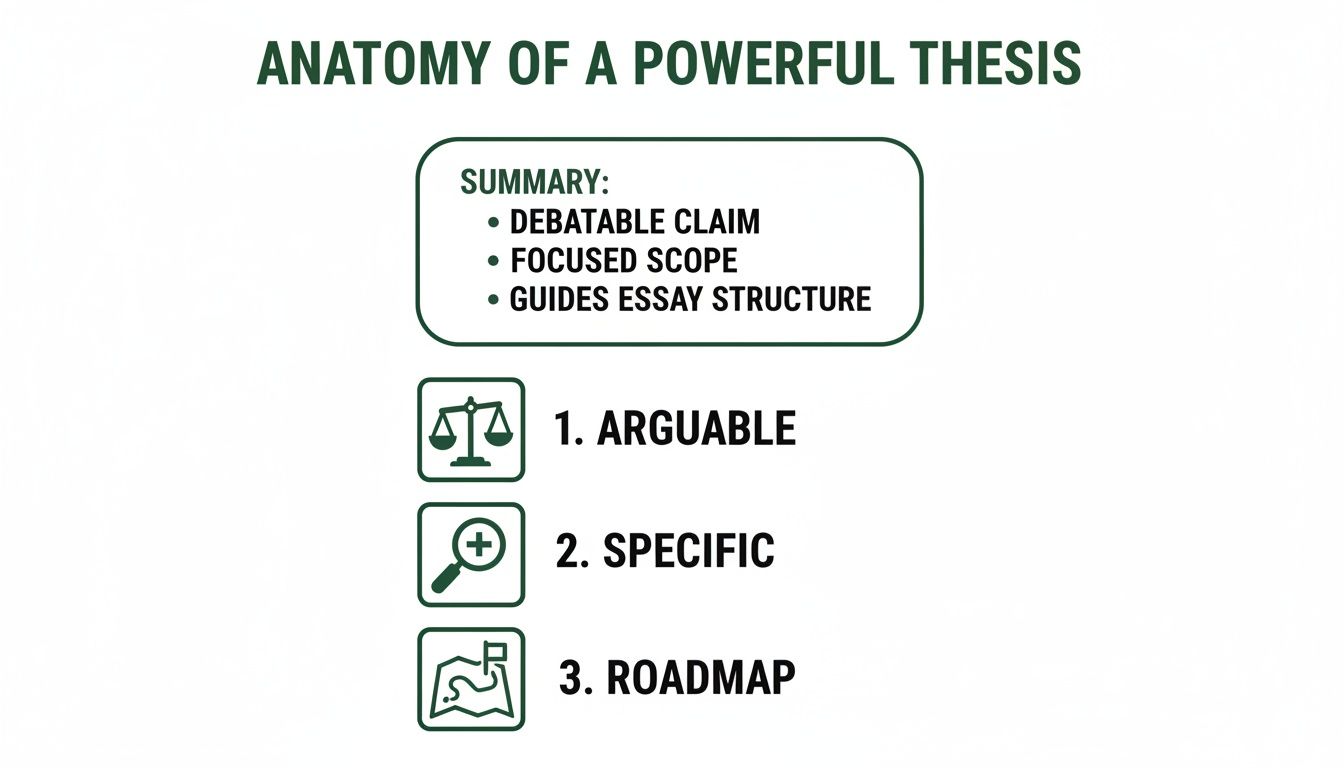
As the visual shows, whether you're arguing a point or analyzing a text, your thesis must always be arguable, specific, and act as a clear roadmap for what’s to come.
Formulating a Thesis for Expository Essays
Expository essays are all about explaining, describing, or informing. Here, your goal is to present a balanced and clear picture of a topic, not to persuade your reader. The thesis for an expository essay, sometimes called a "controlling idea," simply sets the stage for the information that will follow.
It doesn’t make a debatable claim. Instead, it clearly announces the specific facets of the topic your essay will explore, serving as an organizational guide for your reader.
Let's look at how to narrow a huge topic into a manageable expository thesis.
- Broad Topic: "The history of the internet."
- Focused Thesis: "The development of the modern internet was driven by three key innovations: the creation of ARPANET for decentralized communication, the invention of the World Wide Web for public accessibility, and the rise of commercial search engines for information organization."
This thesis is perfectly clear. It states the topic and breaks it down into the three distinct parts the essay will explain. There's no debate—just a straightforward, informative roadmap.
Sometimes an AI writer might generate a thesis that sounds too aggressive for an expository piece or too vague for an argumentative one. This is where you need to step in and calibrate the language. With PureWrite, you can ethically refine that AI-generated draft to match the precise tone and structure needed, making sure your final thesis is both authentic and perfectly suited for its purpose.
From First Draft to Final Polish
Your first crack at a thesis statement is almost never your best. That's okay—in fact, it's expected. Think of that initial attempt as a "working thesis." It’s a flexible signpost guiding your research and writing.
The real work happens during revision. This is the stage where you have to be your own toughest critic, stress-testing the strength and clarity of your core claim. A well-revised thesis doesn't just sound smarter—it makes your entire paper more focused and persuasive.
A Practical Checklist for Strengthening Your Thesis
Got a draft? Great. Now it's time to run it through this checklist. Each of these questions is designed to find weak spots and show you how to fortify them. Be brutally honest with yourself here.
- Is it actually arguable? Read your thesis and ask, "Could someone reasonably disagree with this?" If the answer is no, you've probably just stated a fact.
- Is it specific enough? Vague words like "society," "important," or "negative" are giant red flags. Hunt them down and replace them with something precise. Specificity is what gives your argument its bite.
- Does it pass the "so what?" test? Honestly, this might be the most important question. Why should your reader care? Your thesis needs to hint at the bigger picture, showing what new insight they'll get from reading your essay.
- Does it offer a clear roadmap? Look at your thesis. Can you predict the main points your essay will cover? If not, you might need to tweak the wording to preview the key pieces of evidence or sub-arguments you plan to use.
Of course, this whole process is much easier when your research is solid and well-organized. Sharpening your skills on how to take study notes that actually work can build a much stronger foundation for your argument from the start.
A great thesis isn’t just written; it’s forged through revision. Each edit sharpens its edge, making your argument more precise, more defensible, and more impactful.
Refining Your Language for Maximum Impact
Once you're confident in the argument itself, it's time to polish the language. The words you choose can be the difference between a thesis that feels clunky and one that lands with confidence.
Zero in on your verbs. Strong, active verbs inject life into your writing. Don't just say, "Social media is a problem for communication." Try something like, "Social media platforms fracture public discourse by creating ideological echo chambers." "Fracture" is far more vivid and specific.
Polishing with an Ethical AI Partner
Here’s where many content creators and students hit a wall, especially if they’ve used AI for early drafts. An AI-generated thesis might be technically correct, but it often lacks a human touch. It can sound generic or robotic, completely missing your unique voice.
At PureWrite, we believe your authentic voice should always be front and center. That’s why we built our platform to be a refining tool, not a ghostwriter. You can bring in an AI-generated thesis—or your own messy first draft—and use PureWrite to humanize it.
Our tool can help you:
- Improve clarity and flow: Get suggestions for alternative phrasing to make your argument more elegant and easier to follow.
- Adjust the tone: Make sure your thesis sounds academic and confident, but not stiff or unnatural.
- Enhance concision: We’ll help you trim the fat, cutting unnecessary words to make your claim more direct and powerful.
This is an ethical way to use AI—you’re using technology to sharpen your own ideas, not to have it think for you. The end goal is a thesis that's not only strong but also sounds like you. For more tips, you might find our guide on how to improve English writing skills helpful.
The revision process is about taking complete ownership of your argument. Give your first draft a spin in PureWrite and see how a little polish can make your argument shine.
Common Thesis Statement Mistakes to Avoid
Even seasoned writers can stumble into a few common traps when crafting a thesis. The good news is that once you learn to spot these pitfalls, they’re easy to fix. Think of this as a quick troubleshooting guide for your core argument.
Getting the thesis wrong isn't a minor slip-up; it can derail your entire paper. A weak thesis—one that’s just an announcement or an obvious fact—leaves no room for discussion and gives your reader no compelling reason to continue.
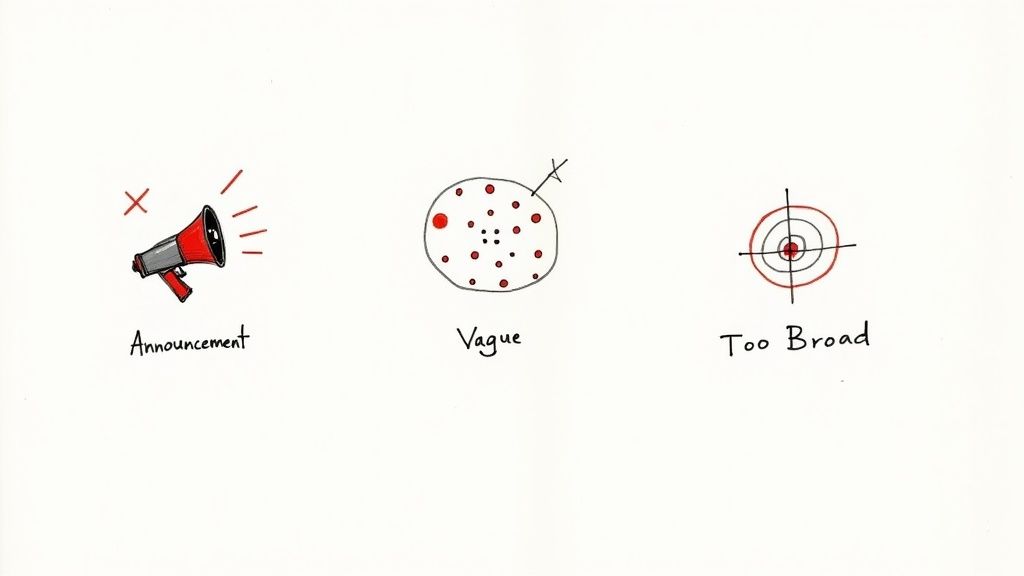
The Announcement That Goes Nowhere
One of the most frequent missteps is writing a thesis that simply announces the essay's topic. It tells the reader what you’re writing about but doesn't actually make an argument.
You've probably seen them before:
- "In this essay, I will discuss the effects of social media on teenagers."
- "The topic of this paper is the importance of renewable energy."
These statements signal your intent but lack the intellectual tension that a strong thesis needs. The fix? Take a stance. Don’t just announce the subject; make a specific, debatable claim about it.
- Better: "While social media offers teenagers valuable social connections, its algorithm-driven nature fosters a toxic culture of comparison that is detrimental to their mental health."
See the difference? We’ve gone from a flat announcement to a real argument with a clear direction.
The Statement of Undisputed Fact
Another classic mistake is mistaking a simple fact for a thesis. A fact isn't arguable—it's just a piece of information everyone already agrees on. If your thesis is a fact, you have nothing to prove.
Here’s a perfect example of what not to do:
- Mistake: "Exercise has many health benefits, like better heart function and weight management."
Who would argue with that? To fix this, you have to find an angle that pushes beyond the obvious. Your goal is to offer a fresh interpretation or a specific perspective on that fact.
- Better: "Although the physical benefits of exercise are widely known, its most critical impact is on mental health, making it an underutilized tool for mitigating symptoms of anxiety and depression in young adults."
This version takes a common fact and gives it a sharper, debatable edge by focusing on a specific impact and a particular demographic.
A thesis must be a claim, not a fact. A fact ends the conversation. A claim invites one. Your goal is to start a thoughtful discussion, not just state the obvious.
The Thesis That’s Way Too Broad
A thesis is not a bucket; you can't throw everything into it. When a thesis is too broad, it makes a huge, sweeping claim that would be impossible to support in a single essay.
For instance:
- Mistake: "Globalization has changed the world."
This is true, but "the world" is a massive place, and "changed" is incredibly vague. You could write an entire library on this topic and still not cover it.
The solution is to get specific. Narrow your focus to a particular effect, a certain region, or a defined time period.
- Better: "Globalization has fundamentally weakened the economic sovereignty of developing nations by forcing them to compete in markets dominated by multinational corporations."
Now that is a manageable argument. For more tips on refining your wording, check out our guide on how to paraphrase without plagiarizing.
AI writing tools often generate these kinds of vague, overly broad statements. Your job is to step in and inject the necessary human specificity and nuance. PureWrite is built for this exact task—helping you transform generic AI content into sharp, focused arguments that truly reflect your own critical thinking.
Frequently Asked Questions About Thesis Statements
Even after you get the hang of writing a thesis statement, some questions always seem to linger. Let's clear up some of the most common ones so you can move forward with confidence.
Can a Thesis Statement Be More Than One Sentence?
It's a great question, and the short answer is: rarely. The gold standard for almost any academic essay is a single, concise sentence. For your typical paper or blog post, one sentence is the way to go.
The one-sentence rule forces you to sharpen your thinking and distill your entire argument down to its core. If you find yourself needing two sentences, take it as a challenge. You'll almost always end up with a stronger, more impactful claim when you combine them.
Where Does the Thesis Statement Go in an Essay?
You’ll want to place your thesis statement at the end of your introductory paragraph. This is the classic, most effective spot for it.
Think of your introduction as a funnel. You start broad by introducing the topic, provide some context, and then narrow down to your specific argument—the thesis. This placement gives your reader a clear roadmap of exactly what you intend to prove.
Can I Change My Thesis Statement While Writing?
Absolutely! In fact, you should. It's a huge misconception that your thesis is carved in stone the moment you write it.
Your first draft of a thesis is really just a working thesis. It's a starting point that gives your research and writing direction. But as you dig into your sources, your perspective will almost certainly change.
Your thesis is a living part of your essay. Allowing it to evolve as you write is not a weakness but a critical step in developing a sophisticated and well-supported argument.
Refining your thesis as you go is a sign that you're engaging deeply with your topic. It's how great papers and content are made.
And speaking of staying organized through the writing process, good tools make a world of difference. For students juggling multiple projects, using some of the best Notion templates for students can be a lifesaver for managing research notes, outlines, and deadlines.
What Is the Difference Between a Thesis and a Topic Sentence?
This one is crucial. Both are guideposts, but they operate on totally different levels. Imagine your essay is an army.
- The Thesis Statement is the general, in command of the entire operation. It makes the single, overarching claim for the whole essay.
- A Topic Sentence is a lieutenant, leading a specific platoon. It makes a smaller claim that governs just one body paragraph, and its sole purpose is to support the general's master plan.
Every single topic sentence in your essay should directly connect back to and support your main thesis. If you find a paragraph's topic sentence wandering off, it’s a red flag that needs to be addressed.
Crafting the perfect thesis is a skill that takes practice, mixing sharp thinking with clear, persuasive writing. If you've used an AI tool to brainstorm but the results feel a bit flat or robotic, PureWrite can help. Our tool is built to humanize AI-generated text, helping you refine your thesis for clarity, tone, and impact. It ensures your unique voice shines through and leads the argument. Give it a try for free at https://purewrite.io.
Ready when you are.
Paste your draft, get writing that reads as yours.
No card required.