How to Write Product Descriptions That Actually Sell
A great product description does one thing exceptionally well: it translates cold, hard features into compelling benefits that solve a real problem for you. The best copy doesn't just list specs; it taps into emotion and experience, making you feel completely understood and confident you're making the right choice.
The Unseen Sales Power of a Great Product Description
It’s time to stop thinking of product descriptions as just filler text. In e-commerce, your words are your best salesperson, working tirelessly to connect with customers who can't physically hold or see your products. This is the critical moment where a casual browser decides to become a paying customer.
A well-crafted description doesn't just describe—it persuades. It gets ahead of your questions, eases your doubts, and paints a clear picture of how a product will make your life better. This is where you build trust and showcase the real value you’re offering.
How Your Words Directly Impact the Bottom Line
Every abandoned cart is a missed connection, and often, the culprit is a lack of clarity. A landmark study by the Nielsen Norman Group found that a staggering 20% of failed online purchases happen because of unclear or incomplete product information.
That statistic is huge. It means when you nail your product descriptions—making them clear, benefit-driven, and engaging—you’re plugging a major leak in your sales funnel. This is especially important when using AI tools for initial drafts; the final human touch is what truly makes copy convert, and we built PureWrite to help you do just that.
Your product description isn't just a technical field to fill out. It’s a direct conversation with your potential customer. Make it count by speaking their language and focusing on what they need.
The Psychology of an Online Shopper
Let's be real: online shoppers are on a mission to find a solution. It could be the perfect gift, a tool to make life easier, or something that helps them express who they are. Your description needs to connect directly with that motivation.
Here’s what a great product description does on a psychological level:
- Builds Trust: Honest, detailed copy shows you care about your customer's experience and aren't trying to hide anything.
- Reduces Risk: By answering questions before they're even asked, you remove the uncertainty that kills a sale.
- Creates Desire: It helps the shopper picture themselves using and loving the product, forging an emotional connection.
- Reinforces Your Brand: The tone and language you choose show customers who you are, attracting the right kind of people.
To give you a quick cheat sheet, here are the core elements we'll be diving into.
Key Elements of a High-Converting Product Description
| Element | Why It Matters | Quick Example |
|---|---|---|
| Audience Focus | Speaks directly to the customer's needs and pain points. | Instead of "Made with titanium," try "Lightweight titanium build means no more arm fatigue." |
| Benefit-Driven Language | Translates features into tangible outcomes for the user. | "Our noise-canceling headphones help you find focus in any environment." |
| Scannable Format | Uses headings, bullets, and short paragraphs for easy reading. | Short, punchy bullet points highlighting the top 3 benefits. |
| Brand Voice & Tone | Creates a consistent and relatable brand personality. | A playful tone for a toy store vs. a professional tone for B2B software. |
| SEO Keywords | Helps customers find your product through search engines. | Naturally weaving in terms like "waterproof hiking boots for women." |
This table is just a snapshot. Mastering these skills is key to crafting content that truly connects. In fact, many of these principles are universal, overlapping with the strategies in our guide on how to write engaging content.
Ultimately, your goal is to bridge the gap between a flat digital image and a real-world experience. You do that with authentic, human-centric writing that informs, persuades, and even delights. Ready to transform your product pages? Let's get started.
First, Get Inside Your Customer's Head
Before you write a single word about your product, you have to stop thinking about your product. It’s a bit counterintuitive, we know. But the best product descriptions aren't about the product at all—they're about the person buying it. The most persuasive copy speaks directly to a customer's real-world problems, needs, and desires.
Many writers and marketers fall into the trap of leading with features like "hand-sewn sequins." Here’s the thing: your customer doesn't really care how the sequins got there. They care about how they'll look and feel at that party. This shift in perspective is the secret sauce behind every product description that actually converts.
Learn to Speak Their Language
To truly connect with your audience, you have to understand how they talk. You need to get inside their head and hear their frustrations and hopes in their own words. This process, often called audience analysis, is simpler than it sounds and gives you the raw material for copy that resonates. If this is new territory for you, our primer on what is audience analysis breaks it all down.
Here are a few of our go-to methods for eavesdropping (ethically, of course):
- Mine Product Reviews: Dig into reviews for your own products and, more importantly, your competitors'. Look for the exact phrasing people use to describe their problems ("I was always struggling to find the time...") and what made them happy ("...it made me feel so organized").
- Snoop on Social Media: Check the comments on your brand’s social media posts, but also look at what people are saying to your competitors and relevant influencers. What questions pop up again and again?
- Lurk in Forums: Find the online communities where your ideal customers hang out, like Reddit, niche forums, or Facebook groups. Observing these candid conversations is gold—it reveals their true priorities and the natural language they use.
When you immerse yourself in their world, you start to pick up their vocabulary. This lets you mirror their language back to them in your copy, creating an instant connection that builds trust.
Sketch Out a Quick Buyer Persona
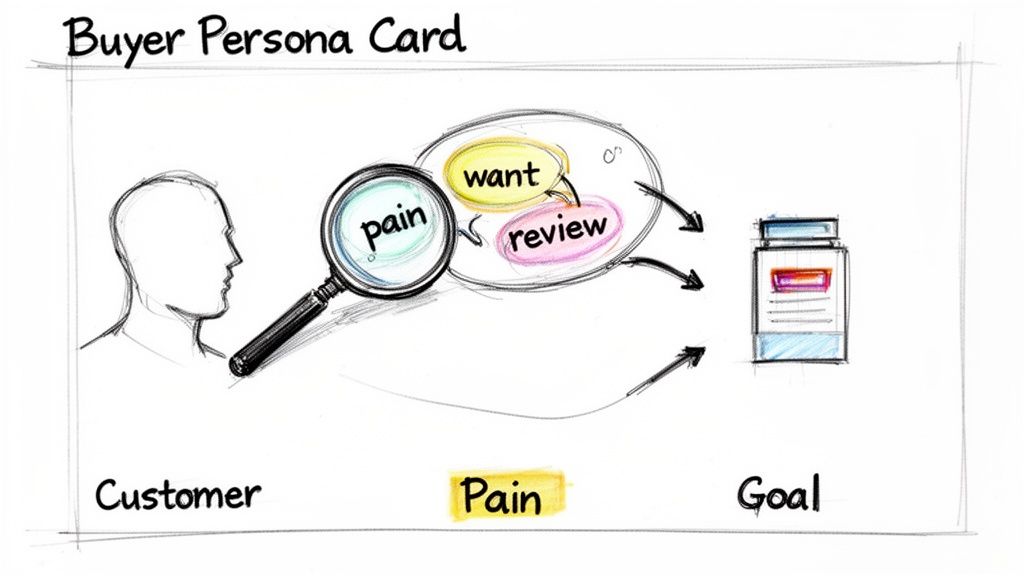
Once you've gathered all these nuggets of insight, it's time to organize them. You don't need a massive, complicated marketing document. Just create a simple sketch of your ideal customer for this specific product. Think of it as a cheat sheet to keep your writing focused.
A buyer persona is your North Star. It ensures every word is aimed squarely at the person who needs your product most, turning a generic sales pitch into a helpful, one-on-one conversation.
Your persona just needs to answer a few key questions. What’s the real problem they’re trying to solve? And what does their ideal solution look like?
Let’s say you’re selling a beautifully illustrated family calendar. Your research shows your target customer is a busy parent juggling way too much.
Example Persona Sketch: The Overwhelmed Organizer
- Pain Point: Feeling frazzled and constantly worried about forgetting appointments, soccer practice, and that random school bake sale.
- Aspiration: Wants to feel in control and cut down on the daily chaos. They're chasing a feeling of calm and order.
- Their Words: They use phrases like "chaotic," "juggle everything," "mental load," and "stay on top of it all."
Armed with this, your job gets a whole lot easier. Instead of a bland opening like, "This calendar has beautiful illustrations," you can hook them with a solution: "Finally get your family's chaotic schedule organized in one beautiful place."
See the difference? You’re immediately showing them you get it. You’re not just selling them a calendar; you’re selling them a solution to their stress. This groundwork makes every other step in the writing process simpler and far more effective.
Turn Features Into Benefits Your Customers Actually Care About
Here’s a hard truth about writing product descriptions: nobody cares about your product. What they do care about is what your product can do for them. They’re buying a better version of themselves—more efficient, more confident, more comfortable.
Your role isn't just to list specs. It's to be a translator. You need to take a cold, technical feature and transform it into a warm, relatable benefit that solves a real problem or fulfills a deep desire. This is the heart and soul of copy that sells.
The "So What?" Test: Your Secret Weapon
The easiest way to bridge that gap from feature to benefit is a simple exercise we call the "So What?" Test.
For every single feature you list, ask yourself, "So what?" And don't stop at the first answer. Keep asking until you land on a tangible, emotional outcome for the customer.
Let's walk through it with a high-powered blender.
- Feature: It has a 1500-watt motor.
- You ask: So what?
- Answer: Well, it blends tough stuff really fast.
- You ask again: So what?
- Answer: It means you can make a green smoothie without gritty kale bits, and it only takes a few seconds.
- The Benefit: Effortlessly pulverize ice and tough greens for a perfectly silky smoothie in under 60 seconds.
See the difference? We went from a boring number (1500 watts) to a delicious, fast, and satisfying real-life experience. That’s what makes a product feel essential.
A feature is what your product has. A benefit is what your customer gets. Always, always lead with what they get.
From Tech Specs to Real-Life Wins
This approach works for literally anything you're selling. The mission is always the same: connect a product detail to a human experience.
For a Laptop:
- Feature: Solid-state drive (SSD).
- Benefit: Boot up your laptop and launch apps in seconds. Stop waiting and start creating.
For a Face Serum:
- Feature: Contains hyaluronic acid.
- Benefit: Deeply hydrates your skin for that plump, dewy look that lasts all day.
For a Raincoat:
- Feature: Heat-sealed seams.
- Benefit: Stay bone-dry and comfortable, even when you’re caught in a sudden downpour on your morning commute.
In every example, the benefit paints a vivid picture. Your customer can almost feel themselves being more productive, looking more radiant, or staying dry and cozy. This is one of the most fundamental persuasive writing techniques you can have in your toolkit.
Putting This Into Practice
Ready to do this for your own products? It's simple. Open a document and make two columns: Features and Benefits. In the first column, list every single technical spec, material, and component. Be exhaustive.
Then, go down the list item by item and apply the "So What?" test. Push past the obvious first answer to find the real emotional payoff. This simple framework forces every detail in your description to earn its keep.
This process is also your secret weapon for ethically humanizing AI-generated copy. An AI can list features flawlessly, but it often misses the emotional core. That’s where you come in. Take that list, breathe life into it, and craft a story that connects. You can use PureWrite to help streamline this process, turning a description that informs to one that truly sells.
Crafting a Structure That Converts and Ranks
Even the most brilliant copy will fall flat if it’s just a giant wall of text. A smart structure is your secret weapon. It guides your eye directly to the "Add to Cart" button and tells search engines your page is a high-quality, relevant answer to a query.
Think of it as building a clear, inviting path for both people and algorithms. You need to hook them with a killer headline, pull them in with a relatable intro, and make the core benefits impossible to ignore.
The Anatomy of a High-Performing Description
While every product is unique, the most effective descriptions share a common DNA. They kick off with a strong, benefit-focused headline that demands attention. Right after that comes a short, narrative paragraph that sets the scene and makes an emotional connection.
From there, you get into the good stuff. Scannable bullet points are your best friend for highlighting the top 3-5 benefits, letting skimmers absorb the most important info in seconds. Finally, a crystal-clear call-to-action (CTA) tells them exactly what to do next.
The best product descriptions are built for scanners. Lead with your most compelling benefit in the headline, use bullet points for clarity, and make key phrases bold. This ensures your message gets across even if someone only reads 25% of the text.
This visual hierarchy is all about presenting information in a logical, persuasive flow. This image perfectly illustrates the journey from a simple product feature to the ultimate value a customer gets.
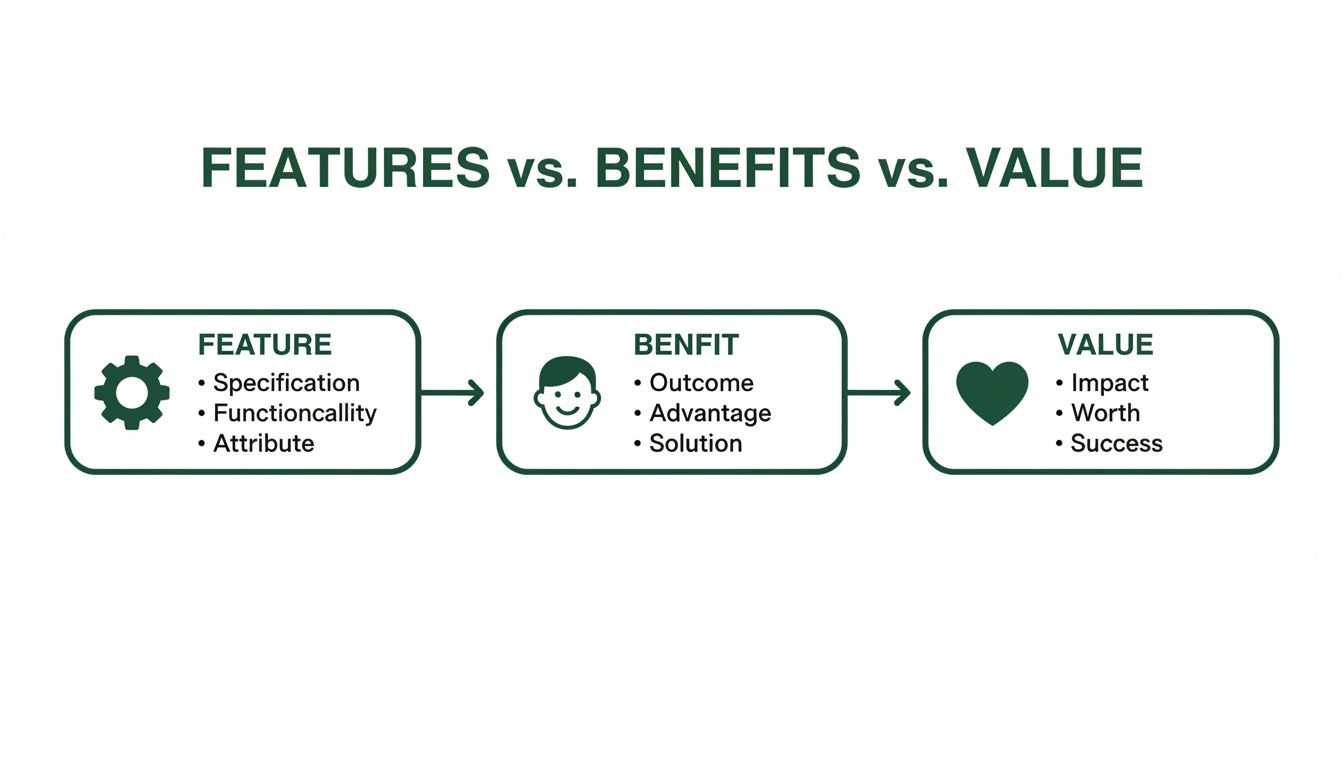
As you can see, the real magic happens when you connect a technical spec to a tangible benefit, which then delivers an emotional payoff. That progression is the backbone of a structure that truly converts.
Formatting for Readability and SEO
Great formatting isn't just about making things look pretty; it's about psychology and SEO. When text is easy on the eyes, people stick around longer—a huge positive signal to Google. It also makes your most persuasive points pop off the page.
Here are a few formatting rules we never break:
- Short Paragraphs: Keep them to 2-3 sentences, max. This creates welcome white space and keeps readers from feeling overwhelmed.
- Bullet Points: Use them to spell out benefits, not just list features. They're perfect for breaking up text and making information easy to digest.
- Bold Text: Be strategic. Use bolding to emphasize your most critical benefits, keywords, or unique selling points.
Getting this right is more important than ever. The Product Information Management (PIM) market is expected to reach $24.82 billion by 2026, all because e-commerce businesses need structured, high-quality product data to compete. It shows just how vital clear, organized information is for scaling sales.
Weaving in Keywords Naturally
Your structure needs to be a natural home for your keywords, not a place to stuff them. Your primary keyword should ideally appear in your headline or the very first sentence, where it carries the most weight. From there, you can sprinkle it—along with secondary keywords—naturally throughout your main paragraph and bullet points.
Always remember: write for humans first. Keyword stuffing sounds robotic and clunky, which kills trust and can actually hurt your search rankings. For more specific ideas on blending keywords and compelling copy, these performance-first tactics to optimize your Amazon product listing are a great resource.
Product Description Templates for Different Niches
Starting from scratch can be tough. The good news is you don't have to reinvent the wheel. Below are a few tried-and-true templates that you can adapt to fit almost any product.
| Template Style | Best For | Key Components |
|---|---|---|
| The Problem-Agitator-Solution | Products that solve a clear pain point (e.g., skincare, cleaning supplies, productivity tools) | - Start by stating a common problem. - Agitate the problem to build emotion. - Introduce your product as the perfect solution. |
| The Storyteller | Lifestyle brands, artisanal goods, products with a unique origin story | - Open with a relatable anecdote or scenario. - Weave benefits into the narrative. - Connect the product to the customer's identity or aspirations. |
| The Feature-to-Benefit Bridge | Technical products, electronics, items with complex specifications | - State a technical feature clearly. - Immediately translate it into a tangible benefit ("which means you can..."). - Use bullet points for easy comparison. |
These frameworks give you a solid starting point. Pick the one that best fits your product and audience, and then infuse it with your unique brand voice.
When you're working with AI-generated drafts, the structure and flow can sometimes feel a little stiff. That’s where a human touch makes all the difference. We designed PureWrite to help you refine that structure, ensuring the final copy is not only optimized but reads like it was written by a real person.
Refining Your Copy with Tools and Testing
Getting that first draft down is a huge milestone, but the real magic happens when you start refining it. This is where you polish your copy, turning a good description into a powerful sales engine that not only reads well but actually performs.
The final polish is so much more than just catching typos. It’s about fine-tuning the tone, checking for readability, and making sure every single word earns its spot. This is especially true if you’ve used AI to get a head start—those drafts often need an authentic human touch to truly connect.
Elevating Your Copy with Writing Tools
Modern writing assistants are more than just grammar checkers. They can be a fantastic co-pilot, helping you elevate your writing so it truly clicks with your audience. Think of them as a fresh pair of eyes that can spot awkward phrasing or a tone that feels just a little bit off-brand.
When we built PureWrite, this was exactly our goal. It’s designed to help you ethically humanize AI-generated text, keeping your authentic voice while boosting clarity and flow. You can paste in your draft, get instant feedback, and apply nuanced suggestions that make your copy sound less like a robot and more like a real person.
The best writing tools don't just fix mistakes; they help you find a better way to say what you mean. They sharpen your message, ensuring it’s clear, persuasive, and perfectly in sync with your brand.
Whether you're wrestling with a clunky sentence or just want to double-check that your tone is on point, these tools offer the support you need. For a deeper dive into this crucial stage, our guide to effective editing and revising is packed with practical strategies.
The Power of A/B Testing Your Descriptions
You can follow every best practice in the book, but you'll never truly know what works best until you test it. A/B testing, or split testing, is simply comparing two versions of your product description to see which one performs better. It’s a data-driven approach that completely removes the guesswork.
The idea is simple: show version A to one group of visitors and version B to another, then measure what happens. By changing just one thing at a time, you can pinpoint exactly what makes your audience tick.
Here are a few easy elements you can start A/B testing right away:
- Headlines: Pit a benefit-driven headline against one that highlights a cool feature.
- Bullet Points: Try reordering your bullets. Does leading with a different benefit grab more attention?
- Calls-to-Action (CTAs): Test "Add to Cart" against "Buy Now." You might be surprised which one gets more clicks.
Even tiny tweaks can lead to big wins. By constantly testing and learning, you’ll build a powerful library of insights about what your customers actually respond to.
Key Metrics to Track for Success
To figure out if your tests are working, you need to track the right numbers. Page views are nice, but you need data that ties directly to your sales goals. This is where you can start applying proven conversion rate optimization best practices and turn those insights into real revenue.
Keep a close eye on these key performance indicators (KPIs) to see what’s truly moving the needle:
- Conversion Rate: This is the big one—the percentage of visitors who actually buy something. A higher conversion rate means your description is doing its job and persuading shoppers.
- Add-to-Cart Rate: This metric shows how many visitors put the product in their cart. It’s a fantastic indicator of purchase intent and proves your description has piqued their interest.
- Bounce Rate: A high bounce rate means people are landing on your page and leaving without doing anything. If a new description lowers that number, you know you’ve made it more engaging.
By tracking these metrics, you can make smart, data-backed decisions. Your product description process shifts from a purely creative exercise to a strategic part of your business. You stop guessing and start knowing what drives results.
Your Product Description Questions, Answered
Alright, you've got the strategy down, but now you're in the trenches, and the real questions start popping up. Let's tackle some of the most common hurdles writers and content creators face when putting these ideas into practice.
So, How Long Should This Thing Actually Be?
Honestly, there's no magic number. It all comes down to what you're selling.
For a simple t-shirt, a quick, punchy paragraph and a few bullet points will do the trick. But if you’re selling something complex like a high-end camera, you need to go deeper. Your customer has more questions and more at stake, so your description needs to build serious trust and justify the investment.
As a solid rule of thumb for most products, aim for a 2-3 sentence paragraph that sets the scene, followed by 4-6 scannable bullet points that drive home the best parts.
How Do I Figure Out the Right SEO Keywords?
Start by getting inside your customer's head. What would they type into Google? Forget the jargon and think about the real words people use when they're trying to solve a problem your product fixes.
Once you have some ideas, use a keyword research tool to find a primary keyword (like "ergonomic office chair") and a few long-tail variations ("best office chair for lower back pain"). It's also a smart move to peek at what your top competitors are ranking for—it’s a goldmine of ideas.
When you have your list, get your main keyword into your product title and the first sentence of the description. Then, naturally work in the other related terms. The key word here is naturally.
The absolute biggest mistake you can make with product SEO is keyword stuffing. Jamming keywords into every sentence sounds robotic, which instantly kills trust. AI content is particularly vulnerable to this, as studies show up to 60% of AI-generated content can be flagged as spammy or unoriginal if not properly edited.
What are the Biggest Mistakes People Make?
Hands down, the most common blunder is just listing features. A feature is what your product is; a benefit is why you should care. Always build that bridge for them. Don't just say "titanium alloy frame"; say "lightweight titanium alloy frame so you can carry it all day without a second thought."
Another classic mistake is using fluffy, meaningless phrases like "high-quality." It means nothing without proof. Instead of telling them it's high-quality, show them. Talk about the Italian leather, the hand-stitched seams, or the rigorous testing process. Be specific.
A few other pitfalls to watch out for:
- A Clashing Tone: You wouldn't use a super playful, jokey tone for a life-saving medical device. Match your voice to the product and the audience.
- The Wall of Text: No one wants to read a dense block of text. Break it up with short paragraphs, bolding, and bullet points. Make it easy on the eyes.
- A Weak Finish: You’ve done all the work to convince them, so don't forget to tell them what to do! A clear "Add to Cart" or "Customize Yours Now" is essential.
How Can I Weave Storytelling into a Description?
Storytelling is your secret weapon for making someone feel something about your product. It’s how you turn a boring object into an aspirational part of their life. You need to paint a picture so vivid they can see themselves in it.
Instead of just describing a coffee maker's specs, sell the experience. Try something like: "Imagine waking up to the rich aroma of freshly brewed coffee, starting your day with a perfect, velvety latte without ever leaving your kitchen." See? That little story makes the product so much more compelling.
You're not selling a thing; you're selling the feeling, the outcome, the better version of their life. This is precisely where authentic human writing leaves generic AI content in the dust.
Ready to make your product descriptions do the heavy lifting? The final piece of the puzzle is making sure your copy sounds like it was written by a real person, for a real person. That's where we come in. Our tool, PureWrite, helps you ethically transform those clunky, AI-generated drafts into natural, persuasive copy that truly connects and converts. Give PureWrite a try and start writing descriptions that actually sell.