What is audience analysis? Master insights to boost engagement

Before you write a single word that truly connects, you have to know who you're writing for. This simple, powerful idea is the core of audience analysis. It's the process of getting to know the people who will read, watch, or listen to your work on a deeper level.
A Practical Introduction to Audience Analysis
Think of it like a chef planning a menu. If they don't know whether their diners are vegan, allergic to nuts, or absolutely love spicy food, every dish is a shot in the dark. Audience analysis is your recipe for success, letting you stop guessing and start understanding who your readers are, what they actually need, and how they think.
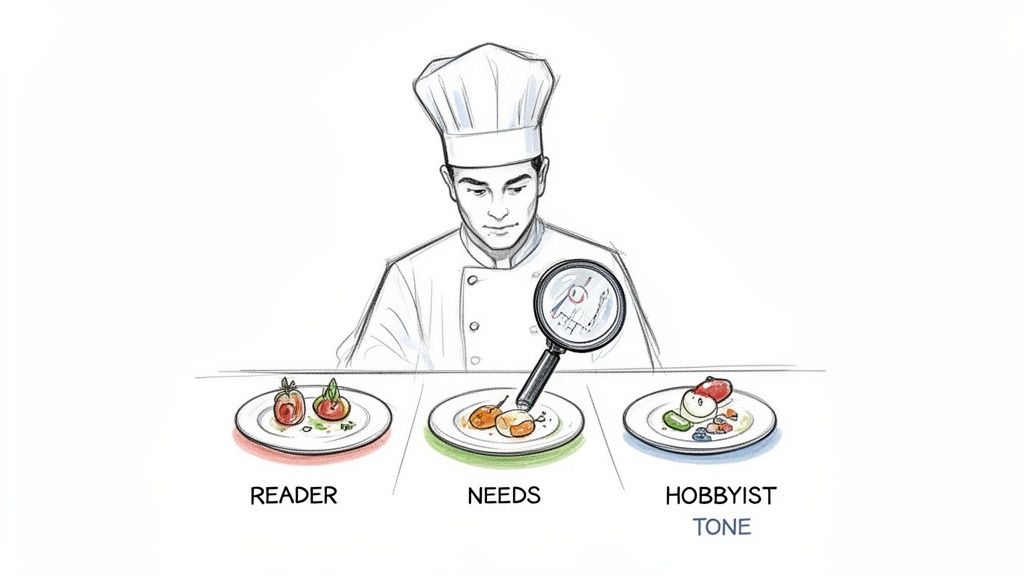
This isn't just a high-level strategy for giant marketing departments. It's a foundational skill for anyone creating content for others, whether you're a student writing a research paper, a marketer using AI tools, or a professional building a presentation. To get people to listen, you first need to understand what is audience analysis. Getting this right is the bedrock of any successful digital content strategy.
The Four Pillars of Audience Analysis
To make this process less abstract, you can break it down into four distinct areas of investigation. Think of these as the pillars holding up your entire content strategy. Focusing on them gives you a clear, actionable roadmap for your research.
Here’s a closer look at what you need to uncover.
| Component | What It Tells You | Example Questions to Ask |
|---|---|---|
| Demographics | The objective "who" of your audience. | What is their age range? Where do they live? What is their job or education level? |
| Psychographics | The "why" behind their behavior. | What are their values and beliefs? What are their hobbies and interests? What is their lifestyle like? |
| Needs & Pain Points | The "what" they are trying to solve. | What problems are they facing? What goals are they trying to achieve? What information are they missing? |
| Consumption Habits | The "how" and "where" they find info. | Do they prefer long articles, short videos, or podcasts? Which social media platforms do they use? |
Exploring these pillars gives you a multi-dimensional view of your audience, far beyond just a simple stereotype. This insight is critical for guiding AI writing tools ethically and effectively.
Once you have these insights, you can create content that feels like it was written just for them. For example, knowing your audience is students helps you explain complex topics simply. At PureWrite, we believe that understanding your audience is the first step to creating authentic, human-like content, even with AI.
Why Audience Analysis Is Your Secret Weapon
Knowing what audience analysis is is one thing. Understanding why it matters is where you gain a real edge. A deep understanding of your audience is the single biggest difference between content that falls flat and content that truly resonates, driving everything from better grades to bigger profits.
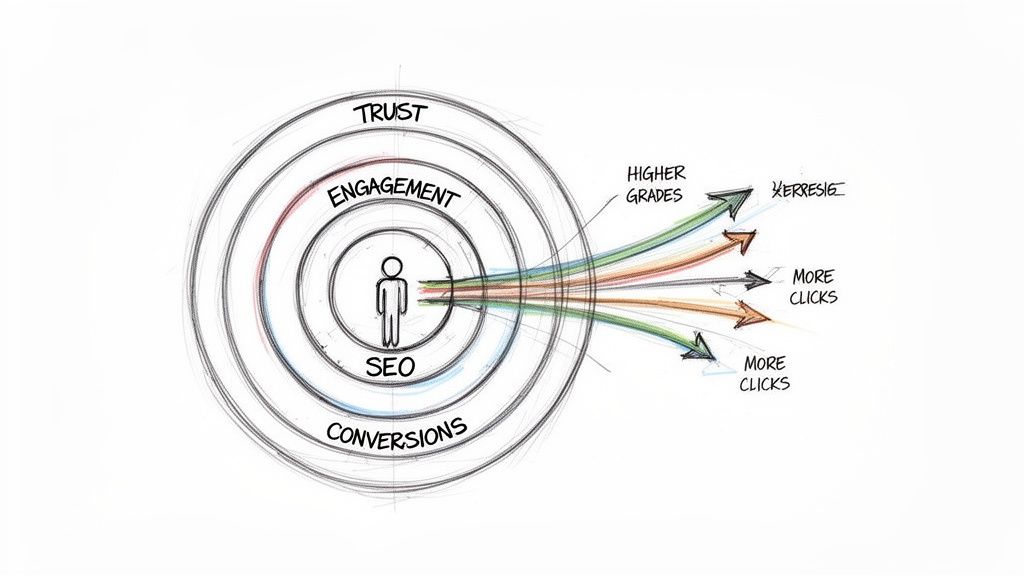
When you know exactly who you're talking to, you can craft a message that hits home. You're speaking directly to their needs, their frustrations, and their curiosities. This creates an instant connection and builds a foundation of trust that makes people feel like you just get them.
Forge Real Connections and Build Lasting Trust
Generic content is forgettable. It's the tailored, specific message that makes someone feel a personal connection. For content creators, this is everything, whether you're finding the best niche for your YouTube channel or trying to grow a dedicated blog following.
When you address the exact problems your audience faces, using the language they use, you stop being just another source of information. You become a trusted guide, building a genuine community around your work.
For a student, this means writing an essay that speaks directly to the prompt and the professor's expectations. For a marketer, it means creating a campaign that addresses a real customer pain point. When your arguments are framed around your audience's priorities, your message doesn't just get heard—it gets valued.
Get Better Results (and Better SEO)
It’s not just about building relationships; understanding your audience directly impacts your visibility. Search engines like Google are designed to reward content that actually helps people. When you know the questions your audience is typing into that search bar, you can create the definitive answers they're looking for. This is the heart of all great SEO content writing best practices.
The business world has caught on in a big way. Statistics show that personalized content can spike engagement by as much as 20%. Companies know that tailoring their message is no longer a "nice-to-have"; it's a core part of modern strategy.
This is especially powerful when you're working with AI writing tools. Your human knowledge of the audience becomes your superpower. It lets you direct the AI with surgical precision, ensuring the final draft isn't just well-written, but perfectly tuned to your reader's needs and expectations.
At PureWrite, we are firm believers that smart, ethical AI use begins with a human-first strategy. When you understand your audience inside and out, our tool becomes your strategic partner for humanizing and refining content. Ready to write something that truly connects?
Practical Ways to Get to Know Your Audience
So, you know you need to understand your audience. But how do you actually do it? Moving from theory to practice is way easier than it sounds. You don't need a massive budget to start pulling in useful data; it’s all about picking the right tool for the job.
The methods for figuring out your audience fall into two main camps: direct and indirect. Direct methods involve asking your audience questions straight up. Indirect methods are more about observing their behavior and connecting the dots from data you already have. Honestly, the best results usually come from mixing a little of both.
Direct Feedback: Just Ask Them
Sometimes, the simplest path is the best one. Direct methods are perfect for getting clear answers to your most specific questions. They let you hear from your audience in their own words, giving you rich, qualitative feedback you can’t get anywhere else.
Here are a couple of go-to methods:
- Surveys and Polls: These are your all-purpose tools. For instance, a YouTuber could run an Instagram poll to see which video idea resonates most, while a company can send an email survey to understand customer satisfaction.
- Interviews: A one-on-one chat with a reader or customer can provide unmatched depth. This is where you can ask follow-up questions and dig into the motivations that a multiple-choice question would completely miss.
These methods are brilliant for understanding the why behind what your audience does. The only catch is that they depend on people being willing to share their time and being able to accurately describe their own feelings.
Indirect Observation: Watch What They Do
Indirect methods are all about observing what people do, not just what they say they do. This is powerful because it uncovers natural behaviors and preferences. Think of yourself as a digital anthropologist, watching your community in its natural online habitat.
By analyzing existing data, you tap into a stream of authentic, unfiltered insights. This is where you can spot emerging trends and identify pain points your audience hasn't explicitly told you about yet.
Key indirect methods to consider:
- Social Media Listening: Monitor mentions of your brand or relevant keywords across platforms. This helps you understand public sentiment, pinpoint common questions, and see what kind of content people are sharing.
- Website and Social Analytics: Your Google Analytics dashboard is a goldmine. It shows you which pages get the most traffic, where your visitors are from, and their demographic breakdown, providing concrete data on user behavior.
- Keyword Research: Seeing the exact terms people are typing into search engines gives you a direct line into their needs. It reveals the precise language your audience uses when they’re looking for the solutions you offer.
These observational techniques give you a ton of quantitative data. They’re great at telling you what is happening, but they don’t always explain why.
Choosing Your Audience Analysis Method
Not sure where to start? Every method has its place. Use this table to compare the most common approaches and find the right fit for your goals and resources.
| Method | Best For | Pros | Cons |
|---|---|---|---|
| Surveys & Polls | Getting quick, specific feedback from a large group. Great for gauging interest or satisfaction. | Easy to create and distribute; highly scalable; provides both quantitative and qualitative data. | Low response rates can be an issue; can't ask deep follow-up questions. |
| Interviews & Focus Groups | Deeply understanding motivations, feelings, and the "why" behind behaviors. | In-depth, nuanced insights; allows for follow-up questions; builds a personal connection. | Time-consuming; expensive; small sample size means findings may not be widely applicable. |
| Social Media Listening | Tracking brand sentiment, identifying trends, and understanding public conversations in real time. | Authentic, unfiltered opinions; great for competitive analysis; identifies customer service issues. | Can be noisy with irrelevant data; sentiment analysis isn't always 100% accurate. |
| Website & Social Analytics | Understanding user behavior, content performance, and traffic patterns on your own platforms. | Provides hard data on what works; reveals user demographics and interests; tracks conversions. | Explains what is happening, but not why; requires some technical skill to interpret correctly. |
| Keyword Research | Discovering what your audience is actively searching for and the language they use to describe their problems. | Direct insight into user intent; helps align content with audience needs; great for SEO. | Highly competitive; search trends can change quickly; doesn't provide demographic context. |
Ultimately, the best strategy is a balanced one. Start with analytics to see what your audience is doing, then use a survey to understand why.
For content creators using AI, this research is a game-changer. Once you've identified your audience's language, you can guide your AI tool with more precision. And when you're ready to refine that draft, Pure Write helps you humanize the text, ensuring it speaks directly to the real people you’ve worked so hard to understand. Try PureWrite today to transform your research into content that truly connects.
A Step-By-Step Guide To Your First Audience Analysis
Alright, you know the theory and have the tools. Now, let’s roll up our sleeves and actually do this. A good audience analysis isn't a mystifying process. It’s a straightforward framework you can use again and again to get from vague ideas to real insights that make your content better.
This four-step process is designed to be simple and repeatable. Think of it as a roadmap that takes you from asking the right questions to building a clear, actionable profile of your ideal reader.
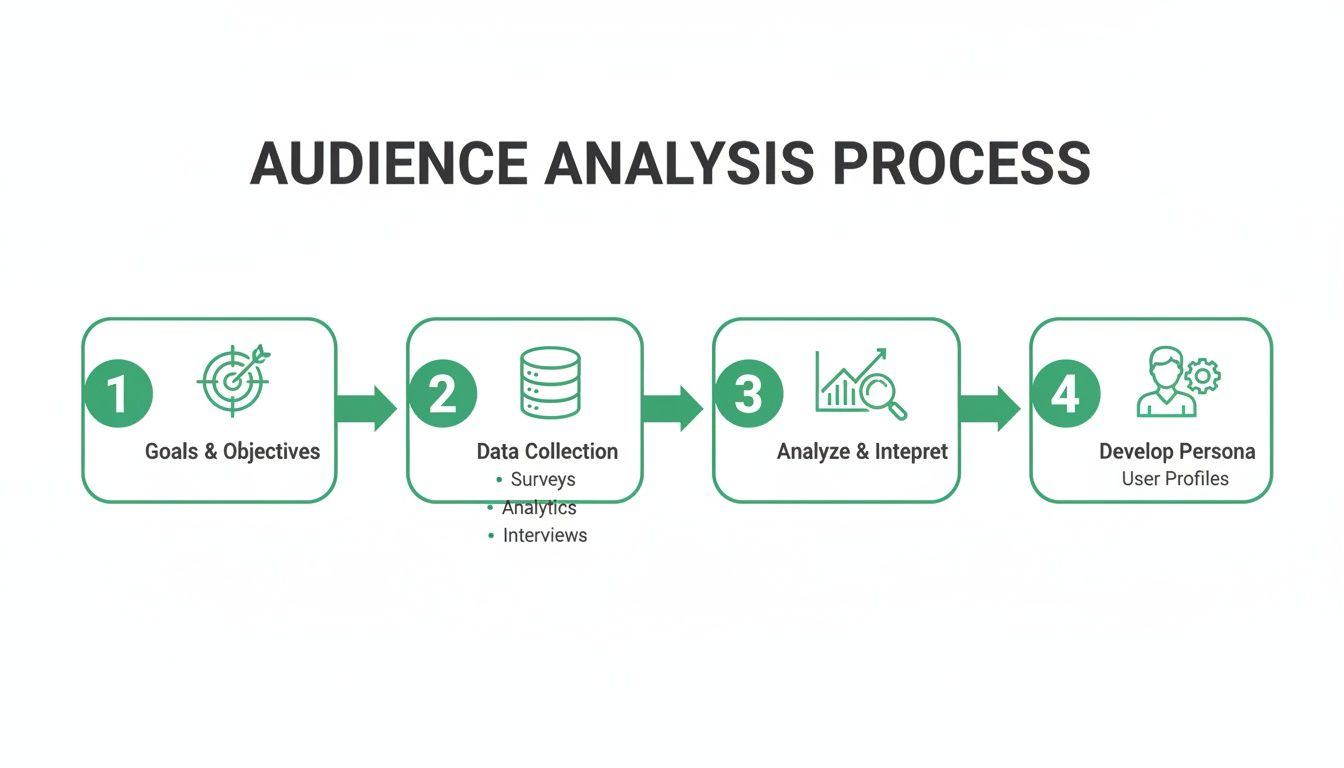
Each stage naturally flows into the next, turning a messy pile of data into a crystal-clear picture of who you're talking to.
Step 1: Define Your Goals
Before you dive into a single spreadsheet or survey, stop and ask yourself: why am I doing this? What, specifically, do you need to know? Without a clear goal, you'll drown in data and end up with nothing useful.
A good goal is specific. It's not just "I want to know my audience." A real-world example would be, "I need to understand the top three pain points of freelance writers to create a relevant blog series." This question will guide every decision you make from here on out.
Step 2: Gather Your Data
With your goal set, you can now pick the right tools for the job. The best approach usually involves a mix of direct and indirect research. For example, you could start by digging into your website analytics to see which topics are already popular (indirect data). Then, run a quick poll on social media asking why people love those topics (direct data).
The key is to pull from multiple sources to get a well-rounded view. Combine the "what" from quantitative data (traffic numbers, demographics) with the "why" from qualitative feedback (survey responses, interview notes). For an extra layer of insight, you can check out some of the best content optimization tools to see what your audience is actively searching for online.
Step 3: Analyze and Find Patterns
Now for the fun part: connecting the dots. Sift through all the information you've gathered and start looking for patterns. Are there recurring themes, common questions, or surprising trends that keep popping up? Maybe you’ll notice a specific demographic consistently engages with your video content.
The goal of analysis is to find the story within the data. It's about translating numbers and quotes into a coherent narrative about who your audience is and what they truly need from you.
Organize your findings into logical buckets, like pain points, motivations, and preferred communication style. This is how you transform raw information into a solid foundation for your content strategy.
Step 4: Build Your Audience Persona
Finally, it’s time to bring your research to life by creating an audience persona. A persona is a semi-fictional character who represents your ideal reader, built from all the patterns you just uncovered. Give this persona a name, a job, and a list of goals and challenges.
This step is a game-changer. Instead of writing for a faceless "audience," you're now creating content for "Marketing Maria," a 32-year-old professional who's struggling with time management and craves data-driven advice. This simple mental shift is incredibly powerful for maintaining an authentic voice.
This is especially true when using an AI writing assistant. Your persona becomes the creative brief for every prompt. At PureWrite, we’ve seen how this deep understanding produces far more authentic writing. You can tell the tool to refine a draft specifically for "Maria," making sure the tone is professional yet encouraging. Try PureWrite today and see how a clear persona can help you humanize your AI content.
Turning Audience Insights Into High-Impact Content
You’ve done the research and built your audience persona. Now comes the fun part: turning that data into a real connection. This is where you create content that doesn’t just get seen but gets felt. It's the difference between a bland, one-size-fits-all message and something that speaks directly to the person you've worked so hard to understand.
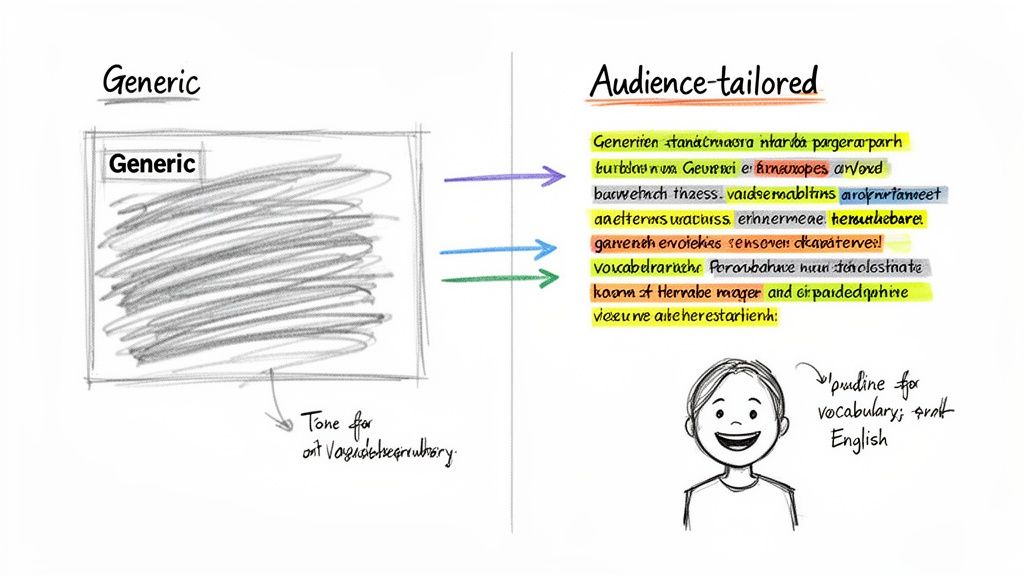
We're moving past theory here and into practical application. It’s about making smart, deliberate choices about your tone, style, and even the specific words you use. This is how you shape your message to fit inside your reader's world, making sure every sentence meets them where they are.
From Generic AI Draft to Human-Centered Content
Let's walk through a common situation for writers today. You get a first draft from an AI tool—it's grammatically sound but feels completely lifeless. Your audience analysis is the secret ingredient that breathes life and authenticity into it.
Let's say your persona is "Startup Sam," a busy entrepreneur who is all about efficiency and has zero time for fluff.
- Generic AI Draft: "The utilization of synergistic frameworks can enhance operational efficacy."
- Humanized for Sam: "The right frameworks help your team work smarter, not harder."
See the difference? The second version ditches the jargon, speaks directly to a core problem (efficiency), and uses a tone that respects Sam's time. This kind of intentional tweaking is central to how to write engaging content that actually builds trust.
The goal isn't just to polish words; it's to align your message with your audience's worldview. This strategic empathy turns passive readers into active fans who feel seen and understood.
There’s a reason for this shift. Recent studies show that nearly 70% of consumers now expect and prefer personalized content. This isn't just a marketing trend; it's a fundamental shift in communication that matters whether you're a student writing an essay or a founder writing a blog post.
Putting Your Persona to Work with PureWrite
This is exactly what we built PureWrite for. It’s not just about getting past AI detectors; it’s a tool for strategic, ethical adaptation. Once you have your persona clearly defined, you can use our platform to consciously shape AI-generated text to fit that person's communication style perfectly.
For instance, you could take a dense academic paragraph and use PureWrite to simplify the vocabulary for an audience of beginners. Or you could take a formal business report and shift its tone to be more encouraging for an internal team memo. Your audience analysis gives you the "why," and PureWrite gives you the "how."
Stop creating content that speaks to everyone and connects with no one. Use your hard-earned insights to craft a message that truly matters. Ready to give it a try?
Common Questions About Audience Analysis
As you start putting these ideas into action, a few questions are bound to pop up. Think of this as your quick-reference guide for those "what about..." moments. We'll clear up some of the most common points of confusion so you can feel confident turning theory into practice.
How Often Should I Conduct An Audience Analysis?
It's tempting to see audience analysis as a one-and-done task, but it's really more of an ongoing conversation. A deep dive is essential when you're kicking off a new project—say, a new blog, product, or marketing push. But remember, people change, and so do their needs.
A good rule of thumb is to refresh your analysis at least once a year. If you're in a fast-paced industry, you might want to do a quick check-in every quarter. The goal is to stay curious and never assume last year's insights still apply today.
What Is The Difference Between Audience Analysis And Market Research?
This is a fantastic question because the two are often confused, but the difference is key.
Market research is the 10,000-foot view. It looks at the entire industry—your competitors, broad economic trends, and the overall size of the opportunity. It's about mapping the whole forest.
Audience analysis, on the other hand, zooms in on the specific group of people within that larger market you want to connect with. Market research tells you there are fish in the sea; audience analysis tells you which fish you’re after and what kind of bait they love.
Can I Do Audience Analysis With A Zero Budget?
Absolutely. You don't need a hefty budget to get powerful insights. While fancy tools can speed things up, a little resourcefulness goes a long way.
Start with the data you already have. Your social media analytics and website dashboard are treasure troves of information about who is already engaging with you.
A zero-budget analysis is not only possible but often leads to more authentic insights. It forces you to get creative and connect directly with your community, which is where the real gold is.
You can also:
- Use free tools like Google Trends to see what people are searching for.
- Read through comment sections—on your posts and your competitors'. They are full of unfiltered thoughts and questions.
- Run simple polls or ask questions directly on your social media channels.
It takes a bit more manual effort, but the understanding you gain is priceless.
How Does Audience Analysis Help With AI Writing Tools?
This is where your research really shines. AI writing tools are incredibly powerful, but they operate in a vacuum. They don't have the context to know "Startup Sam" from "Academic Anna" unless you give it to them.
Your audience analysis becomes the ultimate cheat sheet for the AI. You can feed your persona's details directly into the tool to guide its tone, vocabulary, and sentence structure. This is the difference between a generic article and a piece of content that feels like it was written just for your reader.
After generating a draft, the next step is adding that authentic human touch. Our guide on how to humanize AI content walks you through exactly how to do that. It’s all about using your human insights to steer the technology, making sure the final output genuinely connects.
Your audience analysis gives you the roadmap; it tells you where you need to go to meet your audience. When it’s time to write the message for that journey—especially when refining AI-generated drafts—PureWrite can help you get the tone just right. We help you apply your insights to humanize your text, ensuring it lands exactly as you intended.
Ready to turn your research into writing that resonates? Try PureWrite today!