Is ZeroGPT Accurate? a Practical Guide to Reading the Score
A student sees “AI-generated” above an essay they wrote themselves. A marketer receives a polished article from a freelancer and wonders whether the writer used an undisclosed tool. A teacher notices a submission that sounds unusually smooth. Is ZeroGPT accurate enough to settle any of those questions?
The honest answer isn't a simple yes or no. ZeroGPT can provide a useful signal, but its result changes with the text, language, length, editing history, threshold, and model used to generate the comparison material. A percentage on the screen describes how writing resembles patterns associated with AI. It doesn't prove who wrote the document.
This distinction matters because a detector can support a careful review, or it can become a dangerous shortcut. The practical standard should be authentic authorship, verified evidence, and policy compliance, not a single score. The sections below build a defensible way to interpret ZeroGPT, investigate unusual results, and decide what to do next.
Why ZeroGPT's Accuracy Is the Wrong First Question
When people ask “is ZeroGPT accurate,” they usually need an answer to a more urgent question: Can I trust this result enough to act on it? That question belongs to students, educators, content managers, editors, hiring teams, and anyone whose reputation depends on a piece of writing.
A flagged essay may be entirely human-written. A clean result may come from AI-assisted text that has been revised. The same tool can therefore create two opposite mistakes: accusing an honest writer, or reassuring a reviewer too quickly.
What the percentage does and doesn't mean
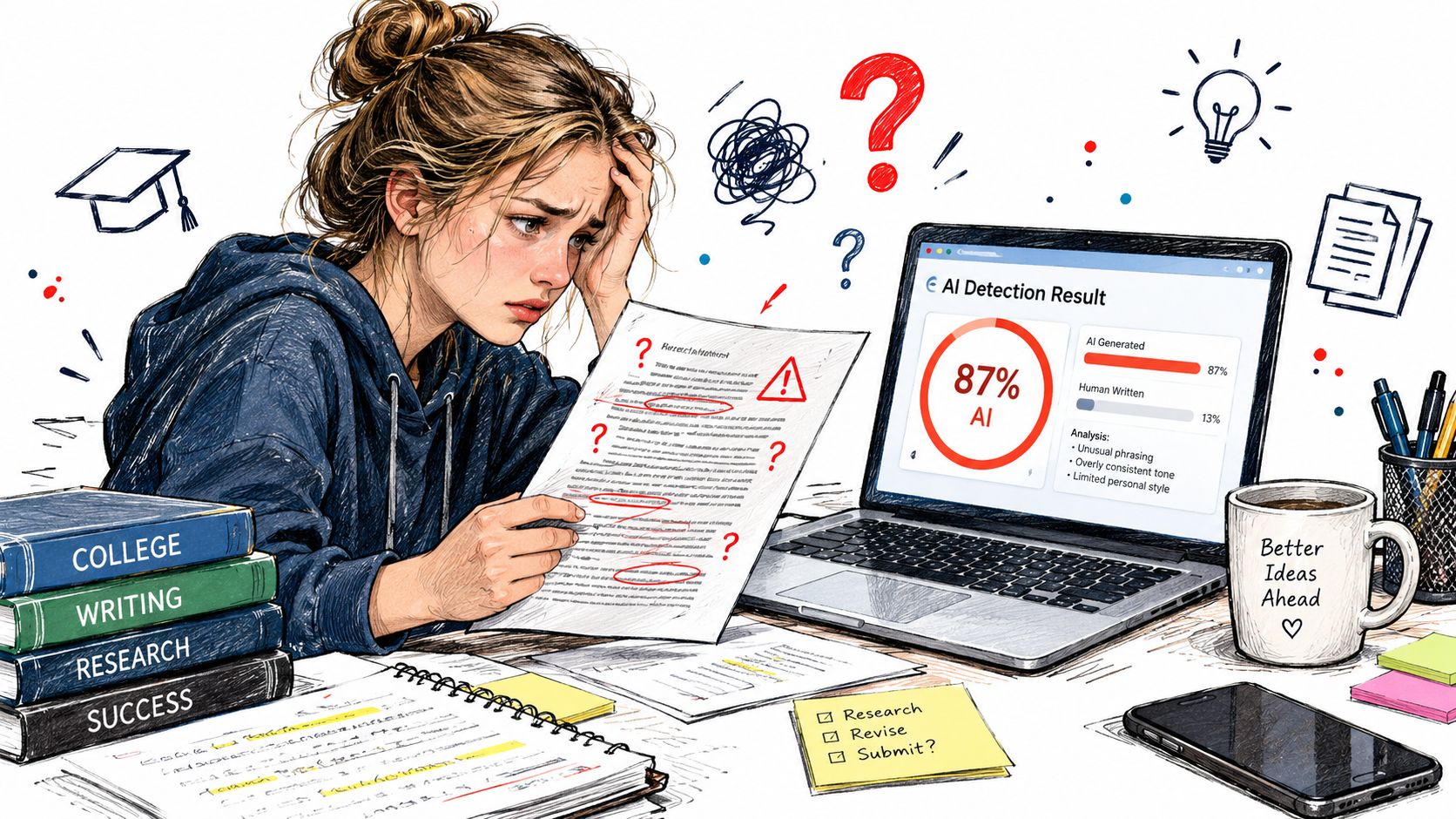
ZeroGPT's output is best understood as a classification estimate. It compares features of your text with patterns found in material associated with machine-generated writing. It doesn't inspect your Google Docs history, watch you write, understand your research process, or know whether you drafted every sentence yourself.
A high result may reflect predictable phrasing, consistent sentence structure, formal academic style, translation, or professional editing. A low result may mean the text looks less like the examples the detector recognizes. Neither result independently establishes authorship.
Practical rule: Treat a detector score as a reason to review the writing, never as the final evidence in a disciplinary, hiring, publishing, or grading decision.
A better question for real workflows
Instead of asking only whether ZeroGPT is accurate, ask four narrower questions:
- What text did you test? A short excerpt, a full article, and a heavily edited draft may produce different signals.
- What kind of writing is it? Academic prose, marketing copy, translated writing, and personal narrative have different stylistic patterns.
- What evidence supports the score? Drafts, notes, citations, version history, and an oral explanation are more informative than a percentage alone.
- What consequence follows? A score used for private revision can be helpful. The same score used to reject a student or freelancer requires much stronger corroboration.
That framework prevents a common error: treating a precise-looking number as if it were a direct observation. For a broader explanation of how these systems should be interpreted, see how to detect AI-generated content. The useful goal isn't to obtain a magical “human” result. It's to understand why the tool reacted and then check whether the writing is accurate, original, transparent, and accountable to its author.
How ZeroGPT-Style Detectors Actually Read Your Text
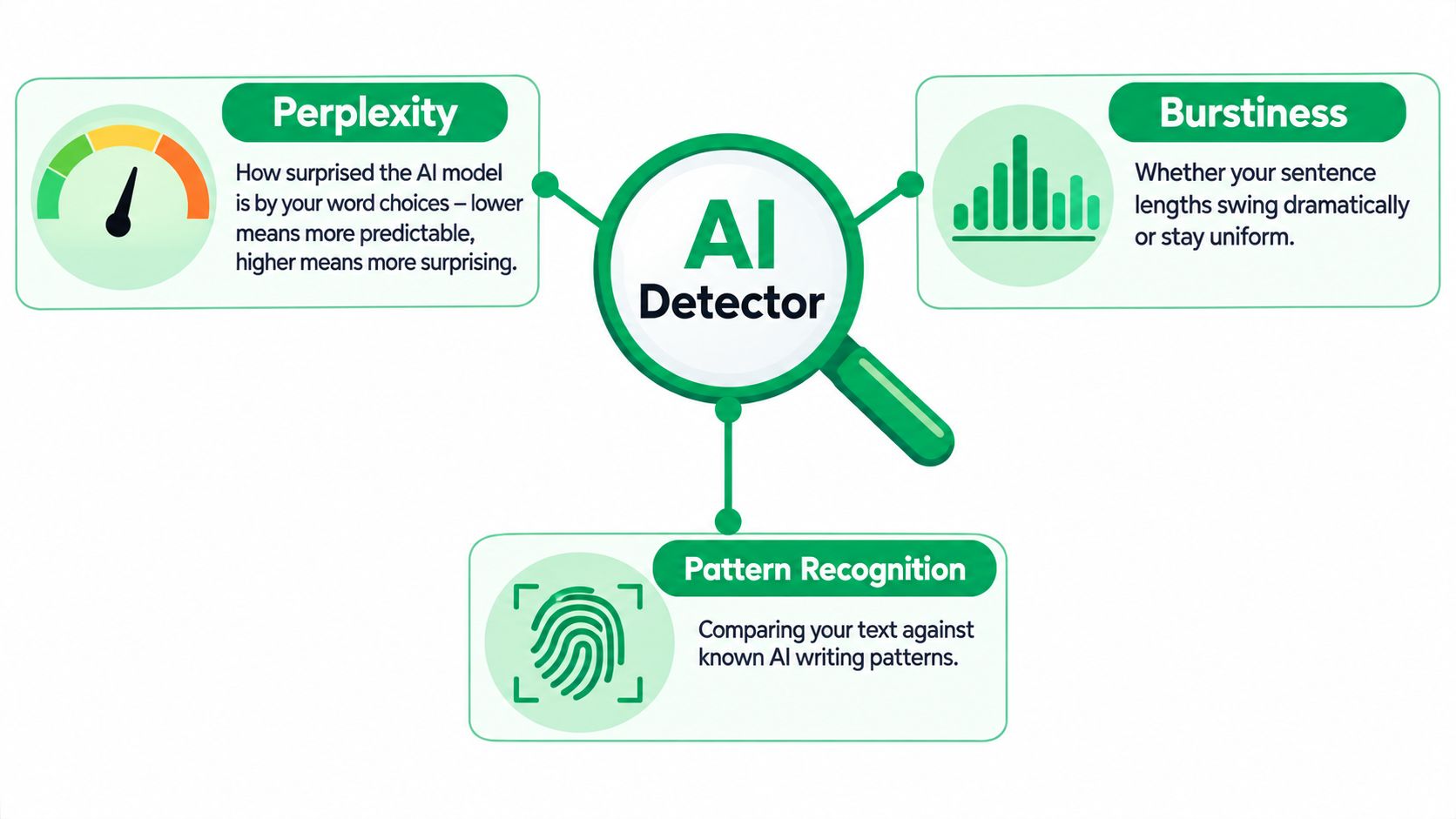
ZeroGPT-style detectors don't read an essay the way a teacher does. A teacher considers the argument, evidence, context, voice, and whether the writer can explain the work. A detector looks for statistical patterns in the language.
Three ideas make the process easier to understand.
Perplexity and predictability
Perplexity means how surprised a language model is by your word choices. If one phrase is a very likely continuation of the previous phrase, the text has lower perplexity. If the wording takes an unusual or less expected path, perplexity is higher.
That doesn't make low-perplexity writing artificial. A careful student explaining a familiar concept may choose straightforward words because clarity matters. A legal summary, product description, or research abstract may also use conventional language. Predictability can reflect genre and purpose, not authorship.
Burstiness and sentence rhythm
Burstiness describes whether sentence lengths and structures vary. Human writers often mix short statements with longer explanations, while generated text can appear more uniform. Detectors may use that contrast as one clue.
Again, this is only a clue. An editor may deliberately smooth a draft so that every paragraph follows a consistent pattern. A professional writer may use short, balanced sentences because the client requested concise copy. A student writing in a second language may rely on a stable grammatical structure to avoid mistakes.
Token patterns and familiar fingerprints
Token patterns are recurring combinations of words and fragments. You can think of them as fingerprints left by common language habits and training material. The detector compares your wording with patterns it has learned to associate with AI output.
A coffee shop analogy helps. Suppose a barista serves a drink and notices that it tastes highly familiar, with a predictable combination of ingredients and a standardized finish. The barista may suspect it came from a common recipe, but can't prove which person prepared it. A detector works similarly. It recognizes a taste of language, not the identity of the writer.
The threshold also matters. A threshold is the point at which a system changes from “this resembles human writing” to “this resembles AI writing.” Different tools, versions, and test conditions can use different thresholds. A paragraph might therefore receive a different classification after a model update, a change in surrounding text, or a different way of sampling language.
A large benchmark summarized in the research found that ZeroGPT's proportion of AI text detected ranged from 95.4% to 0.3%, depending on the generating model and sampling settings, which shows how sharply results can move when the underlying conditions change (independent ZeroGPT testing). That spread is why AI detector accuracy explained is more useful than a claim based on one headline percentage.
You can also compare detector behavior using Pure Write's guide to detecting AI-generated content, but remember that every detector remains an estimate rather than a record of the writing process.
What the Numbers Actually Show Across Studies
Published evaluations don't produce one stable ZeroGPT accuracy figure. They produce a range because researchers test different documents, languages, models, thresholds, and editing conditions.
One peer-reviewed study reported that ZeroGPT correctly identified 96% of ChatGPT-generated articles and 88% of AI-rephrased articles. At a selected threshold of 42.45%, the same study reported 98% sensitivity, 92% specificity, and an area under the receiver operating characteristic curve of 0.98 (peer-reviewed ZeroGPT evaluation).
Those results are meaningful within that experimental design. They don't establish that the tool will perform equally well on every student paper, multilingual draft, edited article, or mixed human-AI document.
| Study setting | Reported accuracy | Key limitation |
|---|---|---|
| Peer-reviewed article samples | 96% of ChatGPT articles identified, with 88% of AI-rephrased articles identified | Narrower article samples and an optimized threshold |
| Multilingual benchmark | 78.0% accuracy and an 81.8% F1 score | Controlled English, French, German, and Spanish test conditions |
| Mixed evaluation of 54 documents | 32 of 54 documents classified correctly, equivalent to 59% accuracy | Included human, machine-translated, generated, hand-edited, and paraphrased text |
| Broad benchmark | AI text detection ranged from 95.4% to 0.3% | Results changed with model and sampling settings |
The 59% result is especially important because the test included the messy material that appears in real submissions. ZeroGPT correctly classified 32 of 54 documents, while none of the 18 human-written or machine-translated documents in that particular sample were falsely accused. Even so, the overall score shows that correct classification became limited when writing was edited or paraphrased (2023 evaluation of AI detectors).
Why F1 can matter more than raw accuracy
Accuracy counts correct classifications overall. F1 score balances two different mistakes: missing AI text and falsely flagging human text. That balance matters when a school, publisher, or content team needs to protect both integrity and fairness.
A tool can perform well on untouched generated passages while failing on revised writing. It can also avoid false positives by labeling too much text as human, which creates a different problem. The reported 78.0% accuracy and 81.8% F1 score in the multilingual benchmark show that readers should look beyond a single headline number (multilingual detector benchmark).
The practical conclusion is straightforward. ZeroGPT may be useful for triage when a person reviews every flagged document, but it becomes unsafe when an organization treats its output as an automatic verdict. For a broader comparison of detector reliability, see whether AI detectors are accurate.
Failure Modes That Hit Real Users
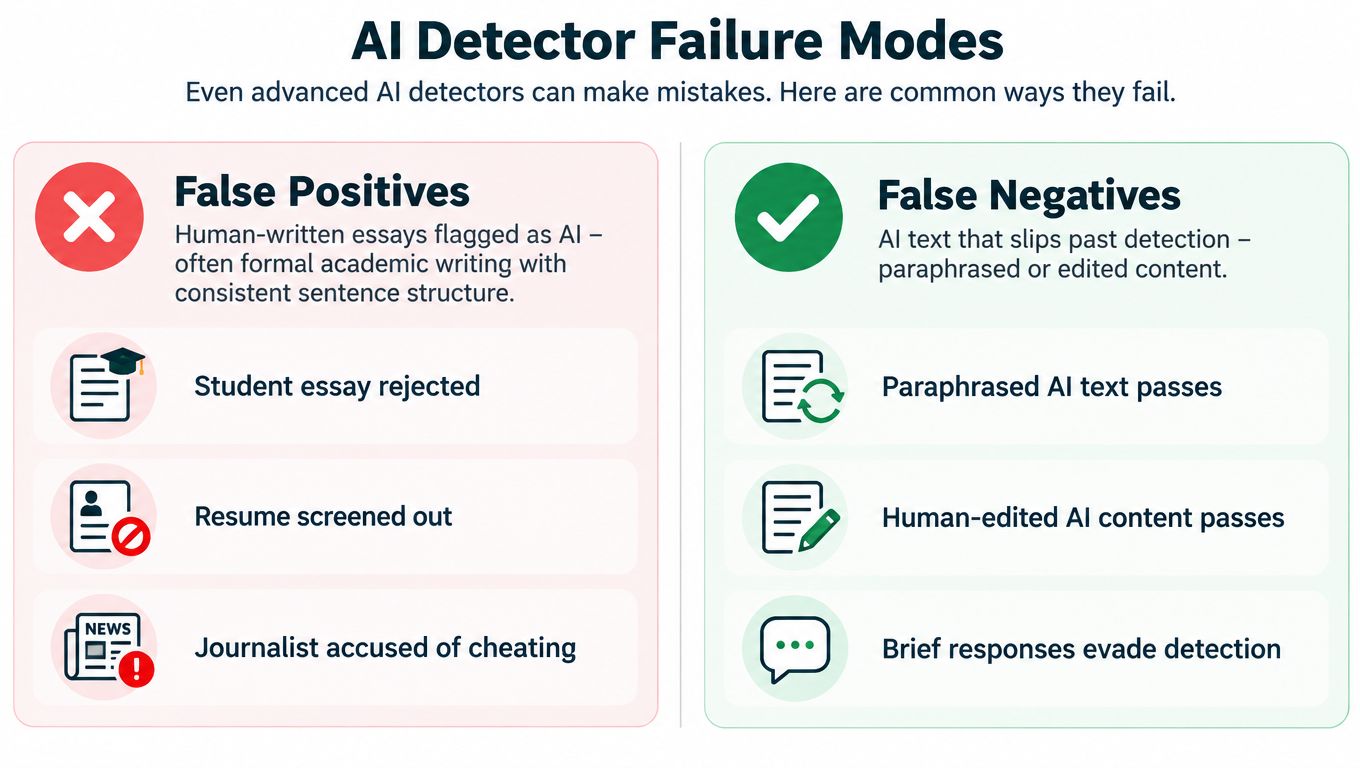
Could a detector flag careful human writing because it looks orderly? Yes. ZeroGPT identifies patterns associated with AI-generated text, not authorship itself, and those patterns can appear in legitimate work.
A graduate student may write and revise a thesis chapter with formal transitions, cautious claims, consistent terminology, and balanced sentence structures. In this hypothetical example, ZeroGPT returns a 70% AI score. That result warrants a closer look at the writing process. It does not establish that the student used a model.
False positives in polished writing
Formal prose often has a regular statistical shape. A thesis, lab report, legal explanation, résumé, or news article may repeat terminology because precision requires consistency. Professional editing can make sentences more uniform, which may increase their similarity to generated text.
Language background adds another source of error. A 2026 benchmark of 135,389 document pairs found that widely used detectors misclassified more than 60% of authentic academic essays written by non-native English speakers, while native-speaker writing was recognized more reliably (research on language background and detector bias). A high score may therefore reflect careful grammar and predictable sentence construction rather than machine authorship.
One educational study found that 9.8% of human student writing was falsely labeled as AI-generated. Another evaluation reported a 24.64% false-positive rate and a 19.14% false-negative rate for ZeroGPT under its tested conditions (technical evaluation of detector errors). These results cannot predict every document, but they show why an automated score should not determine punishment on its own.
False negatives after editing and paraphrasing
The reverse error appears when AI-generated writing passes as human. A writer can change the structure, replace predictable wording, translate a draft, or revise it manually. Those changes may introduce enough variation for the detector to stop recognizing the original pattern.
A low score still does not prove human authorship. Research on modified AI text found that detector performance declined after straightforward edits, and concluded that these tools should not serve as the sole basis for academic-integrity violations (study of edited and paraphrased AI text).
A polished score is not a certificate of authorship. It is one classifier's reading under one set of conditions.
Students, journalists, marketers, and researchers should keep earlier drafts rather than rewriting only to lower a detector score. If questions arise, revision history, source lists, research notes, and the ability to explain the argument provide stronger context than a detector screenshot.
For related institutional questions, whether Turnitin checks for AI provides useful context. Its results, like ZeroGPT's, should be treated as evidence to review, not an infallible verdict.
A Repeatable Method for Testing Any Document
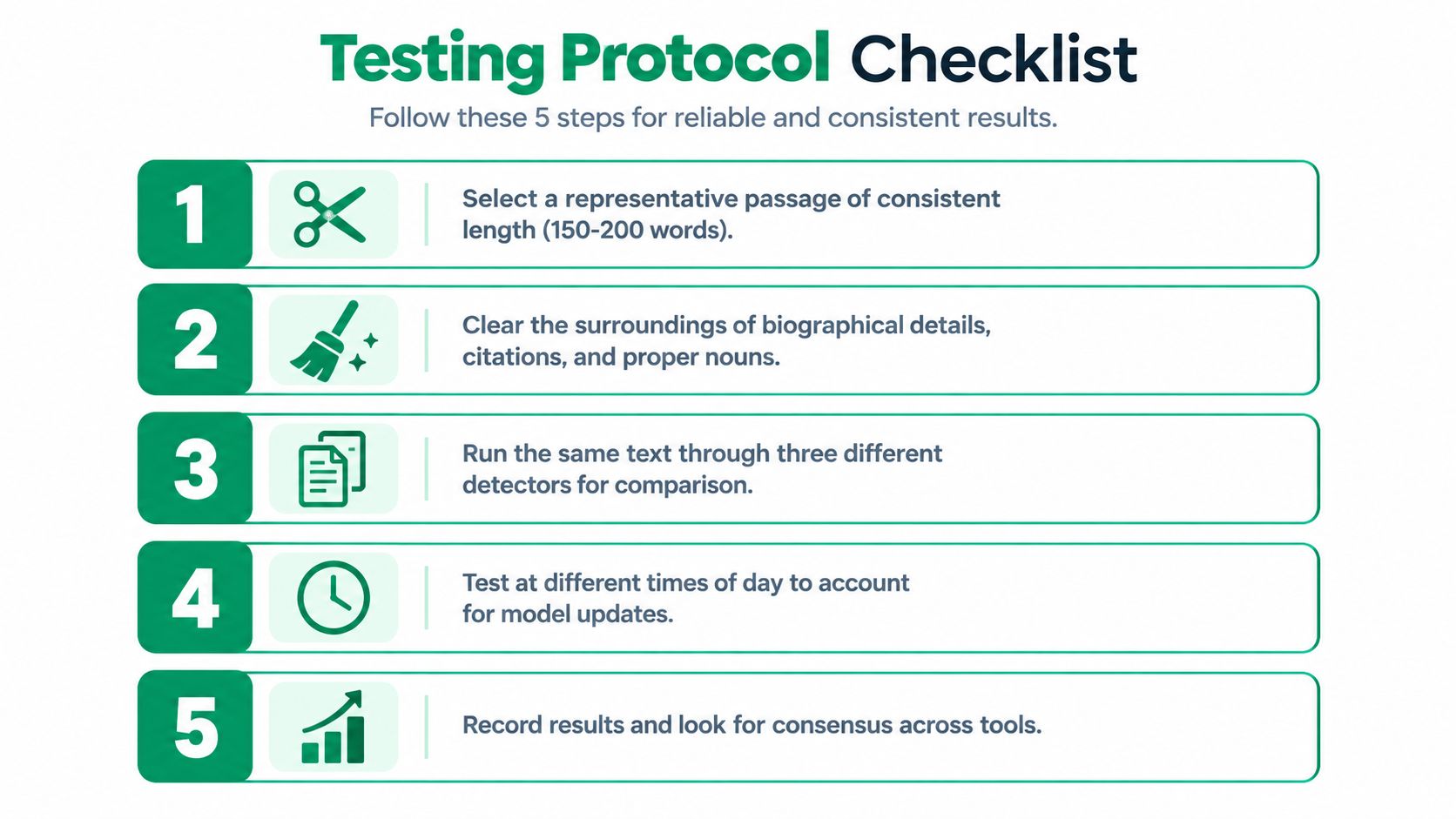
A reliable workflow begins with controlling the test rather than chasing a favorable result. You can't make a detector meaningful by changing the passage until it gives you the answer you want.
Prepare a representative sample
Select a passage that reflects the document's normal style and length. Don't test only the opening paragraph if the rest of the paper contains citations, technical language, or a different tone. Keep the submitted wording unchanged, and record the date, tool, settings, and result.
Remove material that can distort the comparison, such as assignment instructions, biographical notes, long quotations, citation lists, and strings of proper nouns. You aren't trying to hide evidence. You're isolating the prose that the detector is evaluating.
Compare results without treating agreement as proof
Run the same passage through ZeroGPT and at least one detector from another provider. If several tools flag similar passages, review those passages closely. If they disagree, don't pick the score you prefer. Treat the disagreement as evidence that the classification is uncertain.
Keep a simple record:
- Passage selection: Save the exact text tested and explain why it represents the document.
- Testing conditions: Record the tool, date, language, document type, and any available threshold.
- Results: Capture the overall classification and any sentence-level highlights.
- Supporting evidence: Keep drafts, notes, sources, tracked changes, and version history.
- Human review: Ask whether the flagged writing contains factual problems, unsupported claims, abrupt voice changes, or material the author can't explain.
The testing protocol should produce a decision, not a panic response. A low result can mean the passage resembles the detector's human examples, but it isn't proof that no AI assistance occurred. A borderline result should trigger a review of voice, sources, and drafting history. A high result deserves closer examination, but it still needs corroboration before anyone acts.
Keep the writing process as evidence
Think of revision history as a lab notebook. It shows how the work developed, which sources informed it, and where the author made decisions. For students, that may include outlines and earlier drafts. For marketers, it may include briefs, interviews, source documents, editorial comments, and client approvals.
Vanderbilt University disabled Turnitin's AI-writing detector in 2023, citing reliability and false-positive concerns, an institutional response discussed in research on detector uncertainty (research on institutional detector practice). The lesson isn't that all detection is useless. It's that high-stakes decisions require more than an automated score.
Finish by revising for clarity and voice, checking every factual claim and citation, running a final comparison if appropriate, and documenting any permitted AI assistance. Don't rewrite authentic work merely to satisfy an unstable number.
ZeroGPT Compared With Other Popular Detectors
ZeroGPT sits inside a crowded group of tools that make similar promises but use different models, thresholds, interfaces, and training data. GPTZero, Originality.ai, Copyleaks, and Turnitin's AI detector may disagree with one another because they don't measure text in exactly the same way.
A useful comparison looks at role rather than searching for a permanent winner:
| Tool | Common use | What it can add | Important caution |
|---|---|---|---|
| ZeroGPT | Quick checks and first-pass review | Fast classification and accessible feedback | Results can shift with language, editing, and generation conditions |
| GPTZero | Education and document review | Another comparison point for student or professional writing | Its result is still a probabilistic estimate |
| Originality.ai | Marketing and publishing workflows | Detection alongside content-quality checks | Formal or edited prose can create uncertainty |
| Copyleaks | Education, business, and content review | A separate vendor perspective and broader workflow options | Agreement with another detector still isn't proof |
| Turnitin | Institutional submission workflows | Integration with academic review processes | Institutional use doesn't remove false-positive and false-negative risks |
The comparison should guide workflow design, not tool loyalty. A 2026 study of 135,389 document pairs reported false-positive rates ranging from 0% to 100% across 13 detectors, showing that no single system performs uniformly across all writing conditions (large study of detector variability).
How to use disagreement productively
When two detectors agree, the shared result can justify a closer human review of the relevant passages. It still doesn't establish authorship, but agreement may help an editor decide where to ask questions about sources, drafting, or revisions.
When the tools disagree, that disagreement is valuable too. It shows that the result depends on the detector's model and threshold. In that situation, inspect the document itself, compare it with earlier drafts, and ask the author to explain the reasoning and evidence.
A professional team may use one detector for intake, another for a second opinion, and a human editor for the decision. That arrangement is more defensible than allowing a single vendor to determine whether someone gets published, hired, graded, or disciplined. For selection criteria and workflow ideas, see the best AI content detectors, while keeping the limitations above in view.
An Ethical Workflow With Pure Write
Detection becomes more useful when it supports quality control instead of acting as a hunt for a “safe” percentage. A content creator can use AI to brainstorm, organize ideas, or clarify a rough draft when the relevant policy allows it. The final work should still reflect the writer's judgment, preserve accurate citations, and disclose assistance when disclosure is required.
A practical workflow can look like this:
- Draft with accountability. Start from your own brief, research notes, interviews, sources, and argument. If an AI tool contributes wording or ideas, record how you used it.
- Refine the language. Use Pure Write as a writing enhancement option to improve naturalness, clarity, tone, grammar, concision, and formatting while reviewing every change yourself.
- Check the output critically. Run the revised passage through ZeroGPT and a second detector only as risk signals. Investigate unusual highlights rather than rewriting blindly.
- Verify the substance. Check names, quotations, sources, statistics, claims, and citations. Natural-sounding prose can still contain factual errors.
- Preserve the trail. Keep drafts, revision notes, prompts where relevant, source material, and the final disclosure required by your school, employer, client, or publisher.
This approach also applies to wider content operations. A startup preparing an article may improve the prose in Pure Write, verify the claims, and then use ethical promotion such as manual directory listings for startups without presenting automated writing as independent reporting or hiding material assistance.
Don't turn humanizing into evasion
Using a humanizer only to fool a detector misses the ethical issue. A lower score doesn't make unsupported claims accurate, copied ideas original, or undisclosed assistance acceptable. It can also damage the writer's voice if every sentence is changed to satisfy a classifier.
The better objective is authentic revision. Read the output aloud, restore your own examples and reasoning, replace vague claims with evidence, and make sure you can defend every important sentence. Pure Write can support that refinement process, but you remain responsible for the final document.
Our guidance on responsible use is available through Pure Write's ethical AI principles. The central rule is simple: use detection to find questions, use editing to improve communication, and use human judgment to make decisions.
Pure Write offers AI-assisted writing refinement for essays, research papers, blog posts, emails, and professional documents, with tools for naturalness, readability, and clarity. Visit Pure Write to polish your draft, review its quality, and combine the result with your own sources, revision history, judgment, and required disclosures.