How to Detect AI-Generated Content: A Practical Guide for Creators
Spotting AI-generated text isn't a dark art; it's a skill you can develop. It's a blend of old-school critical reading and leveraging new-school tech. You start by looking for tells—writing that's a little too perfect or just feels off—and then you use specialized tools to confirm your gut feeling.
This guide is designed for content creators, students, and marketers who use AI tools. We'll give you practical, actionable advice to help you use AI ethically and preserve your authentic voice.
Why Bother Detecting AI Content?
AI writing tools are everywhere, and they've fundamentally changed the content game. Figuring out what's written by a person versus a machine is no longer a niche skill. It’s a crucial part of being digitally literate today.
For content creators and marketers, being able to tell the difference is fundamental to maintaining trust with your audience. An authentic voice is your greatest asset, and you need to protect it.
This isn't just a hypothetical problem; it affects almost every industry. Marketers are fighting to keep their brand's voice from being diluted by generic AI copy that doesn't connect with customers. As more platforms, like the best AI social listening tools, build in AI features, spotting machine-generated text is vital for data accuracy.
A Threat to Academic and Professional Integrity
Nowhere is this challenge more pressing than in academia. Ever since ChatGPT burst onto the scene in late 2022, originality has become a massive headache for educators and students alike. The numbers from Turnitin, a leading plagiarism detector, are eye-opening. Between 2023 and 2024, they scanned 200 million student papers.
The findings were shocking. A staggering 11% of those papers—that's 22 million—had at least 20% AI writing. Even more concerning, 3% were almost entirely AI, with over 80% of the content flagged. This shift forces a hard conversation about what academic integrity means in the age of AI.
For professionals and creators like you, the stakes are just as high. Authenticity is currency. The moment your audience sniffs out that your content is robotic, you lose them. Your reputation is built on providing a genuine human perspective—something an algorithm can't fake.
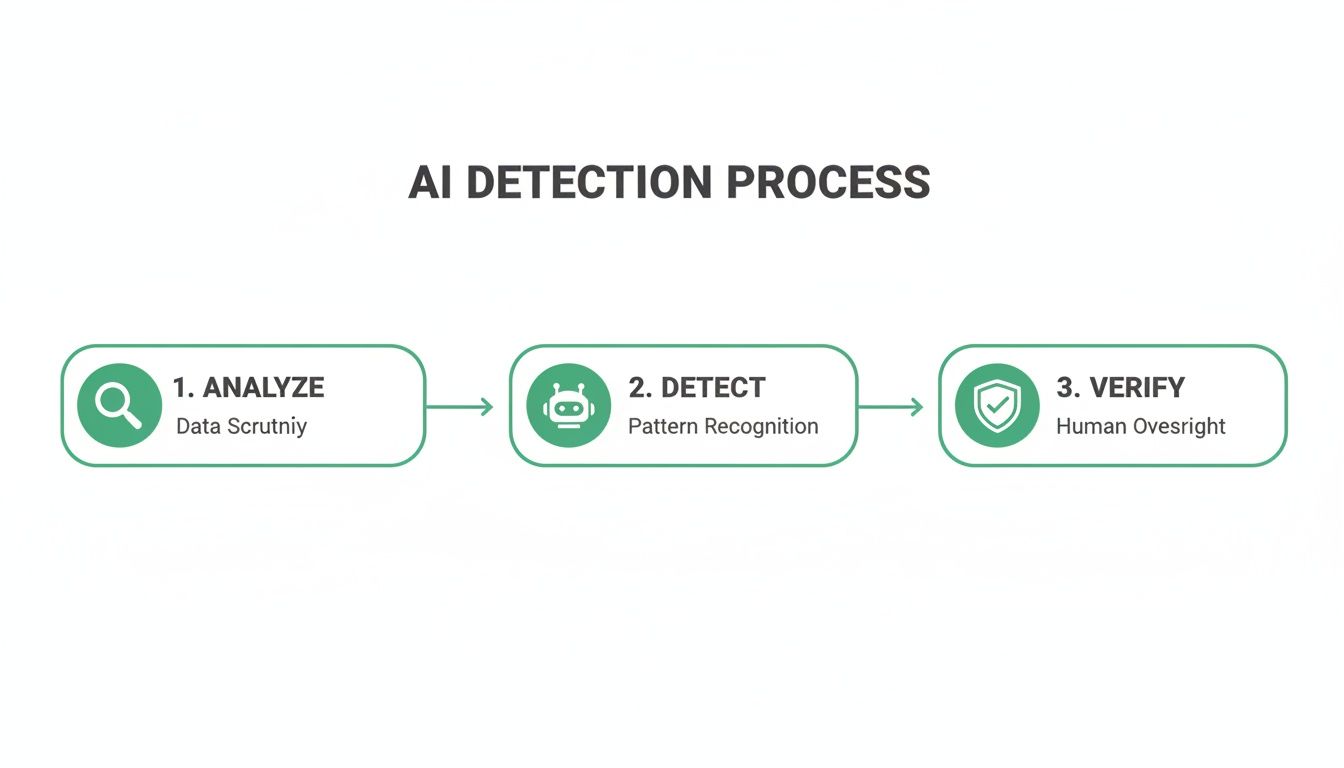
This process really boils down to three core steps: you analyze the text for red flags, use a tool to detect patterns, and then verify the results with your own judgment.
To get started, it's helpful to know the main approaches you can take. This table breaks down the key methods we'll explore.
Quick Guide to Detecting AI Content
| Detection Method | What to Look For | Best For |
|---|---|---|
| Linguistic Analysis | Unnatural phrasing, repetitive sentence structures, lack of personal voice, overly formal tone. | Quick manual checks, identifying content that just "feels" off. |
| Fact-Checking | "Hallucinations," outdated information, vague or non-existent sources. | Verifying the accuracy of technical, historical, or data-driven content. |
| AI Detector Tools | Probabilistic scores (e.g., "98% likely AI-generated"), highlighting specific machine-like sentences. | Getting a data-backed second opinion and scanning large volumes of text quickly. |
| Human Review | Assessing flow, nuance, emotional depth, and originality of ideas. | Making the final call, especially when automated tools give mixed signals. |
Think of these methods as layers. Each one gives you a clearer picture, helping you move from a gut feeling to a confident assessment.
It's About Preserving Your Authentic Voice
Ultimately, this is about more than just playing "spot the bot." It's about protecting the value of human creativity and making sure your own message cuts through the noise.
At PureWrite, we see AI as a starting point, not a final product. Our goal isn't to help you sneak past detectors but to empower you to transform a soulless AI draft into something that reflects your unique voice. By polishing that robotic text, you use AI as a smart assistant without sacrificing the connection your readers expect.
How to Spot the Telltale Signs of AI Writing
Before you even fire up an automated tool, your own critical eye is the first—and often best—line of defense. Even the most sophisticated AI models leave behind subtle but distinct linguistic footprints. Learning to spot these clues will make you a much more discerning writer and editor.
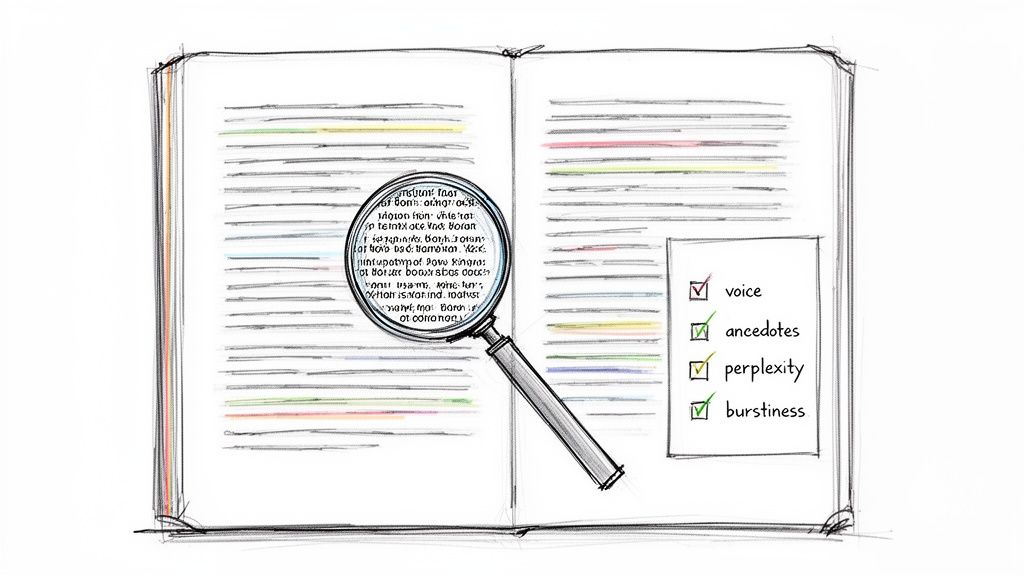
The biggest giveaway is often just a feeling. The writing might be polished and grammatically flawless, yet it feels completely soulless. It's missing that spark of genuine human experience or the authentic voice that truly connects with a reader.
The Problem of Predictable Perfection
AI writing often feels like it was designed by a committee to be as inoffensive as possible. This approach creates content that's technically correct but emotionally vacant. You’ll notice it follows a very clean, predictable structure, ticking all the boxes of "good writing" without any of the heart.
This predictability leads to a flat, uniform rhythm. Human writing, on the other hand, has a natural ebb and flow. We use a mix of long, complex sentences and short, punchy ones—a quality known as "burstiness." AI-generated text often lacks this, sticking to a consistent sentence length that can feel monotonous.
Key Takeaway: AI is trained on enormous datasets, making it an expert at mimicking patterns. The result is often prose that sounds plausible but lacks the unique quirks, personal anecdotes, and emotional depth that define authentic human writing.
This is precisely why manual detection can be so tricky. A recent study revealed that humans can distinguish AI-generated content from human writing only 51.2% of the time—basically a coin toss. This highlights the need for a blended approach that combines your intuition with smart tools.
Linguistic Cues and Overused Phrases
AI models definitely have their favorite words and phrases. They tend to overuse transitional words like "moreover," "furthermore," and "in conclusion." They also have a fondness for grand statements and formal language, even in a casual context.
Keep an eye out for these common AI tells:
- Repetitive sentence starters: Does every other paragraph begin with "Additionally" or "It is important to note"? This is a classic sign of AI-generated filler.
- Lack of personal experience: AI can't share a personal story or a genuine opinion. It can only simulate one, resulting in vague "anecdotes" that feel hollow.
- Over-explanation of simple concepts: An AI might define a common term in painstaking detail because it lacks the human intuition to know what an audience already understands.
- Unnatural use of analogies: AI often deploys metaphors indiscriminately because its training data shows that "good writing" includes them, not because the idea needs clarification.
Exploring tools that analyze how content is 'Seen By AI' can offer valuable insights. For a deeper dive into crafting a more human style, check out our guide on establishing a strong tone and voice in writing.
Human vs. AI Writing Characteristics
To make it easier to spot the differences at a glance, here’s a direct comparison. Think of this as a mental checklist when you're reviewing a piece of content.
| Characteristic | Human Writing | AI Writing |
|---|---|---|
| Tone & Voice | Varies with emotion; contains unique personality, humor, and quirks. | Often flat, neutral, and overly formal; lacks a distinct personality. |
| Sentence Structure | Naturally varied ("bursty") with a mix of long and short sentences. | Tends to be uniform and repetitive, with consistent sentence lengths. |
| Personal Insight | Includes genuine anecdotes, opinions, and lived experiences. | Lacks true personal stories; may use vague, impersonal examples. |
| Word Choice | Uses idioms, slang, and nuanced vocabulary naturally. | Relies on a predictable set of "safe" words and formal transitions. |
| Errors | May contain occasional typos, grammatical errors, or creative phrasing. | Usually grammatically perfect and flawless, which can feel unnatural. |
By training your eye to spot these signs, you add a powerful layer of human judgment to your detection process. When you get that "something feels off" feeling, you'll know exactly what to look for.
Of course, a manual review alone isn't foolproof. That's why at PureWrite, we advocate for using your skills as a first pass, then using tools to confirm your suspicions and refine the content. Our platform is designed to help you transform that robotic first draft into something that sounds genuinely human. Ready to elevate your text? Try PureWrite and feel the difference.
How to Use AI Detector Tools the Right Way
So, your gut feeling is telling you something’s off with a piece of text. That's when an AI detector can be a fantastic second opinion. These tools give you a fast, scalable way to check content, but getting real value from them means going beyond just trusting the number that pops up.
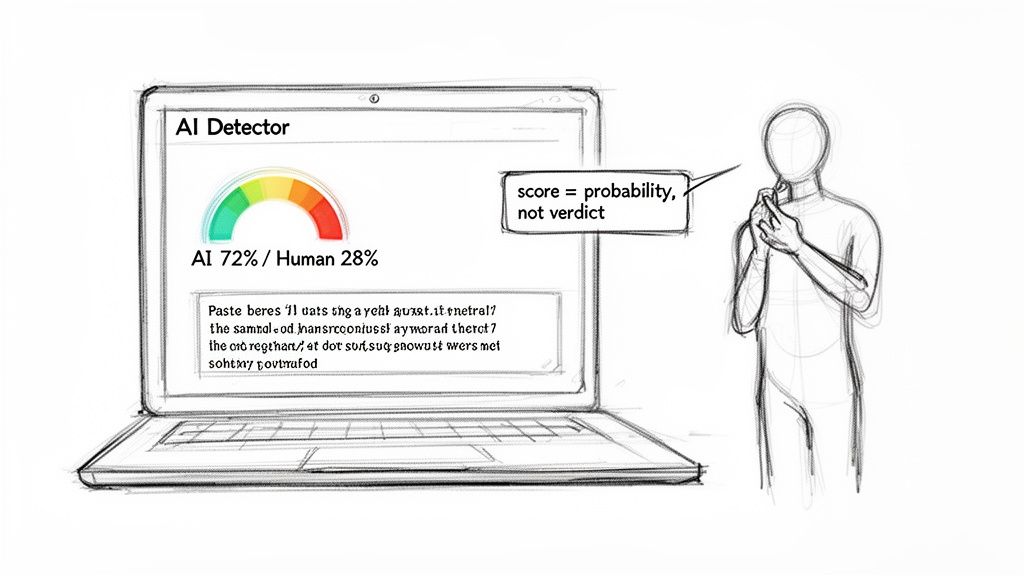
The market for these tools is booming, projected to hit $12 billion by 2030. But their accuracy is all over the place. Even OpenAI’s own detector was famously unreliable, only catching 26% of AI-written text and, worse, flagging 9% of human writing as robotic.
This is exactly why you need to understand what these tools are actually doing. Most of them look at two main concepts from the world of AI: perplexity and burstiness. Perplexity measures how predictable words are; AI writing is often very predictable. Burstiness, as we covered, is the natural, uneven rhythm of human writing that AI struggles to replicate.
Interpreting the Results: A Score Is Not a Verdict
When a detector spits out a score like "98% likely AI-generated," it's easy to take that as the final word. Don't. That number is a probability, not a definitive judgment.
An AI detection score is a statistical probability, not a final verdict. It’s a powerful signal that should prompt further review, not an automatic disqualification of the content.
Think of it like this: the tool isn't reading the text for meaning. It’s just doing math on word patterns. A high AI score simply means the text fits the statistical profile of machine-generated content.
Navigating False Positives and Common Pitfalls
One of the biggest headaches with AI detectors is the false positive—when perfectly good human writing gets flagged as AI. It happens more than you'd think, and usually for a few common reasons.
- Writing from Non-Native Speakers: Someone writing in a second language might naturally use more formal sentence structures. To a detector, this can look a lot like the predictable patterns of an AI.
- Highly Technical or Formal Content: Think about academic papers or legal documents. The language is precise and structured by design, which often lacks the "burstiness" an algorithm is looking for.
- Over-Edited Text: If a piece has been edited and re-edited to within an inch of its life, it can sometimes lose its natural human flow and start to sound robotic.
This is precisely why you can’t rely on just one tool. If you get a high AI score on a piece that feels human, try running it through a second or third detector. For a deeper look at their limitations, check out our article exploring whether AI detectors are accurate.
A Practical Walkthrough for Content Creators
Let's put this into a real-world scenario. You're a content manager, and a blog post from a new freelance writer lands on your desk. It’s grammatically sound, but it just feels… bland. Here’s how you could use a detector the smart way:
- The First Scan: You copy the whole article into an AI detector. It comes back with a score of 85% AI Probability.
- Analyze the Hotspots: Instead of just accepting the number, look at what the tool highlights. You notice the intro and conclusion are flagged, but the middle sections with concrete examples aren't.
- Get a Second Opinion: You take that flagged introduction and run it through a different detector. This one gives it a 92% score. Okay, now you've got corroborating evidence.
- Go Back to a Manual Review: Armed with this data, you reread the intro. It’s full of clichés like "In today's fast-paced world..." and follows a cookie-cutter formula.
- Take Action (Constructively): Now, instead of just rejecting the article, you have specific, data-informed feedback. You can go back to the writer and ask them to rewrite the introduction, requesting a more personal touch.
By following a process like this, you turn the detector from a simple pass/fail button into a genuinely useful diagnostic tool.
At PureWrite, we’re all about this balanced approach. Our platform doesn't just help you humanize AI text; it also has a detector built right in, so you can be confident in your final draft. By understanding how to read the signals, you can create content that’s both well-crafted and authentically human. Ready to refine your drafts with confidence? Try PureWrite today.
Look Beyond the Words: Verifying an Article's Origins
Spotting AI-generated content isn't always about clunky sentences. To do a proper check, you really have to put on your detective hat and dig into the claims made within the text itself. This is a crucial step because one of the biggest blind spots for today's AI models is their tendency to "hallucinate."
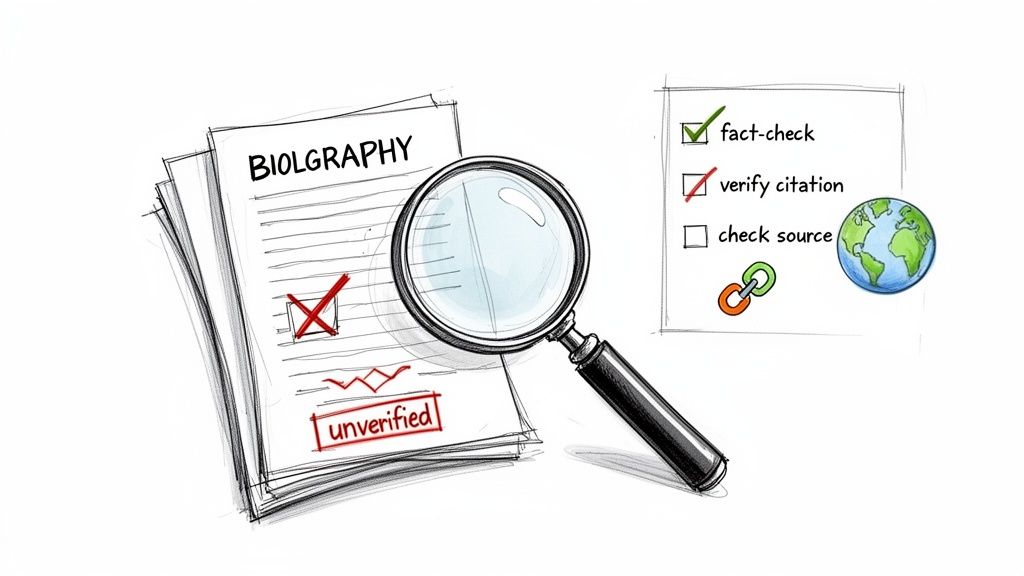
AI hallucinations are when the model just makes things up but presents them as facts. It might invent statistics, create quotes from experts who don't exist, or cite academic studies that were never published. This happens because the AI is a pattern-matching machine, not a truth engine.
The ease of generating text has completely flipped the script on content creation. It's now incredibly fast to produce a first draft, but the real work—verifying its accuracy—is just as intensive as ever. You simply can't afford to take an AI's claims at face value.
A Quick Framework for Fact-Checking
To protect your credibility, you need a straightforward process for checking the facts in any content you suspect might have come from an AI.
First, just pull out the core claims. Isolate any specific numbers, stats, quotes, or references. From there, you can run through a quick verification checklist for each one.
- Scrutinize the Numbers: If the text says "73% of consumers prefer a certain feature," your first move is to find where that number came from. A quick search should point you to a reputable study or report.
- Double-Check the Quotes: For any quotes, search for the exact phrase along with the speaker's name. If you can't find it in published interviews or on their official channels, it's a huge red flag.
- Confirm the Sources: When a source like a book or study is cited, take a moment to confirm it actually exists. AI has a nasty habit of inventing legitimate-sounding titles.
The real danger with AI-generated content is the breakdown of verification. It's tempting to just hit "regenerate" and hope for a better result, but that’s a world away from doing the hard work of confirming accuracy.
Publishing an article with a fabricated statistic or a fake quote can do serious damage to your audience's trust. That’s a loss far more painful to recover from than the few minutes you'll spend fact-checking.
How to Spot a "Hallucinated" Source
Let’s run through a quick, real-world scenario. You're editing a blog post and you see this sentence: "According to a 2023 study by the Chronos Institute, remote teams reported a 22% increase in focused work time."
It sounds pretty credible, right? But when you search for "Chronos Institute 2023 study," you find... nothing. This is a classic AI hallucination—a source that sounds plausible but is completely made up.
This same mindset applies to checking for originality in general. The techniques for verifying sources overlap with plagiarism-checking, which you can learn more about in our guide on checking for plagiarism using Google.
Why This Extra Step Is So Important
Failing to verify sources doesn't just make you look careless; it feeds a much bigger problem of information pollution. Every time false or misleading AI content gets published, it becomes that much harder for everyone to separate fact from fiction.
Here at PureWrite, we see AI as a powerful writing assistant, not a source of absolute truth. Our platform is designed to help you nail the structure and flow of your writing, but the responsibility for factual accuracy always lies with you, the human author. When you pair smart tools with diligent verification, you can create high-quality, trustworthy content.
So You’ve Spotted AI-Generated Content. Now What?
Finding out a piece of content was likely written by AI can feel like a "gotcha" moment. But before you hit delete, take a breath. What you do next depends entirely on the situation.
An educator dealing with a student's paper will react very differently than a content manager reviewing a draft from a freelance writer. The context is everything.
The real issue is distinguishing between AI as a helpful assistant and AI as a substitute for human effort. There’s a world of difference between a writer using an AI to brainstorm an outline versus someone passing off a raw, unedited AI output as their own. One is smart; the other is a serious ethical problem.
Drawing the Ethical Line with AI
Whether you're a professional, a student, or a creator, the ethics of using AI boil down to one thing: honesty.
Are you using the tool to sharpen your own thinking, or are you letting it do the thinking for you? The line is crossed when you claim full authorship for text that you didn't fundamentally shape with your own ideas, analysis, and perspective.
Here at PureWrite, we’re firm believers in responsible AI use. Our platform is designed to be a powerful assistant—a tool to help you refine ideas and polish your writing, not to create the ideas for you. Real authority comes from adding your unique insights, turning a generic draft into something only you could have written.
From Robotic to Relatable: A Practical Guide to Humanizing AI Drafts
Let’s tackle the most common scenario for you as a content creator: you’ve got a first draft from an AI, and now you need to make it yours. Think of the AI output as a lump of clay; your job is to sculpt it into something that actually connects with people.
This "humanizing" process is so much more than just swapping out a few words. It's about injecting your genuine personality into the text. A raw AI draft might sound polished, but it often feels soulless and predictable.
Your goal isn't just to fool an AI detector. It’s to create content that’s genuinely valuable and engaging for your readers. Authentic writing builds a loyal audience; robotic content drives them away.
To get started, you have to actively break down the AI's formulaic patterns. A solid humanizing workflow involves a few key steps that go way beyond a simple grammar check.
Let's Get to Work: Transforming Your Content
Ready to turn a robotic draft into something that sounds like a real person wrote it? Here are the practical steps you can take right now to infuse your voice and make the content truly original.
Tell a Story: AI can't share personal experiences. Where can you add a short, relevant anecdote from your own life or career? This is the fastest way to build a connection and establish credibility.
Kill the Vague Statements: AI loves making broad, safe claims that say nothing. Find these sentences and replace them with specific data, a strong, defensible opinion, or a real-world example.
Fix the Rhythm: Read the draft out loud. Does it have a monotonous rhythm? That’s a classic AI tell. Mix short, punchy sentences with longer, more detailed ones to create a natural, conversational flow.
Tune the Voice: Does this piece sound like you or your brand? Be critical. Adjust the vocabulary and tone to match the voice your audience already knows and trusts.
This is exactly what PureWrite was built to do. Our platform helps you move beyond basic edits by giving you sophisticated, actionable recommendations to improve the naturalness and flow of your text. We help you spot and fix those subtle robotic patterns that make AI content feel "off."
Instead of spending hours manually rewording every sentence, you can use our advanced features to humanize a draft in minutes. We help you keep your core message intact while making sure the final piece reflects your unique expertise.
By using an AI draft as a starting point and then applying your human touch—with a little help from the right tools—you get the best of both worlds. You save time on the heavy lifting and still produce a final piece that is authentic and genuinely yours.
Ready to see how easy it can be? Try PureWrite today and transform your AI drafts into high-quality, human-written content.
Your Questions About AI Content Detection, Answered
As AI writing tools become more common, it's natural to have questions. Everyone from students to marketing professionals is trying to figure out where the lines are drawn. Let's tackle some of the most common questions we hear.
Our aim here is to give you straightforward, practical answers. The goal isn't to avoid AI, but to use it smartly and ethically, so your own voice always shines through.
Can AI Detection Tools Be 100% Accurate?
The short answer is no. Not a single AI detection tool on the market is perfect, and it's crucial to remember that.
These tools are built on probabilities, which means they can get it wrong. You'll run into false positives, where they flag human text as AI-generated, and false negatives, where they miss AI content completely.
Think of a detector's score as a starting point for a closer look, not the final word. The best method is always a combination of tools and your own judgment. The accuracy of tools like Turnitin, for example, is a hot topic, and we did a deep dive into whether Turnitin can reliably detect AI that you might find interesting.
Is It Unethical to Use AI for Writing?
This really boils down to two things: transparency and intent. There’s nothing inherently wrong with using AI to get past writer's block or structure a first draft. It can be a massive time-saver.
The ethical line gets crossed when the intent is to deceive—to pass off AI-generated work as entirely your own, especially where originality is required. Submitting an AI-written essay without adding your own critical thought or analysis is where you get into trouble.
Our Philosophy: We believe AI should be your co-pilot, not the pilot. It can handle some of the heavy lifting, but you should always be the one steering the conversation with your unique insights. True authenticity comes from the author, not the algorithm.
How Do I Make AI-Assisted Content Sound More Human?
Getting rid of that robotic, slightly-too-perfect AI sound is all about adding back the human element. Once you have a draft, the real work of making it yours begins.
Here are a few things that work every time:
- Inject Personal Stories: Share a quick anecdote or a personal opinion. An AI has no life experiences to draw from, but you do. This is your biggest advantage.
- Vary Your Sentence Rhythm: AI often spits out sentences of similar length. Break them up. Follow a long, descriptive sentence with a short, punchy one.
- Get Specific: Swap out generic fluff for hard data or real-world examples. Instead of "many businesses benefit," say "over 50% of small businesses reported a 15% increase in efficiency."
- Refine the Tone: Read it aloud. Does it sound like you? Adjust the word choice until it matches the voice your audience expects to hear.
This is exactly what PureWrite was designed for. Our platform helps you smooth out those robotic edges and make sure the final piece sounds like it was written by a real person.
Will an AI Humanizer Guarantee I Bypass Detectors?
While a tool like PureWrite is incredibly effective at rewriting text to avoid AI detection, no one can offer a 100% guarantee every single time. Why? Because the detection models are constantly being updated. It's a cat-and-mouse game.
That said, our platform is specifically built to restructure text in a way that mimics human writing patterns. By doing this, it scrubs the statistical markers that detectors are trained to find. Using PureWrite to polish your drafts gives you a much higher chance of creating content that not only passes as human but is also more readable for your audience.
Ready to turn those clunky AI drafts into content that truly connects? PureWrite helps you refine robotic text, inject your unique voice, and confidently create high-quality articles, essays, and emails. Try PureWrite today and feel the difference.