Master Passive Voice vs. Active Voice with Clear Examples for Polished Writing
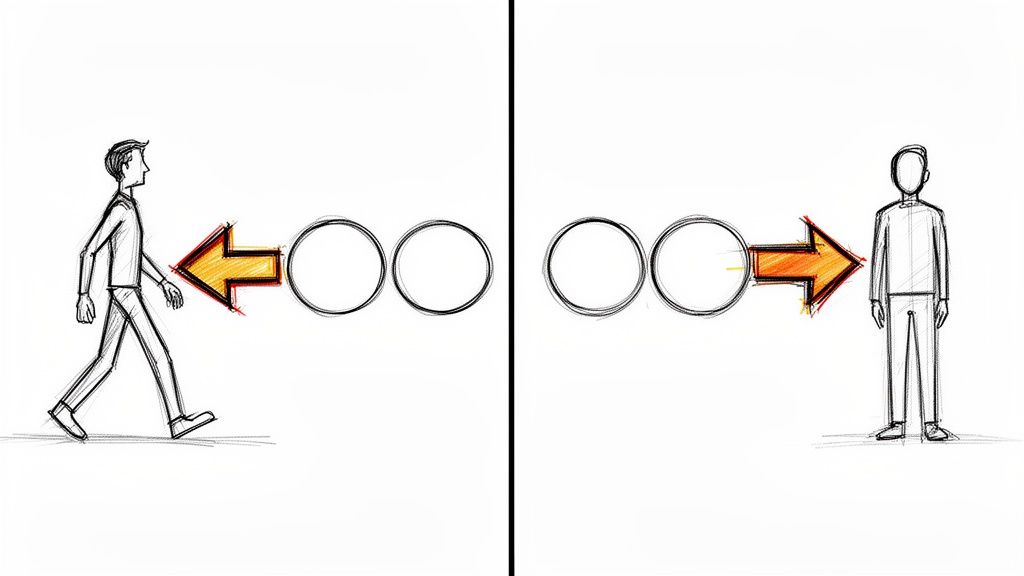
When you get right down to it, the difference between active and passive voice is all about focus. Mastering this distinction is one of the quickest ways to make your writing more powerful, whether you're crafting an email, a blog post, or refining AI-generated content.
Think of it this way: active voice is direct and to the point. It puts the person or thing doing the action (the subject) right at the front. For example: “Our marketing team launched the campaign.” It’s clear, confident, and full of energy.
On the other hand, passive voice is more indirect. It shifts the spotlight to the person or thing receiving the action: “The campaign was launched by our marketing team.” See how the emphasis changed? Grasping this simple shift is the first step to making your writing more deliberate and effective.
Why This Distinction Matters for Content Creators
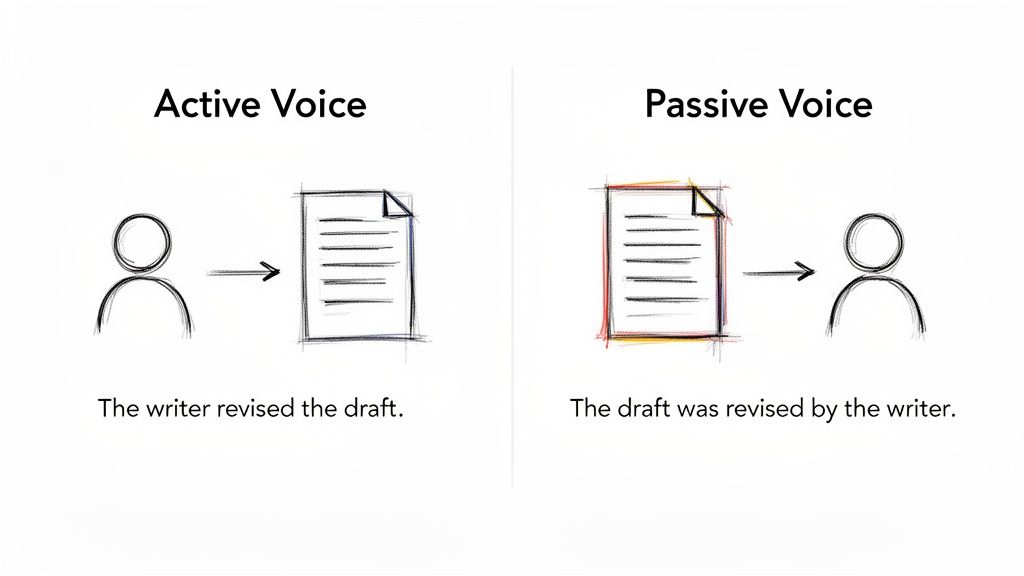
To truly improve your writing, you have to go beyond just memorizing definitions. You need to feel how each voice changes the rhythm and clarity of your sentences. Active voice almost always follows a clean Subject-Verb-Object pattern, making it feel crisp and easy for your audience to follow.
It’s no surprise that most style guides push for active voice in business writing and web content—it builds trust and keeps your readers engaged. Research shows that content with a clear, active voice can improve readability scores by up to 25%, which is a huge advantage in holding a reader's attention.
But that doesn't mean passive voice is a mistake. It’s a tool. You can use it strategically to shift focus away from the doer, which comes in handy when the doer is unknown, irrelevant, or simply less important than the action itself. If you're looking to build your writer's toolkit, exploring these proven ways to improve writing skills will give you a better sense of when and how to deploy different stylistic choices.
The Nuts and Bolts: Structural Differences
The quickest way to tell active and passive voice apart is to look at the sentence structure and see who or what gets the attention. Active voice puts the actor first, making your writing feel more confident and immediate. Passive voice often comes across as more formal or academic.
Getting comfortable with both is a hallmark of strong writing, just as important as knowing the other basic grammar rules that make communication work.
Active vs. Passive Voice At a Glance
Here’s a quick-reference table to help you keep the key differences straight.
| Characteristic | Active Voice | Passive Voice |
|---|---|---|
| Sentence Focus | Highlights the actor performing the action. | Highlights the recipient of the action. |
| Structure | Subject + Verb + Object | Object + Verb ("to be" + past participle) + optional Subject |
| Typical Tone | Direct, confident, and energetic. | Formal, objective, and sometimes evasive. |
| Common Use Case | Marketing copy, storytelling, instructions. | Scientific reports, legal documents, official announcements. |
In the end, choosing the right voice isn’t about blindly following a rule. It's a strategic decision. As a writer, you should ask yourself: What do I want my reader to focus on? Once you have that answer, the choice becomes much clearer.
Deconstructing Active and Passive Sentences
To really master your writing, you need to understand how sentences are actually put together. Let's get under the hood and dissect the grammar of each voice. Once you see how they work, you'll be able to confidently switch between them for the right effect.
The active voice has a crystal-clear, logical structure that’s a breeze for readers to follow. Its directness is exactly why it packs so much energy.
The Anatomy of an Active Sentence
Most active sentences roll out in a simple Subject-Verb-Object (SVO) sequence. This structure immediately puts the spotlight on who or what is doing the action, making your point instantly clear.
- Subject: The person or thing performing the action.
- Verb: The action itself.
- Object: The person or thing on the receiving end of that action.
Take this classic active voice example: *“The content team (Subject) launched (Verb) the new campaign (Object).”* See how that works? It's a straight line from doer to action to receiver. The strong verbs are doing all the heavy lifting here, which you can learn more about in our guide on action verbs vs linking verbs. This clean SVO flow is the secret sauce for clear, authoritative writing.
Understanding the Passive Sentence Structure
Passive sentences, on the other hand, flip this entire structure on its head. They start with the object, which can make the sentence feel more formal or indirect.
The formula for a passive sentence is always the same:
Object + "to be" verb + Past Participle (+ by + Subject)
Let’s rework our active example: *“The new campaign (Object) was launched (‘to be’ verb + past participle) by the content team (Subject).”* Notice how the doer—the content team—is now tacked on at the end with the word "by."
This isn't just some fussy grammatical rule; it's a strategic shift in focus. By pushing the doer to the back of the line (or dropping it completely), the passive voice gives you total control over where your reader's attention lands.
This choice often comes down to the conventions of different writing styles. For instance, statistical analyses show that passive voice makes up about 25% of sentences in academic writing, but it plummets to under 5% in casual conversation, according to the Longman Grammar of Spoken and Written English. This really underscores its role in specific contexts.
Knowing the mechanics is your key to making deliberate, powerful writing choices. When you're editing—whether it’s your own work or text from an AI tool—spotting these patterns lets you switch between voices to get the tone just right. If an AI draft comes out sounding stiff, PureWrite can instantly convert those clunky passive sentences into active ones that connect directly with your reader.
Using Active Voice for Impact and Authority
If you want your writing to be direct, confident, and persuasive, the active voice is your best friend. It’s the engine that drives clear communication, slicing through ambiguity to land your message with real force. When you put the "doer" of the action right at the front of the sentence, you instantly create a stronger connection with the reader.
This directness isn't just about sounding more energetic—it's about building trust. For anyone creating content, especially in marketing, this is absolutely essential. Your audience wants answers and solutions, and the active voice delivers them without hesitation.
Drive Action and Build Credibility
In content marketing, your goal is to inspire action. You want someone to sign up, buy a product, or simply trust what you're saying. To do that, your language has to be compelling, and active voice is how you get there.
Just look at how it works in different real-world settings:
- Marketing Copy: Instead of, "Our new software was designed to simplify your workflow," try this: "We designed our new software to simplify your workflow." The active version sounds confident and shows you own your solution.
- Instructional Content: Rather than, "The 'submit' button should be clicked after the form is completed," just say, "Click the 'submit' button after you complete the form." It’s a clean, direct command.
- Business Communication: Avoid vague statements like, "A decision was made to delay the project." Be clear: "Our leadership team decided to delay the project." This assigns responsibility and feels much more transparent.
Using active voice isn't just a stylistic preference; it's a strategic choice that conveys authority. When you write actively, you’re not just sharing information—you're taking a definitive stance, which makes your message more credible and impactful.
This approach also leads to leaner, more powerful sentences. It naturally pushes you toward concise writing, which is a great way to respect your reader's time and attention. By trimming the fat, your core message shines through. You can dive deeper into this idea in our guide explaining what is concise writing.
Transforming Sentences for Greater Impact
Flipping a sentence from passive to active is usually a simple tune-up. First, pinpoint who or what is actually performing the action. Then, just make that actor the subject of the sentence, paired with a strong verb. It's a small tweak that makes a massive difference.
This is especially important if you're working with AI-generated drafts. AI tools can sometimes lean on passive constructions that sound robotic. Running that text through a tool like PureWrite can help you catch those weak spots and swap them with dynamic, active alternatives. We help you humanize your content so it speaks directly to your audience.
When and Why You Should Intentionally Use the Passive Voice
Let's clear the air: the passive voice isn't always a grammatical sin. While active voice usually delivers more punch, the passive voice is a surprisingly sophisticated tool when you know how to wield it. In certain situations, it’s not just an option—it's the best choice you can make.
The trick is learning to distinguish between a weak, accidental passive construction and a strong, deliberate one. When you get this right, you gain precise control over your sentence's focus, making you a far more versatile and effective writer.
Emphasizing the Action or the Recipient
Sometimes, the person doing the action (the actor) is unknown, irrelevant, or just not the point. The passive voice shines in these moments, shifting the spotlight onto the action itself or the person receiving it.
Think about the difference in these real-world scenarios:
- For diplomacy: “An error was made in the billing process.” This sounds much more tactful than pointing fingers with, “Our new intern made an error in the billing process.”
- For formality: “The new policy has been approved.” This carries an official, authoritative weight that “The board approved the new policy” might lack.
- For scientific clarity: “The samples were analyzed in a controlled environment.” The focus here is rightly on the scientific process, not on who did the analyzing.
This decision tree helps visualize the thought process, especially for marketing copy, instructions, and everyday business communication where clarity is king.
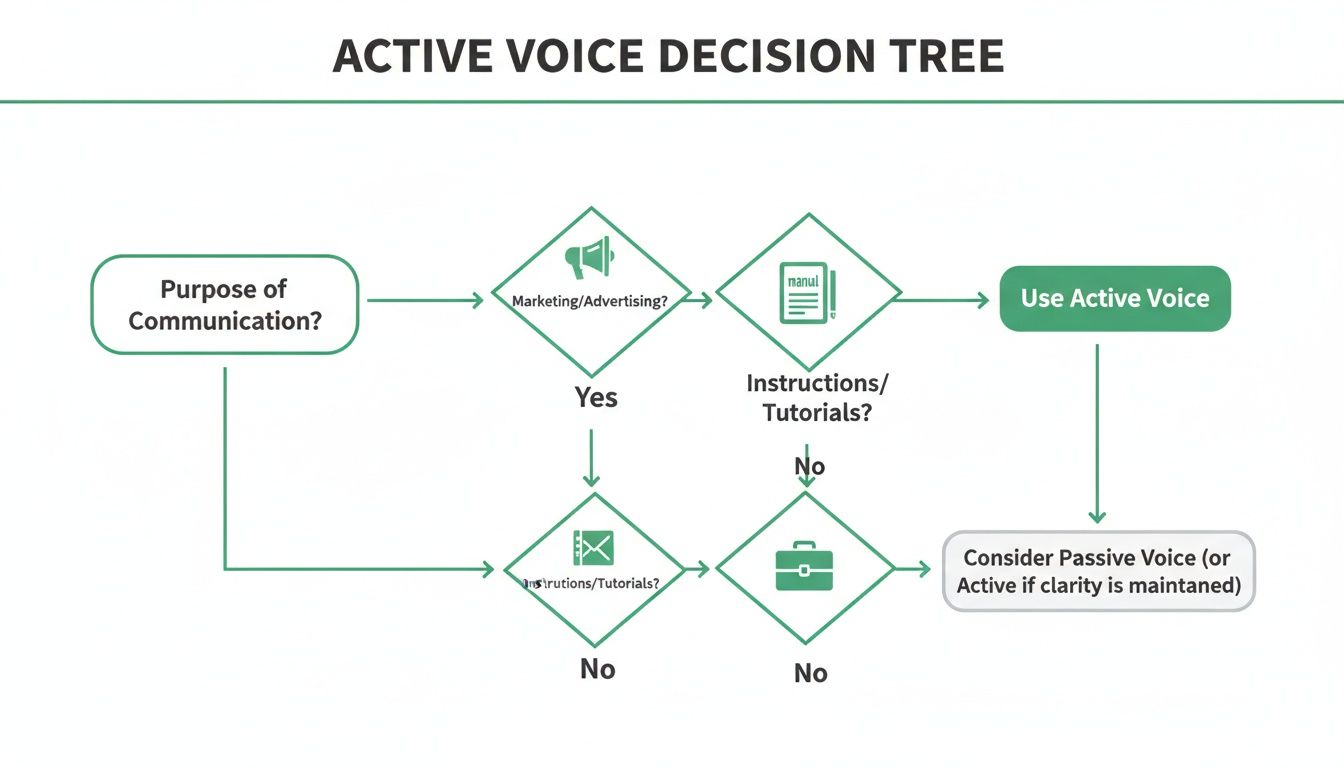
As the flowchart shows, active voice is usually your best bet when you need clear, action-oriented content and when accountability matters.
Maintaining an Objective Tone in Formal Writing
In the world of scientific and academic writing, objectivity is everything. The passive voice is a long-standing convention because it helps create a formal, impersonal tone. By removing the researcher ("I" or "we") from the spotlight, the focus shifts to the experiment, the data, and the findings.
The goal is to make the research itself the star of the show, not the researcher. Passive voice creates a sense of distance, which in this context, builds credibility rather than sounding evasive.
While some academic fields are shifting towards more active constructions, passive voice remains crucial. An analysis of scientific writing conventions.pdf) in high-impact medical journals found that in methodology sections—where the process is the entire point—over 25% of clauses were passive, proving its continued importance.
For more practical tips on this, our guide on how to improve academic writing is a great resource.
Choosing the Right Voice: A Situational Guide
To make the decision even easier, here’s a quick reference table breaking down common writing scenarios and which voice typically works best.
| Writing Goal | Recommended Voice | Example Sentence |
|---|---|---|
| Telling a Story or Narrative | Active | The hero defeated the dragon. |
| Giving Direct Instructions | Active | You should click the "Submit" button. |
| Writing a Business Email | Active | I will send the report by 5 PM. |
| Reporting a Scientific Finding | Passive | The solution was heated to 100°C. |
| Delivering Bad News Gently | Passive | Your application was not selected. |
| When the Actor is Unknown | Passive | The window was broken last night. |
This table isn't a set of rigid rules, but rather a guide to help you think critically about the impact you want to create with your words.
AI writing tools can often get this wrong, defaulting to awkward phrasing. That’s why we built PureWrite—to help you ethically refine AI text, nail the right tone, and sound genuinely human. Ready to polish your next project? Try PureWrite and see the difference.
Common Voice Mistakes and How to Fix Them
Even experienced writers can fall into voice-related traps. Learning to spot these common missteps is the first step toward writing prose that feels clear, direct, and confident. The biggest culprit is often overusing the passive voice, which can make your writing sound stuffy or evasive.
On the flip side, another common mistake is forcing an active sentence so aggressively that it just sounds awkward. Sometimes, the passive construction is actually the more natural choice. The goal isn't to eliminate the passive voice, but to use it deliberately, not accidentally.
Unmasking the "Agentless" Passive
One of the trickiest errors to catch is the "agentless" passive voice. This is what happens when the doer of the action is completely scrubbed from the sentence, leaving your reader to wonder who is actually responsible.
You’ve definitely seen this in corporate-speak or political statements:
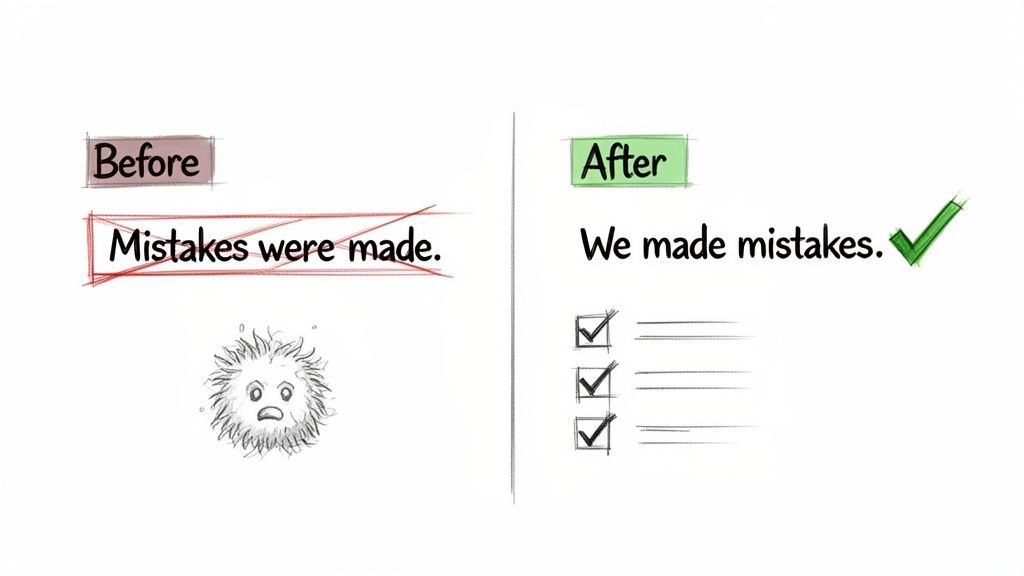
- Agentless Passive: "Mistakes were made."
- Agentless Passive: "The decision has been finalized."
These sentences aren't technically wrong, but they intentionally obscure who is taking the action. The fix is simple: identify who did the thing and put them front and center as the subject.
Before: Mistakes were made during the project launch.
After: Our team made mistakes during the project launch.
That small tweak instantly makes the sentence more transparent and accountable.
The shift toward active voice is so significant that it has even changed traditionally formal disciplines. Top-tier journals now actively encourage it, with some studies showing its use has increased by over 10% in the last decade. You can dig deeper into these trends in scientific writing here.
If you're using AI assistants to help with drafting, you'll probably notice they have a habit of generating these weak, agentless passives. We built PureWrite to catch these limp sentences and offer strong, active alternatives that give your writing more clarity and punch. Try PureWrite for free to strengthen your writing.
Refining AI-Generated Text with PureWrite
AI writing assistants are incredibly useful for overcoming writer's block and generating first drafts. But let's be honest—the text they produce often feels a little... robotic. It can sound stiff, impersonal, and flat. One of the biggest culprits is the AI's frequent and awkward use of the passive voice.
This is exactly why we built PureWrite. We wanted to create a tool that does more than just check grammar. It’s designed to be your writing partner, helping you ethically smooth out those AI-generated sentences and inject authentic human personality back into your work.
From Robotic to Relatable
Think about the last AI draft you edited. It was probably full of sentences like, "The report will be sent by the end of the day." Sure, it's grammatically correct, but it’s also lifeless. A simple switch to, "I will send you the report by the end of the day," makes it direct, clear, and more personal. PureWrite is built to catch these exact opportunities.
Getting your voice right is crucial, especially if you’re exploring strategies for AI social media content creation where authenticity is everything. Your goal should always be to ensure your content sounds like a real person wrote it, maintaining your unique brand voice.
AI-generated content can miss the subtle nuances that make writing feel human. By converting passive voice to active, you reclaim a sense of ownership in your message, making it more trustworthy and impactful for your reader.
Our platform was designed specifically to fix these common AI writing problems. If you want to learn more about turning robotic drafts into authentic content, our guide on how to humanize AI-generated text is a great place to start.
Ready to take your AI-assisted writing to the next level? Try PureWrite today and see how easy it is to turn clunky first drafts into polished, professional content that actually connects with your audience.
Answering Your Top Questions About Voice
When you're trying to master active and passive voice, a few questions always seem to pop up. Let's tackle them head-on so you can write with more confidence and make smarter choices in your own work.
Is Passive Voice Just Bad Grammar?
Let's clear this up right away: no, the passive voice is not grammatically incorrect. It’s a perfectly valid way to structure a sentence. The real issue is about style and impact, not rigid rules.
The reason so many writing guides caution against it is because overusing the passive voice can make your writing sound detached, clunky, or even evasive. For most situations, the active voice is punchier and more direct, which is why it's usually the better choice.
What's the Easiest Way to Spot Passive Voice?
If you want to quickly find passive voice in your writing, keep an eye out for a simple, two-part formula. First, look for a form of the verb "to be" (like is, are, was, were, been). Then, check if it's followed by a past participle, a verb that often ends in -ed or -en.
Here are the tell-tale signs:
- A "to be" verb + a past participle: "The report was written."
- The word "by" to name the doer: "The decision was made by the manager."
Of course, using a good editing tool is a great shortcut. It can flag these constructions automatically, saving you a ton of time during your review process.
The point isn't to hunt down and destroy every single passive sentence. Instead, ask if each one is pulling its weight. If an active version sounds stronger and the passive sentence isn't serving a specific purpose, you've found a great candidate for a rewrite.
Can I Use Both Active and Passive Voice in the Same Paragraph?
You absolutely can, and you often should! Blending the two is a sign of a skilled and versatile writer. You might use the active voice for most of a paragraph to keep the momentum going, but then intentionally switch to a passive sentence to change the rhythm or shift your reader's focus.
Mixing voices is a great way to keep your writing from sounding repetitive. For example, you could use a series of active sentences to describe a sequence of events, then use a passive sentence to emphasize the outcome. It all comes down to making deliberate, strategic choices.
Are your AI-generated drafts feeling a bit stiff or overly formal? We designed PureWrite to catch those awkward passive sentences and suggest more natural, human-sounding alternatives. You can instantly make your content feel more authentic and connect better with your readers. Try PureWrite for free and feel the difference yourself.