Adjective vs Adverb: Your Guide to Flawless Writing
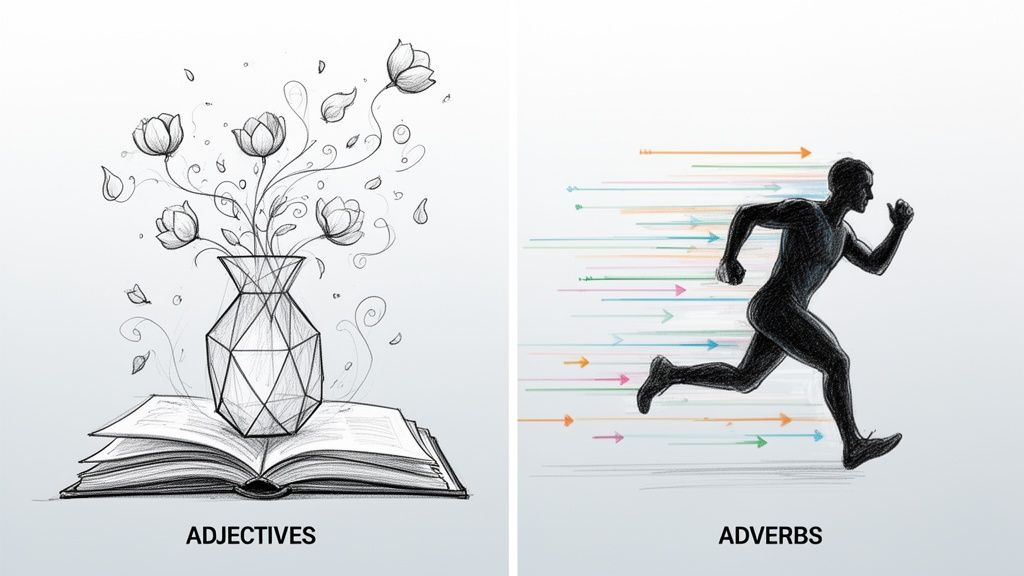
At its heart, the difference between an adjective and an adverb is straightforward. An adjective describes a noun—a person, place, thing, or idea. An adverb describes a verb (an action), an adjective, or even another adverb.
Think of it this way: adjectives are like painters adding detail and color to a subject, while adverbs are like directors telling that subject how to act. This distinction is crucial for content creators, students, and professionals aiming for clear, impactful communication.
Understanding the Core Difference: Adjectives and Adverbs
Getting a firm grip on the adjective vs. adverb distinction is a game-changer for your writing. Adjectives give your nouns substance by answering questions like what kind?, which one?, or how many? In the phrase "a brilliant marketing campaign," the adjective brilliant tells us what kind of noun we're dealing with (campaign).
Adverbs, on the other hand, are all about the action. They answer questions like how?, when?, where?, or to what extent? about a verb. In the sentence, "The campaign performed brilliantly," the adverb brilliantly modifies the verb performed, explaining how the action happened.
Nailing this functional difference is the first step to cleaner grammar, especially since different verbs behave differently. To learn more, we recommend our guide on the differences between action verbs and linking verbs.
Adjective vs Adverb Quick Comparison
To make things even clearer, here’s a quick-reference table that breaks down the essential functions of each part of speech. It's a handy guide for making the right word choice on the fly, whether you're writing from scratch or refining AI-generated text.
| Attribute | Adjective | Adverb |
|---|---|---|
| Primary Job | Modifies nouns or pronouns | Modifies verbs, adjectives, or other adverbs |
| Answers | What kind? Which one? How many? | How? When? Where? To what extent? |
| Example Sentence | The strategic plan was a success. | She planned the project strategically. |
| Common Suffix | Varies widely (-ful, -ic, -ous) | Often ends in -ly (but not always) |
This simple breakdown highlights the core roles adjectives and adverbs play in building a sentence.
When you're editing and find yourself stuck, this decision tree can be a lifesaver. It walks you through the logic of choosing the right word.
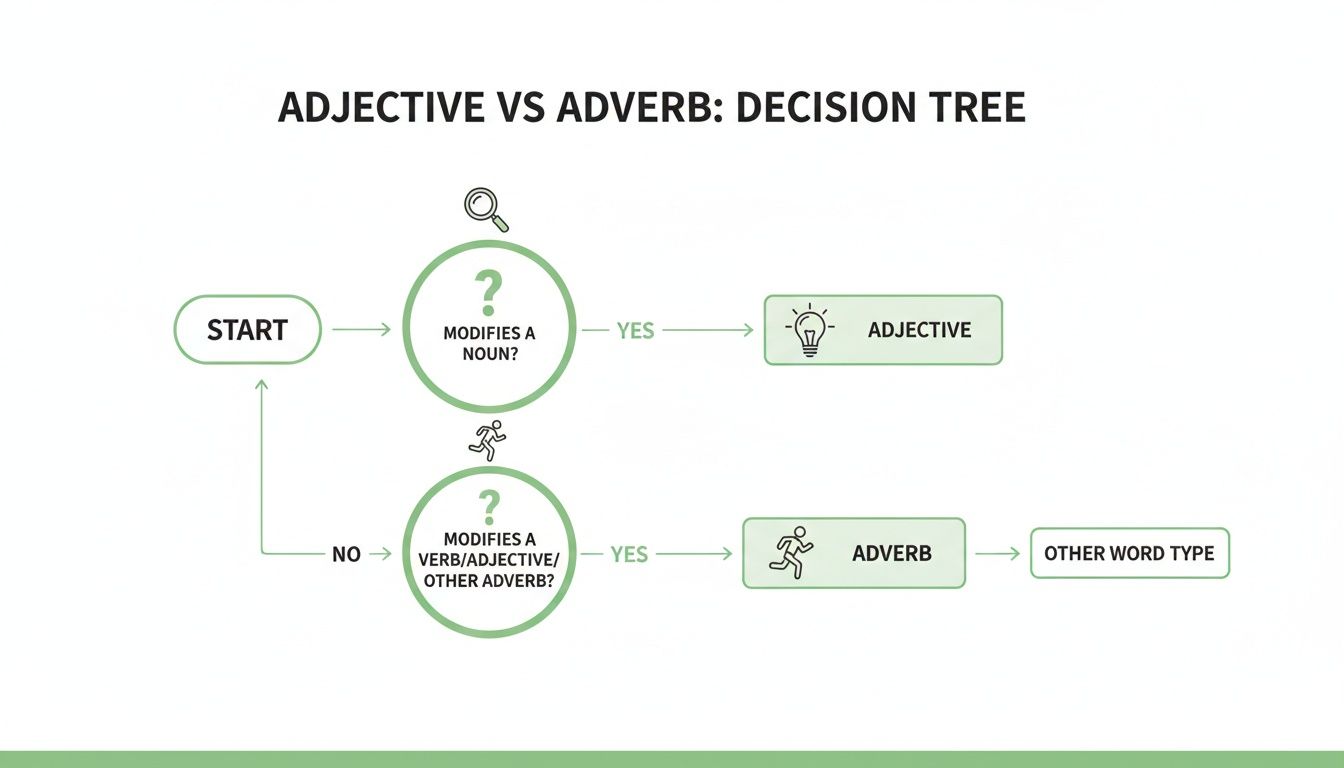
This visual reinforces the fundamental rule: if you're modifying a noun or pronoun, grab an adjective. For just about everything else (verbs, adjectives, other adverbs), an adverb is your go-to. Getting this right is a hallmark of polished, professional writing.
Using Adjectives to Create Vivid Descriptions
Adjectives are the secret sauce of descriptive writing. They have the power to turn a bland statement into a vivid, memorable image. For content creators, mastering adjectives is non-negotiable—it's how you grab and keep your reader's attention.
A well-placed adjective does more than just describe; it injects precision and emotion that helps your message stick. Think about the difference between "a project" and "a strategic project." That one word instantly elevates how you perceive its importance.
You can also think of adjectives as a toolkit for specific jobs. Descriptive ones like "vibrant community" paint a picture, while quantitative ones like "several key metrics" add concrete details. Knowing which to use helps you pick the right tool for your audience.
Placing Adjectives for Maximum Impact
Where an adjective sits in a sentence can completely change its effect. The most common spot is right before the noun, which is clear and direct.
- Example: "The company launched an innovative marketing campaign."
For a little stylistic flair, try placing adjectives after the noun, often in a pair separated by commas. This approach can create a thoughtful pause, making the description feel more intentional.
- Example: "The campaign, bold and unconventional, captured the audience's attention."
Your goal isn't just to add words but to add meaning. A single, powerful adjective is always better than three weak ones. This is crucial for creating writing that feels authentic and human, not cluttered with AI-generated fluff.
AI writing tools often lean on generic adjectives, which can make content feel flat. In fact, studies show that over 60% of readers find content stuffed with weak descriptors less trustworthy. The human touch—choosing words with intent—is what makes the difference.
When you're editing your work or humanizing an AI draft, be ruthless with your adjectives. We actually built PureWrite to help with this. Our tool is designed to spot weak or overused modifiers and suggest stronger alternatives, making sure your writing is sharp and engaging. Try dropping a draft into PureWrite and see how a few refined adjectives can transform your text from robotic to relatable.
Using Adverbs to Add Depth and Nuance
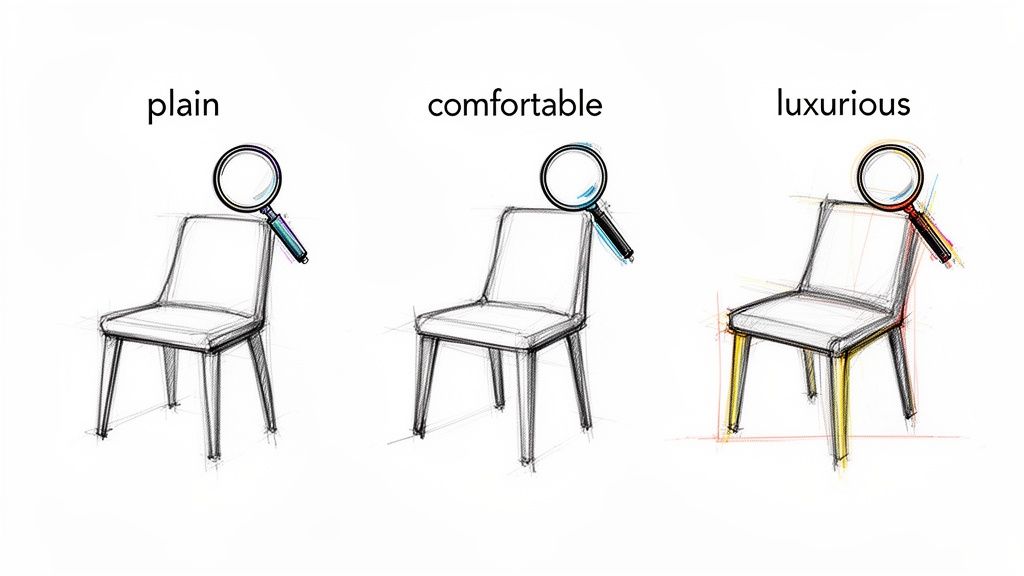
If adjectives give your nouns personality, adverbs bring the action to life. Think of them as the stage directions for your sentences. They tell you how, when, where, and to what extent something is happening, adding a level of detail adjectives can't provide.
Mastering adverbs is what separates good writing from truly persuasive writing. They turn a flat statement like "She spoke" into a vivid picture: "She spoke softly and sincerely." That extra layer of detail is what grabs a reader and makes your message stick.
How Adverbs Shape Your Sentences
The most straightforward way to make an adverb is to add "-ly" to an adjective. For instance, quick becomes quickly. This simple trick works for many adverbs and is a solid go-to for any writer.
But English loves its exceptions. Plenty of adverbs don't follow the "-ly" rule at all. Words like fast, hard, and well are classic examples. It’s why you can drive a fast car (adjective) and also drive fast (adverb).
Adverbs are your secret weapon for controlling rhythm and flow. By placing them strategically, you can build suspense, emphasize an action, or just make a sentence land with more punch. Getting this right shows a writer who is truly in control.
It’s also incredibly powerful to understand how to use groups of adverbs together. If you want to go deeper, our guide on adverb clauses examples is a great resource for building more sophisticated sentences.
Placing Adverbs for Power and Clarity
Where you put an adverb can completely change the feel of a sentence. Moving it from the beginning to the middle or the end shifts the emphasis in subtle but important ways.
- Beginning: "Suddenly, the market shifted." This placement adds drama and immediately sets a new tone.
- Middle: "The market suddenly shifted." Here, the action feels more integrated and flows smoothly.
- End: "The market shifted suddenly." This puts all the focus on how abrupt the change was.
This flexibility is a massive advantage, especially if you're working with AI-generated text. AI assistants often fall into a rut, placing adverbs in the same spot over and over. A recent analysis showed that almost 40% of AI drafts put adverbs in the same predictable sentence positions, which sounds robotic.
When editing AI content, try moving the adverbs around. This one small tweak can instantly make your writing feel more human and authentic. We built PureWrite specifically to catch these repetitive patterns and suggest more natural alternatives. Paste a section into PureWrite and see for yourself how it can improve your sentence flow.
Common Adjective and Adverb Mix-Ups
Even when you've got the basics down, a few tricky adjective and adverb pairs still manage to trip up even experienced writers. These little mix-ups pop up all the time in first drafts—even AI-generated ones—and catching them is crucial for your credibility.
Getting these right is a practical skill that will seriously sharpen your editing.
Good vs. Well: The Classic Mix-Up
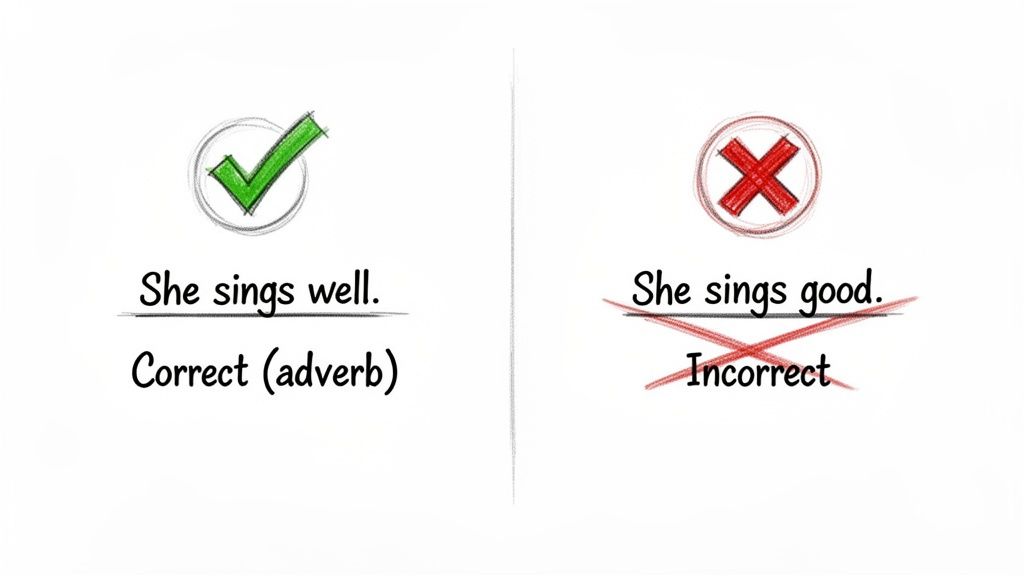
One of the most common slip-ups is confusing "good" and "well." The rule is straightforward: "good" is an adjective, meaning it describes a noun. In contrast, "well" is an adverb that describes a verb, explaining how something is done.
- Adjective: She wrote a good report. (good describes the noun, report.)
- Adverb: She writes well. (well describes the verb, writes.)
This can feel tricky, which is why we created a detailed guide to sort it out. You can find a deeper dive into this specific challenge right here: good vs. well correctly. Mastering this one distinction will clean up a surprising amount of awkwardness in your writing.
Words That Do Double Duty
To keep things interesting, some words can pull double duty as both an adjective and an adverb without changing their spelling. Words like "fast," "hard," and "late" are famous for this. The only way to know which role they’re playing is to look at their job in the sentence.
- Fast: He drives a fast car (adjective, modifying car). He drives fast (adverb, modifying drives).
- Hard: That was a hard test (adjective, modifying test). She works hard (adverb, modifying works).
There’s no helpful "-ly" ending to give you a clue, which is why context is everything. These words demand a second look when you're editing. AI tools, in their quest for sentence variety, can sometimes get these wrong, too.
Solving Common Word Pair Confusion
Let's break down a few more of these classic word-pair puzzles. Getting them right is a small change that makes a big impact on how professional your writing sounds.
| Word Pair | Adjective Usage | Adverb Usage | Explanation |
|---|---|---|---|
| Good / Well | The coffee tastes good. | He plays the piano well. | Good describes the coffee (noun). Well describes how he plays (verb). |
| Real / Really | This is a real diamond. | It is really cold today. | Real means genuine (describes diamond). Really means "very" (modifies cold). |
| Bad / Badly | I have a bad headache. | The team played badly. | Bad describes the headache (noun). Badly describes how the team played (verb). |
| Sure / Surely | I am sure about my answer. | He will surely arrive soon. | Sure means certain (describes "I"). Surely expresses confidence about the verb. |
As you can see, the function of the word in the sentence—what it's modifying—is the key to getting it right. It’s a subtle shift, but it’s one that readers (and editors) notice immediately.
The "Real" vs. "Really" Dilemma
Here's another classic: "real" versus "really." "Real" is an adjective that means genuine. "Really" is an adverb that means very or truly. It's common in conversation to say something like, "That was real good," but in formal or professional writing, that's a mistake.
- Incorrect: That was a real good presentation.
- Correct: That was a really good presentation.
In the business world, precision is everything. Reports and professional communications rely on the correct modifier. For instance, you’ll see adjectives for nouns ('a sharp drop') but adverbs for verbs ('it dropped sharply'). This pattern shows up in over 70% of global business reports.
Fixing these small errors instantly makes your writing feel more polished. And if you cringe at the thought of dense grammar lessons, don't worry. You can even learn how to learn grammar without studying explicit rules by focusing on pattern recognition. At PureWrite, our goal is to help you spot and fix these subtle mistakes, ensuring your final draft sounds professional and authentic.
How Many Adjectives and Adverbs Should You Use?
Knowing the rules is one thing. Knowing when to use them—and when not to—is what elevates your writing. This is where the idea of modifier density comes in.
Simply put, it's the balance of descriptive words in your text. Too many, and your writing becomes cluttered and hard to believe. It’s a classic sign of overwriting, something we see in both human drafts and AI-generated content. The goal isn’t to cut every adjective and adverb, but to make sure each one pulls its weight.
Finding the Right Balance
So, what's the right balance? It depends entirely on your context. A novel might be drenched in rich, evocative language. A business report, on the other hand, needs to be lean and to the point.
A fascinating 2013 study looked at academic papers and found that social science articles had a modifier density of about 17%. In contrast, math and science papers hovered around a much lower 10-11%. You can dig into the academic writing data here.
The takeaway is that your audience and purpose dictate your style. Drowning a business email in flowery adjectives will muddy your message, but a travel blog with zero descriptive words will put readers to sleep. If you need a refresher on the fundamentals, our guide on basic grammar rules is a great place to start.
The best writing often relies on strong, specific nouns and verbs rather than a pile of adjectives and adverbs. Instead of writing "the very tall man walked quickly," try "the giant strode." The second option is more direct, powerful, and memorable.
This is a core principle for creating writing that sounds genuinely human. When you find yourself reaching for an adverb to spice up a bland verb, it’s usually a signal that a stronger verb is hiding just around the corner.
We built PureWrite to help writers tackle this exact problem. Our tools analyze your text to spot sections overloaded with modifiers and suggest more direct, powerful alternatives. By trimming the excess, you make your message cleaner, more persuasive, and far more likely to connect with your audience. Try PureWrite to see how easily you can humanize your AI content and nail that natural, professional tone.
Refining Your Writing with PureWrite
Knowing the rules is one thing, but applying them consistently is what takes your writing from good to great. The final, crucial step is to edit your drafts and make sure every word is pulling its weight. This is where we move from theory to practical, high-impact editing.
A classic mistake, especially in first drafts, is using a weak verb propped up by an adverb. For example, "the team worked diligently" is fine, but "the team persevered" is stronger. The same goes for "she ran quickly"—why not just say "she sprinted"? It paints a more vivid picture.
Streamlining Your Editing Process
Let's be honest, hunting for every single one of these opportunities by hand is a slog. This is where the right tool can be a lifesaver. Linguistic studies show that clean, professional writing tends to have a combined adjective and adverb density of about 10-20%. More specifically, adverbs should only make up around 2-7% of your text. Anything higher is often a red flag for clunky prose—a common tell of an unedited AI draft.
We built PureWrite with exactly this challenge in mind. Our 'Humanize' mode is designed to spot modifier overuse and offer stronger alternatives. It’s not just about correcting grammar; it’s about sharpening your style until it has an authentic, human voice. Our AI text enhancer is perfect for this task.
Effective editing isn't about getting rid of every adjective and adverb. It’s about making each one count, so your writing is precise, powerful, and free of fluff. That’s the secret to creating content that feels both professional and natural.
As you get into the rhythm of refining your work, you might find it helpful to use other specialized tools. For instance, there are various tools to compare text online that can help you track your revisions side-by-side and see how your changes are improving the final piece.
Ready to see what a difference this can make? Try pasting your text into PureWrite and watch it transform your draft into something polished, professional, and genuinely human.
A Few Lingering Questions
Even after you get the hang of the basics, a few tricky questions about adjectives and adverbs tend to pop up. Let's tackle the most common ones so you can write with total confidence.
Think of this as your go-to guide for those "wait, which one is it?" moments. Getting these details right is a huge part of polishing your work, especially when you're cleaning up AI drafts that often get them mixed up.
Can a Word Be Both an Adjective and an Adverb?
You bet. A handful of words can pull double duty without changing their form at all. Words like fast, hard, and late are perfect examples. The only way to know which role they're playing is to look at their job in the sentence.
Context is everything here:
- It's an adjective if it's describing a noun: "That's a fast car."
- It's an adverb if it's describing a verb: "That car goes fast."
What's the Easiest Way to Tell Them Apart?
The quickest check is to ask yourself one simple question: what is this word describing? If it's modifying a person, place, or thing (a noun), you've got an adjective. If it's describing an action (a verb), another descriptive word, or even the whole sentence, it's an adverb.
A lot of adverbs end in "-ly," but don't let that be your only guide—it's a common trap. Always double-check the word's function in the sentence to be sure.
Why Is "Good" an Adjective but "Well" an Adverb?
Ah, the classic grammar hurdle. This one trips up even seasoned writers. Here’s the breakdown: "good" is always an adjective. It describes nouns. For instance, "He did a good job."
On the other hand, "well" is an adverb that describes verbs, telling you how an action was done. So, you'd say, "He did the job well." The only major exception is when you use "well" as an adjective to mean "healthy," as in, "I'm not feeling well today."
Nailing the difference between adjectives and adverbs can make or break your writing, turning it from clumsy to professional. If you're trying to make AI drafts sound more natural, PureWrite is a huge help for spotting awkward phrasing and finding better words. You can take your writing from robotic to genuinely human by trying it at https://purewrite.io.