Good or Well: A Practical Guide for Flawless Writing
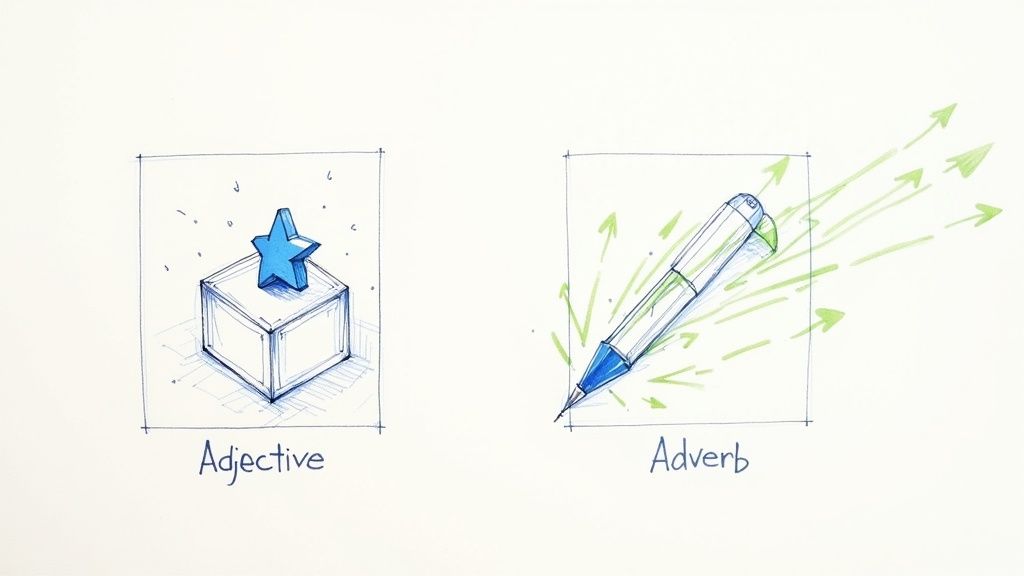
When you’re deciding between good and well, the core difference is simple. Good is an adjective—it describes a thing. Well is an adverb—it describes an action.
You have a good idea (describing the noun, "idea"). You write well (describing the verb, "write"). Nailing this distinction is a small tweak that instantly makes your writing feel more polished and professional.
The Quick Answer to the Good vs Well Debate
Getting this right isn't just about fussy grammar rules; it's about credibility. For you as a content creator, small, repeated errors can chip away at the authority you're building. Your audience might not know the rule, but they can often sense when something sounds "off."
Think of it this way: ‘good’ is a label you stick on a noun, while ‘well’ tells you how an action is done. A strong command of word choice is the bedrock of clear communication, and if you're looking to build a framework for your messaging, it helps to start with an essential communication strategy template.
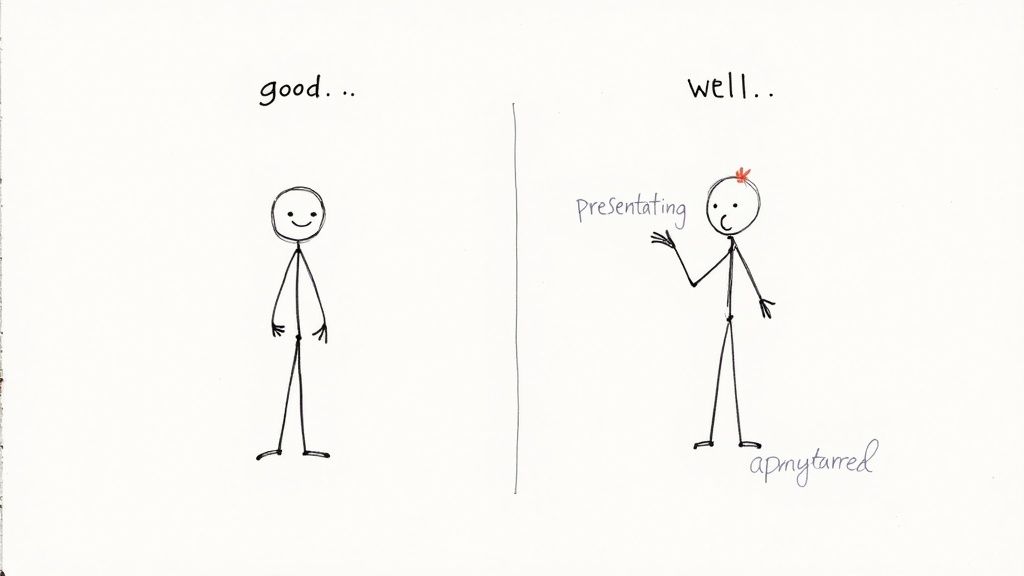
A Clear Framework for Usage
So, how do you choose? Just ask yourself what word you're trying to modify. Are you describing a person, a place, or an idea? Or are you describing how something is happening? That simple question will point you to the right word 90% of the time.
To make it even clearer, here’s a quick-reference table to keep the two straight.
Good vs Well At a Glance
This little table breaks down the fundamental roles of each word, offering a handy visual guide for when you're in a pinch.
| Word | Part of Speech | What It Does | Example Sentence |
|---|---|---|---|
| Good | Adjective | Describes a noun (person, place, thing, idea) | "You delivered a good presentation." |
| Well | Adverb | Describes a verb (an action) | "You presented the data well." |
This fundamental difference between describing a thing versus an action is your most reliable guide.
Of course, there's always a curveball. The main exception that trips people up involves health and "linking verbs" like feel, seem, or look. This is where things get a bit more nuanced.
For instance, "I feel good" usually describes your general mood. On the other hand, "I feel well" almost always refers to your physical health. At PureWrite, we help writers navigate these subtle differences, ensuring your content feels authentic and human.
Going Deeper: The Jobs of Adjectives and Adverbs
To really get a handle on the "good vs. well" puzzle, you have to look past the dictionary. It’s about understanding the job each word does in a sentence. Think of it like a movie set. Nouns are your actors, and verbs are what they do.
In this movie, adjectives are the costume designer. Their one and only job is to describe the actors. When you say, “You are a good writer,” the adjective ‘good’ is dressing up the noun ‘writer,’ telling us what kind of writer you are.
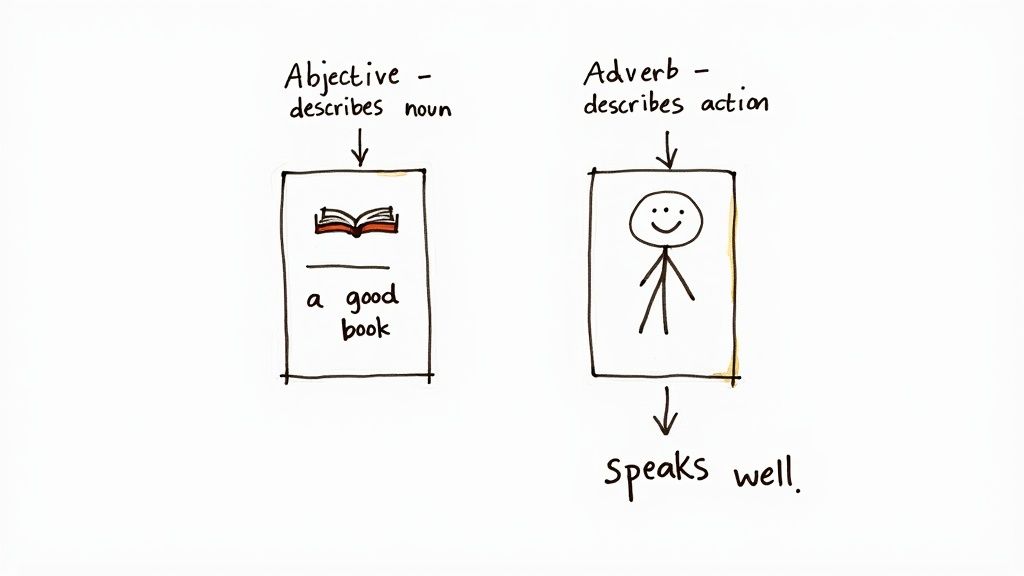
Adverbs, however, are the director. They aren't interested in the actors themselves; they're focused on the action. When you say, “You write well,” the adverb ‘well’ is directing the verb ‘writes.’ It’s explaining how the action gets done.
The Role of Adjectives Like ‘Good’
Adjectives give nouns their flavor. They answer questions like "What kind?" or "Which one?" They never, ever describe the action.
- Correct: "The report had a good conclusion." (Good describes the noun, 'conclusion'.)
- Incorrect: "You concluded the report good." (Here, 'good' is trying—and failing—to describe the verb, 'concluded'.)
Using an adjective when you need an adverb is a classic slip-up that can make your writing feel clumsy. If you want to build on this, it's worth brushing up on the most important basic grammar rules every writer should have in their back pocket.
The Power of Adverbs Like ‘Well’
Adverbs are what make verbs interesting. They provide the "how," "when," or "where" of the action. Specifically, 'well' almost always answers the question, "How?"
Key Takeaway: An adjective tells you about the noun. An adverb tells you about the verb. If you can remember that simple rule, you're already halfway there.
Take a simple sentence: "You managed the project." It's correct, but a bit flat. Now add the adverb: "You managed the project well." Suddenly, we know something about the quality of your management. The action has come to life.
At PureWrite, we’re obsessed with this stuff. Our tool is designed to catch these subtle but important errors, ensuring your writing—whether you wrote it yourself or started with AI—uses words like ‘good’ and ‘well’ perfectly. It’s all about refining your text to sound clear, natural, and trustworthy.
Navigating the Linking Verb Exception
Just when you think you’ve got the rule down, an exception pops up. This one is the linking verb, and it’s a classic grammar tripwire, even for experienced professionals.
Verbs like feel, seem, taste, smell, and look are a special bunch. Their job isn’t to show action; it's to link the subject of a sentence to a word that describes its state of being. Think of them as a grammatical equals sign (=).
When you say, "The soup smells good," you're essentially saying "The soup = good." Because ‘good’ describes the soup itself (a noun), the adjective is the right call. This is where knowing the difference between an action verb and a linking verb really matters.
Understanding State of Being vs. Action
The heart of this exception comes down to one question: is the verb describing a physical action or a sensory state? If the verb is about how a subject is, use an adjective like ‘good’. If it describes an action the subject is actively doing, you need an adverb like ‘well’.
Let’s take the verb 'look' for a spin:
- "You look good today." (Your appearance = good. This is your state of being.)
- "You look well for someone just recovering from the flu." (You appear to be in good health. This is a state of being related to health.)
This is why understanding context is so important for authentic writing. If you want to dive deeper into telling these verbs apart, check out our guide on action verbs vs linking verbs.
The Special Case of Health
And here’s one final, subtle twist: talking about health. When someone asks, “How are you?” both “I feel good” and “I feel well” can be correct, but they carry different meanings.
“I feel good” usually describes your emotional state. You’re happy, in good spirits, or feeling positive.
“I feel well” is specifically about your physical health. You aren’t sick; you feel healthy.
In everyday conversation, lots of people say "I'm good" to mean they're healthy, and that’s perfectly fine. But for you as a writer, precision is power. Stating you are "doing well" or "feeling well" is the clearer, more formal way to communicate good physical health.
For content creators, getting these small details right is what makes writing feel authentic and human—not like it was pieced together by a machine. At PureWrite, we help writers master these crucial distinctions. Our tool analyzes your writing to make sure your word choices are not just correct, but also a perfect fit for the context, helping you humanize AI drafts and polish your own work.
Two Simple Tests for Choosing the Right Word
When you're in the writing zone, the last thing you want is for a simple word choice to kill your momentum. Instead of second-guessing, here are a couple of quick mental checks you can use to get it right every time.
Think of these as your go-to diagnostic tools. They help you instantly figure out what your sentence needs without having to stop and pull up a grammar guide.
To make it even clearer, this flowchart maps out the decision process. It all comes down to the type of verb you're using and whether you're talking about health.
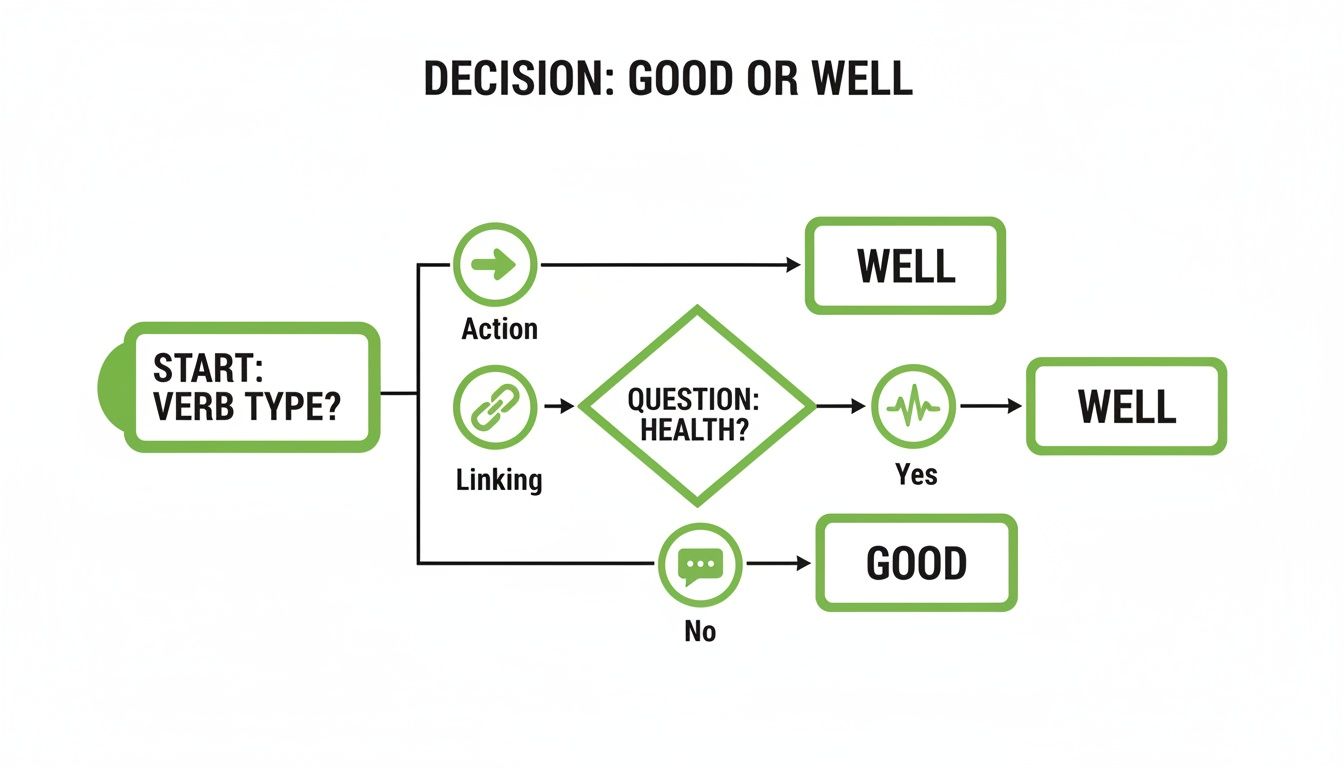
As you can see, the path almost always leads back to one question: are you dealing with an action verb or a linking verb? The only exception is when health enters the conversation.
The Substitution Test
First up is the Substitution Test. This is all about swapping out "good" or "well" with similar words to see which one feels right. It’s a beautifully simple way to confirm the word’s function in the sentence.
For ‘Good’ (Adjective): Try popping in another adjective like ‘excellent,’ ‘terrible,’ or ‘strong.’ If the sentence still makes grammatical sense, good is your word.
- Example: "You wrote a (good/well) story." -> "You wrote an excellent story." (That works perfectly, so ‘good’ is correct.)
For ‘Well’ (Adverb): Try replacing it with another adverb, such as ‘excellently,’ ‘terribly,’ or ‘strongly.’ If the new sentence clicks, you need well.
- Example: "You write (good/well)." -> "You write excellently." (Sounds right, so ‘well’ is the one.)
This little trick is so effective because it helps you feel the sentence's structure instead of just trying to recall a dusty rule.
The Question Test
The second method is the Question Test. This one focuses on what question the word is actually answering in your sentence. If you want to dive deeper into how adverbs work, our guide covering examples of adverb clauses is a great resource.
Key Insight: The question a word answers reveals its grammatical job. If it answers "what kind?" it's describing a thing (adjective). If it answers "how?" it's describing an action (adverb).
Here’s how you apply it:
- Does it answer "What kind?" -> Use good.
- "You have a good job." (What kind of job do you have? A good one.)
- Does it answer "How?" -> Use well.
- "The team worked well together." (How did the team work? They worked well.)
Speaking of "working well," this idea applies to more than just office dynamics. Financial stability is a big one. It's a bit worrying to see that only 29% of people feel hopeful about their financial future for 2025. That's a huge drop from 60% in 2024, driven by concerns over inflation and housing costs, according to the Global Financial Wellbeing Report 2025.
At PureWrite, we know that getting these small details right is what separates merely correct writing from truly effective communication. Our platform is designed to catch these nuances, ensuring your content—whether you write it yourself or with AI's help—always comes across with clarity and precision.
When to Follow the Rules and When to Break Them
Language isn't static; it evolves with how we speak every day. This is why you hear "I'm doing good" all the time in casual conversation, even when grammar sticklers insist "I'm doing well" is the only correct answer.
So, who's right? The answer depends on your audience, your goals, and the context of your writing. As a creator, making the right choice is key to connecting with your readers.
Formal vs. Informal Writing
When you're drafting a business proposal, an academic paper, or any professional correspondence, sticking to the grammatical playbook is your best bet. Using "well" correctly demonstrates a command of the language, signaling credibility and a sharp eye for detail.
But for a social media update or a friendly blog post? In those more relaxed settings, using conversational language like "doing good" can build a stronger, more authentic connection with your readers. This is a classic dilemma writers face, especially with so many frequently misused words that walk a fine line between formal and informal use.
Knowing Your Audience Is Everything
The real trick is learning to read the room. Deciding whether to be a grammar purist or to bend the rules a bit almost always comes down to a single question: who are you talking to?
- Academic or Professional Crowd? Stick to the rules. In these circles, precision matters, and a simple slip-up can unintentionally undermine your authority.
- A More General or Casual Audience? You've got more wiggle room here. Your primary goal is to sound genuine and relatable. If your audience naturally says "doing good," you probably can, too.
Look at the global wellness economy, which has skyrocketed to an incredible $6.8 trillion in 2024. That growth is built on a deep understanding of how people feel, live, and communicate. You can dive into more insights on this from the Global Wellness Institute’s 2025 monitor.
The Bottom Line: Your goal should always be clear and effective communication. Sometimes that means following the rules to the letter. Other times, it means speaking your audience’s language to forge a real connection.
At PureWrite, we're all about helping you find that perfect balance. Our tool can help you polish your formal writing to a professional shine, but it can also help you humanize content to make sure it lands with real people. Give it a try and see how you can make your writing both correct and compelling.
How to Proofread for Good and Well Errors
Even when you know the rules, catching every "good" or "well" mistake in your own writing is tough. Our brains are notorious for reading what we meant to say, not what’s actually on the page.
This is where a dedicated proofreading strategy becomes your secret weapon. A simple but surprisingly effective technique is the "find and review" method. Use your document's search function (Ctrl+F or Command+F) and hunt down every single instance of the word "good."
When you find one, ask yourself: "Is this describing a thing (a noun)?" If the answer is no, it probably needs to be changed to "well." Then, do the exact same thing for the word "well," asking if it's describing an action. This forces you to focus on each case individually.
Using Tools for That Final Polish
Manual checks are great, but a second set of eyes—even digital ones—can be a lifesaver. Standard grammar checkers are a decent first line of defense, but they often miss the subtle context of the "good" versus "well" conundrum.
They might glance right past a sentence like, "The presentation went good," because it’s so common in everyday speech. Advanced tools are built to catch these finer points. Upholding high standards is a core part of effective content management best practices, ensuring your message always lands with clarity and professionalism.
Go Beyond Basic Grammar with PureWrite
This is precisely why we built PureWrite. Our platform doesn't just scan for typos; it digs deeper to analyze your writing and helps make sure it sounds natural and authentic, especially when humanizing AI content.
It’s particularly effective at untangling tricky word pairs like "good" and "well," along with other common mix-ups. For instance, subject-verb agreement is another detail that makes a huge difference, and our guide on using is vs are breaks that down, too.
For anyone creating content, the twin goals are always clarity and credibility. A solid proofreading process—whether you do it by hand or with an AI assistant—is that final quality check to ensure your writing not only works well but also makes a good impression.
Whether you're polishing a blog post from scratch or making an AI draft sound more human, PureWrite helps you elevate your message. We invite you to try PureWrite and see for yourself how it can help you write with more confidence and precision.
A Few Lingering Questions (FAQ)
Still have a few questions about "good" versus "well"? You're not alone. Let's tackle some of the most common points of confusion writers run into.
Our goal here is to iron out those last few wrinkles and get you feeling completely confident in your word choice.
Is It Ever Correct to Say "I am Good"?
Absolutely. The key is understanding what you're actually describing. When you say, "I am good," you're using "good" as an adjective to describe your emotional state or general well-being. It's a perfectly natural way to say you're happy or content.
The nuance comes in when someone asks about your health, especially after you've been sick. In that case, the more precise and formal response is "I am well." While "I'm good" is completely fine in casual chats, sticking to the distinction in your writing shows a command of the language.
Can "Well" Be an Adjective?
Yes, it can, and this is the one major exception to the rule. "Well" almost always acts as an adjective when you're talking about someone's physical health.
Think about the sentence, "She is a well person." Here, "well" is an adjective that means "in good health" or "not sick." It's the direct opposite of saying, "She is a sick person." This is really the only common situation where you’ll find "well" doing an adjective's job.
A Simple Trick: If you're describing an emotion, "good" usually feels right. If you're talking about physical health, "well" works better. Remembering this can help you make the right call on the fly.
Getting these little details right is what makes writing feel polished and professional. For writers using AI assistants, this is a critical distinction. An AI tool might not catch the subtle difference between feeling good and being physically well, but a sharp human editor will.
At PureWrite, we live for these details. Our platform is built to catch the kind of subtle grammatical slip-ups and stylistic issues that other checkers often miss. We help you turn AI-generated drafts into content that feels authentic and credible. If you want to make sure your writing is always on point, try PureWrite today and see the difference for yourself.