Another Word for Constantly: 8 Synonyms with Tone Notes
You reread a paragraph and find “constantly” three times. The repetition is easy to fix, but the meaning needs more care. Does the action continue without a break, happen again and again, or carry a forceful emotional tone? Replacing the word with the most impressive-looking synonym can make the sentence less accurate.
The best another word for constantly depends on that distinction. Perpetually, continuously, and ceaselessly suggest an unbroken or enduring condition. Repeatedly describes recurrence. Incessantly and relentlessly add intensity, while all the time keeps the voice conversational. Without pause makes the meaning especially direct. The eight options below are sorted by the nuance they carry, with register notes and examples for writers, students, professionals, marketers, and people refining AI-assisted drafts.
1. Perpetually
Perpetually suggests that something continues for an indefinite period, often with a sense of permanence or timelessness. It sounds more formal than “constantly,” so it can add polish to an academic paper, professional report, or carefully edited article. That formality is useful only when the subject genuinely supports it.
Consider the difference between “The algorithm constantly optimizes user experience” and “The algorithm perpetually optimizes user experience.” The second version sounds broader and more philosophical. It may fit a discussion of an ongoing design principle, but it can overstate a process that merely runs at regular intervals.
Practical rule: Choose “perpetually” for an enduring condition, not for an action that simply happens often.
The word works well with present-tense verbs when you want to emphasize continuation:
- Academic writing: “The algorithm perpetually optimizes user experience.”
- Professional reporting: “Market conditions perpetually shift.”
- Blog content: “Technology perpetually transforms how we work.”
It also carries a slightly higher register. A student writing about a changing field might use it effectively in a sentence such as, “Scientific knowledge perpetually develops as researchers test new explanations.” A marketer could write, “Customer expectations perpetually evolve,” though “continually” may sound more natural if the changes occur in stages.
Before choosing an advanced synonym, check whether it matches your audience. Our guidance on other words for simplify follows the same principle: clarity matters more than vocabulary that merely sounds advanced. PureWrite can help you review whether “perpetually” makes the sentence more precise or more ornate.
2. Continuously
Continuously is the clearest choice when you mean that something happens without interruption. It describes an unbroken process, not a series of separate events. That distinction matters in technical documentation, process descriptions, business updates, and research writing.
“Our team continuously monitors performance metrics” implies ongoing monitoring. “Our team frequently monitors performance metrics” means the team checks them often, but it leaves room for gaps. If the team reviews a dashboard at set intervals, “regularly” may be more accurate than either option.
A useful editing test is to ask whether a meaningful pause would make the sentence false. If a service operates through an uninterrupted process, “continuously” may fit. If users submit requests throughout the day, “repeatedly” or “frequently” will usually describe the activity better.
Use it for processes that stay in motion
These examples show the word in several registers:
- Business reporting: “Our team continuously monitors performance metrics.”
- Content marketing: “The algorithm continuously learns from user behavior.”
- Customer communication: “We're continuously improving our services.”
The word pairs naturally with verbs such as monitor, improve, update, and operate. Still, don't use it as a vague upgrade for every instance of “constantly.” “The team continuously meets with clients” sounds as if the meetings never stop. “The team regularly meets with clients” communicates a schedule instead.
Adverb position can also affect rhythm and scope. English frequency adverbials often appear before the main verb, while words such as “continuously” can move more freely when the sentence needs a different emphasis. Read the finished sentence aloud, then review how to use an adverb in a sentence if the placement feels awkward.
Technical prose benefits from this level of precision because readers may make decisions based on your wording. Before you publish, run the sentence through PureWrite to check whether the intended meaning remains clear to readers with different levels of subject knowledge.
3. Incessantly
Incessantly means that something continues without relief, and it often adds emotional weight. The word can suggest irritation, exhaustion, pressure, or sheer intensity. That makes it stronger than a neutral replacement such as “continuously.”
“The rain fell incessantly throughout the night” gives the reader more than a timeline. It creates a sense of relentless weather and mounting discomfort. “Users incessantly demanded new features” makes those requests sound persistent and possibly annoying. If you only mean that requests arrived regularly, “repeatedly” is less loaded.
Let the word carry the mood
“Incessantly” works best in narrative, descriptive, and creative writing:
- Narrative content: “The rain fell incessantly throughout the night.”
- Blog storytelling: “Users incessantly demanded new features.”
- Creative writing: “The machines worked incessantly to meet demand.”
It can also appear in opinion writing, but use it carefully. A product team that “incessantly improves its service” may sound admirable in a dramatic brand story, yet the phrase can also imply strain or excess. In a formal report, “continuously improves” is usually more neutral.
This is a good example of why dictionary synonyms aren't interchangeable. Incessantly focuses on persistence with an emotional edge. Continuously focuses on the lack of interruption. Frequently says only that something happens often. The sentence should tell you which layer matters.
When editing AI-generated prose, this distinction is especially useful. AI drafts often choose a strong adverb without establishing the surrounding mood. Our guide to denotative and connotative examples explains the difference between a word's direct meaning and the associations it brings. PureWrite can help you decide whether “incessantly” gives the passage the intended human tone or makes a neutral observation sound hostile.
4. Relentlessly
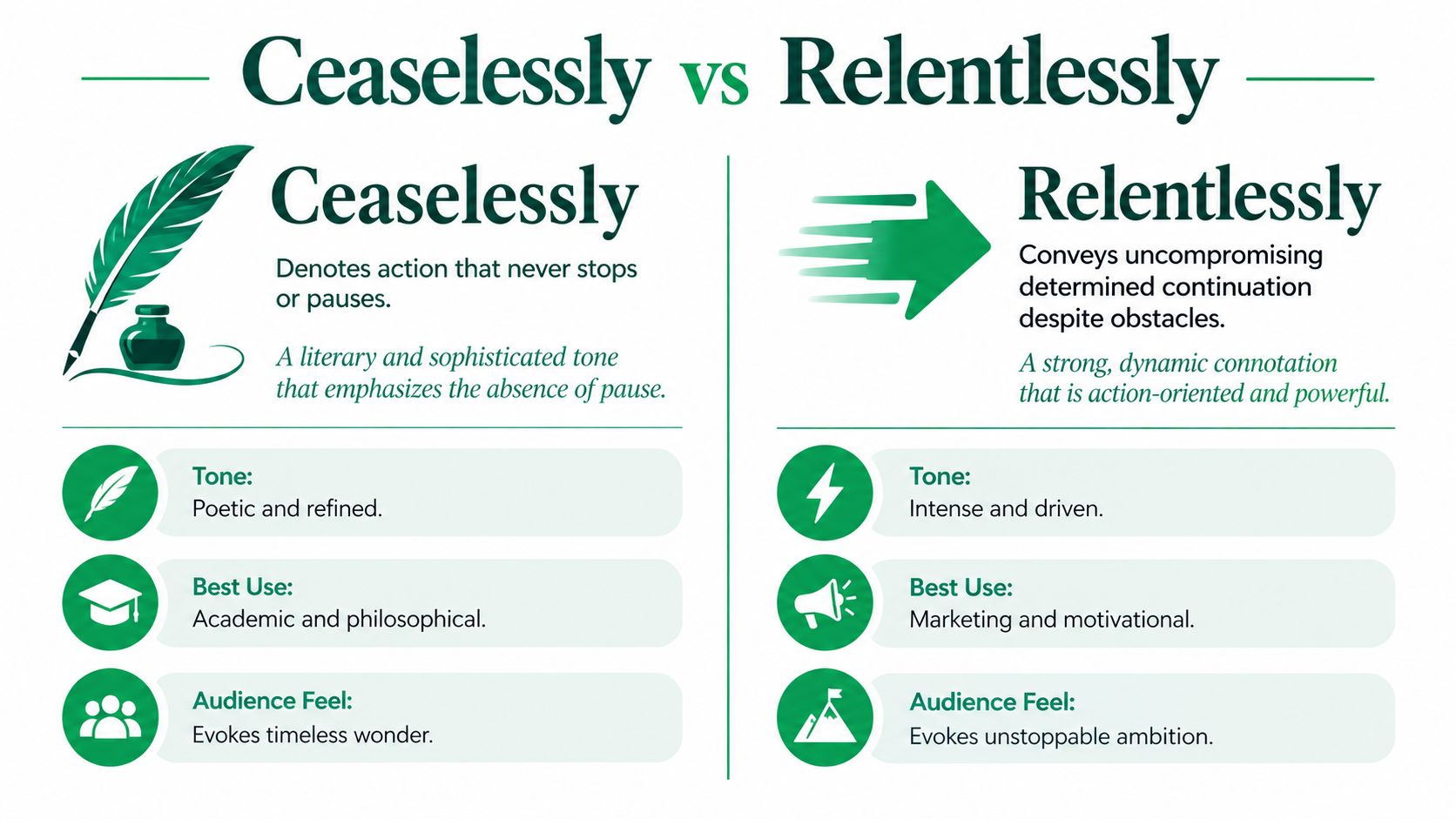
Relentlessly emphasizes determined continuation despite resistance, difficulty, or failure. It's not just that an action keeps happening. Someone or something keeps pushing forward. That makes the word energetic and persuasive, but also more aggressive than “constantly.”
“We relentlessly pursue innovation for our customers” is familiar marketing language. It presents the company as ambitious and unwilling to settle. “The startup relentlessly optimized every process” suggests sustained effort under pressure. In both sentences, the word describes attitude as much as frequency.
Relentless action implies resistance. If there's no obstacle, choose a less dramatic word.
The word fits business storytelling, motivational writing, campaign copy, and narratives about perseverance. It pairs naturally with ambitious verbs:
- Marketing: “We relentlessly pursue innovation for our customers.”
- Business storytelling: “The startup relentlessly optimized every process.”
- Content marketing: “Tech leaders relentlessly challenge the status quo.”
That strength can become a liability. “The support team relentlessly answers questions” sounds more like pressure than good service. “The support team consistently answers questions” emphasizes dependable performance without suggesting aggression. “The company relentlessly communicates with customers” may also feel excessive unless the story is about overcoming a serious challenge.
The grammar around the word matters too. It's an adverb, so it modifies the action, not the noun. If you're unsure whether your sentence needs an adjective or an adverb, review adjective versus adverb before making the substitution.

Use PureWrite's tone review before publishing persuasive copy. It can help you see whether “relentlessly” supports your brand voice or makes a reasonable promise sound combative.
5. Perpetually, or All the Time
All the time is the most conversational option in this list. It usually means that something happens very often, but context determines whether readers interpret it as literal nonstop activity or casual exaggeration. That flexibility makes it natural in blogs, emails, social posts, and friendly explanations.
“I'm checking analytics all the time to see what resonates” sounds personal and accessible. “Updates are happening all the time” suits a casual product message. The phrase feels closer to spoken English than “perpetually” or “ceaselessly,” so it can restore warmth to a stiff draft.
Match the phrase to the audience
Use it when the reader expects a relaxed voice:
- Blog post: “I'm checking analytics all the time to see what resonates.”
- Social media: “We're always thinking about ways to serve you better.”
- Casual email: “Updates are happening all the time.”
The trade-off is register. “All the time” can sound too informal in a research paper, legal document, board report, or official corporate announcement. A student might write, “The author returns to this theme all the time,” in a personal response, but “repeatedly” or “consistently” would usually suit an analytical essay better.
Be careful with “always,” too. It often suggests every time or an exceptionless pattern. If your customers contact support often but not on every occasion, “all the time” may sound friendlier than “always,” yet “frequently” may be more exact.
PureWrite is useful here because tone is part of meaning. We can review a casual draft for readability and natural expression without forcing it into formal language. If the sentence is for a broad audience, keep the familiar phrase. If it belongs in an academic or official context, choose a more precise alternative and preserve the relaxed version for dialogue or social copy.
6. Ceaselessly
Ceaselessly means without interruption, but it also carries a literary, reflective tone. Choose it when the sentence needs both meanings: an ongoing process and a sense of scale or atmosphere. In a synonym list, it belongs to the uninterrupted group, with a literary register.
“The universe ceaselessly expands” sounds philosophical. “Innovation ceaselessly drives our mission” gives brand language more force. “The market ceaselessly evolves” presents change as a sustained movement rather than a series of separate adjustments.
The trade-off is clarity. On a product page, “Our platform ceaselessly updates your dashboard” may sound dressed up. “Continuously updates” identifies the process faster. Use the more expressive word only when its tone adds something.
A river, season, or long historical change can justify ceaselessly because movement and atmosphere matter:
- Academic prose: “The universe ceaselessly expands.”
- Organizational writing: “Innovation ceaselessly drives our mission.”
- Professional narrative: “The market ceaselessly evolves.”
The word suits essays about nature, time, philosophy, and transformation over long periods. It is less suitable for a scheduled report or a technical instruction, where readers need the operating detail first.
Read the whole sentence aloud. If the surrounding language is plain, ceaselessly may create useful emphasis, or it may feel ornamental. For non-specialist readers, keep the syntax direct and let the word supply the atmosphere. The aim is a deliberate register, not literary language in every line.
7. Repeatedly
Repeatedly marks recurrence, not uninterrupted action. It means something happens again and again, with breaks between events. Use it when constantly would exaggerate the frequency or suggest a nonstop state.
“Users repeatedly request this feature” records multiple requests over time. “Studies repeatedly confirm this hypothesis” points to consistent findings across separate investigations. “The process repeatedly cycles through four stages” describes a sequence that occurs again within a system.
The word suits research, technical writing, customer analysis, and careful editing. Its register is neutral and professional. It identifies a recurring pattern without implying that the action happens at every moment.
A time marker can make the pattern more precise: “The process repeatedly cycles through the stages during each test.” That sentence places the recurrence inside a defined context. By contrast, “The system repeatedly updates records” leaves timing unclear. The updates might follow errors, occur at intervals, or result from a loop. Add the surrounding detail when that distinction affects the reader's interpretation.
Repeatedly also differs from incessantly in tone. A customer who repeatedly asks for an export option has made several requests. A customer who incessantly demands it sounds persistent, irritated, or burdensome. Choose the stronger word only when the source sentence supports that attitude.
Use this test before replacing constantly:
- Recurring action: “Users repeatedly request this feature.”
- Separate findings: “Studies repeatedly confirm this hypothesis.”
- Defined process: “The process repeatedly cycles through four stages.”
In an AI-assisted draft, treat synonym suggestions as editorial prompts. Check whether the replacement preserves the process, timing, and attitude. A word can be grammatically correct and still misrepresent how often something happens.
8. Without Pause
A launch deadline is close, the servers are active, and the copy needs to convey sustained effort. Without pause suits that scene because it shows action continuing without a break. It is a descriptive phrase, not a single-word synonym, and its register is vivid rather than technical.
“Our servers run without pause to serve customers” creates more movement than “Our servers constantly operate.” “The team worked without pause to launch on time” adds urgency. “Innovation continues without pause in our industry” gives a professional statement momentum, although continuously is more compact for a technical report.
Use the phrase for uninterrupted activity that readers should feel. Choose a shorter adverb when the sentence records an operating condition and precision matters more than energy.
Match the phrase to the scene
The register shifts with the subject:
- Content marketing: “Our servers run without pause to serve customers.”
- Brand storytelling: “The team worked without pause to launch on time.”
- Professional narrative: “Innovation continues without pause in our industry.”
It pairs naturally with verbs such as work, run, grow, and continue. Avoid stacking intensity onto an already forceful phrase. “Worked tirelessly without pause” can sound inflated when the task is routine.
The phrase also makes a claim more explicit than constantly. “The monitoring service runs without pause” states that the service is intended to operate continuously. “The team reviews alerts without pause” makes a stronger claim about human activity. Unless the team works without interruption, “the team regularly reviews alerts” is the more credible choice.
For sentence-level checks, adverb clause examples show how timing and modification operate across a full clause. Review the finished passage for readability, tone, and repeated ideas before publishing.
8-Term Comparison: Alternatives to Constantly
| Term | 🔄 Implementation complexity | ⚡ Resource requirements | 📊 Expected outcomes | Ideal use cases | ⭐ Key advantages | 💡 Tip |
|---|---|---|---|---|---|---|
| Perpetually | Low, easy to insert but requires formal tone control | Moderate, editorial review to match audience | Conveys permanence and authority | Academic papers, formal reports, theoretical writing | Elegant; signals timelessness and authority | Pair with present tense; validate tone with PureWrite |
| Continuously | Low, broadly applicable and neutral | Low, minimal editing needed | Clarifies non-stop, uninterrupted processes | Business/technical writing, process descriptions, reports | Precise and widely understood | Use with action verbs (monitor/improve) for clarity |
| Incessantly | Low–Medium, needs careful emotional framing | Medium, may require tone adjustments to avoid negativity | Adds intensity and emotional resonance (can feel burdensome) | Creative writing, narratives, descriptive passages | Vivid, emotive imagery that engages readers | Reserve for narrative contexts; check connotation |
| Relentlessly | Low–Medium, strong tone requires contextual support | Medium, brand/voice review recommended | Produces energetic, motivating impact | Marketing, motivational copy, business storytelling | Dynamic, action-oriented; implies determined persistence | Pair with ambitious verbs; test brand fit before publishing |
| Perpetually (All the time) | Very low, conversational and easy to use | Low, accessible to general audiences | Increases relatability and warmth | Blogs, social media, informal emails, customer messaging | Highly conversational and approachable | Avoid in formal contexts; keep tone natural |
| Ceaselessly | Medium, elevated diction that needs audience confidence | Medium, readability checks advised | Adds poetic sophistication while remaining precise | Sophisticated business, academic, long-form content | Poetic yet precise; enhances engagement without excess formality | Use for philosophical or natural-process descriptions; test readability |
| Repeatedly | Low, requires contextual time markers for precision | Low, straightforward to implement | Clarifies frequent recurrence rather than uninterrupted action | Technical docs, research, instructional content, pattern descriptions | Precise about frequency and cycles | Combine with time markers (e.g., "each month") for clarity |
| Without Pause (Multi-word Alternative Phrase) | Low–Medium, longer phrasing may need sentence rework | Medium, integration into prose may require edits | Creates vivid immediacy and strong imagery | Content marketing, brand narratives, storytelling, professional prose | Descriptive and evocative; emphasizes absence of interruption | Pair with action verbs; ensure phrase doesn't clutter dense text |
Choose by Meaning, Then Polish With Care
The strongest synonym isn't the longest or most unusual word. It's the one that preserves your intended meaning. Start by deciding whether the action is uninterrupted, recurring, or emphatic.
Choose continuously, ceaselessly, or without pause when the action has no meaningful break. Choose repeatedly when events happen multiple times. Choose incessantly when the continuation feels tiring or irritating, and choose relentlessly when someone keeps pursuing a goal despite resistance. Perpetually suits an enduring or timeless idea, while all the time keeps the sentence conversational and accessible.
A useful edit takes only a moment. Replace “constantly,” read the sentence aloud, and listen for the implied strength. “The platform continuously updates records” makes a technical claim about an unbroken process. “The platform regularly updates records” suggests a schedule. “The platform repeatedly updates records” suggests separate update events. Those sentences aren't interchangeable, even though each may appear in a synonym list.
Register matters just as much. A student writing a research paper should usually favor precision over flourish. A marketing writer may use “relentlessly” to create drive, but the word should match the brand's personality and the action being described. A blogger speaking directly to readers may sound more natural with “all the time.” There's no prize for making a simple sentence sound grand.
Keep your own voice intact while editing AI-assisted work. Google's guidance says AI-generated content can contain inaccuracies because language models predict likely word sequences, so writers should fact-check and review every draft before publication. Google also distinguishes useful, original content from automation intended primarily to manipulate search rankings. A polished synonym cannot repair an unsupported claim or a sentence that doesn't reflect your experience.
AI detection scores deserve the same caution. UNESCO's guidance on generative AI in education and research says there's little evidence that AI watermarks and detection tools are effective, and it recommends human accountability and review. A separate evaluation reported that seven detectors misclassified authentic TOEFL essays by non-native English speakers at a mean false-positive rate of 61.3%. That evidence is available in the published evaluation of AI detectors and non-native English writing, and it's a strong reason not to treat a detector score as proof of authorship.
Save drafts, notes, sources, and revision history. Use AI for brainstorming, organization, or language refinement, then verify the claims and make the final choices yourself. Our glossary of word choice is another useful reference when a near-synonym changes the force of a sentence.
PureWrite can support that editorial process. We help you review tone, readability, grammar, concision, and formatting while preserving your voice. Use the tool to refine a sentence, not to disguise authorship or bypass your school, employer, publisher, or client rules. The final wording should remain honest, accurate, and recognizably yours.
PureWrite helps you humanize AI-assisted drafts, improve readability, and choose wording that matches your audience, whether you're editing an essay, report, email, or SEO article. Paste your draft into Pure Write to review tone and clarity, then make the final synonym choices with your own judgment.