Mastering Denotative vs Connotative Examples for Impactful Writing
The real magic of language isn't just in what words say, but in what they suggest. At the heart of this is the difference between denotation and connotation.
Simply put, denotation is a word's literal, dictionary-ready definition. It’s the straightforward, no-frills meaning. Connotation, on the other hand, is the whole cloud of feelings, ideas, and cultural baggage that comes along with it.
Think about "house" versus "home." Both denote a place where someone lives. But "home" feels different, right? It evokes warmth, family, and a sense of belonging. That feeling is its connotation, and as a creator, it's one of your most powerful tools.
Understanding Denotation and Connotation in Writing
Every single word you pick has these two layers of meaning. The first is its denotation—the precise, objective definition. The second, and often where the real persuasive power lies, is its connotation. This is the subtle, emotional coloring that can completely change how your message lands.
For anyone creating content—from students and marketers to professionals using AI tools—getting a handle on this is non-negotiable. Using the right denotation makes sure your message is clear. But choosing the right connotation? That’s how you control the feel of your message and make your audience connect.
Denotation Vs Connotation At a Glance
Before we dive into some real-world examples, it helps to see the core differences laid out side-by-side. This quick comparison gives you a solid foundation for understanding how these two concepts work together.
| Attribute | Denotation | Connotation |
|---|---|---|
| Nature | Literal, objective, and dictionary-based | Emotional, cultural, and subjective |
| Function | To inform and define with precision | To persuade, evoke feeling, and suggest meaning |
| Consistency | Universally agreed upon and stable | Varies between individuals and cultures |
| Example | Blue: The color between green and violet. | Blue: Suggests sadness, calm, or loyalty. |
Looking at it this way, the distinction becomes crystal clear. Denotation is about precision, while connotation is all about perception.
Key Takeaway: Denotation is what a word is. Connotation is what a word feels like. Nailing this difference is a huge step toward developing a powerful and distinct writing voice.
Mastering this balance is fundamental to connecting with your readers. To learn more about how word choice shapes your audience's experience, we recommend our in-depth guide to mastering tone and voice in writing.
Denotative Vs Connotative Examples in Action
The best way to really wrap your head around denotation and connotation is to see them in a head-to-head comparison. While a word's dictionary definition—its denotation—is pretty stable, its emotional baggage—its connotation—can change everything.
Your goal as a writer is to pick the word that doesn't just say what you mean but feels the way you want it to feel. This is a practical skill that elevates good writing to great writing.
Take "house" and "home" for example. Both denote a physical building someone lives in. But "house" is just bricks and mortar, a neutral, architectural term. "Home," on the other hand, is loaded with positive connotations—it evokes warmth, family, safety, and belonging. You sell a house, but you create a home.
Everyday Word Choices with Big Impact
This push and pull between meaning and feeling happens all the time in everyday conversation. Think about the difference between calling someone "assertive" versus "aggressive." Both words denote a person who states their opinions directly.
But "assertive" feels positive, suggesting confidence and self-respect, while "aggressive" comes across as hostile and negative. One builds a bridge, the other a wall.
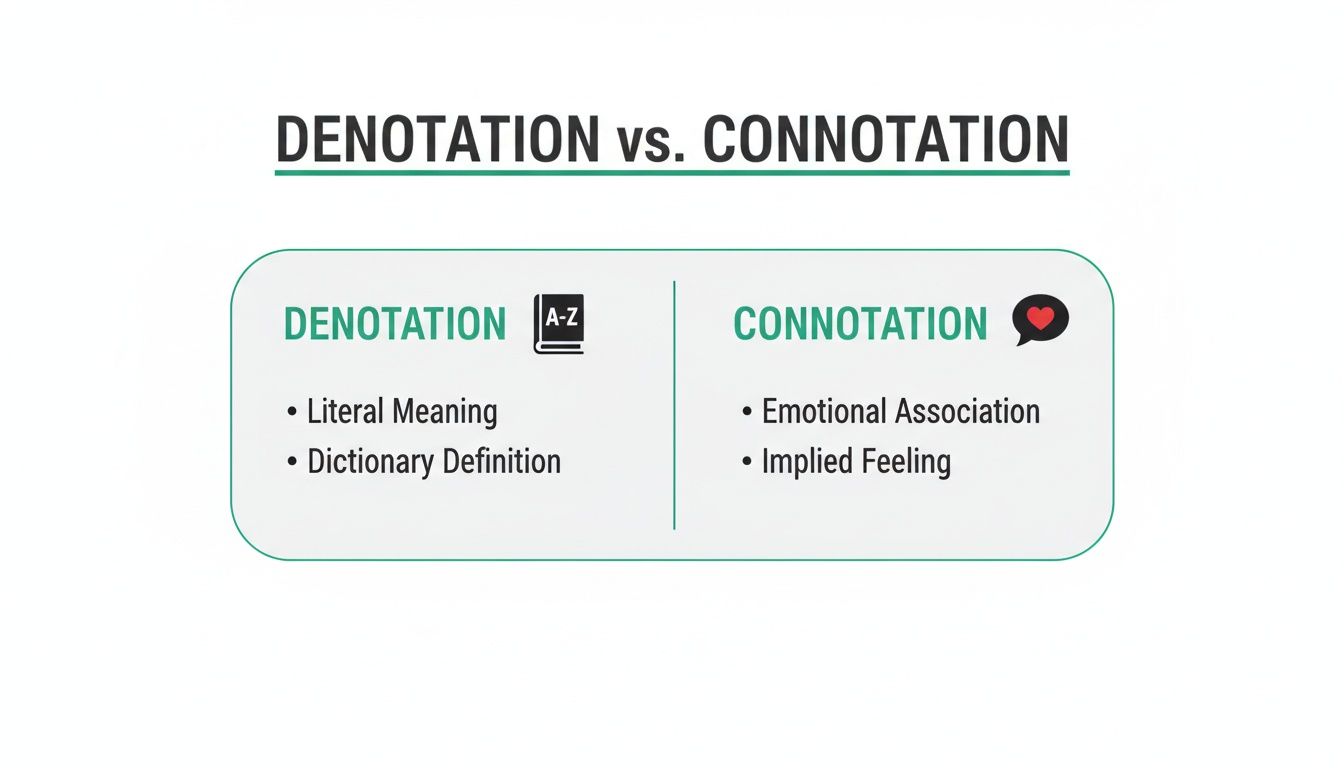
As you can see, denotation is the literal bedrock, but connotation adds all the crucial emotional and cultural flavor.
Here are a few more common pairs that drive the point home:
- Cheap vs. Affordable: Both mean low in price. "Affordable" is positive, suggesting great value for your money. "Cheap" is usually negative, implying poor quality or corner-cutting.
- Curious vs. Nosy: Both describe someone interested in learning more. We see "curious" as a wonderful, positive trait. "Nosy," however, suggests they're poking their nose where it doesn't belong—a negative intrusion.
- Unique vs. Strange: Both mean something is uncommon. "Unique" is a compliment, a positive spin on being one-of-a-kind. "Strange" often has a negative, unsettling, or critical edge.
Your word choice can flip a statement from a compliment to an insult, or turn a bland observation into a powerful call to action. This is why mastering connotation isn't just for poets—it's a critical skill for any content creator.
Getting a feel for these subtle shades of meaning is key to writing with precision. In fact, studies on teaching vocabulary have found that when students learn both the denotative definition and the connotative context, their understanding skyrockets. This approach has been shown to boost immediate comprehension scores by an average of 0.35 standard deviations. You can dig into the data yourself by exploring the impact of word choice in educational settings.
Connotations and AI Generated Content
AI writing assistants are fantastic for getting words on the page quickly, but they often stumble when it comes to connotative nuance. An AI can produce a paragraph that is denotatively perfect yet feels completely tone-deaf or emotionally flat. This is where ethical and authentic AI usage comes into play.
For instance, if an AI describes a beautifully handcrafted product as "cheap" instead of "affordable," it could instantly kill a brand's entire marketing message. This is exactly where your human touch is non-negotiable.
At PureWrite, we help you close that gap. Once you have a draft from an AI, our tool helps you polish its word choices, making sure the connotation is perfectly aligned with your intent. We've built our platform to help you humanize your content, turning technically correct sentences into writing that actually connects with people.
If you're interested in how the right words can make your writing more dynamic, check out our guide on the different types of figurative language and how you can use them effectively.
How Word Choice Shapes Professional Communication
In professional, academic, and marketing circles, the words you choose do more than just convey information—they build trust, create desire, and establish authority. It's not just about being "correct"; it's about being effective.
When you're marketing a product, for instance, you're not just selling features. You're selling an identity, a feeling, an aspiration. That’s where connotation becomes your most powerful tool, allowing you to connect with people on an emotional level that goes far beyond a simple purchase.
Connotation in Marketing and Advertising
Think about how a luxury car brand talks about its latest model. You won't hear them lead with denotative specs like "a 2.5-liter, four-cylinder engine." Instead, they'll paint a picture with connotative language, promising an "exhilarating driving experience" or the "freedom of the open road."
The beauty industry does this brilliantly. A skincare company won't describe its product as a "chemical exfoliant" (its denotative function). They'll call it a "radiance-boosting serum" (its connotative promise). The first sounds clinical and sterile; the second suggests youth, health, and a vibrant glow.
This isn't just fluffy talk—it's backed by data. Marketing campaigns that swap dry, denotative descriptions for evocative, connotative ones have seen real results, including an average lift of 12–18% in click-through rates and an 8–14% boost in purchase intent.
Denotation in Academic and Technical Writing
On the complete opposite end of the spectrum, academic and technical writing lives and dies by denotative precision. Here, the goal isn't to stir emotion but to present information with absolute, unambiguous clarity.
For example, a medical researcher wouldn't describe a patient's condition with "worryingly high blood pressure." That’s too open to interpretation. They would state the fact: "systolic blood pressure of 145 mmHg." This denotative language is precise and universally understood by peers, leaving no room for misunderstanding.
Sticking to denotation is what allows research to be replicated, reviewed, and built upon by others across the globe. It's the bedrock of objective fact.
Key Insight: In the professional world, your goal dictates your vocabulary. Marketing aims to persuade through feeling (connotation), while academic and technical writing seeks to inform through fact (denotation).
The real skill lies in knowing when to switch between these modes. For a deeper look at navigating these choices in high-stakes environments, exploring executive communication skills training can provide valuable strategic frameworks.
The following table breaks down how these approaches differ across a few key fields.
Word Choice Examples Across Different Fields
| Field | Objective | Language Focus | Example |
|---|---|---|---|
| Marketing | Persuade and connect emotionally | Connotative (evokes feeling) | "Experience the serenity of our new fragrance." |
| Academic Writing | Inform with precision and objectivity | Denotative (literal, factual) | "The study's findings indicate a correlation." |
| Journalism | Report events factually and without bias | Denotative (clear, unbiased) | "The politician stated that the policy would be reviewed." |
As you can see, the context and goal are everything. The word serenity would feel out of place in an academic paper, just as findings indicate would fall flat in an ad campaign.
Word Choice in Corporate Communications
Corporate communication is a fascinating middle ground, often demanding a careful dance between denotation and connotation. A Chief Financial Officer presenting a quarterly earnings report needs to stick to the hard, denotative numbers.
But a CEO addressing the company after a tough quarter needs to use connotative language to rally the troops and inspire confidence. It's all about matching the language to the situation.
- Goal: Announce a new software feature.
- Denotative: "The software now includes a data export function."
- Connotative: "Unlock deeper insights with our powerful new data export tool."
- Goal: Describe a company setback.
- Denotative: "Q3 revenue decreased by 15%."
- Connotative: "We faced significant headwinds in Q3, but our team's resilience positions us for a strong recovery."
Getting this balance right is a hallmark of strong leadership. As a professional, this skill is what distinguishes simple communication from strategic influence.
Putting This All to Work in Your Own Writing
Knowing the difference between denotation and connotation is one thing. Actually using that knowledge to make your writing pop is a whole different ballgame. The real goal is to get past choosing words that are merely correct and start picking words that are truly effective.
This means you have to start editing with an eye for the emotional and cultural baggage your words carry.
It all starts with knowing your audience. A word that one group finds inspiring might feel condescending or just plain weird to another. Before you start swapping words around, take a second to ask yourself: Who am I trying to reach, and how do I want them to feel?
A Quick and Dirty Editing Framework
To make this less abstract, here's a practical, three-step exercise for your next piece of writing. This isn't about a complete overhaul, but about making small, smart tweaks that deliver a big punch.
- Hunt for Words with Flavor: First, do a quick scan of your text. Highlight any descriptive words—adjectives, adverbs, and strong verbs. You're looking for any word that could have an alternative with a slightly different emotional feel.
- Check the Vibe: For each word you highlighted, think about its baggage. Does calling something "unique" fit your tone better than calling it "weird"? Does "affordable" sound like a good deal, while "cheap" just sounds flimsy?
- Swap and Align: If a word’s connotation clashes with the message you’re trying to send, find a better one. Your new choice should be accurate but also align emotionally with what you're trying to achieve.
Making this a regular habit really sharpens your writer's intuition. After a while, you'll start making these intentional choices without even thinking about it.
A Word of Caution on the Thesaurus: A thesaurus can be your best friend for finding alternatives, but use it carefully. It's a tool, not a crutch. "Walk," "stroll," "trudge," and "march" all mean putting one foot in front of the other, but each one paints a completely different mental picture.
It's All Part of Your Writing Voice
When you get right down to it, mastering connotation is a huge part of developing a writing style that feels authentic and powerful. The words you choose are a direct reflection of your point of view and your ability to connect with people on a real, human level.
If you’re serious about honing your personal style, you might want to explore some tips on how to find your writing voice. Here at PureWrite, we’re obsessed with that irreplaceable human element. Our tools are built to help you bridge the gap between AI-driven efficiency and genuine human nuance, making sure your final text is more than just correct—it’s resonant.
Ready to make every word count? Try PureWrite to humanize your AI drafts and ensure your message connects perfectly with your audience.
Navigating Connotation with AI Writing Assistants
AI writing assistants are fantastic for generating ideas and getting a first draft on the page. They're fast and efficient. But where they often fall short is in capturing the subtle, uniquely human layers of connotation.
An AI can easily generate text that is denotatively perfect—the grammar is sound, the facts are right—but it can still feel emotionally flat or tone-deaf to a human reader. A 2023 study by Stanford University found that AI detection tools flag text as AI-written over 60% of the time based on its lack of stylistic variation—a direct result of poor connotative choices.
Imagine you ask an AI to describe a handcrafted, artisanal product. It might call it "cheap" instead of "affordable." Both words denote a low price, but "cheap" comes with negative baggage suggesting poor quality. This is precisely why the best content comes from an ethical partnership between technology and a discerning human editor.
The Problem of Literal-Minded AI
So, why does this happen? AI models are trained on massive datasets of text, which makes them brilliant at recognizing patterns and predicting the most probable next word. However, they don't feel the emotional weight or cultural context behind those words. To an AI, the world is mostly denotation.
This is a key concept in AI detection. When text lacks connotative depth, it often reads as predictable and overly uniform, which are classic tells of machine-generated content. An authentic human voice, in contrast, is rich with intentional, varied word choices.
Bridging the Gap Between AI and Authentic Writing
The trick is to view AI-generated text as what it is: a starting point. It's raw material. Your job as a writer or editor is to step in and weave in the connotative nuance that will actually resonate with your audience.
Here are a few practical steps for polishing an AI draft:
- Hunt for Emotionally-Charged Words: First, do a quick scan for the adjectives and verbs. These are the words that carry the most emotional weight and are most likely to be slightly off.
- Check the Tone: Does the AI’s word choice match the tone you’re going for? For example, did it use a flat, neutral word like "stated" when a more loaded one like "insisted" or "claimed" would better fit the situation?
- Swap for Nuance: This is where the magic happens. Replace those generic or mismatched words with alternatives that capture the precise feeling and context you want to convey.
As you get better at this, you'll see how critical tone is. If you're creating content for different channels, learning about customizing content tone with AI tools can be a huge help, especially for social media.
At PureWrite, we believe AI should empower writers, not replace them. Our tool is built to help you navigate this exact challenge. When you run AI-generated text through PureWrite, it helps you spot that robotic phrasing and offers suggestions to add the right connotative depth. We offer a clear path for anyone wondering how to humanize AI text without spending hours on manual edits.
Ready to turn your AI drafts into content that truly connects? Try PureWrite for free and see how simple it can be to add that essential human touch.
A Few Lingering Questions About Connotation
Even with a bunch of examples under your belt, you might still have a few questions. Let's dig into some of the most common ones so you can start putting these ideas to work with confidence.
What Is the Opposite of Connotation?
Easy one: it’s denotation. If connotation is all about the emotional, cultural, and subjective vibe a word gives off, denotation is its cold, hard, literal dictionary definition.
I like to think of it this way: denotation is the "what," and connotation is the "how it feels." You absolutely need both to get your point across, but they play completely different roles in your writing.
How Can I Spot Connotation in a Piece of Writing?
This gets way easier with a little practice. When you come across a word, just ask yourself if it brings up any feelings or images beyond its most basic meaning. A fantastic trick for this is to compare a word with its synonyms.
Take the words "slim," "thin," and "scrawny." They all denote a person with low body weight. But the connotative flavor of each is completely different:
- Slim: Feels positive, right? It suggests someone is healthy and elegant.
- Thin: Much more neutral. It's just a straightforward description.
- Scrawny: Definitely negative. This one implies weakness or maybe even an unhealthy appearance.
Learning to feel these subtle distinctions is the real secret to spotting—and using—connotation like a pro.
Key Takeaway: If a word makes you feel something—good, bad, or even just a specific mood—you're tuning into its connotation. That emotional gut check is a dead giveaway that the word is doing more than just stating a fact.
Does a Word's Connotation Ever Change?
Absolutely, and this is a massive deal for any writer. A word’s connotation can swing wildly depending on the culture, the audience, and even the time period you're in. What’s considered a compliment in one group might be neutral or even insulting in another.
This is exactly why knowing your audience is non-negotiable. You have to think about who is actually going to be reading your work. The words you pick need to land well with them, not just you. This becomes critical when you're writing for international audiences or diverse communities.
For example, in many Western business circles, calling someone "ambitious" is a high compliment, suggesting they have drive and passion. In other cultural contexts, though, it could come across as negative, implying someone is ruthless or pushy. When you truly understand your readers, you can navigate these tricky waters and make sure your message hits home precisely the way you want it to.
Ready to turn your AI drafts into writing that actually sounds human? PureWrite can help you fine-tune your word choices, nail the perfect tone, and make sure your connotations always land right. Try PureWrite for free and see what it feels like to create content that genuinely connects.