How to Cite in Chicago Style Without the Guesswork
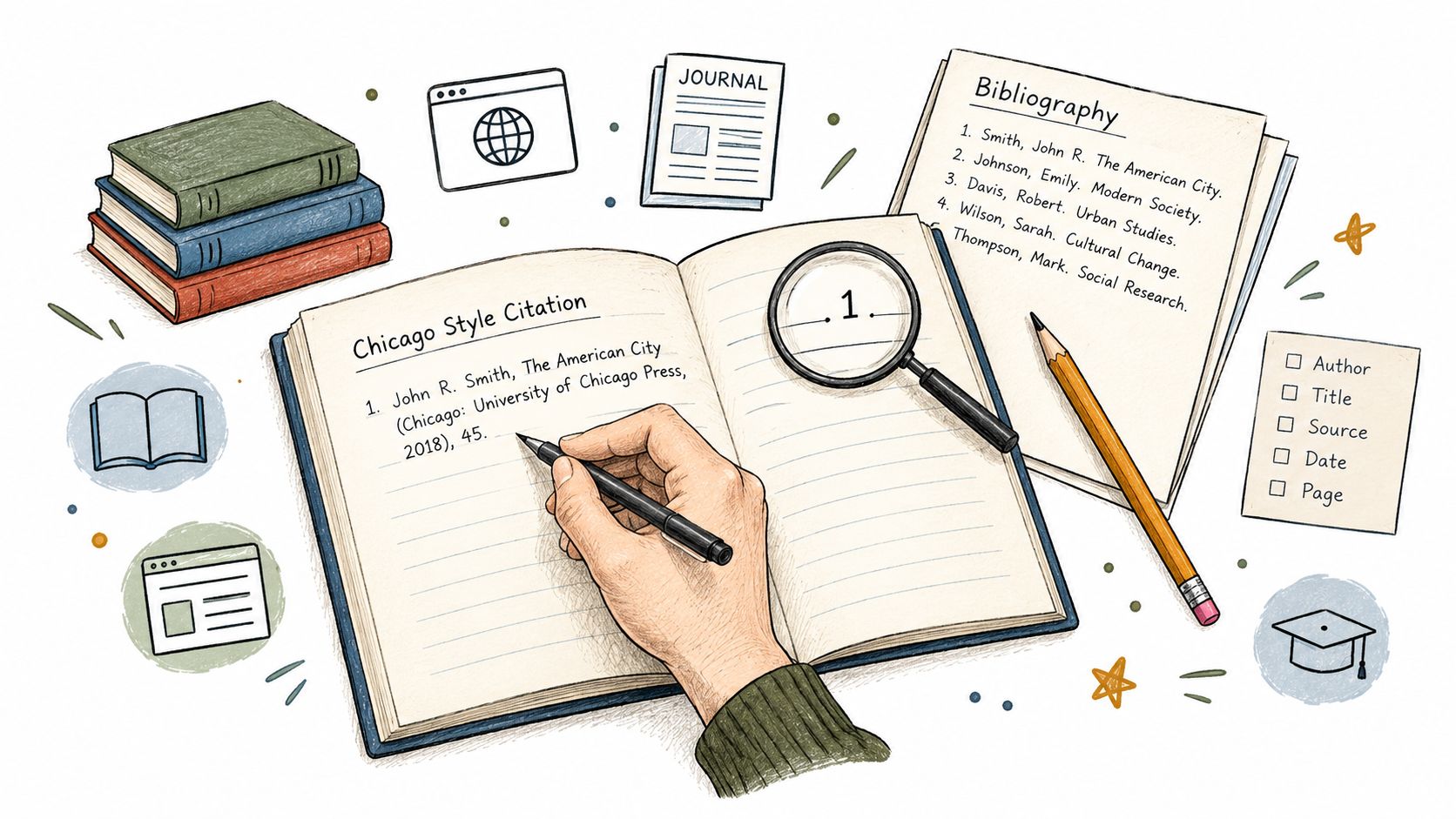
You've drafted the paper, placed a few footnotes, and then hit the citation that makes you stop: how did the example in your textbook get its commas and parentheses in that order? If you're trying to cite in Chicago style, that confusion often comes from treating Chicago as one template rather than a system with different choices for different kinds of writing.
The practical starting point is simple: choose the right documentation system, identify what kind of source you're citing, and record enough detail for someone else to find it. Once you know those steps, citations become less like punctuation trivia and more like a consistent record of where your ideas came from.
Why Chicago Style Still Trips Writers Up
A source supports your sentence, but you pause at the punctuation: should the citation be a superscript number, a parenthetical note, or both? The answer depends on the Chicago documentation system you are using. Chicago has two, and each connects claims to sources in its own way.
Chicago began as a publishing tool. The University of Chicago Press opened in 1891 and published the first edition of its style manual in 1906. That early guide standardized typography and editorial procedures. As publishing needs changed, the manual grew to cover writing, editing, publishing, and source documentation. Its history explains why Chicago refers to a broad editorial system, not only a format for references.
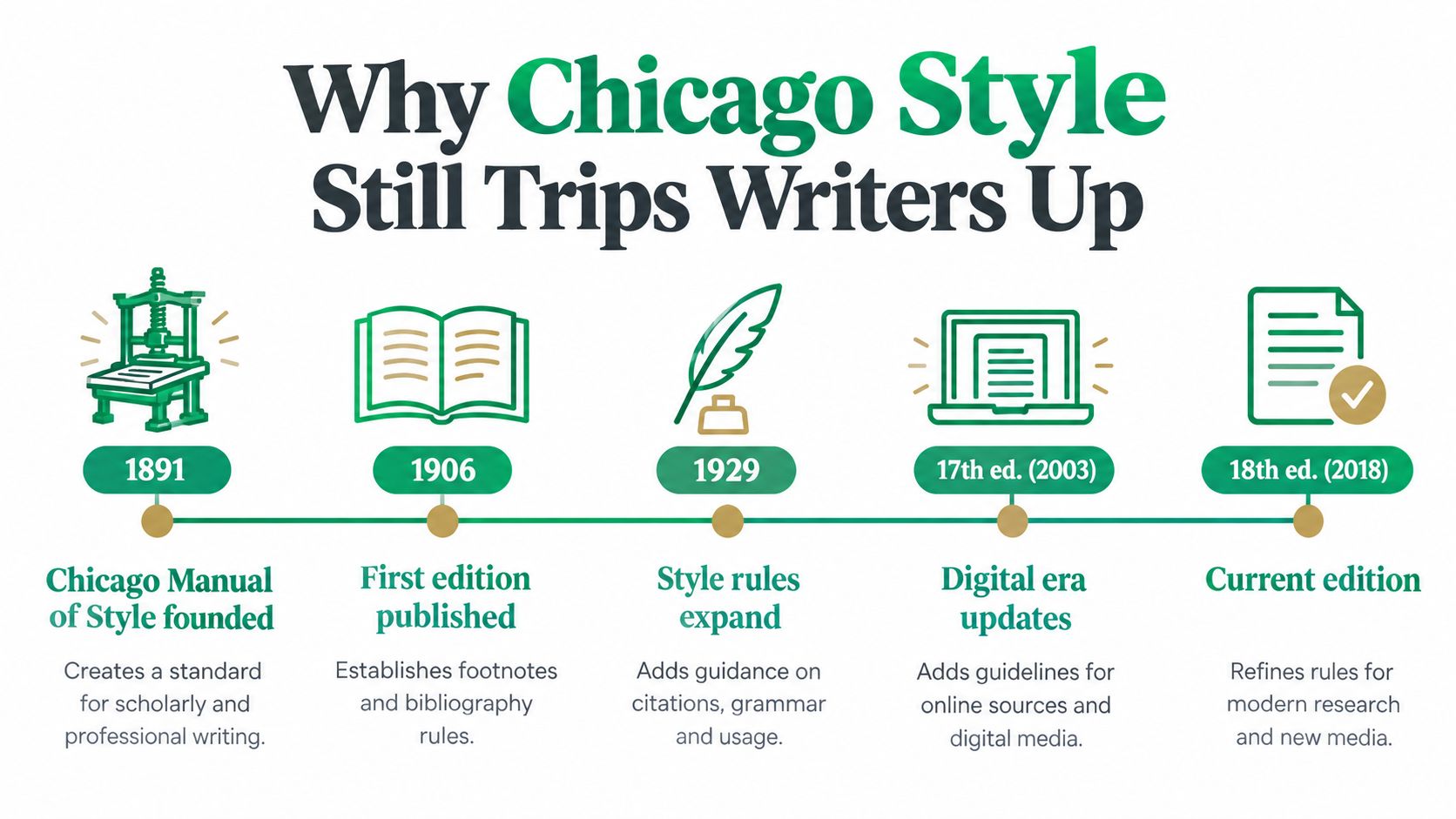
The manual has continued to change with publishing practices and scholarly expectations. A major revision in the 1960s strengthened its standing as an industry authority. The 13th edition, published in 1982, adopted the title The Chicago Manual of Style. The current 18th edition appeared in 2024. These dates are recorded in the official Chicago Manual of Style history.
Chicago works like a system, not a template
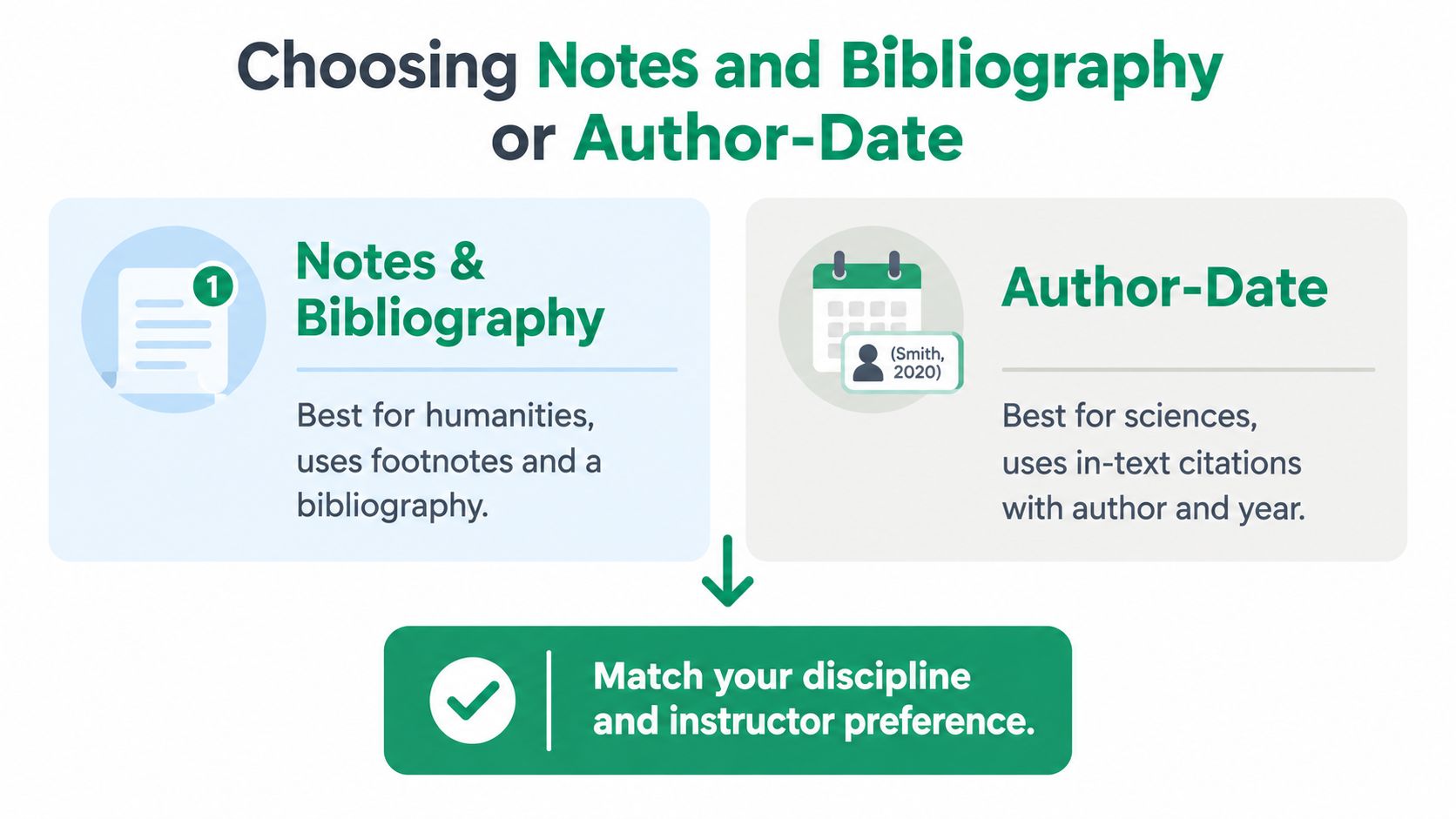
That history helps explain why Chicago has no single citation shape. Notes and Bibliography is often used in the humanities, while Author-Date is common in the sciences and social sciences. Choosing one is like choosing the rules for a particular game: the pieces may serve similar purposes, but they follow different instructions.
A footnote, an author-date citation, and a bibliography entry all connect readers with sources, but they are not interchangeable. Identify which system your paper uses before applying its conventions. This distinction matters especially when a project draws on different kinds of material, from books and websites to AI tools, multimedia, or archival records. The source may change, while the system still determines how you document it.
Choosing Notes and Bibliography or Author-Date
Before you format any citation, decide which Chicago system the assignment requires. This choice affects how source information appears throughout your paper, so don't begin by copying a citation from a sample until you know that sample uses the right system.
Use this decision path:
- Check the assignment first. If your instructor specifies Notes and Bibliography or Author-Date, follow that direction, even if another system is more common in your field.
- Check the discipline next. Notes and Bibliography is commonly used in the humanities. Author-Date is more common in the sciences and social sciences.
- Check publication instructions. For an article, report, or professional project, the journal or publisher's style sheet should guide your choice.
- If no guidance is available, use your discipline's usual system. If you're still unsure, ask the instructor or editor before formatting the whole document.
This discipline-based choice is also described in the University of California, Santa Barbara's Chicago style guide. For a broader look at how citation approaches differ, you can also compare writing style guides.
What each system looks like on the page
Notes and Bibliography connects a superscript number in the text to a footnote or endnote. The note gives source details, and a bibliography usually lists the sources alphabetically by author surname. This system lets you document a claim without placing a long parenthetical citation in the sentence.
Author-Date places the author's surname and publication year in parentheses, adding a page number when a pinpoint is available. The citation points readers to a matching entry in an alphabetized reference list. For example, a citation might look like (Yu 2020, 45).
The systems can't be blended just because one seems more convenient. A paper with superscript note numbers shouldn't switch to parenthetical author-year references, and a paper using Author-Date needs a reference list that matches its in-text citations. When no rule is supplied, choose one system and keep the choice consistent from the first citation to the final entry.
Building Footnotes, Endnotes, and Bibliography Entries
Once you've chosen Notes and Bibliography, build each citation from the same basic information: author, title, publication details, and the specific page you used. A book makes a useful first example because it shows how one source changes shape in a full note, a shortened note, and a bibliography entry.
Suppose you quote a passage from Charles Yu's Interior Chinatown. In the text, place the superscript number after the material it supports. The first note gives the source in full:
- Charles Yu, Interior Chinatown (Pantheon Books, 2020), 45.
The example's author, title, publisher, year, and pinpoint page are provided in Chicago's citation guide for Notes and Bibliography. The page number matters because it directs readers to the passage you quoted or discussed.
Make each citation form do its own job
If you cite the same book again, use a shortened note rather than repeating all publication information:
- Yu, Interior Chinatown, 52.
A shortened note should still identify the source clearly. If the work has multiple authors, retain names in the order shown in the publication and follow Chicago's guidance for the number of authors. Don't abbreviate a title so aggressively that readers can't tell which work you mean.
The bibliography entry reorders the source information and places the author's surname first:
Yu, Charles. Interior Chinatown. Pantheon Books, 2020.
That change in ordering is intentional. A note supports a particular passage in your text, so it includes the pinpoint page. A bibliography helps readers locate the work as a whole, so it begins with the author's surname and typically doesn't repeat the page you cited.
A footnote appears at the bottom of the page; an endnote appears in a notes section, often at the end of a document. The superscript number links either kind of note to the relevant sentence. Use the format your assignment requires, and place the marker immediately after the quotation, paraphrase, or factual claim it supports.
Practical rule: Capture the page you actually used while researching. Reconstructing it from memory during final editing is a common source of avoidable errors.
Some assignments involve sacred texts, where conventional citation practices differ from those for books. If you need help distinguishing Bible references from ordinary book footnotes, this guide to Bible footnote formats for APA and MLA can provide useful context. Follow your instructor's Chicago-specific direction when formatting the final paper.
Formatting the Sources You Use
A source's shape determines what belongs in its citation. Before drafting, identify the type of material and gather the details that let a reader find the exact item: its author or creator, title, publication or release information, relevant page or section, and a stable URL or identifier when available. Chicago's 2024 18th edition works across familiar sources and newer ones, but the details change with the material.
Journal articles show why the source type matters. A note identifies the page supporting your point; the bibliography lists the article's full page range. The distinction is explained in Chicago's Notes and Bibliography citation guide, linked in section 3.
Compare source types before formatting
These examples show the structure of entries, not citations to real publications. Replace bracketed details with verified information from your source. Required fields and punctuation may vary by source and by your assignment.
| Source type | First note template | Bibliography template |
|---|---|---|
| Journal article | 1. First Name Last Name, “Article Title,” Journal Title volume, no. issue (year): specific page. | Last Name, First Name. “Article Title.” Journal Title volume, no. issue (year): full page range. |
| Chapter in an edited book | 1. Chapter Author, “Chapter Title,” in Book Title, ed. Editor Name (Publisher, year), specific page. | Chapter Author. “Chapter Title.” In Book Title, edited by Editor Name, chapter page range. Publisher, year. |
| Web page | 1. Author Name, “Page Title,” Website Name, publication or update date, URL. | Author Name. “Page Title.” Website Name. Publication or update date. URL. |
| Podcast or video | 1. Creator or Host, “Episode or Video Title,” Program or Channel, publication date, URL. | Creator or Host. “Episode or Video Title.” Program or Channel. Publication date. URL. |
For an article, keep the pinpoint page in the note distinct from the article's complete page span in the bibliography. For a web page, the page title names the specific item, while the website name identifies where it appears. Record a publication or update date if one is available. Multimedia citations need to identify the particular item: a podcast episode, video, image, or program may each call for different locating details.
Save source details before you draft
For a chapter, record both the chapter author and the editor of the book. For an image, capture its creator, title or description, date, medium, and collection or institution when relevant. A video creator's name alone may not point readers to the right item, so include the title and channel or program.
For online sources, use a URL that leads to the specific item when possible, rather than a general homepage. The differences among citation systems can clarify what Chicago shares with and separates from other styles; use this guide to compare Harvard, APA, MLA, Chicago, and Vancouver. For a practical contrast, see this example of citing a website in MLA format.
Use a simple sequence: classify first, collect metadata second, format third. It works like sorting papers before filing them. An article, image, or video cannot fit a book-shaped entry without losing details readers need. The same habit helps with AI-generated material and archival records, where the source's form affects which identifying information belongs in the citation.
Citing AI Tools and Archival Materials the Right Way
AI output and archival sources require more than a familiar citation template. The key questions are whether the material contributed words or ideas, whether a reader can retrieve it, and what details establish where it came from.
Decide what role the AI tool played
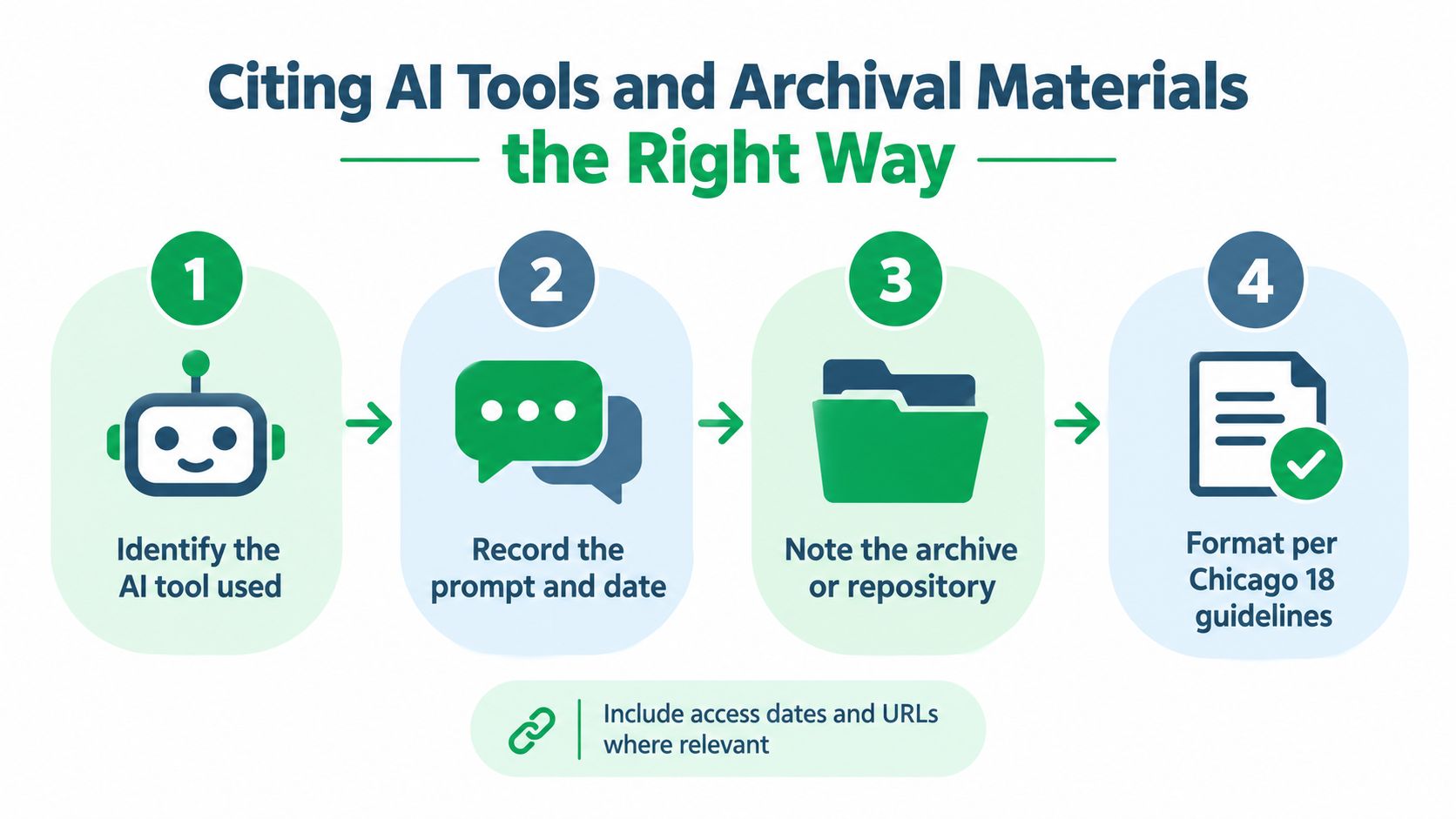
If you used ChatGPT or a similar tool and incorporated its generated text, Chicago says to credit the tool. A formal note can identify the tool, company, date, prompt, and a shareable conversation URL. If you edited the output, describe that editing, such as editing for style or content. The Chicago FAQ on documenting AI-generated text also explains that Chicago 18th edition generally treats textual AI output as personal communication, so it doesn't require a bibliography entry unless the exchange is publicly accessible.
Use the purpose of the interaction to decide what needs disclosing. Brainstorming may have shaped your approach without supplying language; translation may have affected wording; direct drafting may have supplied text or ideas. In each case, check your institution's, publisher's, or employer's rules as well as Chicago's. Citation doesn't make an AI tool an author, verify its claims, or transfer responsibility away from you. You're accountable for checking facts and representing the tool's role openly.
Record provenance for primary sources
Archival materials don't share one universal citation format. A letter, manuscript, museum object, oral history, or archival scan needs details suited to the object and the repository. Include the information that helps another person locate it, such as the creator, item title or description, date, collection, box or folder, repository, and stable identifier when available.
For a translated source, preserve the original title and add a translation when it helps readers understand the item. If a scan has no page numbers, identify its collection and location rather than inventing a page. If you encounter a source only through another author's quotation, identify both the original and the secondary work, and be clear that you accessed the quotation indirectly.
Researchers working with university sources may also find these academic integrity tips for university useful when deciding how to disclose assistance and represent sources responsibly. For a broader discussion of responsible scholarship, see this guide to what academic integrity means.
A complete citation isn't one that squeezes every item into a standard book or webpage template. It's one that preserves provenance, signals translation or indirect access when relevant, and gives readers enough context to understand what you consulted.
Common Pitfalls and a Five-Minute Citation Check
A paper can contain citations that look individually plausible and still fail as a system. The most persistent errors appear when writers check only whether entries look polished, instead of checking whether the text and the reference list match in both directions.
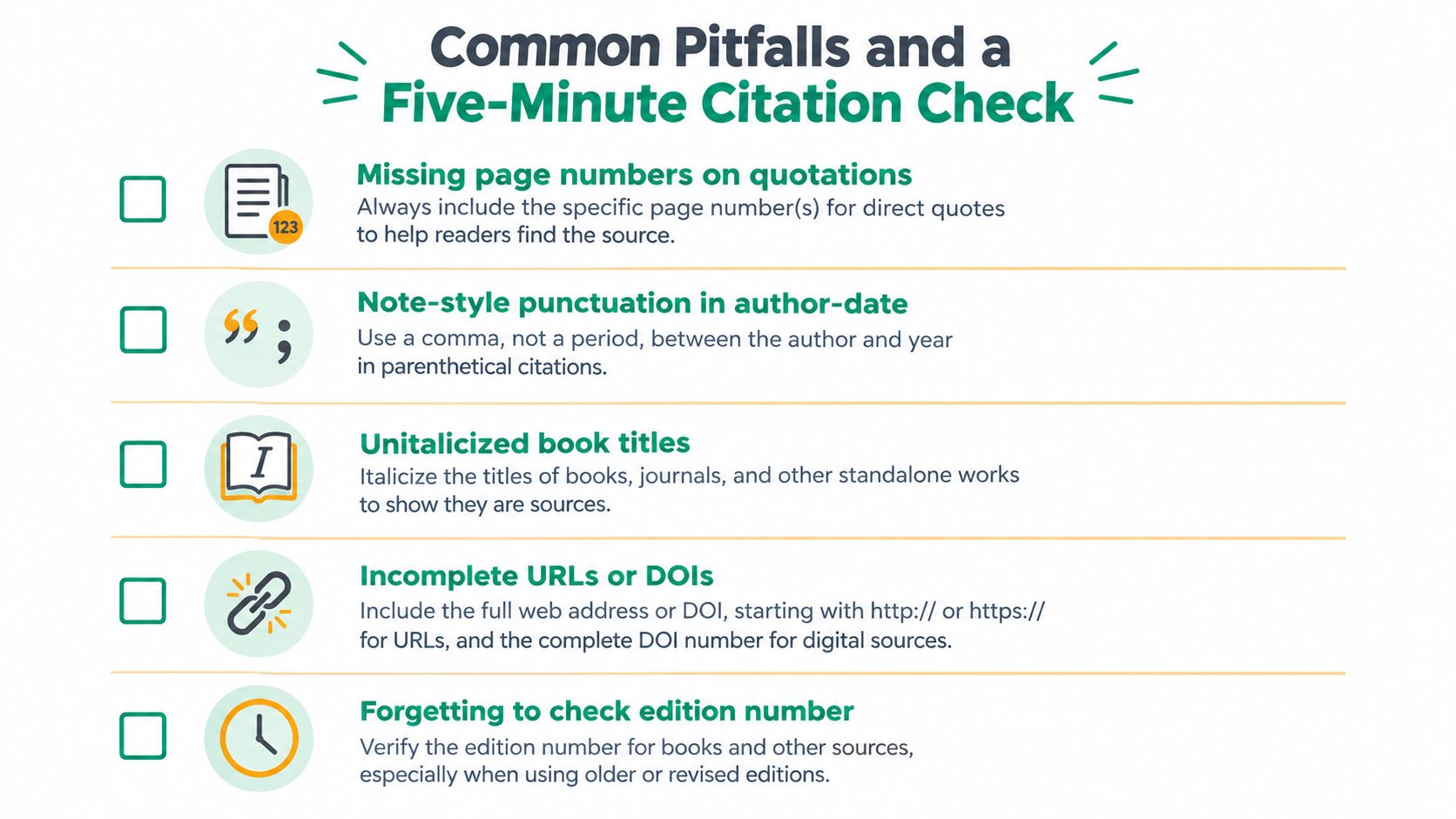
For Author-Date, common problems include missing page numbers for quotations, using note-style punctuation in a reference entry, failing to alphabetize, and listing sources that never appear in the text. The University of New England's Chicago Author-Date guide recommends comparing in-text citations against the reference list in both directions.
Check the paper from text to list, then back again
Read the draft once for citations with no matching source record. Then start from the bibliography or reference list and check whether each entry appears in the paper. A source listed but never used may belong in research notes, but it generally shouldn't stay in the final reference list unless your assignment asks for a broader bibliography.
Next, look for consistency within the system you chose. In Notes and Bibliography, check that each note number matches the right footnote or endnote and that the bibliography uses bibliography order. In Author-Date, make sure parenthetical citations and reference entries match, the list is alphabetized, and quoted material includes a page number when one is available.
Then check details that depend on source type. Confirm that a journal note points to the relevant page while its bibliography entry gives the complete page range. For websites and digital media, verify that the title and URL identify the item you used.
Keep this final checklist beside your draft:
- Match the system: Don't mix note citations with Author-Date formatting.
- Find every source: Each in-text citation should connect to the appropriate note or reference entry.
- Check pinpoint details: Add the page or other locator for the material you quote or discuss.
- Inspect titles and punctuation: Italicize book and journal titles, and use quotation marks for shorter works where appropriate.
- Confirm the source record: Check author names, publication details, URL, and any required edition information.
If you're uncertain about et al. or where a comma belongs, check a focused guide to et al. punctuation, then apply the same convention consistently through the document.
Keeping the Habit When the Deadline Is Tomorrow
A citation scramble often begins before the deadline. It starts during research, when you save a quotation but not its page number, copy a link without the page title, or plan to “fill in” publication details later. A small capture habit prevents that reconstruction work.
As you take notes, record the source type, author or creator, title, publication details, page or section, and URL or repository information. Add a short note about what the source supports. When you draft, you'll know which claim needs documentation and won't have to guess which browser tab or saved file contained the evidence.
A one-sheet reference beside your workspace can keep the essential decisions visible: choose Notes and Bibliography or Author-Date, capture complete metadata, use the right locator, and check citations against the bibliography or reference list. Keep the relevant assignment or publisher guidance close, too. Chicago's details can vary by source, so a concise checklist works best as a reminder, not a replacement for instructions.
Citation also belongs to the ethical side of writing. If an AI tool helped draft, translate, or reshape material, disclose that role according to Chicago guidance and any rules that apply to your work. Then review the claims yourself. A citation records where material came from; it doesn't make unsupported text reliable or make borrowed language your own.
When you're revising under time pressure, separate the work: check source accuracy first, citation consistency next, then polish readability. Writers preparing student papers may also benefit from this resource on plagiarism checking for students. The goal is not to make every citation look complicated. It's to make your sources traceable and your own contribution clear.
Polish your draft without losing your voice, and use a final review to catch phrasing or formatting that needs attention. Try Pure Write to refine AI-assisted prose ethically and make your Chicago-style paper clearer and more consistent.