
Welcome to your practical guide on one of writing's most sophisticated tools. The semicolon in a compound sentence does something special: it connects two closely related, complete thoughts without needing a word like 'and' or 'but'. Think of it as a super-connector, creating a stronger, more nuanced link than a simple period or comma ever could.
At PureWrite, we believe that understanding these nuances is key to transforming good writing into great writing, especially when refining AI-generated content.
Understanding the Power of the Semicolon
Getting the hang of the semicolon isn't just about ticking a grammar box; it's a way to seriously upgrade your writing. When you join two independent clauses with a semicolon, you're sending a clear signal to your reader. You're telling them that these ideas are two sides of the same coin—that one thought directly explains, contrasts, or builds on the other.
This simple mark helps you craft a more elegant and mature style. Instead of a series of short, choppy sentences, you can build prose with a natural rhythm that keeps your reader engaged. For content creators and professionals, mastering this is a real game-changer.
Why Semicolons Matter for Clarity
Good punctuation is all about clear communication, and the semicolon is a prime example. Recent readability studies have shown that using semicolons correctly in compound sentences can boost sentence clarity scores by up to 28%. That little dot-and-comma combo really does pack a punch, making it easier for your audience to follow your train of thought.
A semicolon essentially tells your reader, "Pay attention; these two ideas belong together." It creates a pause that’s stronger than a comma but softer than a full stop, guiding them through your logic without a jarring halt.
Elevating AI-Generated Content
Let's be honest, AI writing tools can be a bit… repetitive. They often churn out simplistic sentence structures that sound robotic and lack a human touch. This is where your editorial skill makes all the difference. By strategically adding a compound sentence semicolon, you can break up that monotony and transform clunky text into something that sounds genuinely authentic.
It’s a small edit that adds a ton of depth and sophistication. At PureWrite, we've designed our tool to help you spot these opportunities. It analyzes AI-generated drafts and flags places where a semicolon would work better than another period or a clunky transition, instantly elevating your content. To dive deeper, you can also check out our detailed guide on the differences between colon and semicolon use. Ready to humanize your AI text into polished, engaging writing? Give PureWrite a try and see the difference for yourself.
Semicolon vs. Comma: Which Connector Should You Use?
One of the most common grammar puzzles you'll face is deciding between a semicolon and a comma with a conjunction (like 'and' or 'but'). Both are perfectly valid ways to connect complete thoughts, but they create entirely different effects. Your choice here isn't just about being correct; it's about controlling the rhythm of your sentence and signaling the relationship between your ideas.
Think of a comma plus a coordinating conjunction (the classic FANBOYS: for, and, nor, but, or, yet, so) as a standard door hinge. It connects two independent clauses simply and cleanly, creating a clear separation. This is your go-to, everyday method for building a compound sentence.
A semicolon, on the other hand, is more like a subtle, powerful magnet. It pulls two independent clauses together into a single, seamless thought. When you use a semicolon, you're telling your reader that the two ideas are so closely related that a full stop is too much, and a simple conjunction isn't quite enough. The second clause almost always explains, elaborates on, or provides a sharp contrast to the first.
Semicolon vs. Comma + Conjunction in Compound Sentences
So, how do you make the call? It all comes down to nuance. If the two ideas are just listed in sequence or have a basic relationship, the comma and conjunction will do the job perfectly. But if they're two sides of the same coin, the semicolon is the more elegant and impactful choice.
This table breaks down a few common scenarios to make the decision clearer for you.
| Scenario | Use a Semicolon | Use a Comma + Conjunction | Example |
|---|---|---|---|
| Close Relationship | The two clauses are tightly linked; one explains or expands on the other. | The two clauses are related but present separate pieces of information. | Semicolon: The marketing campaign was a success; brand engagement tripled in the first quarter. Comma: The marketing campaign was a success, and we are planning a follow-up. |
| Pacing & Flow | To create a quick, fluid transition between two ideas. | To create a more deliberate pause and a standard sentence rhythm. | Semicolon: She knew the risks; she took the leap anyway. Comma: She knew the risks, but she took the leap anyway. |
| Emphasis | To place equal weight on both clauses, presenting them as a single, powerful unit. | To show a more straightforward connection (e.g., cause/effect, sequence). | Semicolon: Don't be late; the keynote starts precisely at nine. Comma: The keynote starts precisely at nine, so don't be late. |
Mastering this distinction is what separates technically correct writing from truly deliberate, stylistic writing. If you need a refresher on the basics, our guide on proper capitalization and punctuation is a great place to start.
This handy decision tree boils it down to one simple question for you.
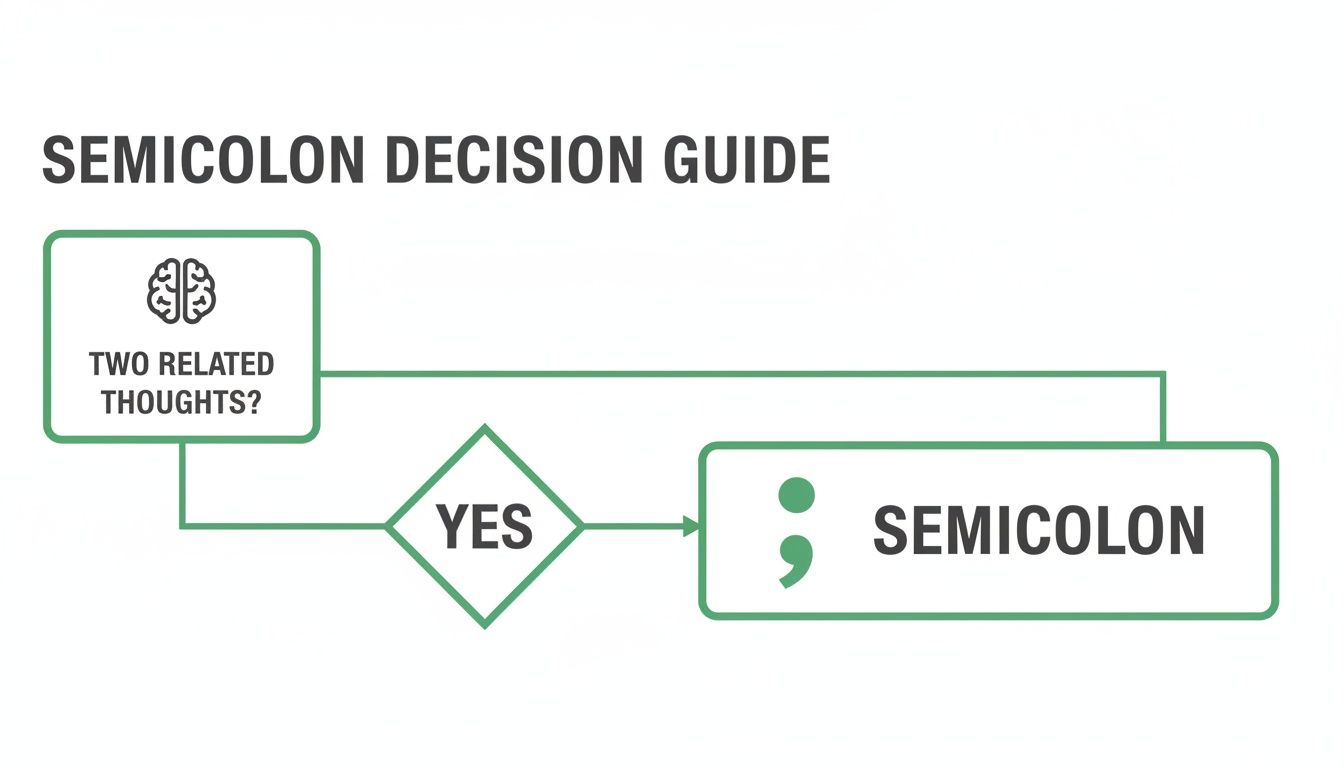
As the visual shows, the core principle is simple: a semicolon is for connecting two deeply related, complete thoughts. This is exactly the kind of subtle, impactful technique that AI writing tools often miss, as they tend to default to simpler, more formulaic structures. When you're polishing AI-generated text, keep an eye out for places where a compound sentence semicolon could add a layer of human sophistication.
Semicolons and Transitional Phrases: The Power Couple of Punctuation
The semicolon really comes into its own when you pair it with a transitional phrase, often called a conjunctive adverb. Think of words like however, therefore, and moreover. These aren't just filler; they act as signposts, showing your reader the precise logical road you're taking them down. They add a layer of nuance that elevates your writing from a simple statement of facts to a well-reasoned argument.
When you use one of these powerful words to connect two complete sentences, the semicolon is your go-to punctuation. It sits right before the transitional word, creating a strong, clean link between your ideas. This structure neatly sidesteps a common pitfall called a comma splice, where a lone comma tries (and fails) to hold two sentences together.
The formula is straightforward: [First complete thought]; transitional phrase, [second complete thought].

Putting This Pattern to Work
Getting comfortable with this semicolon-and-transition pattern is a surefire way to make your writing sound more professional and confident. It’s a signal to your reader that you’re in full control, deliberately guiding them through your thoughts. For anyone working with AI-generated content, this is a golden opportunity for improvement. AI often sticks to simpler sentence structures, so manually adding this pattern is an instant upgrade.
Here are a few common transitional phrases that pair perfectly with a semicolon in a compound sentence:
- For Contrast: however, nevertheless, instead, on the other hand
- For Results: therefore, consequently, accordingly, as a result
- For Adding On: moreover, furthermore, additionally, in addition
- For Emphasis: indeed, in fact, certainly
Need more options? We've put together a comprehensive guide on transitional words and phrases to give your writing that extra spark.
See It in the Wild
Let's look at how this plays out in real-world writing. Pay attention to the semicolon before the transition word and the comma that follows it.
Business Report: The quarterly sales figures exceeded our projections; consequently, we are increasing the marketing budget for Q4.
Blog Post: Many writers struggle with creating a consistent tone; however, using a style guide can solve this problem.
Email: Your flight is confirmed for Tuesday morning; in fact, I've already emailed you the itinerary.
This structure lends a polished, authoritative voice that simpler sentences just can't match. In fact, studies on efficiency gains in writing workflows show that refining AI drafts with these kinds of sophisticated structures can cut revision time by up to 40%. That’s exactly what PureWrite’s Humanize mode is designed to do for you.
We built PureWrite to spot these exact opportunities for improvement. Paste your draft in, and our platform will flag comma splices and suggest the correct semicolon-plus-transition combination. It’s a fast, simple way to humanize AI text, ensuring your writing is not just grammatically correct but also stylistically impressive. Give PureWrite a try and see how it can polish your sentences.
Advanced Semicolon Uses and Common Mistakes to Avoid
Once you're comfortable connecting two related ideas, you can start using the semicolon for a couple of more specialized jobs. These are the expert-level moves that bring a whole new level of clarity to your writing, especially when your sentences get a bit more complex.
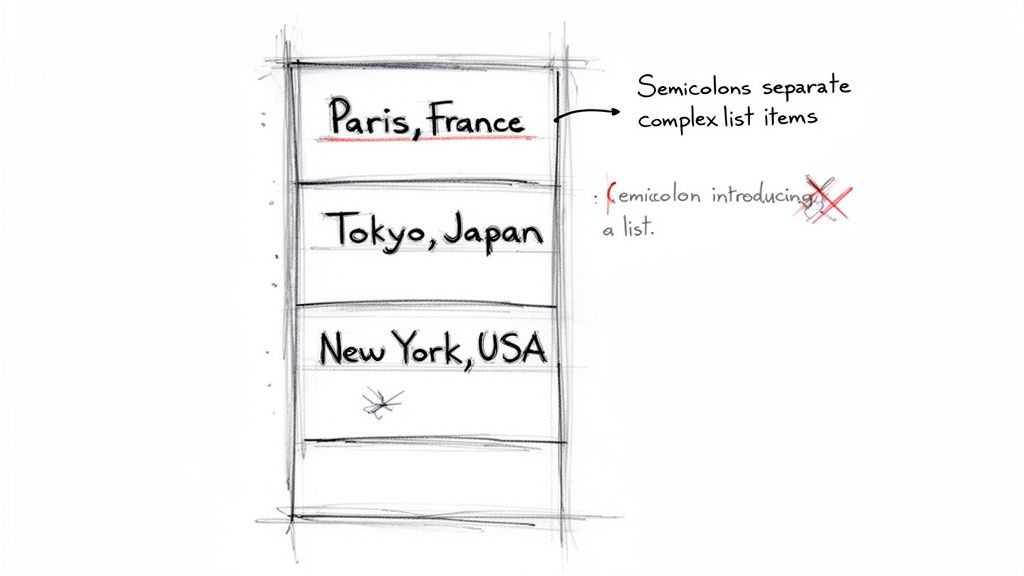
The first, and maybe most common, advanced use is for organizing a complex list. This is a lifesaver when the items in your list already have commas within them. If you just used more commas, your sentence would turn into a confusing mess. The semicolon steps in to act as a "super-comma," creating clean, clear divisions between each item.
Untangling Complex Sentences and Lists
The second key area where semicolons really shine is in the compound-complex sentence. This sentence structure is a mouthful, but it's just a sentence with at least two independent clauses and one or more dependent clauses. Semicolons are invaluable here; they let you join the main clauses without accidentally creating a long, rambling run-on.
Let’s look at these two uses in action:
- Complex List: The project team includes Sarah, the lead designer; Mark, the head of engineering; and Chloe, the content strategist.
- Compound-Complex Sentence: After the presentation ended, the team felt relieved; they knew their hard work had finally paid off.
See how the semicolon in the first example makes it perfectly clear who holds which role? In the second example, it neatly connects the two main ideas, even with that introductory clause at the beginning. If you want to get more familiar with these sentence types, our guide on compound and complex sentences breaks it all down.
Common Semicolon Mistakes to Avoid
Using a semicolon correctly is a hallmark of a confident writer, but a few common slip-ups can easily trip you up. If you know what to watch out for, you can use this powerful little mark with precision.
By far the most common mistake is using a semicolon where a colon should be. Just remember: a semicolon links two complete, related thoughts. A colon, on the other hand, introduces something—a list, a quote, or an explanation.
Here are the top three mistakes we see writers make all the time:
- Connecting an independent and a dependent clause: This is a big one. A semicolon must have a complete sentence on both sides. You can't use it to attach a fragment.
- Incorrect: I finished the report; although it took all night.
- Correct: I finished the report; it took all night.
- Introducing a list: This is a colon's job, plain and simple. Semicolons don't introduce lists.
- Incorrect: We need three things for the trip; sunscreen, hats, and water.
- Correct: We need three things for the trip: sunscreen, hats, and water.
- Using a semicolon with a coordinating conjunction: You have to pick one or the other. Use the semicolon on its own, or use a comma with a conjunction like 'and' or 'but'.
- Incorrect: She loved the idea; but she had some reservations.
- Correct: She loved the idea, but she had some reservations.
AI writing tools can be notorious for making these kinds of errors, spitting out sentences that are grammatically off. When you're editing or humanizing AI-generated text, keep a sharp eye out for these specific semicolon blunders. A good editing tool can be your best friend here. For instance, PureWrite is built to catch these tricky punctuation problems, helping you polish your draft until it’s professional and error-free.
Putting Your Semicolon Skills into Practice
Knowing the rules is one thing, but actually using them with confidence is another. This is where we put everything we've talked about into practice. You'll get a chance to test your new skills and see how the right tools can make editing a whole lot faster.
Let's start with a few quick exercises. The goal here isn't just to spot the right answer—it's to understand why it's the right answer. Each example is designed to mimic a common mistake, from classic comma splices to those notoriously messy lists.
Quick Practice Exercises
Ready to give it a shot? Pick the correctly punctuated sentence from each pair. The answers are just below.
- Sentence A: The data was conclusive, the project was a clear success.
Sentence B: The data was conclusive; the project was a clear success. - Sentence A: She submitted the draft, however, the editor requested revisions.
Sentence B: She submitted the draft; however, the editor requested revisions. - Sentence A: Our itinerary includes Paris, France; Rome, Italy; and Berlin, Germany.
Sentence B: Our itinerary includes Paris, France, Rome, Italy, and Berlin, Germany.
Answers:
- In the first set, Sentence B is correct. It uses a semicolon to perfectly link two independent but closely related thoughts. Sentence A is a comma splice.
- For the second one, Sentence B gets the point. You need a semicolon before a conjunctive adverb like "however" when it connects two complete sentences.
- And for the last one, Sentence A correctly uses semicolons to separate items in a complex list that already contains commas. It keeps things neat and easy to read.
How did it go? These little exercises show just how easily subtle punctuation errors can sneak into your writing. For even more practice, check out our guide filled with examples of compound sentences.
Instantly Elevate Your Content with PureWrite
Now, let's see how you can apply these rules in a fraction of the time. Manually hunting for punctuation mistakes in a long document is a drag, especially if you're trying to polish up a first draft from an AI writer that often gets the basics right but misses the stylistic details.
This is exactly why we built the 'Humanize' feature at PureWrite. It's not just a simple spell-checker. It actually analyzes your sentence structures and suggests more sophisticated improvements, like adding a well-placed semicolon to give your writing a more professional and natural rhythm.
Think about it: instead of wrestling with a clunky, AI-generated paragraph line by line, you can just paste it into PureWrite. With a single click, our platform flags comma splices, finds opportunities to use a compound sentence semicolon correctly, and refines your text for better clarity and flow. It’s a hands-on way to take your writing from robotic to genuinely human in seconds.
Ready to see how fast your writing can improve? Try PureWrite today and watch it transform your content.
Your Semicolon Questions Answered
We’ve covered the rules, looked at the alternatives, and even done a little practice. Now, it’s time to tackle some of the most common questions that pop up when writers try to use the compound sentence semicolon. Getting these finer points right is often what separates good writing from great writing.
This is the part where we clear up any lingering confusion. Let's dig into the questions we hear most often from writers, students, and professionals who are serious about polishing their work.
Can I Use a Capital Letter After a Semicolon?
Almost never. The word that follows a semicolon should be lowercase unless it’s a proper noun—like a person’s name or a city. Remember, a semicolon connects two closely related complete thoughts within the same sentence. You’re continuing the idea, not starting a brand new one.
Think of it like this: a semicolon is a stronger pause than a comma, but it’s not a full stop like a period. Since the sentence is still technically in progress, a capital letter would be out of place.
Correct: The team wrapped up the project ahead of schedule; they were praised for their efficiency.
Correct: We visited several cities on our trip; Paris was our absolute favorite.
Is It Bad to Use Too Many Semicolons?
Yes, absolutely. Moderation is key. While a well-placed semicolon can signal real stylistic control, sprinkling them everywhere can make your writing feel stuffy, overly academic, or just plain old-fashioned. They’re a special tool, best saved for moments when you want to create a deliberate, powerful link between two ideas.
A good rule of thumb is to use them sparingly to get the most impact. For most connections, a simple period or a comma with a coordinating conjunction (and, but, so) will do the job just fine and usually sound more natural. Great writing comes from varying your sentence structures, not from relying on a single trick.
Does Correct Semicolon Usage Help My SEO?
Indirectly, it does. While search engines like Google don't look for semicolons as a specific ranking factor, they are obsessed with high-quality, readable content that gives users a good experience. When you use semicolons correctly, you improve the flow and logical structure of your sentences, which makes your writing clearer and easier to understand.
This improved clarity can keep people on your page longer and lower your bounce rate—both of which are strong positive signals for SEO. So, while a semicolon won't magically boost your rank, the polished, authoritative writing it contributes to is a massive part of what Google calls E-E-A-T (Experience, Expertise, Authoritativeness, and Trustworthiness).
When Should I Absolutely Avoid Using a Semicolon?
There are a few hard-and-fast rules where a semicolon is simply the wrong tool for the job. If you can avoid these common traps, your punctuation will always be sharp and effective.
Steer clear of semicolons in these situations:
- Connecting a complete sentence to an incomplete phrase. A semicolon needs a full, independent clause on both sides. If one side is just a fragment, the semicolon is incorrect.
- Introducing a list or a quotation. This is the classic job of a colon (
:). Using a semicolon here is one of the most common punctuation mix-ups out there. - With a coordinating conjunction (like 'and' or 'but'). This is redundant—you’re doing the same job twice. You have to pick one: either the semicolon on its own or a comma followed by the conjunction.
These are exactly the kinds of subtle mistakes that AI writing tools often make. It’s why a final, human-led edit is so critical for producing truly professional and authentic content.
At PureWrite, we built our platform to spot these very issues. Our AI text humanizer looks past basic grammar and analyzes sentence structure, flags incorrect semicolon use, and even suggests more sophisticated ways to connect your ideas. By refining your text for both clarity and flow, you can be confident your final draft reads like it was written by a seasoned pro, not a machine.
Ready to polish your writing with confidence? Try PureWrite today and see how you can transform your AI drafts into authentic, engaging content.